Showing posts with label Paintings. Show all posts

Wednesday, June 06, 2007

Further gazing at "The Venus Effect": Some questions

Magritte, Not to Be Reproduced

A couple of posts ago, I posted a couple of images that show their subject(s) interacting in some way with a mirror. I also linked to this page by Marco Bertamini, who claims that the work it sums up is the first psychological description of what he and his colleagues call "The Venus Effect": that in certain instances, such as Velázquez's Venus at Her Mirror, observers will say that the subject is admiring herself when, in fact, it's demonstrable that the subject is actually looking at the viewer. Following the links will lead you to descriptions of tests performed on subjects with paintings similar to the ones you see here, and with actual mirrors. The upshot of their research is that people are generally confused about how mirrors work and that that confusion manifests itself when we look at paintings.

What's curious to me, especially given that the researchers are psychologists, is that they offer no speculation as to what that confusion might reveal about the psyche. Maybe the answer to that question is so self-evident that it doesn't bear asking. But I ask it anyway because, surely, it is an issue that came into play for the painters of these pictures--Bertamini, in fact, mentions that the earliest description of the Velázquez Venus describes her as looking at herself--and one that matters vitally, given Venus's mirror's ancient association with self-knowledge.

The following is from Robert A. Johnson's book She: Understanding Feminine Psychology (found here):

Aphrodite is the principle of mirroring every experience back into our own consciousness. As man is occupied with expansion and exploration and finding that which is new, Aphrodite is reflecting and mirroring and assimilating. Aphrodite's mirror is symbolic of a most profound quality of the goddess of love. She frequently offers one a mirror by which one can see one's self, a self hopelessly stuck in projection without the help of the mirror. Asking what is being mirrored back can begin the process of understanding, which may prevent getting stuck in an insoluble emotional tangle. This is not to say there are not outer events. But it is important to realize and understand that many things of our own interior nature masquerade as outer events when they should be mirrored back into our subjective world from which they sprang. Aphrodite provides this mirror more often than we would like to admit. When ever one falls in love, sees the god or goddess-like qualities in another, it is Aphrodite mirroring our immortality and divine-like qualities. We are as reluctant to see our virtues as our faults and a long period of suffering generally lies between the mirroring and the accomplishment. Psyche takes just such a long journey between her falling in love with Eros and the discovery of her own immortality. (Emphases mine)
The mirror-as-self-knowledge certainly is a two-edged sword, leading as it can either to an honest appraisal of one's virtues and faults or to vanity. I got that. Here, though, are the questions that this leads me to ask: 1) Are we somehow misreading these paintings because of the Venus Effect? That is, are we in effect excluding ourselves from the scene depicted because we assume it is "about" Venus and not us, that the painting is ultimately about Venus's vanity and not an invitation to us to see ourselves more truly? [Aside: in view of our cultural ignorance of the Greek and Roman gods and the associations they once held, we may be misreading them anyway, Venus Effect or no, but that's another issue emtirely] 2) Or, alternately, were at least some of these painters aware of this phenomenon (I wouldn't put this possibility past Velázquez, for example, though the ter Borch in the earlier post might be playing with this as well) and in some way make use of it?

Comments are welcome, as always.

Read More...

Tuesday, March 09, 2004

Flemish painting; Film class next spring?

Addendum:
Something that got overlooked in my discussion of Hughes' book is that that contextualizing he does is such that it allows me to link what he says about modern art with what I think I know about modernism in literature. He's really writing about Modernism as an aesthetic and intellectual movement, and, of course, doing so will inevitably lead to generalizations. But we can save specifics for the particular genres, no?

Flemish painting:
A new "character" to introduce, first of all. Susan is a (mostly) on-line friend--we've met once--who lives in the D.C. area. I've known her for over 3 years. She is a very serious and enormously talented painter and an equally-serious basketball fan. She is college-educated, with an MFA in art; she teaches painting part time to adults and children through the local colleges as continuing-ed courses. I know of no one outside academe (and not that many in it) who are as widely and deeply read as she is, at least in art, literature and philosophy, and to speak with her about art and about what she tries to do as an artist is enormously enriching. Anyway: You may recall, a couple of entries ago, my observations about Flemish interiors and landscapes that arose from my visit to the Nelson on Saturday. So far, at least, she's been listening to me as I try to clarify my thinking about them. She says she has some things to contribute to the discussion once she's sure I'm sure what it is I'm noticing. So, here's what I so far realize (these comments exclude Vermeer, who, though Dutch and though painting the same sorts of scenes the others are painting, is actually doing something subtly yet very visibly different): She reminded me that the open-window/open-door motif dates from medieval times, and others besides the Flemish painters used it. This I knew. I think that what makes the Renaissance-era paintings more distinctive is that the medieval paintings, with their flat perspective, made the space beyond the window/door seem like a backdrop. It's not supposed to be interesting; what should matter is what's happening in the foreground: a religious scene of some sort. The Renaissance and later paintings, though, have a more pronounced 3-dimensional perspective. The eye gets drawn back beyond the foreground, out the door or window. Susan had understood me to be saying that that space is now more important that the foregrounded figures; I think what's going on is not that, but that now the background is more important than it had been. The interior dramas matter, but they are, after all, small quotidian things of the sort you'd see in every household. The world is out there, calling our attention outside (the very opposite of a Caravaggio painting, whose subject is always "inside," according to John Berger).
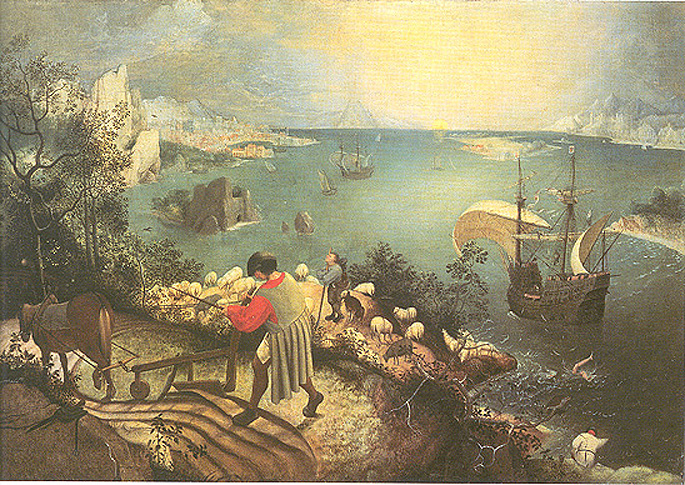
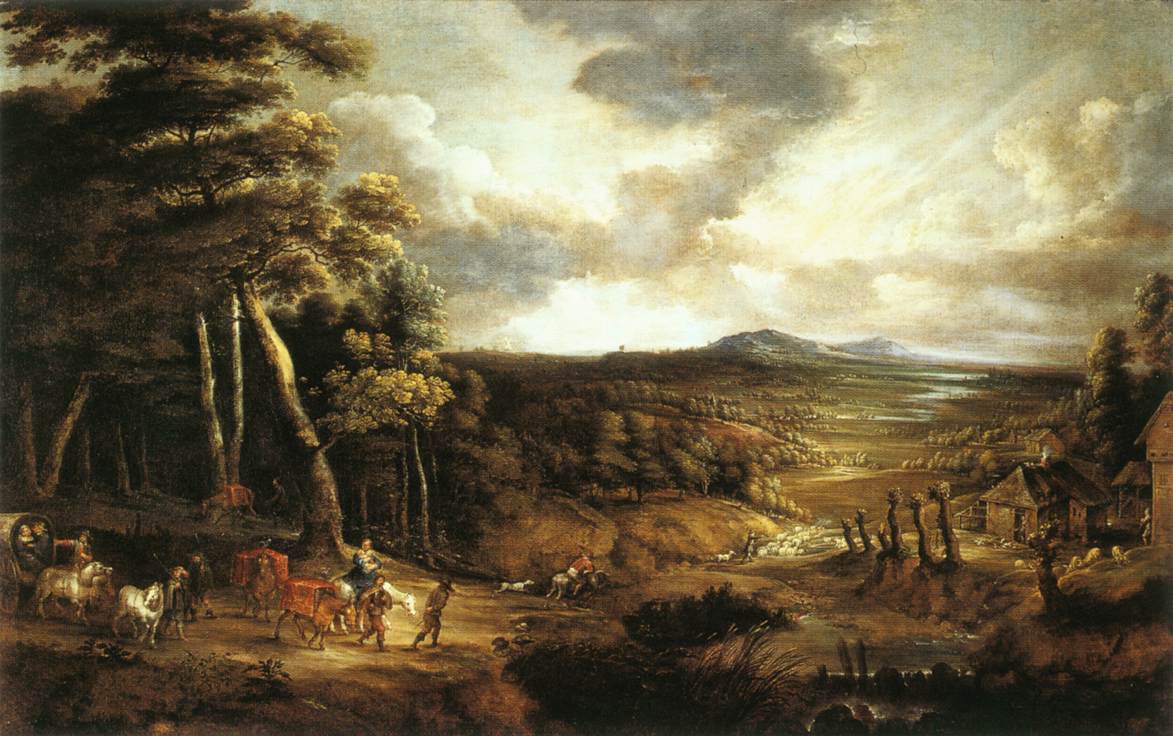
From there, I made a huge, unsubstantiated leap to the landscapes. I find it fascinating that these paintings have titles like Landscape with the Fall of Icarus and Landscape with the Flight to Egypt, etc. The emphasis in the title falls on "landscape," as if to say, Yes, those things are more famous but no less significant than that plowman's work or that of the drover or the sailors on those ships in that faraway harbor. The world becomes secularized in these paintings: the religious assumes no greater/lesser role in the world than the secular. Of course, judging from Bosch's and Bruegel's apocalyptic paintings, there is considerable danger in seeing the diminshment of the sacred's centrality, whether in one's on life or in that of the world.
Who knows if any of this is right? Susan's response to all this is coming. She, by the way, has been working with me on an idea in which we compare the gazes of the figures in Velazquez's painting Las Meninas to the narrative perspectives in House of Leaves. It won't shed any brilliant light on either the painting or the novel, but it's been fun talking with her about it; we plan to post what we come up with--actually, it'll be substantially her writing.

Film class?
Well, maybe. Larry and I were musing aloud that this would be fun to do and that it would probably make. Where I teach, we also happen to have pretty good facilities for such a class: each room has a data projector hooked up to a computer and a DVD player; the screen it projects on is about 8' wide and reaches from ceiling to floor. I showed Rear Window to my Humanities students last night, and it looked great. So anyway, the big question is whether such a class would count as General Education credit. If it would, great; if not, it wouldn't be as big a draw--the students at my campus are actually very business-like. So anyway: even as I plan the Honors course in the fall, here I am excavating a trench for another pipe dream.

Read More...

Sunday, March 07, 2004

Yesterday's adventures at the Nelson-Atkins

For those keeping score, yes, it IS Sunday and thus book day. And you may also be saying, And Saturday's entry (which was supposed to be a film)? Okay, okay. In the first place, I was gone most of Saturday (see the subject heading above); in the second place, I'm letting the discussion of The Ox-Bow Incident stand for the Saturday film. In the third place, I'll have the book discussion in a later entry today/tonight.
For now, though, I'd like to recount my trip to Kansas City's Nelson-Atkins Museum of Art. This was an optional field trip offered to my Humanities class. Though the Nelson is not the Met or Art Institute in terms of the size or star-quality of its collection, it IS a nice collection, containing works by many of the artists you've heard of, if not the WORKS you've heard of. Also, it's only 3 hours away from Wichita, and it's not such a large museum that it overwhelms or exhausts even the person relatively unaccustomed to museum-going.
So anyway. Only one student showed for this trip, and not exactly my favorite student, either. Not that I don't mind honesty from my students, but the overriding impression I had gotten from him throughout the class is that he would just not be bothered to look at and consider things he didn't immediately like. Moreover, he has not been shy in sharing his disdain for works or about speculating (briefly) about the artists: "He must have been a fruit" has often been about as introspective as he's gotten. So when this student was the only one to show, I decided, well, at least we're taking our own vehicles up there.
We arrived. And before we even got inside, we actually spent a good 5 minutes looking at and talking about the Nelson's bronze copy of Rodin's The Thinker that sits in front of the south entrance (he made no remarks--to me, at least--about the monumental Oldenburg shuttlecocks on the lawn). My student revealed himself to be intrigued by technique: the surfaces of the paintings in particular--smooth? rough? Thick/thin paints? etc. So, then, the Nelson's Renaissance religious paintings, with their gold-leaf overlays and glossy surfaces, intrigued him to the point that the docents had to warn him to back up a couple of times. So also did a Renaissance-era painting of the Last Judgment by a German indebted, it appeared to my untrained eye, to Bruegel's The Triumph of Death. He confessed to being attracted to violent images, so I made sure he also saw a small German Renaissance portrait of the Christ wearing a crown of thorns painted with such attention to detail that you can actually see some of the thorns not just penetrating the forehead but actually visible beneath the skin's surface. Yet not 10 minutes later and with no sense of irony, as we looked at a spectacular Bierstadt landscape depicting a sunset in a Yosemite valley, he confessed a deep appreciation for Thomas Kinkaide. Ah, well.
The best moment of the trip, I think, came when we went to look at the post-WW II and contemporary galleries. The first thing we saw was a Warhol portrait of Mao; my student looked for a bit and then said something like, "What was THAT about?" and then said that if a piece of art doesn't immediately "tell me what it's about," it has failed in his eyes. Ditto, apparently, for the Kapoor sculptures (which he DID look at, though) and, in the next gallery, the Kline. But then I took him to one of my favorite paintings in the museum, one of Rhinehardt's so-called "black paintings." Here, I said. I think you might find this one interesting. This painting appears, from a distance, to be a solid, even black canvas. Up close, though, it reveals itself to be a series of black squares measuring about 1' each and arranged in such a way that some of them form, by design, a Roman cross. I told my student, Here's a painting that seems to be purely about technique; whatever representation occurs in this painting is the order our eye imposes on it. So, it becomes an object of contemplation, yet we're the one who provide most of the stuff to be contemplated.
That's not exactly what I said, but the gist is there. He sat. He actually looked at it. Really LOOKED at it. He actually liked it. Score! And immediately from there we looked at a small De Kooning called Boudoir that I hadn't seen there before--a pink figure all but amorphous in a Henry-Moore sort of way, surrounded by various lines intended to represent bedroom furniture, and he immediately said, "That reminds me of a pregnant woman--I don't know why; maybe because of this" ::pointing to a large, egg-like distension in the pink figure:: But he didn't scoff; he was LOOKING.
And then we were done. The American gallery is closed because of construction, and a large Catlin exhibition was off-limits to us because we didn't pay to see it (the other neat thing about the Nelson is that admission is free). As we said our good-byes, he thanked me a couple of times for showing him around, that it was "interesting."
He didn't like everything, but that's not the point of museum-going. The point is to look and to think. Why? How? What does this remind you of, if anything? I think that on those grounds, my student had a good experience. And I actually enjoyed showing him around.

Other random observations:
1) It happens every time and happened yet again to me yesterday: the Nelson has some very nice Impressionist paintings in its collection by the people you've heard of, but the one I always look at for the longest is the Corot landscape showing two men sitting under a tree on the bank of a river or pond. The times I've seen Corots--including the first time I recall seeing his work, at a small exibition of Impressionist paintings in Tulsa a few years ago--they have been the ones that stand out in my mind. Something about that gauzy, even dreamy yet utterly natural light . . .
2) This one deserves more development when I know more, but I was noticing that even the earliest Flemish paintings in the Nelson's collection (from the 14th century) delight in including that motif so common in the more familiar ones from Vermeer's time, the one of the interior with an open door or window in the background that permits us to look out into the street and the skyline beyond. I've always liked the more familar ones (I'm thinking in particular of de Hooch's paintings, but he was by no means the only painter who did them)--"liked" to the point of fascination. And--after my recent encounter with the Bruegel book--I found myself paying close attention to the Flemish landscapes, all aquas and beige/sepia rock formations. And, again as with the Bruegels--I'm thinking in particular of his Landscape with the Fall of Icarus--the Nelson's Flemish lanscapes are so arranged as to require their viewer to hunt for the nominative "subject" of the painting. Poor St. Jerome, having to undergo his temptation almost unnoticed in the lower-left of the painting whose title is The Temptation of St. Jerome, while elsewhere there's a drover with pack animals, a village scene, and a ship-filled bay stretching off toward the sea in the distance. I feel instinctively that there's some connection between the interiors and the landscapes, but I haven't quite worked out the link. Of course, I could just be delusional.
 
Those wishing to read the comments from the original LiveJournal post can go here.

Technorati Tags:
,

Read More...