"The vocabulary of machines": Three kinda-related things on technology and human connectedness
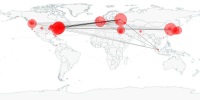
 Yves Jeason, The Noosphere Sculpture. Image found here.
First, a couple of things from the Technium section of Kevin Kelly's website. Kelly is the author of What Technology Wants, the title of which I think is a pretty succinct way of capturing both the promise and the peril we saw Hannah Arendt (and me) going on about a few days ago; though I'd heard him interviewed last year on NPR and immediately added his book to my Amazon Wishlist, it was only today that I bumped into his website via Andrew Sullivan's blog. I've had a couple of hours of pleasure this morning reading around his place. Kelly's great appeal to me is that he's very clear-eyed about technology. He's not just extraordinarily knowledgeable; he really has thought about it, as I hope a rather lengthy passage below will show.
The first bit I'd like to share is "Theological Chatbots," in which Kelly interviews the Cornell researchers who had the bright idea of having two chatbots converse with each other and came up with this video, now making the rounds (be sure to watch it if you haven't already):
The interview itself is relatively short; here, for me, is the interesting part:
What about all the talk about God? And why are the bots so quick to call the other a liar?
"We think this is because the database of replies in Cleverbot is compiled from the questions and responses of human users, and apparently, humans will often accuse the bots of lying, or will query the bots about their origins, so when they start talking to each other, they mimic what humans say to them."
Our bots ask theological questions because we do. So far, our bots are made in the image of their creators.
This is an odd little moment, a healthy reminder that we too are machines that process and act on information from our environment . . . except these chatbots' information is second-hand. They "know," if that's the right word, what they've been told, as opposed to what they've independently observed and wondered about. So, that little "so far" creates space for a question: if/when we have genuine AI devices that can create genuinely original thought, will these machines also have a capacity for wonder when encountering something unknown; will they have an aesthetic sensibility or a sense of transcendence? Or will AI have no capacity for pondering or experiencing the irrational? Some would say that our capacity for such things gets us into trouble, more often than not, and I would agree in part, but surely the irrational also plays some role in shaping intelligence of the human variety.
Or, alternately, I can hear a committed atheist say that perhaps religious people, just parroting what belief and cultural custom have to say about such matters without ever investigating to determine their truth, are no wiser in their questions about God than these chatbots are.
Here is a bit from another of Kelly's Technium pieces, a meditation on our ever-increasing interconnectedness and the resulting exponentially-increasing rate of invention and innovation, "Why the Impossible Happens More Often":
I think we'll be surprised by how many things we assumed were "natural" for humans are not really, and how many impossible ideas are possible. "Everyone knows" that humans are warlike, and like war, but I would guess organized war will become less and less attractive over time as new means of social conflict and social conflict resolution arise at a global level. Not that people will cease killing each other; just that deliberate ritualistic battle over territories will be displaced by other activities -- like terrorism, extreme sports, subversion, mafias, and organized crime. The new technologies of social media will unleash whole new ways to lie, cheat, steal and kill. As they are already doing. (Nefarious hackers use social media to identify corporate network administrators, and their personal off-time hobbies, and then spoof a gift of a cool new product from their favorite company, which when opened, takes over their computer and thence the network they are in charge of.) Yes, many of the impossible things we can expect will be impossibly bad.
They will be beyond our imagining because the level at which they are enabled is hard for us to picture. In large groups the laws of statistics take over and our brains have not evolved to do statistics. The amount of data tracked is inhuman; the magnitudes of giga, peta, and exa don't really mean anything to us; it's the vocabulary of machines. Collectively we behave differently than individuals. Much more importantly, as individuals we behave differently in collectives.
This has been true a long while. What's new is the velocity at which we a[re] headed into this higher territory of global connectivity. We are swept up in a tectonic shift toward large, fast, social organizations connecting us in novel ways. There may be a million different ways to connect a billion people, and each way will reveal something new about us. Something hidden previously. Others have named this emergence the Noosphere, or MetaMan, or Hive Mind. We don't have a good name for it yet.
Along these lines, here's something from Adam Frank's piece on NPR.org, "Fear of the TwitterBook: When to Adopt or Reject New Tech", in which he compares the ubiquity of social media to the relatively quick adoption of mechanical clocks in late-medieval Europe
It is the open-ended brilliance of Facebook and (as I am learning) Twitter in creating ever-shifting, ever-nested webs of connection that take them beyond themselves. Both sites may eventually be replaced by something newer. But by creating technological norms for a particular kind of connectivity, the electronic social networks they embody are transforming our historical moment as completely as mechanical time metering changed life in [the] 15th century.
Culture sees itself and the cosmos as a whole through the lens of its technological capabilities. That fact may explain when adoption grows beyond mere choice. Once a technology settles in to the point where it begins shaping the dominant metaphors of a society (the 17th century's "clockwork universe" for example), then there is no going back, no opting out. You and everyone you know will be assimilated.
There's much to say about this, but I've taken you away from your Labor Day long enough. Go and have some fun.