Showing posts with label Painting. Show all posts

Saturday, January 17, 2009

Andrew Wyeth (1917-2009)

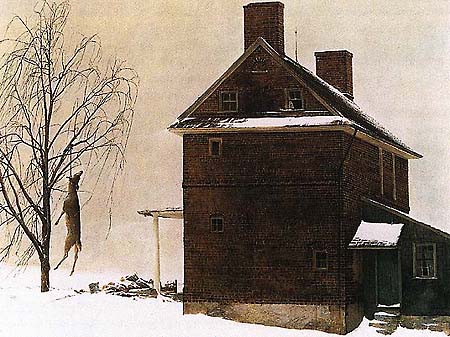
Love in the Afternoon. Image found here.

I wanted to briefly acknowledge Wyeth's death, which happened yesterday. Just off the top of my head, it seems unlikely that there was a more widely known contemporary American painter than him (I'm deliberately excluding Thomas Kinkade), and to my mind his work is deserving of that broad recognition. Other painters hold my attention for longer, but Wyeth is no slouch.

Via Andrew Sullivan comes this excerpt from an article on Wyeth from 1987, written by Robert Hughes:

The time is past when one could dismiss Wyeth as nothing more that a sentimental illustrator, as critics irked by his popular appeal regularly did a decade or more ago. True, his work is grounded in illustration and often fails to transcend it. Not a few of the images of Helga lying naked on a bed or tramping resolutely through the snow in her Loden coat have the banal neatness of things done for a women's magazine. Some of them, like the technically impressive watercolor In the Orchard, 1974, are as deadly in their "sensitiveness" as greeting cards. But there are some fine drawings here, moments of vision caught with attentiveness and precision, that have a lot more visual oomph than the more laboriously finished works. And two or three of the paintings are marvels of iconic condensation. Like a good second-rate novelist who can rise to first-rate episodes, Wyeth can surprise you.
Like I'm going to argue with one of our best art critics. I'll just say this, though: you look at a painting like this one, Master Bedroom (image found here), and you can see Hughes' point about Wyeth's dancing on that fine line between sympathy and sentimentality. But look at Love in the Afternoon, its left side dominated by the window, and you realize that there is a suggestion of an interrupted tryst, a lover's escape over the field. Or, have a look at paintings such as Tenant Farmer and Karl's Room, or one that I have in mind that I can't find online that shows a farmer inside his gloomily-lit barn and about the only thing visible is an enormous haying hook hanging out of the gloom hanging in the background over the farmer's shoulder or, just in general, Wyeth's bleak wintry light in painting after painting, and it seems a mistake to characterize him in quite the way Hughes does. Even Wyeth's most famous painting, Christina's World, has a darkness, or at least a melancholy, beneath its sunny surface: It's not overt, but the girl's emaciated right arm reveals that Christina is crippled and, far from gazing dreamily at the house in the distance, may in fact be wondering just how she is going to get back there.

In thinking about all this, it occurred to me that Wyeth is to American painting as Robert Frost is to American literature: a well-known and much-loved figure who produced accessible art depicting the lives of rural folks, the better-known examples of which usually make their audiences feel kind of warm and fuzzy inside but just below whose surfaces lurk some uncomfortable truths about these people's lives.

Art doesn't have to be difficult to be good, or valuable to have. Wyeth's art, it seems to me, is partial confirmation of that.

UPDATE: You'll want to have a look at Amy's remembrance as well. Have a close look at the painting she's posted, keeping Christina's World in mind as you do.

Read More...

Saturday, May 03, 2008

Dalí re-imagines Vermeer

The Ghost of Vermeer of Delft Which Can Be Used as a Table, 1934.

One of my students is writing a paper on a couple of Dalí paintings; I didn't recognize them from her descriptions of them and so went a-Google-ing for them yesterday. It was while hunting for them that I ran across these images, which make explicit reference to certain of Vermeer's works.

They're here because, well, it's my blog and (not that I'm all that familiar with Dalí in the first place) these are new-to-me images that are at least intriguing to me because of my appreciation for Vermeer--and in the case of The Ghost of Vermeer I genuinely like. Beyond that, I don't have much to say about them aside from the rather simplistic speculation that Dalí sensed in the work of this otherwise very different painter a sort of dreaminess that would, you'd think, appeal to a Surrealist painter.

All the images here were found at Virtual Dalí. As always, click on the images to enlarge them.

The titles are, in order, Apparition of the Town of Delft (1936), The Lacemaker (1955), and Paranoiac--Critical Study of Vermeer's Lacemaker (1955). As a bonus for you fans of Velázquez, I've also included Dalí's very late painting, The Pearl (1981).


Read More...

Saturday, March 29, 2008

Rembrandt, Portrait of a Young Man

[Note: This post will be familiar to some of you; it originally appeared at my now-moribund blog, Admiring Baroque Art. I've been finding myself thinking about it of late, and I thought I would re-post it here. I hope no one minds too much.]

In its gallery, it is not front and center on the wall directly opposite the entrance, as you might expect. It hangs on one of the shorter walls, and then not even in the center of that wall. It's in a semi-shadowy corner, in fact, the sitter's white collar being the first thing to catch the visitor's eye there in its penumbra. (Note: the actual painting is not quite this dark.) You almost have to be looking for it to see it: an odd thing to say about a museum's choice in hanging a Rembrandt.

As a general rule, portraits leave me a bit cold. I don't know these people; why should they hold my attention? Of course, there are exceptions, and those I will happily stand in front of, trying to get to know them--it is, after all, as though they have introduced themselves to me, rather than I to them. I think that's the initial paradox of this painting for me: off in the corner like a wallflower in the Dutch Baroque gallery, as though intimidated by the older, more-worldly man in the 3/4-length Hals in the same room, it's Rembrandt's young man that I want to spend time in front of. The Hals, as good as it is, is dead to me--just another portrait. No offense, sir. Even so, the intensity of the young man's gaze is such that I have to move away from it for a while and then come back to it.

Why is that?

As you can see, information is sketchy as to the sitter's identity or his precise station in life. Whoever this man is, he is just starting out on the adventure called adulthood. Not so his painter, though: Rembrandt would be dead 3 years after painting this portrait. By this point in his life, he knows a thing or two about how to get his viewer to pay attention even to someone who has yet to make his way in the world, at the expense of his more-accomplished companions.

Part of the explanation is "just" technique, which the Nelson-Atkins' website mentions:

Rembrandt has used the butt end of his brush to make incisions in the still-wet paint of the hair to provide a richer sense of texture.
This is certainly true, but it's not what I'm drawn to when I approach the painting for a closer look. What I notice is that Rembrandt also used that butt-end to create a slight depression in his subject's pupils, giving them a 3-dimensional quality. It's the sitter's white collar that initially catches my eye; it's his eyes that hold it.

Tiny wells, "just" minute displacements of pigments on the canvas, nevertheless draw me into the sitter's mind and heart and not just look at his face. I have no choice but to look at this fellow and take seriously his steady, quiet, confident optimism. Whether student, graduate or aspiring artist, Rembrandt certainly seems to take him seriously as well.

But here's where looking at this painting becomes not merely an aesthetic experience but a personal one for me. As so many have said regarding Rembrandt's self-portraits, the directness, the honesty of this fellow's gaze has the effect of not just regarding the viewer but implicitly putting a question to him/her: "And you? What have you to say about your spent time?" A good question, and one that, depending on the day, can be an uncomfortable one to consider. You can't rebut this fellow: he will always be quietly confident, optimistic, damn him. His life remains perpetually ahead of him. But what about yours?

What else to do, then, but promise to amend your life?

Read More...

Sunday, September 16, 2007

Mark Rothko

Long-time readers may recall that I have a poster of a painting by Mark Rothko (which you can see here) that a few years ago I tried to write about here and here. At any rate, via Andrew Sullivan comes this video on Rothko. Possessing something of the sensibilities of the Qatsi trilogy, it manages to persuade me, at least, that Rothko might not have been quite as abstract an artist as one might think.

Enjoy.

Read More...

Thursday, June 28, 2007

"Women in Art"

From Bonnie, a regular visitor here (not sure if she has a blog), comes this wonderful video called "Women in Art."


It works equally well as a survey of Western painting or as a visual meditation on how women have been depicted in Western art. I hope you enjoy it.

Read More...

Friday, May 04, 2007

A stretch of river XXXVI: On good old Corot, and Places to Go

Jean-Baptiste-Camille Corot, Ville-d'Avray, 1870

It's a misty, grey morning here in Wichita, and/but today there is something about today's light that reminds me of the Corot that hangs at the Nelson-Atkins (NB: the one you see here hangs in the Met but is quite similar in terms of both the scene depicted and, in particular, the quality of its light). Over the years, I've grown more and more appreciative of the Nelson's collection of 19th-century French paintings--it's taught me, for example, that Pisarro's work, more than others', is better appreciated in person. Even so--even though I know those other painters are "better"--it's the Corot I linger and linger in front of, every visit, and for the same reason I wanted to linger this morning and gaze across the river even as Scruffy wanted to chase the squirrel on the fence--a dog's catnip--separating the path from the apartment's pool: not anything remarkable in the scene itself, but the pearlescence of the light illuminating it--no, more like glazing it.

John Berger, whose socialist's sense that art and its appreciation can and should be something that you don't have to wear black and stroke your chin significantly in order to do, writes about Corot with a combination of, on the one hand, disappointment in what Corot might have accomplished but chose not to and, on the other, the value in what he most assuredly does accomplish, for me at least, whenever I stand in front of that landscape in Kansas City:

Corot remained a petit-bourgeois. Matching, pinning, sewing, he was never quite able to shake off the effect of his father's drapery business and his mother's dress-shop.

[snip]

[But h]e was a petit-bourgeois only in his refusal to speculate on how the world could be changed. This explains why he was timid without being a coward. Instead of questioning, he set out to make his own peace, to avoid all contradictions. He knew it himself: 'Delacroix is an eagle and I'm only a lark. I sing little songs in my grey clouds.' He reveals it unconsciously when he says: 'Charity is a still more beautiful thing than talent. Besides, one benefits the other. If you have a kind heart, your work will show it.' How comfortably without contradictions that 'Besides' is!

[snip]

Corot was a lovable man. At his best he was an artist of minor genius, comparable to, say, Manet. And let me add--with the due modesty that ought to precede such a statement--that Corot has contributed to many people's happiness. (208-209)

Yes indeed. The Nelson's Van Goghs, the early (and late) Monets, the Manet, they challenge me in various ways with their assertiveness. The Corot "just" makes me happy.

In the meantime, though, Scruffy is tugging at his leash . . . which brings me to the "Places to Go" part of this post. We're on the cusp of finals week here, which means that I can't say when my next post here will appear. So, below the fold, I want to recommend some places worth your visits--assuming, that is, that you have plenty of time, as several of these places will require that of you.

(Aside: I can't decide just now, as the duties of finals week command my attention, whether the blog is analogous to Corot or to the squirrel Scruffy wants to chase. Both are pleasurable, so that doesn't enter into deciding.)

Anyway:

For better or for worse, many of the blogs I visit are kept by people with lots of things to say and who are not shy about taking their time in saying them. I'm as appreciative of the pithy observation as the next guy, but I know as well that some things simply take a longer time to say in order to say them well . . . and I am just as appreciative of that.

Gawain of Heaven Tree, whose blog's post's leisurely pace on leisurely subjects exudes "Man of Leisure," has a wonderful post on one of my very favorite American painters, John Singer Sargent, that is ostensibly about an exhibition of Sargent's paintings done in Venice or on Venetian subjects currently on exhibit in Venice. But it turns into, as well, meditations on technique, on seeking out the proper viewing distance for paintings, "and, as always, love." Reading it, it occurred to me that I like Sargent for the same reason I like Corot: he makes me happy.

Gawain meditates; Hank of A Lake County Point of View does not meditate so much as forays. Hank writes like he's in a hurry, but you can't be when you read him. The title of his most recent post, "Lupins, Wolves, Chinese Romans, Peaches and the Unforgettable Cream," does not quite cover everything that he ends up writing on. It starts out as simple homesickness for Texas Bluebonnets, which, I can attest to, are especially abundant this spring and so are deserving of being homesick over; like Proust's madeleine, though, that homesickness leads to, um, all sorts of other things, places, people, across time and space and cultures. Fully referenced and complete with footnotes-within-footnotes (which are as much a part of the show as the rest of the post and thus are not to be missed), reading this post (and others . . . it's interesting how the color blue seems to inspire these posts of his . . . ) is like reading some hyper-texted cross of Montaigne, the afore-mentioned Proust, David Foster Wallace, and a coy Henry Miller. No one else I've yet run across is doing what Hank is doing--which is a very good thing, seeing as I have enough to read as it is . . . but sad in its way, too.

Also: I gotta get me some sort of footnotes-within-footnotes hack for Blogger . . . or move to Typepad . . .

Hank's longer posts are strange knowledge-maps that reveal the sometimes-odd and -unexpected interconnectedness of things; in a recent post, though, Conrad of Varieties of Unreligious Experience writes about another kind of map: ones all but unreadable except by the person who made it. We tend to think of maps as being objective visual descriptions of places that anyone is able to use with success. But these maps are expressions of a kind of knowledge, as I noted in comments over there, that cannot be taught but only learned.

My long-time blogging compadre Raminagrobis, over at his eponymously-named blog, has up "In Praise of Bathos," a patient discussion of meter and its connection to whatever "bad poetry" might be.

Finally, Randall of Musings from the Hinterland has initiated what this reader, at least, fervently hopes will be an ongoing series called "You Be the Jury" (a more interactive take on The People's Court--or like a "Take Your Blog's Audience to Court" kind of thing). Judging from this first installment, it promises to be both a celebration of the Weird Stuff that People Sue Over and the extent to which the law helps (or hinders) us in thinking about said Weird Stuff.

Still not enough? Then be sure to have a look at the other folks in the "Daily (B)reads" section of the right gutter. They too are worthy of your attention.

As always, thanks for visiting and reading and deigning to come back every once in a while. I'll see you around.

UPDATE: As a bonus to those of you who read this far, I give you the (two) last word(s) in gloriously-vulgar but dead-on movie reviewing, Neil Cumpston.

Read More...

Sunday, April 11, 2004

Further thought on The Milkmaid

Earlier tonight, Susan and I spoke on the phone at some length about the two Vermeers I mentioned in the previous entry, specifically about their composition. I just wanted to add a couple of comments about The Milkmaid here.
I have always felt welcomed and included in the space of this painting, and I had said this was so because of the activity depicted.  Well, in part, Susan has helped me to see.  First of all, she made me notice that the table is angled in such a way that it points into the space of the painting and thus doesn't form a barrier between viewer and maid.  But second and more significant for me, she asked me where my eyes end up resting when I look at this painting.  It's the opening of the pitcher of milk: the thin white pouring of the milk contrasting with the round black orifice of the pitcher.  That black space creates a psychic entrance into the painting for me, one that is as inexhaustible as the stream of milk the Maid pours.

Read More...

Saturday, April 10, 2004

Assessment-Land; Vermeer's Milkmaid

It's Holy Saturday, and now, I think, I have a bit more distance from our faculty's Thursday discussion of assessment.  Then after that, I'd like to talk at some length about Vermeer's beautiful painting.
Where to start?  Perhaps with the truism that American education, because of demands from parents and businesses and government, is driven by the requirement that it assess its students and itself.  Fine (I guess).  I'm ambivalent because I certainly believe that schools need to demonstrate in some way that they are fulfilling their mission; but what is irksome is that the assessment models the accreditation agencies have adopted recently are essentially cribbed from Total Quality Management models and then allegedly tinkered with to fit the work that happens in a college or university.  The trouble is simply that actual learning is fiendishly difficult to quantify--and since all schools declare, in some form or fashion in their mission statements, that they seek to shape their students into productive citizens, how the heck does one measure THAT?It is tempting--and many faculty do this--to blame assesment models on the administration, but they have no choice: the accrediting agency tells the schools, "This is the model and the language we'll be using for assessment, and, assuming you want to retain your accreditation (duh!), this is what YOU'LL be using, too."So, then: On Thursday, the president (whom I have great respect for, talked about our new assessment model, something called AQIP (which stands for something but whose meaning escapes me--and in any event, as I'll note late, it doesn't much matter what it stands for).  Among other things, she mentioned that it was a model that had been borrowed from business but had been reworked so as to fit better with the work colleges do.  So far, so good.  But then we moved into our "break out sessions" (a term whose connotations spin in myriad not-necessarily-desirable directions), and Jim, one of my fellow English faculty, led us through how this model is supposed to work.  He began by saying that everyone who has any sort of investment in the success of the school is termed a "stakeholder."  Internal stakeholders are those people who receive a paycheck from the school; external stakeholders are everyone else: the community, businesses, government . . . and students???  "Oh, really?" I asked Jim.  "Students are external stakeholders?"  "Yes"  "Well: I certainly have learned something new today."  The minute Jim told us this, it was clear that, at least as far as student were concerned, the only modification of the business model was that, while we wouldn't be referring to students as "customers" (thank God), they weren't re-imagined as being anything other than customers.Here's the trouble with that analogy: its presumption is that an education is what's for sale, just like widgets.  The model breaks down, though, when one considers what an education actually is.  Buying a widget doesn't make one smarter; it doesn't fundamentally transform the purchaser.  An education is supposed to do that by design, though.  In other words, students may start out as external stakeholders, but while they not become internal stakeholders as defined in this model, they certainly don't remain external ones as defined by that model.That becomes even more obvious when we get to the assessment process itself: we in the faculty are supposed to assess the learning of our students--our "outcome," to use the model's language.  Yet in the process model we were given, which shows us what elements contribute to the Outcome, "students" are one of those elements.  Never mind that, as an open-admissions campus, we have no control over the quality of students we admit; how can external stakeholders also logically be considered intrinsic to the "product" the school produces--and, for that matter, as passive an element of the process as wood is when making widgets?The system is inconsistent on its own terms; how then will it produce accurate assessments?  What makes some of us even more cynical is the strong suspicion that, even as this model has been handed to us as the One True Assessment Model, in another 5 or so years we'll find ourselves in another in-service meeting being introduced to another One True Assessment Model."He loved Big Brother."
On to Vermeer now.For about about 3 days now, my friend Susan and I have been "talking" (actually, e-mailing back and forth) about two paintings by Vermeer, Young Woman with a Water Pitcher and The Milkmaid. I am entranced by The Milkmaid: the cool yet inviting light; the woman's intense gaze as she pours; the textures of the bread and ceramics and baskets.  But even more: how this painting radiates welcome and even nurturing.  The bread, the milk she pours, are for me.  It is the humblest of communions, and therein lies its beauty, despite the dinginess of the room we find ourselves in.  The center of the painting is the space within the rough circle described by the woman's arms and shoulders--to be precise, her left breast is the painting's center.  So, then: it is more than the sense that she serves me; it is as though the very bread and the milk she pours comes from her in some essential way--note how her apron is hiked up around her left hip, as if to suggest that the jug of milk had been under her apron.  To that end, it's a bit unnerving even as it entrances.  Vermeer is a poet, Susan says; I compared him to someone like Stevens, someone whose poems aren't rooted in time because they are about metaphysics and not about the material.  But the presentness of this painting is undeniable.  It is timeless.  It may lack the utterly ethereal quality of the paintings depicting women reading letters or Woman Holding a Balance or Girl with a Pearl Earring, but that coarse bread and thick milk provide sustenance a-plenty.

Read More...

Sunday, March 14, 2004

Basquiat and "Kubla Khan"

Toward the end of a NY Times article about private collections of art in Miami, the discussion of the last collection mentioned, among others, a painting by Jean-Michel Basquiat. Something about his name seemed familiar, but I couldn't recall any work of his that I'd seen.

To Google I go; below are some links to commentary/reminiscence and images:

Emory University

Artchive

John Seed

I looked hastily, I admit, but part of that haste was due to not seeing much that I liked. Basquiat objected to being called a "graffiti artist," but--and keep in mind, my eye is still in training--that seems an apt description of his work. But this isn't the Soul Train-style graffiti that, frankly, fascinates me, with its leaning tenement towers and alphabets that appear to come from a planet with beings shaped like Henry Moore sculptures. In fact, a former student of mine liked to paint in that style; I am the very proud owner of one of his diptychs. Basquiat's work is more like that sort of graffiti that looks scrawl-like, more like defacement than vision. I saw the echoes of DaVinci, Picasso, and Gray's Anatomy that you'll see the commenters mention; some of his work also aspires to political statement as well, just as the Emory U. article argues. But, aside from some striking contrasts of color in some of what I've seen, the one painting I liked was the tribute to Dizzy Gillespie in the John Seed piece; it reminded me a bit of Romare Bearden's work, with its collage-like feel and intense blue slab.
I suppose what is even more interesting than his work is how, in the space of less than a decade, Basquiat was discovered, mentored by Warhol, became very prominent in contemporary art circles, and died and became even MORE valuable dead--or his work did, at any rate. For that is the overwhelming impression one gets from reading about him: that people mostly wanted to use him. Many he dealt with didn't care about him as a human being or, one suspects, the work as Art but about the work as marketable art. It is sad. But I will look some more.

Basquiat was a heroin addict; he died of an overdose, in fact. And that leads me to Coleridge (and, I would suppose, other writers like Poe and William Burroughs) who produced great art and were also addicts of one sort or another. Just how should we approach the work of addicts? To what extent does acknowledging an artist's addiction amount to a dismissal of "strange" elements--or perhaps even the entire premise--of his or her work? And--the other side of that question: to what extent should the audience absolve the artist of his/her obligation to communicate on the grounds of his/her addiction? Probably the most famous under-the-influence poem ever is Coleridge's "Kubla Khan." A relatively new visitor to the House of Leaves message board named "gandulfthegray" (his spelling) fancies himself a poet and, in a thread he initiated called "word sex," posted a poem that he characterized as a "stream on consience" [sic] "sort of lyrical ballet" that he reveals he had written while drinking absinthe. When another member said that he might be able to understand the poem if he were under the influence "of about three narcotics," G responded by saying "no one here could understand 'Kubla Khan' without narcotics, either." It struck me as a bit early for him, not to say arrogant, to be comparing his work, however tenuously, with Coleridge's, and so I said so. But the real issue, it seems to me, is the mistaking (on the part of the maker OR the audience) of chemically-influenced effusions, in and of themselves, for Art simply because they proceed unmediated and unfiltered from mind to pen/brush etc. "Well, Coleridge wrote down his opium dream." Yes: but he was AWAKE when he wrote it down; and you can bet that, once Byron's urging had persuaded him to publish it, Coleridge edited and proofed it. "He/I was high/drunk when he/I wrote it, so it's not going to make sense." G suggests that "Kubla Khan" has no internal logic and that that is why it's beautiful. I seriously doubt, though, that if that were true we'd still be reading it, much less see it canonized. This isn't the place to explicate the poem, but I'll say that it DOES have an internal logic and that THAT, along with its incantatory--yes, even hallucinogenic--language, is what makes it beautiful.
I don't drink to excess; caffeine is the one addiction I imbibe in. But--just guessing here--it seems to me that chemicals can supply images, but they don't, in the end, guarantee Art.

Tonight: the promised observations on Flemish painting and the Field of 64.
 
Those wishing to read the comments from the original LiveJournal post can go here.

Read More...

Friday, March 05, 2004

The Ox-Bow Incident; Things Seen While Book-Browsing

First, the film:
The Ox-Bow Incident (1942, dir. William A. Wellman; starring Henry Fonda, Henry Morgan, Anthony Quinn, Dana Andrews, Mary Beth Hughes, William Eythe). I'm at something of a disadvantage in discussing this film, in that while I'm an old guy, I'm not THAT old: of the actors listed above, I only recognized the first three. The DVD box assures me, though, that this is "an all-star cast." No matter: everybody was fine in it. It was nominated for Best Picture for the 1943 Academy Awards.
As I mentioned in my earlier post today, this film, like High Noon, both cuts against the grain of the staples of the Western and, in so doing, establishes some new ones. In fact, I found myself thinking, as I watched this one, that High Noon owes some of its overall feel to its predecessor, just as, when I watched High Noon about a month ago, I couldn't help but be reminded of the look--though not the content--of Sergio Leone's Westerns with Clint Eastwood. Harold Bloom, speaking of literature in his book The Western Canon, said that the power of classics is that they either make the world look strange or make the world look like the world of that work. Surely the same is also true of film. The opening scene of The Ox-Bow Incident has Fonda and Morgan riding into town and pulling up at the saloon for a drink. They walk in, and we first see Fonda staring fixedly at something behind the bartender. The camera then reveals what it is: a painting of a reclining woman with a cloth draped over her torso but her exposed arms and legs showing no other clothing, and, in the middle background, a man approaching her. Cut back to Fonda, still staring. A few more seconds. Then he says, "That man is sure taking a long time getting there." The first words spoken in the film--he hadn't even ordered a drink, and there he is making a comment that could have been written by Keats, had he been a cowboy writing "Ode on a Grecian Urn." But, appropriately, whereas Keats sees the ever-about-to-kiss lovers as the personification of beauty, Fonda's remark emphasizes the delay in achieving something seen as implictly appropriate--and, as it turns out, we'll soon learn that that's an important theme for him personally (it's not clear why exactly, but he had lost a woman whom he had loved some time before; we'll see later that she has remarried and gone to live in San Francisco with her husband) and for the film as well. The plot is that a cattle rancher named Kinkaid is reported to have been killed when rustlers came to steal his cattle; the sheriff is out of town, but his deputy decides to round up a posse, even though he can't legally do so. It's led by the mayor, who wears his uniform from his Civil War days and who commands as though he still were leading an army. The town judge tries to get the posse to disband, to no avail. But even though on the surface the men (and one very mannish woman who proves to be even more coarse than many of the men) are united in their purpose to find the rustlers, in fact the group has many internal rifts. Those rifts come to the surface when the posse encounters 3 men who have some of the dead man's cattle in their possession. The remainder of the movie (in a negative image of Aristotle's unity of time, it takes place between the setting and the rising of the sun)consists of the examination of the case against the men and the growing uncertainty among the members of the posse as to the guilt of the men and, assuming they are guilty, the correct procedure for punishing them.
As you can see, most all of what I've said above flies in the face of the conventional Western. Frontier justice, we are usually shown, is the old-fashioned eye-for-an-eye type, swift, compensatory, and certain as to the question of guilt. In this film, we don't know for certain the guilt or innocence of the men until quite late. Maybe even more interesting about this film, especially for those interested in such things, is its examination of gender roles. Most of the men seem to be the usual sort of men you see in Westerns. However, I've already mentioned the very mannish woman: when no one immediately volunteers to whip the horses the condemned men will sit on when it's time to hang them, she volunteers, saying that she'll do it "if no one else wants to." Meanwhile, serving as a counterbalance to this woman is the mayor's son, who is at least effeminate and, if certain shots of him gazing a little longer than one might expect at Anthony Quinn are any indication, perhaps even gay. All the other men (and the woman) wear solid-colored overcoats; the son wears a double-breasted plaid overcoat. In another, smaller, subplot, it's revealed that Henry Fonda's girl leaves town not because people are talking about her but because she doesn't want to wait for them to talk. Again, the theme of guilt and innocence, but also we see here a single woman who does what she must to survive with her dignity intact. But she does so on her own terms.
Anyway: this film was a treat. The tensions are fascinating and suspensful to watch as they play out. They are much more intense than those of the usual Western, in which, once you've identified the good guys, you know whom we'll see the final credits roll over. And, as I say, it's interesting to see how this film both breaks ranks with other Westerns and influences subsequent ones.

The bookstore:
At least once a week, I like to go to the nearby Barnes & Noble, browse the stacks, pick out a few books that look interesting, and then read a chapter or two in them to get a sense of them. I did some of that today, but my chief purpose this time was to look at a couple of art books in anticipation of an Honors section of English Comp that I'll be teaching this fall. I chose two thick Abrams-like books on Pieter Bruegel and Frida Kahlo and a much thinner one on Caravaggio. Though I liked the Caravaggio well enough, for some reason the images left me cold. Not so with the other two. It grows late, and I simply cannot now give you a sense of what it was like to look at these painters' work. I was and remain awash in their imaginations, as though I was bathing in them. Though on the surface they are very different, they are remarkably alike in that each, in painting after painting, seeks to create and develop a mythology, a visual language with images serving as the alphabet. Bruegel's language is rooted in the Church and the folklore of his people; Kahlo's in the geography and events of her life. Breugel's overwhelms with its profusion of images; Kahlo's, with its many fewer but highly evocative images. Geez, this is so simplistic. It's true, but what you need are examples, and these paintings are hard work to look at and talk about--something I wouldn't be up to tonight even if I had the images in front of me, which I don't. So there.

I seem to have said something in Wednesday's entry about March Madness. Well. It's my prerogative to change the course of the Meridian, no? Rest assurred, basketball is never far from the surface of my conscience, especially these days. Soon. Patience.

Technorati Tags:
, ,

Read More...