Showing posts with label John Berger. Show all posts

Saturday, April 07, 2012

Caravaggio and Lent

Caravaggio, The Calling of St. Matthew, 1599-1600. Click on image to enlarge. Image (and a lengthy discussion of the painting) found here.

With Good Friday being last night and Easter to come tomorrow and a gloomy sky accompanying Scruffy and me this morning, I found myself thinking about Lent's demand of us that we take its questions as serious, inevitable ones. Just before Ash Wednesday this year, I half-seriously said to someone that Lent is a church season that anyone, regardless of belief, could participate in. Perhaps this is something of an overstatement, since Lent supplies an answer to those questions that won't be to many non-Christians' liking (and, perhaps, not even really to the liking of some Christians), but its starting place--You are mortal--and its question--What will you do with that fact?--are, there's no debating, unavoidable ones.

This is why I've placed Caravaggio's great painting at the beginning of this post. As I thought this morning about what if anything I've learned during this season, this image and John Berger's comments about it came to mind. The power of this painting and Caravaggio's other religious art is that it creates, in me at least, a sense that I too am being called but, really, to who knows what? Nor does Caravaggio pretty up what that calling can lead to: have a look, for example, at The Crucifixion of St. Peter with its strong sense of arrested motion, its figures' limbs arranged like spokes in a wheel moving inexorably forward--as though Peter's long-ago choice to be a disciple has even, before this moment, also in that same past obligated his executioners to be where they are, now.

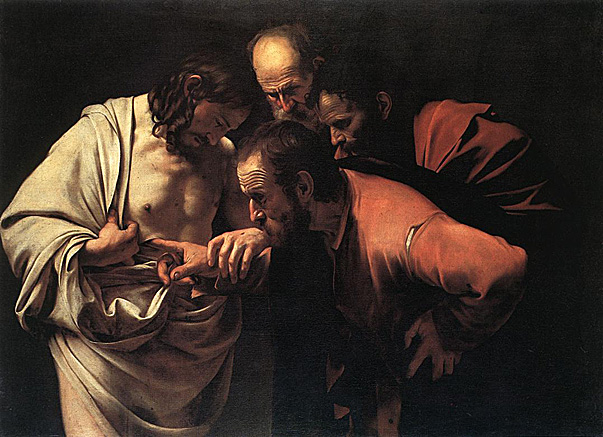
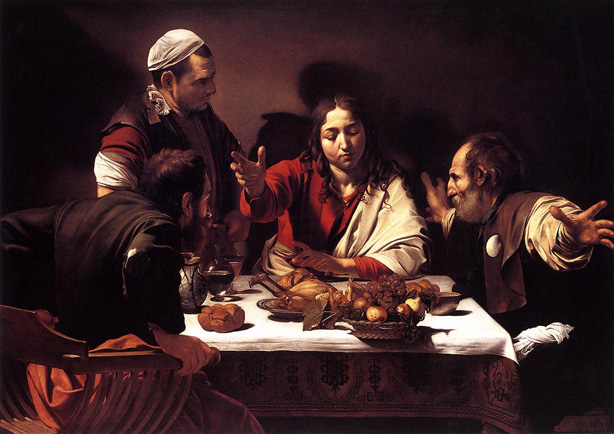
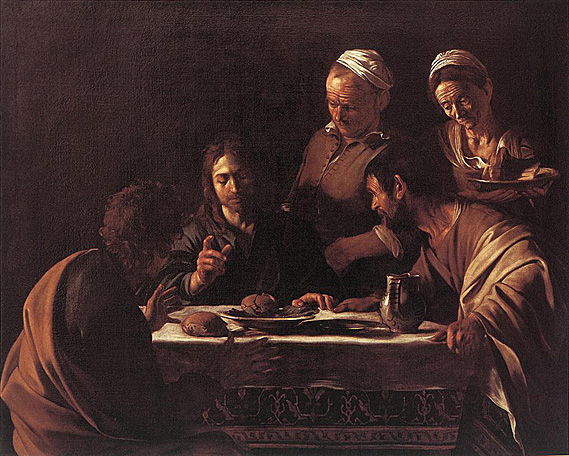
I do not know if Caravaggio ever painted Jesus' resurrection. It would be fitting, somehow, if he had not. (The closest we get, so far as I can determine, are The Incredulity of St. Thomas and his two versions of the supper at Emmaus.) Christ's resurrection, Christians believe, is a prefigurement of our own rescue from death. But it is not yet lived experience. Caravaggio, at his most compelling, painted what he knew.

In this excerpt from his essay "Caravaggio: A Contemporary View," we have Berger discussing Caravaggio's painting within the context of Berger's understanding of him as a champion of the underclass--which, by the way, I think it safe to say Jesus was and is, too--certainly, that is an idea I have found myself returning to many times this Lent. At any rate, what follows is one of my favorite discussions of one of my favorite paintings. Easter is coming, in more ways than one; there will be time aplenty for that. For me today, though, it feels right to be ending Lent on this note.

Once I was asked to name my favourite painter. I hesitated, searching for the least knowing, most truthful answer. 'Caravaggio'. There are nobler painters and painters of greater breadth of vision. There are painters I admire more and who are more admirable. But there is none, so it seems - for the answer came unpremeditated - to whom I feel closer.

The few canvases from my own incomparably modest life as a painter, which I would like to see again, are those I painted in the late 40s of the streets of Livorno. This city was then war-scarred and poor, and it was there that I first began to learn something about the ingenuity of the dispossessed. It was there too that I discovered that I wanted as little as possible to do in this world with those who wield power. This has turned out to be a life-long aversion.

The complicity I feel with Caravaggio began, I think, during that time in Livorno. He was the first painter of life as experienced by the popolaccio, the people of the back streets, les sans-culottes, the lumpenproletariat, the lower orders, those of the lower depths, the underworld. Interestingly enough, there is no word in any traditional European language which does not either denigrate or patronise the urban poor it is naming. That is power.

Following Caravaggio up to the present day, other painters - Brower, Ostade, Hogarth, Goya, Gericault, Gultuso - have painted pictures of the same social milieu. But all of them - however great - were genre pictures, painted in order to show others how the less fortunate or the more dangerous lived. With Caravaggio, however, it was not a question of presenting scenes but of seeing itself. He does not depict the underworld for others: his vision is one that he shares with it.

[snip]

His chiaroscuro allowed him to banish daylight. Shadows, he felt, offered shelter as can four walls and a roof. Whatever and wherever he painted he really painted interiors. Sometimes - for 'The Flight into Egypt' or one of his beloved John the Baptists - he was obliged to include a landscape in the background. But these landscapes are like rugs or drapes hung up on a line across an inner courtyard. He only felt at home - no, that he felt nowhere - he only felt relatively at ease inside.

His darkness smells of candles, over-ripe melons, damp washing waiting to be hung out the next day: it is the darkness of stairwells, gambling corners, cheap lodgings, sudden encounters. And the promise is not in what will flare against it, but in the darkness itself. The shelter it offers is only relative, for the chiaroscuro reveals violence, suffering, longing, mortality, but at least it reveals them intimately. What has been banished, along with the daylight, are distance and solitude - and both these are feared by the underworld.

Those who live precariously and are habitually crowded together develop a phobia about open spaces which transforms their frustrating lack of space and privacy into something reassuring. He shared those fears.

'The Calling of St. Matthew' depicts five men sitting round their usual table, telling stories, gossiping, boasting of what one day they will do, counting money. The room is dimly lit. Suddenly the door is flung open. The two figures who enter are still part of the violent noise and light of the invasion. (Berenson wrote that Christ comes in like a police inspector to make an arrest.)

Two of Matthew's colleagues refuse to look up, the other two younger ones stare at the strangers with a mixture of curiosity and condescension. Why is he proposing something so mad? Who's protecting him, the thin one who does all the talking? And Matthew, the tax-collector with a shifty conscience which has made him more unreasonable than most of his colleagues, points at himself and asks: is it really I who must go? Is it really I?

How many thousands of decisions to leave have resembled Christ's hand here! The hand is hold [sic] out towards the one who has to decide, yet it is ungraspable because so fluid. It orders the way, yet offers no direct support. Matthew will get up and follow the thin stranger from the room, down the narrow streets, out of the district. He will write his gospel, he will travel to Ethiopia and the South Caspian and Persia. Probably he will be murdered.

And behind the drama of this moment of decision is a window, giving onto the outside world. In painting, up to then, windows were treated either as sources of light, or as frames framing nature or an exemplary event outside. Not so this window. No light enters. The window is opaque. We see nothing. Mercifully we see nothing because what is outside is threatening. It is a window through which only the worst news can come; distance and solitude.


[UPDATE: If, however, someone would like some Easter reading to lighten the shadows, here is something from a while back that I'm still happy with.]

Read More...

Monday, July 04, 2011

"A potential model of freedom": An excerpt from "The Work of Art"

Jasper Johns, Three Flags (1958). Click on image to enlarge. Brief commentary here. Image found here.

Happy Fourth, reader(s)! Here's wishing you a safe and enjoyable consumption of food and beverages and fireworks-watching . . . and, yes, if you need it, history.

In keeping with the spirit of the day, my long-time online friend Pam of Tales from the Microbial Laboratory has posted a collection of four, very different performances of "The Star-Spangled Banner." All of them, I personally would say, are respectful performances, but it's easy to see how some could take issue with the appropriateness of a couple of them. The fact that two of these versions are by the same person makes watching them even more intriguing.

While watching these performances on Independence Day, I began thinking about the tension between the idea of artistic freedom and our assumptions about how the anthem "should" be performed. The artist who chooses to perform our anthem has a question to answer that seems simpler than it is: "Should I perform this piece of music? Or can I interpret it?" What is/are the expectation(s) accompanying a performance of the anthem, and how constrained should the artist feel by it/them? The dilemma is that the anthem is a piece of music that, like any music, must be performed in order to be fully realized. At the same time, though, the anthem is a piece of public art, just like any monument that seeks to memorialize an event or person from our history . . . except that, as noted, the anthem lacks a full existence until it's performed. It's not like, say, the Lincoln Memorial. Regarding the anthem, I think most people would say that ideally, the performance shouldn't ultimately be about the performer; those times in the past when performers have run into trouble for their versions, for whatever reason, have been when the performance in some way detracts from the "work" of the anthem. [Aside: Do other nations have discussions of the sort that some of us had after Christina Aguilera's forgetting the lyrics to the anthem when she performed it at this year's Super Bowl?] But that doesn't necessarily mean that only "straight" performances of the anthem "work" well or should be the only kind of performances permitted. Or does it? Put another way: Should performances of the anthem simply be, or should they, in J.T. Kirkland's phrase, "do something"?

This post started out this morning with my thinking on Kirkland's phrase and asking myself what exactly it is that Art does or "should" do; my questions about the anthem seemed to me to want to participate in all that. Kirkland phrase "doing something" (his italics) appears in his meditation on the directions his art is taking in this post. I really like that phrase. Like Kirkland, I'm not quite sure what it means; but like him (though speaking from my perspective as a viewer), I know it's happening when I see it: Art itself is intrinsically kinetic, and the interaction between art and audience is something like a dialogue. Anyway, while looking for something else by Berger, I found "The Work of Art" (in his Selected Essays. Berger's great power for me as a writer and critic is that he is completely invested in his subject and persuaded of its importance to people like you and me; as I phrased it here long ago, he believes "art and its appreciation can and should be something that you don't have to wear black and stroke your chin significantly in order to do." Even more important and vital an idea: that at its best, art "imitates a creation, something to propose an alternative world, sometimes simply to amplify, to confirm, to make social the brief hope offered by nature. Art is an organized response to what nature allows us to glimpse occasionally" ("The White Bird"; fuller context here). The making and appreciation of art, in other words, are essential to the establishing of community and as such are vital human social activities.

As for "The Work of Art" itself, its occasion is a response to Nico Hadjinicolaou's book Art History and Class Consciousness, an attempt to articulate a scientific Marxist art history. Shorter Hadjinicolaou: "There's no such thing as 'art history' or 'schools' or 'style'--there's only 'visual ideology,' the manifestation of those various environmental influences working on an individual artist at the time s/he engages in 'the production-of-pictures' [his preferred term for Art]." Shorter Berger: "[Hogwash]." Berger's politics makes him sympathetic to the need for a valid Marxist aesthetic theory; he notes that Marx himself, valorizing the empirical and the scientific as he did, could not account for why, despite the changing tastes of the centuries, we still think of centuries-old works as being that very unscientific thing, "beautiful." But for Berger the solution is not just to surrender the discussion of aesthetics to the bourgeoisie.

In the passage below, Berger lays out what's at stake in these discussions before going on to give his accounting of the artistic act. What's interesting to me is that, as per the title of his essay, his rhetoric conceives of that act as physical as well as intellectual labor:

The [Marxist] refusal of comparative judgments about art ultimately derives from a lack of belief in the purpose of art. [. . .] If paintings have no purpose, have no value other than their promotion of a visual ideology, there is little reason for looking at old pictures except as specialist historians. [. . .]

The culture of capitalism has reduced paintings, as it reduces everything which is alive, to market commodities, and to an advertisement for other commodities. The new reductionism of revolutionary theory, which we are considering, is in danger of doing something similar. [. . .] Both eliminate art as a potential model of freedom, which is how artists and the masses have always treated art when it spoke to their needs.

When a painter is working, he is aware of the means which are available to him–-these include his materials, the style he inherits, the conventions he must obey, his prescribed or freely chosen subject matter–as constituting both an opportunity and a restraint. By working and using the opportunity he becomes conscious of some of its limits. These limits challenge him, at either an artisanal, a magical or an imaginative level. He pushes against one or several of them. According to his character and historical situation, the result of his pushing varies from a barely discernible variation of a convention–changing no more than the individual voice of a singer changes a melody–to a fully original discovery, a breakthrough. Except in the case of the pure hack, who, needless to say, is a modern invention of the market, every painter from palaeolithic times onward has experienced this will to push. It is intrinsic to the activity of rendering the absent present, of cheating the visible, of making images.

Ideology partly determines the finished result, but it does not determine the energy flowing through the current. And it is with this energy that the spectator identifies. Every image used by a spectator is a going further [Berger's italics] than he could have achieved alone, towards a prey, a Madonna, a sexual pleasure, a landscape, a face, a different world. (434-435)


The idea of Art keeping us free through its constant firing of the collective imagination is really compelling to me today. I hope it might be for some of you, too.

Read More...

Thursday, February 04, 2010

Excerpts from "The White Bird"

Image found here.

What follows are a few passages from John Berger, "The White Bird" (my source is Selected Essays). They might have some relation to some things I was trying to get at in my post on Serra and the Irreproducible. Maybe. But even if they don't, many thanks to Jim, in his comment on that post, for pointing me in this essay's direction. Reading Berger is always invigorating in its own right. Apologies for the length, but I want to show how Berger arrives where he does, and Berger is nothing if not a patient writer, showing his work. Especially in the case of the arts, anyone can declaim. Berger's great appeal for me is that he explains.

Everything not bracketed is Berger's own.

Urban living has always tended to produce a sentimental view of nature. Nature is thought of as a garden, or a view framed by a window, or as an arena of freedom. Peasants, sailors, nomads have known better. Nature is energy and struggle. It is what exists without any promise. If it can be thought of by man as an arena, a setting, it has to be thought of as one which lends itself as much to evil as to good. Its energy is fearsomely indifferent. The first necessity of life is shelter. Shelter against nature. The first prayer is for protection. The first sign of life is pain. If the Creation was purposeful, its purpose is a hidden one which can only be discovered intangibly within signs, never by the evidence of what happens.

It is within this bleak natural context that beauty is encountered, and the encounter is by its nature sudden and unpredictable. The gale blows itself out, the sea changes from the colour of grey shit to aquamarine. Under the fallen boulder of an avalanche a flower grows. Over the shanty town the moon rises. I offer dramatic examples so as to insist on the bleakness of the context. Reflect upon more everyday examples. However it is encountered, beauty is always an exception, always in despite of. This is why it moves us.

[snip]

[T]here seem to be certain constants which all cultures have found 'beautiful': among them--certain flowers, trees, forms of rocks, birds, animals, the moon, running water . . .

One is obliged to acknowledge a coincidence or perhaps a congruence. The evolution of natural forms and the evolution of human perception have coincided to produce the phenomenon of a potential recognition: what is and what we can see (and by seeing also feel) sometimes meet at a point of affirmation. This point, this coincidence, is two-faced: what has been seen is recognized and affirmed and, at the same time, the seer is affirmed by what he sees. For a brief moment one finds oneself--without the pretensions of a creator--in the position of God in the first chapter of Genesis . . . And he saw that it was good. The aesthetic emotion before nature derives, I believe, from this double affirmation.

Yet we do not live in the first chapter of Genesis. We live--if one follows the biblical sequence of events--after the Fall. In any case, we live in a world of suffering in which evil is rampant, a world whose events do not confirm our Being, a world that has to be resisted. It is in this situation that the aesthetic moment offers hope. That we find a crystal or a poppy beautiful means that we are less alone[; . . .] its form, perceived as such, becomes a message that one receives but cannot translate because, in it, all is instantaneous. For an instant, the energy of one's perception becomes inseparable from the energy of the creation.

[snip]

[. . . .]Art does not imitate nature, it imitates a creation, something to propose an alternative world, sometimes simply to amplify, to confirm, to make social the brief hope offered by nature. Art is an organized response to what nature allows us to glimpse occasionally. Art sets out to transform the potential recognition into an unceasing one. It proclaims man in the hope of receiving a surer reply . . . the transcendental face of art is always a form of prayer.

UPDATE (February 8): Over at Musings from the Hinterland, Randall pursues Berger's ideas in a couple of fruitful and compelling directions. Go and read.

Read More...

Friday, May 04, 2007

A stretch of river XXXVI: On good old Corot, and Places to Go

Jean-Baptiste-Camille Corot, Ville-d'Avray, 1870

It's a misty, grey morning here in Wichita, and/but today there is something about today's light that reminds me of the Corot that hangs at the Nelson-Atkins (NB: the one you see here hangs in the Met but is quite similar in terms of both the scene depicted and, in particular, the quality of its light). Over the years, I've grown more and more appreciative of the Nelson's collection of 19th-century French paintings--it's taught me, for example, that Pisarro's work, more than others', is better appreciated in person. Even so--even though I know those other painters are "better"--it's the Corot I linger and linger in front of, every visit, and for the same reason I wanted to linger this morning and gaze across the river even as Scruffy wanted to chase the squirrel on the fence--a dog's catnip--separating the path from the apartment's pool: not anything remarkable in the scene itself, but the pearlescence of the light illuminating it--no, more like glazing it.

John Berger, whose socialist's sense that art and its appreciation can and should be something that you don't have to wear black and stroke your chin significantly in order to do, writes about Corot with a combination of, on the one hand, disappointment in what Corot might have accomplished but chose not to and, on the other, the value in what he most assuredly does accomplish, for me at least, whenever I stand in front of that landscape in Kansas City:

Corot remained a petit-bourgeois. Matching, pinning, sewing, he was never quite able to shake off the effect of his father's drapery business and his mother's dress-shop.

[snip]

[But h]e was a petit-bourgeois only in his refusal to speculate on how the world could be changed. This explains why he was timid without being a coward. Instead of questioning, he set out to make his own peace, to avoid all contradictions. He knew it himself: 'Delacroix is an eagle and I'm only a lark. I sing little songs in my grey clouds.' He reveals it unconsciously when he says: 'Charity is a still more beautiful thing than talent. Besides, one benefits the other. If you have a kind heart, your work will show it.' How comfortably without contradictions that 'Besides' is!

[snip]

Corot was a lovable man. At his best he was an artist of minor genius, comparable to, say, Manet. And let me add--with the due modesty that ought to precede such a statement--that Corot has contributed to many people's happiness. (208-209)

Yes indeed. The Nelson's Van Goghs, the early (and late) Monets, the Manet, they challenge me in various ways with their assertiveness. The Corot "just" makes me happy.

In the meantime, though, Scruffy is tugging at his leash . . . which brings me to the "Places to Go" part of this post. We're on the cusp of finals week here, which means that I can't say when my next post here will appear. So, below the fold, I want to recommend some places worth your visits--assuming, that is, that you have plenty of time, as several of these places will require that of you.

(Aside: I can't decide just now, as the duties of finals week command my attention, whether the blog is analogous to Corot or to the squirrel Scruffy wants to chase. Both are pleasurable, so that doesn't enter into deciding.)

Anyway:

For better or for worse, many of the blogs I visit are kept by people with lots of things to say and who are not shy about taking their time in saying them. I'm as appreciative of the pithy observation as the next guy, but I know as well that some things simply take a longer time to say in order to say them well . . . and I am just as appreciative of that.

Gawain of Heaven Tree, whose blog's post's leisurely pace on leisurely subjects exudes "Man of Leisure," has a wonderful post on one of my very favorite American painters, John Singer Sargent, that is ostensibly about an exhibition of Sargent's paintings done in Venice or on Venetian subjects currently on exhibit in Venice. But it turns into, as well, meditations on technique, on seeking out the proper viewing distance for paintings, "and, as always, love." Reading it, it occurred to me that I like Sargent for the same reason I like Corot: he makes me happy.

Gawain meditates; Hank of A Lake County Point of View does not meditate so much as forays. Hank writes like he's in a hurry, but you can't be when you read him. The title of his most recent post, "Lupins, Wolves, Chinese Romans, Peaches and the Unforgettable Cream," does not quite cover everything that he ends up writing on. It starts out as simple homesickness for Texas Bluebonnets, which, I can attest to, are especially abundant this spring and so are deserving of being homesick over; like Proust's madeleine, though, that homesickness leads to, um, all sorts of other things, places, people, across time and space and cultures. Fully referenced and complete with footnotes-within-footnotes (which are as much a part of the show as the rest of the post and thus are not to be missed), reading this post (and others . . . it's interesting how the color blue seems to inspire these posts of his . . . ) is like reading some hyper-texted cross of Montaigne, the afore-mentioned Proust, David Foster Wallace, and a coy Henry Miller. No one else I've yet run across is doing what Hank is doing--which is a very good thing, seeing as I have enough to read as it is . . . but sad in its way, too.

Also: I gotta get me some sort of footnotes-within-footnotes hack for Blogger . . . or move to Typepad . . .

Hank's longer posts are strange knowledge-maps that reveal the sometimes-odd and -unexpected interconnectedness of things; in a recent post, though, Conrad of Varieties of Unreligious Experience writes about another kind of map: ones all but unreadable except by the person who made it. We tend to think of maps as being objective visual descriptions of places that anyone is able to use with success. But these maps are expressions of a kind of knowledge, as I noted in comments over there, that cannot be taught but only learned.

My long-time blogging compadre Raminagrobis, over at his eponymously-named blog, has up "In Praise of Bathos," a patient discussion of meter and its connection to whatever "bad poetry" might be.

Finally, Randall of Musings from the Hinterland has initiated what this reader, at least, fervently hopes will be an ongoing series called "You Be the Jury" (a more interactive take on The People's Court--or like a "Take Your Blog's Audience to Court" kind of thing). Judging from this first installment, it promises to be both a celebration of the Weird Stuff that People Sue Over and the extent to which the law helps (or hinders) us in thinking about said Weird Stuff.

Still not enough? Then be sure to have a look at the other folks in the "Daily (B)reads" section of the right gutter. They too are worthy of your attention.

As always, thanks for visiting and reading and deigning to come back every once in a while. I'll see you around.

UPDATE: As a bonus to those of you who read this far, I give you the (two) last word(s) in gloriously-vulgar but dead-on movie reviewing, Neil Cumpston.

Read More...