The Savage Detectives: Straight-line labyrinths and the nearly-blank book
 Giuseppe Arcimboldo (1527-1593), The Librarian. Image found here. Arcimboldo is something of a preoccupation for Bolaño, about which more later.
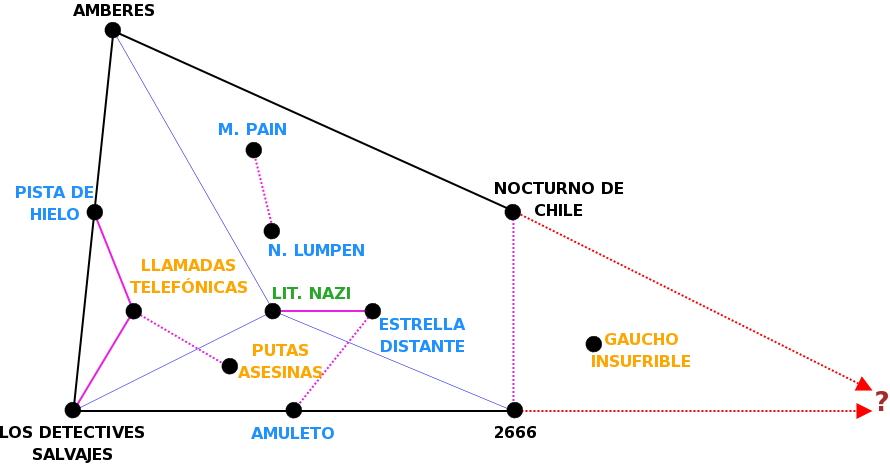
[UPDATE: Below, I discuss some of the interrelatedness of this novel with Bolaño's 2666; my good friend (and Bolaño fan) from Mexico City, René of Teoría del Caos, sent me a link to this diagram (explanation (in Spanish) here) that shows the interrelationships of all Bolaño's works. Fun to look at and ponder, for those interested.]
Roberto Bolaño, The Savage Detectives.
In his lively essay-as-fiction "Borges in Action," Mexican novelist Carlos Fuentes offers up in passing a succinct throwaway line that, back in the day, once described for some the essence of Latin American culture: "Mexicans descend from the Aztecs, and Argentinians descend from ships" (Myself with Others: Selected Essays, 152). This piece, set on Calle Amsterdam in Mexico City's Colonia Hipódromo, is a pastiche of stories and ideas of the grandfather of 20th century Latin American literature, Jorge Luis Borges . . . though, truth be told, for Borges "stories" and "ideas" amount to pretty much the same thing; it includes cameos by Borges, still alive at the time Fuentes wrote this, and the definitely-dead Erasmus. It's with Erasmus that "Fuentes" has the following conversation:"Tell me [Erasmus says], where were we truly lost? In the maze [of the colonia] or in the pampa?" The question stunned me.
"Why, come to think of it, in the pampa. In the labyrinth." I hesitated. "In the maze I expected to be lost, but it was--you are right--so symmetrical; its sharp turns, its willful design: we were meant to be lost . . . "
"So we weren't: the maze is foreseeable," said the Dutchman. But the pampa isn't. But that is the real labyrinth: the straight line, you see."
Then you mean, Erasmus, that everything we have seen stands for something else: the maze is simple; the straight line is the true labyrinth, the true mystery . . . "
"And the true name of the garden of Eden, El Dorado, is Time. Do not go away impatiently without understanding this, you above all, you of the New World: you do have something more than an epic fatality; you do have a mythic chance." (156)
I don't want to claim that Roberto Bolaño has this essay in mind as he writes his semi-autobiographical novel, The Savage Detectives. But it is true that much of that novel's action is set in that broad midsection of Mexico City that ranges from the Zócalo to Chapultepec Park. (Colonia Hipódromo is near Chapultepec.) It is also true that The Savage Detectives' central action is the the story (often quite funny and, in places, Henry Miller-like) of the founding of an artistic movement called visceral realism and the tracking-down of a writer named Cesárea Tinajero, considered to be visceral realism's forebear and whose sole published poem, "Sión,"  is shown here (image found here). They search for her, moreover, not in the pampas but in the equally-labyrinthine deserts of northern Sonora. But Bolaño, a Chilean just old enough to do what he could to try to prevent Pinochet from taking power and feeling much more kinship with fellow South Americans-in-exile Borges and Julio Cortázar, would definitely take issue with Fuentes' Erasmus' hopeful "mythic chance" for the New World. Having finished reading The Savage Detectives only yesterday, I'm still thinking through this sprawling, thoroughly contemporary novel--magical realism, this is not. But one thing I think I can say about it is that, whereas in the novels of '60s-era Latin Americans like Fuentes and Gabriel García Márquez, the implicit assumption seems to be that the myth of Latin America has yet to be written, Bolaño would argue that, for better or for worse, there's no myth but only a Reality shaped by dark forces that is already written, that demands to be read and understood and which only Art can do and rail against . . . and perhaps, even prevail against.
More below the fold.
Some of you reading this may remember that back in June I posted on Bolaño's 2666. Reading The Savage Detectives is in many ways like revisiting that other novel: the pseudonymous writer Archimboldi, about whom much of 2666's action is concerned, gets referred to in passing here; moreover, the search for Tinejero takes Ulises Lima and Arturo Belano (the titular Detectives) to Santa Teresa, 2666's fictional border town; The Savage Detectives is as obsessive in locating the reader in Mexico City's actual streets as 2666 is in locating the reader in Santa Teresa's fictional ones. Each novel also moves forward and backward in time and has multiple narrative threads (The Savage Detectives is especially complex in this regard--you can trust me on this, or you can see a visual rendering of this here). Despite those intersections and structural similarities, though, The Savage Detectives is ultimately its own book, focused as it is on the literary culture of Mexico City and, more directly, with the lives and adventures of the Mexican poet Ulises Lima (note the first name) and Arturo Belano, a Chilean and Bolaño's stand-in, as they travel about Mexico City and, later, abroad.
I think also that, despite the fact that a quest to find the poet Arcimboldi is what begins 2666's action (and, for that matter, his life story concludes that novel), it was in the course of reading The Savage Detectives that the choice of the name Arcimboldi truly began to resonate with me. Like the painter's Librarian, Bolaño's writers and artists are known less by who they are than by what they have read and their embrace or rejection of those books . . . and, in this novel, what others remember of those same people (Lima and Belano may be our two central characters, but they never speak directly to the reader). We are what we read; we are what others can/choose to remember about us; but even what we write gets read, and read into, by others, and so we can never truly speak, directly and unfiltered.
As for Art itself, the Librarian's constructedness--he is made of books that are already written--is emblematic of the artist's dilemma: What to do in the face of Tradition? The visceral realists feel not inspired but trapped by Latin American literature's giants, embodied here by Octavio Paz and Pablo Neruda (perhaps significantly for our protagonists, a Mexican and a Chilean, respectively); moreover, they're of the opinion that the established writers, no matter their politics, have sold out artistically to curry favor with either those in power or those ultimately more interested in politics than in art. Power is power, whether emanating from the left or the right; real life and experience aren't found in the literary salons or cell meetings but in the streets and the lives of the people one finds there. Though the phrase "speak truth to power" does not appear in The Savage Detectives, the visceral realists would at least say that they agree that that is Art's goal.
In the end, it's also futile. Language betrays the writer through its ultimate inadequacy to say what he means; to be published, he must inevitably make some compromises, or starve for attention. Belano's stalking of Paz in a Mexico City park becomes something of an allegory for the attention the visceral realists crave but fail to achieve. Cesárea Tinajero thus becomes, for Lima and Belano, the closest thing to an artistic ideal they can find: one published poem--and a truly enigmatic, labyrinthine one that, title aside, must be read on its own terms--and that is the end of her literary career . . . though, as our protagonists will learn, she has not stopped writing.
Near the very end of the novel, Lima and Belano meet a woman, identified only as a teacher, who had known and worked with Tinajero. One day, the teacher tells them, she had gone to visit Tinajero in her spare apartment in Santa Teresa, and here is a little of what the teacher told them she saw:And then the teacher saw or thought she saw a plan of the canning factory [where Cesárea was then working] pinned to the wall. And as she was listening to what Cesárea had to tell her, in words that were neither faltering nor rushed, words that the teacher would rather have forgotten, but that she remembers perfectly well and even understands, understands now anyway, her eyes were drawn to the plan of the factory, a plan that Cesárea had drawn with great attention to certain details, leaving other parts shadowy or vague, complete with notations in the margins, although sometimes what was written was illegible and other times it was all in capital letters and even followed by exclamation marks, as if Cesárea were seeing herself in her hand-drawn map, or seeing facts of herself that she had until then overlooked. And then the teacher had to sit down on the edge of the bed, although she didn't want to, and close her eyes and listen to what Cesárea was saying. And even though she was feeling worse and worse, she had the courage to ask Cesárea why she had drawn the plan. And Cesárea said something about days to come, although the teacher imagined that if Cesárea had spent time on that senseless plan it was simply because she lived such a lonely life. But Cesárea spoke of times to come and the teacher, to change the subject, asked here what times she meant and when they would be. And Cesárea named a date, sometime around the year 2600. Two thousand six hundred and something. And then, when the teacher couldn't help but laugh at such a random date, a smothered little laugh that could scarely be heard, Cesárea laughed again, although this time the thunder of her laughter remained within the confines of her own room. (633-634)
How much to read into this passage in relation to Bolaño's 2666? There is the pretty-clear nod in the direction of the title; and the scene just related occurs a good 20 years before the central action of 2666, but many of the murdered women in that novel are employed by Santa Teresa's maquiladoras, of which the canning factory is the first, we're told earlier. Those are the easy things to say, of course. But to argue only for the straight line between the two books is to assume there's no labyrinth to be negotiated by the reader. On the contrary: As I've been thinking about both these books this morning, they seem to me like two separate books that are parts of a larger, Archimbodian assemblage that, when completed, will tell us something more than the sum of its parts . . . or would have, had Bolaño not died so young. His novel Amulet, set on the campus of Mexico's National University during the 1968 student protests, is also part of that assemblage: its central narrator appears in The Savage Detectives and briefly relates what happened to her during that time. No doubt other of Bolaño's books are as well.
Another appropriate adjective to describe my sense of Bolaño's project would be "Faulknerian" in its intent to tell, in cumulative fashion, the story of a region and its contemporary moment. But whereas Faulkner searched through his fictions for a way to understand the origins of the South's tragedy, for Bolaño there seems to be no mystery to Latin America's tragedy. Pace, Fuentes' Erasmus, there's no mythic chance. For Bolaño, the mystery is whether Art will speak to, and be brave in the face of, Latin America's reality. That book is nearly blank, but this novel by Bolaño goes far in showing other writers how to fill up those pages.