Saturday, April 29, 2006

Noted with interest and without comment

Via Josh at Thoughts from Kansas, here is the Blog Meridian Theme Song:

Your Theme Song is Back in Black by AC/DC

"Back in black, I hit the sack,
I've been too long, I'm glad to be back"

Things sometimes get really crazy for you, and sometimes you have to get away from all the chaos.
But each time you stage your comeback, it's even better than the last!

Read More...

What the manner in which schools are funded says about a people


Over at Sine.qua.non, Nancy has assurred me via this post that my native state is just as clueless about how (not to mention "whether") to fund public schools properly as the state where I currently reside. I see from the article Nancy links to that, like Kansas, Texas is under a court order to address how its schools are funded. The specifics of the funding are different, though: In Texas, the court ruled that funding is too dependent on property taxes (amazingly, schools there have plenty of money in the eyes of the court, but whether that's true or not is something I can't speak to and certainly doubt); here in Kansas, the schools are just plain old underfunded. A lot.

Details, and some borrowed thinking from others, below the fold.


In Texas, the plan is to cut property taxes and make up for the decrease in revenue by dipping into the state's sizeable revenue surplus and increasing taxes on cigarettes by $1 a pack. I gather from its absence from the article that the simple 3-word phrase "state income tax" (which Texas does not have and is a fact of which it officially is quite proud) is still political taboo and yet would immediately satisfy the courts, reduce the tax burden on property owners (smokers too, Nancy), AND provide schools with all the revenue they need.

In Kansas, the most popular solution to the underfunding question is to permit state-controlled casino gambling in selected cities. While I'm not anti-casino per se, I do wonder about the underlying assumptions regarding the importance of public education reflected in proposals such as that and raising tobacco taxes.

Wichita's mayor, Carlos Mayans, made me wonder about this question last year when he himself raised it. He is not anti-casino, either, but his point is a simple one: if we say we value education, then we should fund it so as to reflect that sentiment--not just in terms of dollar amounts but in terms of the sources of those funds. No one likes to pay taxes, of course, and politicians in election years are reluctant to raise (the issue of) taxes; nevertheless, the representatives of a state should be politically willing to ask its people to invest directly and adequately in those things we collectively say we care about. Gambling revenues and other so-called sin taxes are disposable income, monies that people have decided they don't need for other things. To fund schools in this way, Mayans is suggesting, is to imply that schools are being funded with left-overs: a disgraceful attitude.

If there's one certain thing a state can do to better ensure a brighter future for itself, it's not granting massive tax incentives to businesses to lure them there. It's investing adequately and wisely in education from pre-kindergarten to post-graduate. Well-educated people attract businesses with higher-paying jobs.

By way of closing, I link to this post by Dr. Jan regarding the brouhaha in Oklahoma when her school's students decorated a Christmas tree with discarded lottery tickets and the displayed it in the state capitol building last December. I know she meant no harm in doing this; the blame is not with her, and certainly not her students. But I'd like to think that it made people uncomfortable at least in part because it embarrassed them into thinking about the choice the state had made. Here, legislators, that tree could be read as saying: you fund us with left-overs; we'll honor you with the left-overs from the left-overs.

Technorati tags:
, , ,

Read More...

Friday, April 28, 2006

Carnival time again

A rushed reminder to those of you who have any sort of relationship whatsoever with the Sunflower State--natal, residential, wistful, angst-ridden, etc.--that EMAW_KC at 3 O'Clock in the Morning would appreciate your submissions to the next weekly installment of the Kansas Guild of Bloggers' Blog Carnival. Here, for your convenience, is the link to the Submission page.

My own submission has nothing to do with Kansas, just so you're wondering. So neither does yours have to.

Read More...

United 93: Art, film, and national trauma


Though I'm a great admirer of the TV show Law & Order, I've always found NBC's favorite teaser for that show's episodes, "Ripped from today's headlines," to have a crassness of tone considerably at odds with the quality of its writing. The show's appeal lies not in the fact that many of the show's plots are indeed based on cases that have recently occurred, but in the fact that, even years after our memory of the news accounts of those cases has faded, the show's treatment of that material still retains a weight, an oomph that, sorry, you AP wireservice writers out there, those news stories lost long ago. It's not the events but their telling that we remember and admire.

But Law & Order's narratives are about local matters, no matter how nationally- or culturally-pertinent their themes. National narratives, especially traumatic ones, are another matter entirely. Over at Cup o' Joel, a well-written blog worthy of your visits, fellow Kansan Joel Mathis recently posted a commentary on the soon-to-be released film United 93. Well, not so much the film as the context in which it's being released. I happen to agree with his sentiments; indeed, just before I read his post this morning, I had posted the following over on the House of Leaves boards, where a small discussion about the film has begun:

My wife and I saw a trailer for the film night before last--as we've been seeing them for the past couple of weeks now--and she asked me what I thought about "all that."

In principle I'm not opposed to the idea of making films about events such as this--I'm not sure about Marsjams' tone above, but I'll just say here that I do think some things are worth dying for and it's valuable to be reminded of that--but my own feeling is that in the case of this film, it's just too soon. Not that one can or should ever be truly objective and clinical in one's thinking about national traumas, but my personal sense of things is that we're still trying to clarify for ourselves just how that day has affected us as a nation and, even more important, what our proper response(s) should be to it. I have doubts that this or any film about that day, right now, will help in that process, and the making of money off this only makes "all this" more, not less, problematic.

And with regard to the appealing of the "R" rating and all that that implies: Here's a suggestion: if the makers and studio truly want to honor the event depicted, I propose they put their money where their collective mouth is and not charge admission. Show their film in stadiums and throw the doors open. What SHOULD matter for them is an audience, not a paying audience. What's the never-to-be-recovered expense of a few tens of millions of dollars compared to paying tribute to the never-to-be-recovered lives of the thousands of people who died that day?

Lurking about in all this, hard to see because of our constant associations between commercial film-making and money, is the question of what is, or should be, the place of Art in depicting moments of national trauma.

One of Joel's commenters notes that Art has the potential to clarify our thinking about such events and that this film might accomplish that--something that I sort of acknowledge without directly stating it above. But as I say above: the question is not the choice of subject matter; the question is its timing and whether it is too soon for this film to engage us emotionally without blinding us rationally. In other words: is it too soon to make effective Art out of the complex materials of this event?

Back in January, my good online friend Raminagrobis asks this same question regarding recent novels that use the events of 9/11 in his post "Too Loud and Too Close", and he intriguingly (given the literal meaning of "novel") reaches the following conclusion:
Though we no longer have to think of novels as totalities, fully realised worlds in which no element is otiose and all contributes to the perfection of the form, we retain the (perhaps outmoded) conviction that a novel should represent a unity, an aesthetic whole. I think that the intrusion of the present, in all its stupid, brute meaninglessness, fractures that unity irreparably. It is not only a problem of perspective – of our blindness towards outcomes distorting our view of things – it is a question of form. If vision is style (and it is: ‘Le style,’ wrote Flaubert (I think), ‘est une vision du monde.’), I might call this an astigmatism of form.

Grobie of course is more concerned with the novel-as-form here, but personally I'd give more weight in this matter to the audience's response to the intrusion of the present. Speaking for myself as a reader, there's something about the novel's written-ness that makes that intrusion seem more controlled, more mediated--more akin, in other words, to Wordsworth's definition for poetry: emotion recollected in tranquility. It's startling, that intrusion of the present, yes: but I'd argue that the novel can handle it; the question is whether the reader can.

Film, though, is another matter entirely, it seems to me: its text is image. It's a scripted and thus written image; but the audience's act of processing that image is a very different, much more direct one compared to the act of processing a written text. There have been no outcries against the novels Grobie mentions that I'm aware of. But much of the reluctance that many feel about United 93 has to do precisely with the nature of the medium itself, no matter how honorably its makers have depicted those events.

In a very real way, we won't be able to watch United 93 for a very long time. But I do think we're ready to read about it, if novelists are ready to write about it.


Technorati tags:
, , ,

Read More...

Thursday, April 27, 2006

In which the Meridian, having seen Le Samouraï, contemplates a couple of additions to his wardrobe

Specifically, a fedora and a black trenchcoat.

Le Samouraï (1967; dir. Jean-Pierre Melville; starring Alain Delon, François Périer, Nathalie Delon, Cathy Rosier) is the sort of film where you think, If I dressed like that guy, I could BE that guy. That is just how powerful, how iconic, wardrobe becomes here. It does this film no disservice to say that its style IS its substance.

Because that is so, this film, visually spare and with long stretches of no dialogue (no one speaks a word for the film's first 9 minutes and 52 seconds), demands our close, attentive watching as few films of any genre require of us these days. This is a film in which surfaces do not deceive but reveal to us all we need to know to follow what's happening--if we're paying attention, that is. Thematically as well, those surfaces reveal two worlds, two manners of living, in conflict with each other.


Alain Delon plays Jef Costello, a nearly-silent, austere-living man so good at his job of gun-for-hire (he's never yet been arrested for any crime) that it is his very blankness that attracts the attention of a police superintendent (François Périer) when the owner of a Paris nightclub turns up dead. Jef lives in a spare room but clean room in a run-down hotel, his only apparent luxury being a small bird he keeps in a cage. I say "apparent" because, well, let's just say that it is Jef's close observation of the bird--twice--that keeps the film from ending way too early. He is also the "samurai" of the film's title: the mythos of the samurai's bearing and honor are very much part of this film's texture. The manner in which he straightens his fedora after putting on his coat, even the way he puts on his white gloves just before he kills someone, transform his wardrobe from mere costume into the physical trappings of ritual.

The film's plot is très noir-ish: Jef is the killer of the nightclub owner--we see him do it--but because he is picked up on suspicion of having committed the murder, the people who hired him now seek to kill him (he had promised that no complications would arise from the hit). Only trouble is, Jef doesn't know who hired him, much less why they wanted the man dead. So the balance of the film consists of Jef simultaneously seeking information on his client and dodging the various police survelliances of his activities. Through all this, Jef betrays almost no sign of emotion, with the possible exception of the second time we see him steal a car to make a getaway; though shot almost exactly like the first car-stealing scene, early in the film, in the second one we see just the faintest twitches of nervousness in his upper lip. Jef is the epitome of cool, of elegance; his manner of living is as sharp, as clean, as the brim of his fedora. But his austerity tempers that coolness, making him as priest-like as it's possible for this very secular man to be.

But he lives in a Paris distinctly lacking in those qualities. The buildings all need paint jobs, the trash doesn't get picked up very often. Among the suspects rounded up for the nightclub owner's shooting, he stands out because, as the superintendent says, he's had no trouble with the police before and his alibi is "too airtight." Messiness, be it in one's manner of dress or in how one has lived one's life, is the norm in this world: one other suspect is revealed to have a fairly lengthy criminal record, including attempted murder, but he is let go immediately. Jef becomes a sympathetic character because we recognize that, allowing for that little matter of his killing people for a living, his way of living is perhaps preferable to how most of the rest of us live ours. His integrity is not to himself so much as it is to a code not of his own making that shapes the choices he makes. So long as he is true to it, he does not have to worry about himself. But the corollary of that statement is, if others do not follow the same code, THEN he has to worry about himself.

My students, fine 'Murikins all, tend not to like foreign films because they don't like reading the subtitles. But I will be recommending Le Samouraï to them. My hook will be that Quentin Tarantino and John Woo are great admirers of it, but I'll also tell them that this French film's real language is what we see. As an IMDB reviewer notes, its great strength as a film is that it so forcefully reminds us that film is a visual medium, first and foremost. And in these days of film-making that, for various reasons, causes us to ask, What was the point in making that?, reminders can be valuable things.

Technorati tags:
, , ,

Read More...

Monday, April 24, 2006

Vermeer's Woman in Blue gives birth to a Waterhouse painting?


Vermeer, Woman in Blue Reading a Letter

John William Waterhouse, The Crystal Ball

I don't have anything profound to say about these paintings except to note their (to my mind) striking similarities, down to their analogous compositional principles (the vertical and horizontal lines in the woman's room in the Vermeer mirroring the straight edges of the letter; the rounds in the woman's room in the Waterhouse echoing the crystal ball. Also, as the post's title indicates, I like the sense of these paintings' intertextuality: the suggestion that Vermeer's woman's pregnant roundness gives birth to the roundnesses in the Waterhouse.

And I just happen to like both of them, each on its own terms.


Technorati tags:
, , , ,

Read More...

Friday, April 21, 2006

The contents of decision letters as Schrödinger's Cats


(Contextual material here)

And, regarding the cartoon (hat-tip: Cartoon Stock): Pet-doors:cats::decision-letters:____?____

I have not posted in some time about Mrs. Meridian's successes or failures regarding the law schools she's applied to. In truth, as long-time readers know, I've only spoken of this in passing here, here, and here. But we have good news on this front: we have yet to hear from 3 schools, but of the ones we've heard from, Mrs. M. has been wait-listed only once; all the rest have accepted her.

But.

It's the three best schools she's applied to that we've not yet heard from. She doesn't want to jinx things and, seeing as it's always been good news so far when she's opened the letters, this morning we had something like the following conversation:

Mrs M: Don't open any mail today.
Me: Oh?
MM: No--I want to be the one who opens it.
Me: Why?
MM: I'm afraid that if you open the decision letters, they'll have bad news.
Me: So if YOU open them, they'll have good news?
MM: Yes.
ME: So, so long as the letter remains closed, the potential exists for the letter to simultaneously contain good news AND bad news?
MM: Yes.

Well. Who am I to argue with a basic principle of quantum mechanics? After all, I've linked to the proof of this before.

You'll know sometime after we do.

Technorati tags:
,

Read More...

The KGB wants YOU, Comrade Blogger

Over at 3 O'Clock in the Morning, EMAW_KC is the current host of the Kansas Guild of Bloggers' weekly Bloggers' Carnival. A blog carnival, for those who don't know (it's a relatively new term for me, too), is a compendium of links to recent posts by participating bloggers. The two more altruistic purposes are to share work you're pleased with and read that of others; the more selfish one is to increase traffic to your site, if you're into that sort of thing.

The deadline for this Monday's posting of the Carnival is Sunday the 23rd at 3 pm CST, so don't dawdle.

The name of the Guild DOES have "Kansas" in it; but, as EMAW puts it, even if you've driven through or flown over Kansas (or, I would add, thought wistfully or maybe even disdainfully about Kansas), your posts are eligible for inclusion.

Shake some dust an' git yerselfs over there.

Technorati tags:
, , , , ,

Read More...

A stretch of river XII: Wildness


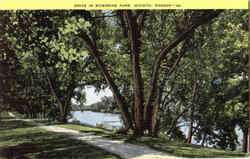
As I bet you can tell from this image, a picture on an old postcard, our stretch of the Little Arkansas river usually doesn't have a smell. This morning, though, it has that (to me) wonderful smell the rivers and creeks of my Texas childhood had that reminds me a bit of tarragon with the sharp edge of something like basil or perhaps rosemary--I can't decide which. It's the smell of spring, so strong that even we olfactorially-challenged humans can smell it, the smell of pollen and new leaves and already-fallen early blooms.

It is also the smell of somthing I keep wanting to call "wildness."

Nature is at its wildest in the spring, even along this ostensibly urbanized stretch of river. Spring is all about procreation, of course, and that is the single most crucial act of perpetuation. So--there is wildness, a kind of fierceness, in the spring, even in the passive yet open invitations the flowers extend to the bees. The plants, the animals, are driven by impulses and urges whose ends don't benefit them as individuals but help to ensure a future for the species of which they are a part. The mallards have been paired off, males with females, for over a month now, and just a couple of days ago I saw the first brood of ducklings. But not all the males have found mates; for the past month, those males have tried to mate with the females, only to be driven off by the females' mates. So now, the "single" males congregate off by themselves in a little indentation of the riverbank like the awkward kids at the high school dance who show up because that's what they're supposed to do but whom no one will dance with. I initially see some humor in their situation, knowing that there's always next year, but with a little thinking I have to recognize that they probably can't know that. They see only this one season, and their failure. There is a poignancy in that, no?

But precisely because of this stretch of river's now-sharp, human-managed edges, we've lost much of our ancient ability to see all this on Nature's terms. We're too busy thawing out from the winter and wondering how it could have passed so quickly (especially this past, very mild winter). Even the used condom I saw in the park a few weeks ago, the morning after our first cool-but-not-cold night of the season, was, for me at least then, more the potential subject for a joke-y blog post ("What were you expecting--Walden?") than, as I think about it now, a human expression of this wildness.

Oddly enough, it's been Scruffy who has been calling my attention to all this.


Now, mind you, my dog isn't exactly the brightest star in the canine firmament, especially when it comes to learning lessons about wildness that should need teaching only once. But he DOES have a much better nose than I do, and for these past few weeks of mornings now all those scents--not just the ducks, but the recent increased activity of the robins, pigeons, mourning doves, squirrels, rabbits, skunks and possums that we have seen--have caused his behavior to be even more ADHD-like than usual. Not content merely to snuffle along the path we take, he'll suddenly lunge underneath a bush to sniff at its base where some animal had taken refuge for part of the night. Perhaps they are just stronger now, what with the air being warmer and more humid these days; perhaps they are just more numerous. But, adolescent that he is, he responds giddily, straining against his collar so hard it begins to cause him to wheeze and yet he doesn't seem to notice it, deep in the throes of his own kind of puppy love.

And yet he's neutered.

While I'd be the last to argue that humans should be slaves to hormones and pheromones in the ways that plants and animals are, there are times when I see Scruffy's behavior and feel shut off from the very world whose air I breathe. The signals in the air, the breaths, the odors of other living things: The air actually tells him things; I can only know that I cannot know them, and that that is a now-irrecoverable loss that "the perfume from a dress," though pretty enough, can only gloss over.

Technorati tags:
, , ,

Read More...

Thursday, April 20, 2006

Midweek Miscellany

I've not had time in a while to write up something decent on my own, so to give your visit here some value I thought I'd send you to some friends and acquaintances who HAVE had time to write posts--and pretty good ones, at that.

Serious stuff first: Gregory Djerejian of Belgravia Dispatch is, it seems to me, THE fellow to read these days on Iraq: long, thoughtful, well-sourced posts from a former diplomat with a long view and a long memory. He is still of the belief that something good can yet be salvaged from that adventure, but he is not blind to the fact that things must change dramatically and soon if that good is to be salvaged. This post is a long meditation on the retired generals who have made public their anger with Donald Rumsfeld's conducting of the war, on those who are impugning the reputations of these generals, and the general state of the relationship between civilian and military leadership at the Pentagon. This is the sort of writing for which adjectives like "searching" are reserved. This one, meanwhile, examines the cries of "wild speculation" emanating from the White House regarding attack plans aimed at Iran and hears a distinct echo of vintage late-2002/early-2003 rhetoric regarding Iraq.

Cheerier stuff now:

Nancy over at Sine.qua.non has this eloquent post about the value of the arts in/for society. As the proud father of two daughters who love to paint, draw, read, sing and, in my older daughter G.'s case, play the violin--all of this facilitated at least in part by the public school they attend--I could not agree more with Nancy's sentiment.

Over at Musings from the Hinterland, intrepid world traveller R. Sherman braves the wilds of northwestern Arkansas with his lovely wife and two children who might have questions of a rather awkward nature . . . Oh, just go read.

Belle Lettre over at Law and Letters ruminates on the advantages and disadvantages for academic types regarding pseudonomynous blogging--especially for those who, like her, don't quite have Ann Althouse's rep.

Do we talk about reality in only subjective terms, or can we ever achieve objectivity? Over at Epiphatic Exhaustion, Overlyconscious, putting on his best Socrates, would like to know.

And speaking of Socrates, at Delights for the Ingenious, Fearful Syzygy begins to suspect that, when it comes to conveying to others his version of haircut-ness, the language for that might not exist.

And, for the thinking-person's pugilist: Chess-boxing.

Enjoy.

Read More...

The birth of the assassin of painting

Today is Joan Miró's birthday. What better excuse is there for posting one of my favorite paintings of his?

Wichita can be fairly surreal, too, in a Great Plains sort of way, but this Miró mural over the entrance to Wichita State U's Ulrich Museum of Art is a very public exhibition of our surrealist street cred.

Technorati tag:

Read More...

Sunday, April 16, 2006

A(n over?)reading of about 2 seconds total of Vertigo


First of all: a belated Happy Passover and Happy Easter to my readers. I hope your holidays were happy and safe and blessed.

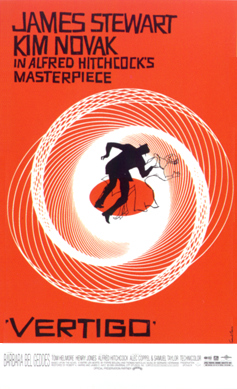
Long-time readers of this blog know that I have a thing about Vertigo. It is such a strange film: the plot isn't terribly complicated, but as the mysterious Madeline tells us regarding her mystery, "There is no way to explain it." That's probably true, and I should be happy with that. But while I can't fully explain Madeline (or Scottie, either, for that matter), I can at least take a stab at describing and speculating about four quick shots in Vertigo, widely separated in time that would never be missed if they weren't in the film but nevertheless ARE there and thus must matter in this otherwise carefully-shot film.

Below the fold you'll find some tedious speculation about, of all things, shots of cushions and pillows in Hitchcock's masterpiece.


For a long time, I have wondered about that moment in Scottie's apartment, after he has brought Madeline home from her swan dive into the bay, when he invites her to sit by the fire. He picks up a couple of pillows and drops them on the floor, and we actually have a shot of the pillows landing on the carpet. Why show that? What purpose does that serve? It just never made sense to me . . . until last week, when I was watching the film with one of my classes.

This time, my attention was drawn to the second big scene in the film, in Midge's apartment, where we get some lighthearted banter (and important exposition) between Midge and Scottie. At the climax of that scene, where Scottie tests his theory that he can overcome his vertigo by climbing a step-stool, the camera gives us a tight shot of his foot stepping on the cushions of the stool. "Ah-ha," I thought: stepping on the cushions will lead to an episode of Scottie's vertigo; inviting Madeline to sit on the pillows serves as a prelude to Scottie's ever-growing emotional vertigo where she is concerned. Cushions serve ironic functions in these scenes: they are meant to soften landings, but they signal coming landings that are anything but soft.

This casts a more meaningful light on a brief moment in Midge's apartment in the scene following Scottie's and Madeline's kiss along the shoreline. Midge has been painting a parody of Portrait of Carlotta, as we'll soon see; at any rate, when she hears Scottie approaching, she quickly hides her copy of the museum's guidebook . . . under a pillow on the top cushion of her step-stool. Madeline's apparent obsession with/possession by the ghost of Carlotta leads to Scottie's obsession with Madeline--and, as viewers know, Scottie's vertigo plays a crucial role in his pursuit of Madeline.

The final scene involving cushions and pillows takes place in Scottie's apartment again; this time, though, the visitor is Judy Barton, a young woman who bears a striking physical resemblance to the now-dead Madeline. Judy so wants Scottie to love her that she has just agreed to wear the same kinds of clothes Madeline used to wear and will even change her hair color to match Madeline's. Scottie invites her to sit by the fire with him, and he tosses a couple of pillows on the floor, just as he had done in the earlier scene with Madeline. In this scene, though, the camera doesn't show the pillows landing on the floor. That could be because, while that earlier scene was one that leads to Scottie becoming more and more enthralled by Madeline, in this scene the enthralling is complete--HE is possessed by the memory of Madeline and has just wooed Judy into playing that role for him.

Of course, these moments I've just described may just be coincidences, happy accidents; or, you're thinking, Hmm: a whole blog post on two seconds of film--now go get some sleep. Well, yes to both. But I think it's a measure of this film's attention to detail elsewhere that something like the shots of pillows and cushions have the potential to cause the viewer to ponder, to wonder.

Technorati tags:
, , ,

Read More...

Sunday, April 09, 2006

A meeting of minds that Steve Allen, alas, didn't live long enough to show us

Via Thesaurus Rex (and a friend of HIS) by way of Auntie Marianne at Tomato and Basil Sandwiches (this credit-where-credit-is-due stuff is real complicated sometimes), this imagined but entirely plausible conversation between P. Diddy and Björk as they plot musical domination. Or something.

Enjoy.


Technorati tags:
,

Read More...

A stretch of river XI: Not quite "MacArthur Park" . . .

. . . because, well, I don't live by MacArthur Park (much less in Los Angeles).

And it's not raining.

And the cake (rectangular, from a grocery store) is covered, even if it WERE raining.

And it's sitting on a bridge railing as though it's thinking about jumping, perhaps precisely because someone had left it there.

And I'm pretty sure I can take it, since I didn't bake it and thus never had its recipe, much less the opportunity to lose it.

And, seeing as it's from a grocery store, I'm pretty sure THEY still have the recipe. Whew! THAT's a load off my mind, let me tell you.

So, now that I think about it, that cake with the green icing that's sitting there on the bridge railing (and it's been there since before 6:30 this morning), seeing as its particular context bears almost no relation to that of the green cake in Jimmy Webb's song, isn't all that remarkable after all.

Sorry to have bothered you.

Read More...

Wednesday, April 05, 2006

In which the Meridian gazes at the piles of to-be-read papers on his desk

I have things to do for the next few days which are decidedly NOT blog-updating related. I look forward to returning "here" this weekend.

Read More...

Sunday, April 02, 2006

Cyber-backscratching

My good on-line friend Nancy of Sine.qua.non has asked me to help promote an online exhibition of artists and musicians whose work she has championed for some time now. She has also been a long-time friend of good old Blog Meridian, so I am only too happy to oblige.

In the next few days, I'll be posting some comments on these artists' works. In the meantime, you can find the ad over there in the right gutter, below the Amazon search box (What?? You mean you didn't know that was there??). Go and click and see and hear . . . and maybe buy something, too. Nancy and I thank you.

Read More...

Saturday, April 01, 2006

Sport and narrative (sort of)

As I write this, it's less than two hours before the tip-off between George Mason(!!) and Florida, the first of the two semi-final games (LSU vs. UCLA is the other game) that will determine which two teams will play Monday for the championship of this year's NCAA Men's Basketball Tournament. And I am perplexed about something.

From what I have read, CBS is worried that the ratings for these games will be lower than before because none of the teams is nationally prominent or was expected by many people to be in the Final Four. And while that's true, I am either too naïve or too dense to understand why such a thing would affect the ratings. Indeed, as Frank Deford argues here, the very myth of the tournament--that any team in it has a shot at winning it--is, with the presence of George Mason and not UConn, as close to coming true as has ever happened. It's like Hoosiers in real life--and in Indiana, too, no less. I figure, who wouldn't want to see this play out for real?

Mrs. Meridian doesn't, for one.


She and I talked about this this morning. Her take on the phenomenon that is George Mason is that the casual fan probably doesn't care so much. In real life, we attach our affections/animosities to teams. In narratives, though, what we care about isn't the fact that a team is an underdog but that the characters on that team show themselves to be worthy of winning and Big Bad State U. is revealed to be arrogant ne'er-do-wells.

I have to admit that I am a bit blind to this with regard to college basketball: though I have teams that I prefer over others, I'm ultimately a fan of the game itself. One clear way in which the game benefits is parity, and not just the tournament but this whole past season shows, I think, that parity is here: overall quality of play has improved, and scholarship rules changes a few years ago have distributed good players more evenly among schools. But when I think about the quality of my engagement with, say, golf, I am Mr. Casual Fan. No offense to anyone else on the PGA tour, but I want Tiger Woods to win. And I wish he'd drive more consistently so he'd win more, or at least not make the games too "interesting." I watch when he's playing and has a chance to win. Period.

Narratives, the ones that we remember and preserve, aren't about the norm but about deviations from it; yet in an odd paradox, even though we can pretty much write the scripts of those underdogs-triumph narratives, we flock to the multiplexes to see them anyway. And in the first weekend of the tournament, CBS trumpets those upsets. But Billy Packer's nationally-televised disquiet with, specifically, the inclusion of 4 Missouri Valley Conference teams and George Mason as an at-large selection (did its conference REALLY deserve to have 2 teams in the tourney??) should have been a clue to me that at least some still want to see, if not Big Bad State U., at least Same Old State U. Make that lots of Same Old State U's, and fewer Never Heard of 'Em Techs.

Perhaps the casual sports fan might not tune in to watch the (very real) possibility of George Mason's winning tonight because the actual contest is controlled by its own rules and is thus already existing in a state of unreality (or in a reality apart from our own). Within that space, we don't want to see intangibles determine the outcome; we expect to see "the better team" win, through skill or brawn or what have you . . . just as in our narratives, we want the underdog to triumph. Weird, that.

But: Go Pats!

Read More...

Friday, March 31, 2006

Velázquez, The Supper at Emmaus

As my regular readers have probably noticed, it's been a while since I've posted here. The chief reason for that is that I've had other things to do, like my job. But Thursday afternoon marks the de facto beginning of my weekend, so I have a bit of time to post.

This post, in fact, has to do with something that was said in class this morning. As an option for their research papers, students can write about some paintings of their choosing by a painter of my choosing: the idea (the hope, actually) is for them to choose paintings that have something in common and offer and support an opinion about what they think the painter wants to convey via this whatever-it-is that recurs in the paintings they've chosen. So today, I talked through how that might work by showing them three paintings by Velázquez (who, by the way, isn't on their list of painters). Two of them, Las Meninas and Venus at Her Mirror, I've posted images of before and so won't here, but the third one is this one, The Supper at Emmaus. They are very different, to my mind, in terms of style, but what they have in common, and what we as a class have spent time discussing, is the presence of mirrors in each. We spend some time speculating as to why Velázquez has them in these paintings, functioning, as they do, as something more than mere detail; we've also meditated a bit on what mirrors themselves do and so begin to get at the implications of words such as "reflection" and "image." Ultimately, though, the goal has been simply to model for them how to get started on this task of writing about the paintings they've chosen.

Anyway, in the course of discussing The Supper at Emmaus this morning, a student said something interesting that I found interesting about a possible theological reading of the painting. That, if you're interested, appears below the fold.


First of all, note that the event which gives the painting its title is depicted in the upper left-hand corner of the painting. Apparently, there's been some dispute among those who make a living at deciding such things over whether that scene is a painting hanging on the wall in the kitchen or is actually a mirror reflcting the activity in another room--the one we viewers would happen to be standing in; the consensus seems to be, now, that we're looking at a mirror.

Once I got all that out of the way, it suddenly occurred to me to ask something I'd not asked the other classes in which I've shown this painting: does it trivialize the event (Jesus' revealing Himself to his disciples after the Resurrection) to deliberately NOT make it the focal center of the painting? Compare, for example, to one of Caravaggio's treatments of the same theme. A student immediately said No. When I asked him why, he said that the serving woman provides an implicit message about Christ himself: specifically, his humility ("The Son of Man came not to be served but to serve"). Also, there's something in the serving woman's manner--her looking down, the overturned dishes--that suggests a sort of rushedness to attend to the men, and should that not also be our response when guests arrive? So, then, the painting is really more about our response to the event than it is the event itself.

Now: Velázquez didn't paint many religious subjects. in his salad days in Seville, he had to to make a living, but when he became a court painter, he didn't have to except when asked to (aside: but then again, just how many paintings of a Prince Baltasar does a family need? 5 appear in the catalogue of the Velázquez exhibit that I own, and no doubt there are more). Though he'd have to be, publicly, Catholic, there's no way to know the depth of his faith. If his library is any indication, his reading tastes definitively tended toward the secular rather than the sacred. But it IS true that he is very thoughtful about his subjects, that he's not into simple picture-making but is eager to communicate some larger idea through certain canvases. It's equally true that the Church of the Counter-Reformation sought art that would engage its viewers on a more emotional, less cerebral level.

I think this painting reflects both Velázquez' thoughtfulness and that desire of the Church for its art. Making the serving woman the focal point has the effect of creating a sort of 3-dimensionality (one could call it "realism" for lack of a better term) for the viewer: while the acount in Luke mentions no one other than the two disciples, surely a woman served them their meal. And so Velázquez depicts her. But there's more than "mere" realism here: our attention is on this woman. We watch her actions and, surely, wonder what she is thinking. She becomes our stand-in in this scene, even as the mirror on the back wall causes us to stand in the space of the painting.

Technorati tags:
, , , , ,

Read More...

Thursday, March 23, 2006

In which the Meridian offers up a joke for his 300th post

Courtesy of this NPR story about a festival celebrating Minimalist music:

A: Knock, knock.
B: Who's there?
A: Philip Glass--Knock, knock.
B: Who's there?
A: Philip Glass--Knock, knock.
B: Who's there?
A: Philip Glass . . .
(etc.)

Read More...

Art noir?: The Dark Corner

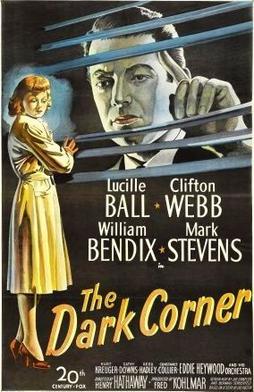
"The enjoyment of art remains the only ecstacy that is neither immoral nor illegal." Thus sayeth Hardy Cathcart (Clifton Webb), an aging, effete but dangerous gallery owner in The Dark Corner (1946), a solid example of film noir. My colleague Larry the movie guy (who else?) lent this to me after he told me that Lucille Ball(!) stars in it. Who wouldn't be curious to see her in a dramatic role? I frankly wasn't expecting much. But Ball is quite good in it, reminding me a little in her delivery of Lauren Bacall, though she's not as scorchingly sexy as Bacall. I also thought that Joseph MacDonald's cinematography, especially interior shots, was quite good: some of those scenes would have made Edward Hopper smile.

The film's plot is classic noir fare: private eye with a checkered past (Brad Galt, played by Mark Stevens) thinks he's being hassled by someone from that past (Jardine, played by Kurt Kreuger), when in fact Galt is the unwitting means to Cathcart's end of doing away with Jardine, Galt's lawyer. Jardine, it seems, is having an affair with Cathcart's very lovely, very young wife, Mari (Cathy Downs). Ball plays Kathleen, Galt's secretary, who loyally aids him in extracting himself from this mess and, of course, ends up falling for him.

The reason I'm posting about this film, though, is its fascinating use of art and its appreciation (not to mention the potentially corrupting influence of that appreciation) as a solid subtext for the plot. Or, as Galt puts it as he becomes aware that he's being set up, "I can be framed easier than Whistler's Mother."


It's ironic that Cathcart says what he says about art. In a crucial scene in the film, he invites some gallery guests down into a vault to show off a portrait he's recently acquired but has wanted to own for decades. It is on a wall behind some drapes, and when he reveals it, one of the guests notes that the woman in the portrait looks more than a little like Mari. He acknowledges that fact, saying that his meeting Mari had felt like destiny given his love of the portrait, and then draws the curtain again. As the guests leave the vault, Mari and Jardine stay behind to plot their leaving together the following night; they kiss, and Cathcart sees this via their shadows on the floor (the physics don't work, but never mind that). If you are thinking, "My Last Duchess", I can't blame you. As for this film's version of that story, let's just say screenwriters Jay Dratler and Bernard Schoenfeld engage in a bit of proto-feminist rewriting of Browning's poem. But that poem's theme--the story of a man who could not control in life what he sought to control in art--remains intact here. Cathcart is aging and hates reminders of that fact--he hates mornings, especially the dew on the grass, he says, because it makes the grass look like it's been left out all night. Art is static and, thus, timeless.

It is also the realm of the effete among us, the dried up, the used up, and the corrupt. Jardine accepts a Van Gogh painting from a woman in exchange for some incriminating letters in his possession; but, he tells her, he would have preferred cash. Or consider this: in the film's funniest moment, Galt feigns interest in a Donatello sculpture1 in Cathcart's gallery as a way of gaining entrance into his office, then says to the salesperson, "Wrap it up!" and asks if the base comes with it. Frankly, it's hard to determine whether the joke is on Galt or on a piece of sculpture being talked about as though it were a fish filet. And in the film's final scene, two beat cops are looking at the same Donatello and one says to the other, "Believe it or not, some people think that's art!" In that single line, not just the piece itself but a whole set of cultural and societal values and presumptions get dissed. What, after all, has the collecting, the buying and selling of this sort of art, to their mind, led to but unnatural desires, corrupted value systems, murder? Why, there's not a Rockwell in the bunch.

__________
1Donatello or not, it's truly awful. Most of the works in Cathcart's gallery, whether older or more contemporary, fall into that category. They are meant to resemble the styles of Painters You've Heard Of. Intriguingly, though, one painting clearly intended not merely to resemble a famous work but actually BE that work is Vermeer's Girl with a Pearl Earring.

Technorati tags:
, , ,

Read More...