Showing posts with label Mexico City. Show all posts

Tuesday, May 15, 2012

Carlos Fuentes, 1928-2012

Fuentes, standing in front of the Aztec Sun Calendar at the National Museum of Anthropology, Mexico City. Image found here.

Carlos Fuentes died today in his home town of Mexico City. He was 83. Here is a brief obituary in today's Los Angeles Times. His passing means that of that generation of Latin American writers of the "Boom" years of the '60s and '70s, only Colombia's Gabriel García Márquez and Peru's Mario Vargas Llosa are still alive.

Fuentes' work was very important to me early on in my intellectual life, such as it has been, and in my understanding of Mexico's history and how that history has shaped its people. Long ago, I posted a little something about his novel The Death of Artemio Cruz, how back in college it served as my introduction to both Mexico City before my first trip there and, later, via my preparing some notes for students who had been assigned it, something like the work that professors do before teaching something. A few years later, I found myself in Mexico City in a bookstore, staring at brand-spanking new copies of his novel Cristóbal Nonato (translated as Christopher Unborn and bought it without even looking inside the covers. I'd just finished reading García Márquez's Love in the Time of Cholera in Spanish; how hard could this one be? Well: If I'd known that novel was his own Mexican amalgamation of Tristram Shandy and Finnegans Wake . . . Still, struggling through that novel, my three dictionaries often stymied by its slang and invented Spanish, remains one of my favorite reading experiences.

It's safe to say that only Octavio Paz rivaled Fuentes' status as the preeminent man of letters of 20th-century Mexico. More than a novelist, Fuentes was also an accomplished essayist, and even served his country as a diplomat. Like Paz, his subject was Mexico, almost always; he once told me after a reading (in response to my asking about Faulkner's influence on his work), and has also mentioned elsewhere, that Balzac's attempt to document all of French society via his novels was a major source of inspiration for him (Fuentes). But whereas Paz returned in his work, again and again, to Mexico's indigenous civilizations and the Encounter with Spain in his efforts to understand the Mexican psyche, Fuentes looked more to Europe--it was, after all, Europeans who came up with that brilliant, ambiguous term "New World"**--and to Mexico's vexed history (political, economic, cultural) with the United States, and found political inspiration in both the New Deal and (like most every Latin American intellectual, at least for a while, in the Cuban Revolution. Compared to writers like Bolaño, and given Mexico's and Latin America's contemporary promise and problems, Fuentes' (and Paz's) humanist-laden late modernism/post-modernism (despite the tumult of events, he keeps returning to the Americas' intellectual foundations) can seem a bit quaint at times. But don't assume quaintness is tantamount to irrelevancy. One could do worse, still, than prepare for a trip to Mexico City by reading Artemio Cruz along with your Fodors.

_________________

**(Wednesday, May 16) Fuentes says somewhere (I couldn't find it last night) that the New World "was doomed to Utopia by the Old World"--that is, he argues, the New World, because it had in a sense always already existed in the imagination of Europeans (whose writing is filled with various Never-Never Lands), has never had a chance to imagine itself . . . until, he argues, García Márquez's One Hundred Years of Solitude begins that process.

I was lucky enough to hear and briefly talk to Fuentes three times back in the '80s and '90s. The first time was in San Antonio in '83 or '84, while I was still in college; Trinity University had hosted a public reading the night before (which I attended; he read "Borges in Action," which I mentioned here a while back), and the next day was a Q&A intended for Trinity folks but which I snuck into anyway. That was the time I asked him about Faulkner's influence on his work (Artemio Cruz seems, in some ways, a latter-day Thomas Sutpen); he said that while Balzac was more important to him personally, Faulkner was important for all Latin American writers, and he signed my copy of Artemio Cruz with "To the ghost of William Faulkner." The second time was again in San Antonio when I was working on my master's. I forget the exact occasion for his being there, but he read the opening chapter of Christopher Unborn. At the book-signing afterward, I told him that I'd read Christopher Unborn in Spanish, and he looked at me with a sort of sad, pitying, "you foolish little man" look (about which he was absolutely right). The third time was at Rice, which I conveniently happened to be attending at the time. This time, he was giving a lecture on U.S.-Latin American relations. At the Q&A afterward, I told him that this was my third time to have heard him speak; without hesitation, he said, "Yes--I remember you."

Read More...

Tuesday, December 27, 2011

Pictures from Mexico City: La Merced, Monuments, and Maps

(Earlier post here. Belated best wishes to all during this season of wonder and hope.)

A stack of banana leaves at a vendor's stall at La Merced, Mexico City. Banana leaves are used as wrappers for steaming/holding together food, especially in the southern regions of Mexico. In person, these were various beautiful shades of dark green, but that quality didn't show up so well in the color picture; so the Mrs. switched the image to black and white and revealed these marvelous textures. Click on this and the following images to enlarge them. This and all images by the Mrs.

In yesterday's post, I said that our primary goals for our trip were "1) Visit the Basilica on the 12th; 2) Be a little more selective about where we ate some of our meals; 3) Relax." Yesterday's post was primarily about the Basilica, so here we'll sort of cover 2) and 3).

For me, at least, the two blur together more than I'd like. Thanks to some intrepid researching by the Mrs. we ate some very good food indeed, at prices that didn't exactly break the bank. In a couple of instances, though, these places were in parts of the city that were either brand-new to me or that I had not visited in many, many years (brief example here: all I remembered about my mid-'80s visit to the National University to see its famous mosaics was that I'd gotten off at the University's Metro stop and climbed a hill . . . I had forgotten the part about walking about a mile--important because by that day on this most recent trip, the Mrs. had developed blisters), and it so happened that I was without my trusty flip-map of the city. (It is in some box, somewhere, that I know it made sense to put it in at the time as we were packing for the move, but I couldn't find it the day before our departure.) The Mrs., however, had her equally-trusty smartphone with GoogleMaps and GPS, and more than a few times that did indeed come in very handy. One morning, when in search of a restaurant that, the reviews assured us, "everyone" knew (advice to Comp students: Beware of those absolutes!), we were able to use these marvels to help out our taxi driver when he got a little turned around in the neighborhood where the restaurant is.

But I still found myself missing my map's fixed scale and, for that matter, its much larger "screen." We'd look on the Mrs.' smartphone's screen at the little dots showing where we were and where we wanted to go (sometimes having to decrease the image to make both dots appear on the screen) and she'd ask me, "How far is that from here?" and I'd have to say, "I'm not really sure." Only the very oldest part of the city (the Spanish-built, mid-16th-century part) is laid out on anything resembling a standard grid, so it's pretty easy to estimate distances there; the rest is a crazy-quilt of self-contained colonias, each with its own autonomous determination of the shape and dimensions of a city block. Lots of fun if one is wandering through on foot--the way to really get a sense of this city, huge as it is, is to a good bit of walking in it; but it's not so much fun if one is looking for a specific place and one's feet really, really hurt.

Anyway. This isn't a criticism of GPS, by any means (I've done a bit of that elsewhere in other contexts, if you really don't have anything better to do this holiday season), but just an acknowledgement that having a traditional map would have been very nice, but it was in large measure thanks to GPS and the Mrs.' aforementioned research that we had some truly wonderful meals.

In lieu of pictures of said meals, how about some images of some of the ingredients for those meals from La Merced? First some general words about this place: It is a mercado, but it's no tranquil, adobe-walled place with humble serape-wearing folk with their wares (often made or grown by the sellers themselves) spread out on blankets. Imagine a space that's, oh, the size of at least three Super Wal-Marts, filled with, maybe, three times the amount of displayed merchandise of those Wal-Marts, the shouts of venders hawking their wares, the polite pushing (if that's not an oxymoron) of shoppers, and a fair amount of visual chaos: no signage; just merchandise stacked way north of 10' feet high and the sudden awareness that, "Oh--this must be the shoe section, and that over there [one peers down a very long aisle and sees lots of gleaming cylindrical aluminum and stainless-steel things] looks like the cookware section. Maybe foodstuffs are next to that?" One should not go to this place when on a schedule or when looking for something in particular, both of which rules we violated: We went on our last day in the city (we had several hours before our flight left that afternoon, but I was more than a little concerned that we'd have trouble finding our way back to the entrance to the Metro station), and we were in search of vanilla for friends and family back home. (I could write a whole blog post on our quest for vanilla, but I'll spare you. It was just yet another reminder that I need to stop asking the rhetorical question, "How hard can this be?") But we promised ourselves that the next time we visit, we'll go there when we can just wander.

Dried chiles. This was by no means the only, or largest, display of chiles; its corner location lent itself well to photographing it, though. Incidentally, the Mrs. herself asked for permission to take pictures; no one refused us--indeed, the sellers were most gracious and even seemed pleased to be asked.


Heads of garlic. To get a sense of just how big these were, the heads to the right are regular-sized heads. These made our "elephant head" garlic look positively scrawny by comparison.


Huitlacoche. This is a corn fungus named by the Aztecs (it translates literally as "ravens' excrement"); it's used as a filling in tamales and quesadillas, and in soups. We didn't try anything with huitlacoche, alas, which I now am regretting; it has a mushroom-like, smoky taste, which sounds pretty good to me. Here is more information and some recipes, for the curious.


Mushrooms. We don't know what variety these are (they weren't labeled); we just very much liked their shape and very subtle gradations of color.


Flores de calabaza--squash blossoms. As with the huitlacoche, we didn't try anything with this as an ingredient; like huitlacoche, these flowers are used in soups and as an ingredient in variations on traditional dishes such as tamales and quesadillas.


Okay: enough food. Now, below the fold, some monuments.


El Ángel a la Independencia, or simply "El Ángel." Dedicated in 1910 to commemorate the centennial of Mexico's independence from Spain, this is one of the capital's most iconic monuments and, for American visitors, a potentially-crucial landmark--the U.S. embassy is just a couple hundred yards away.


El Monumento a la Revolución. This was two blocks from our hotel; we passed by it daily because it was on the way to the Metro station we always used. Last year was the bicentennial of Mexican independence and the centennial of the Revolution; in honor of the latter, this Monument has undergone a modest transformation: there's a small but very nice museum below it, and now there's a glass-enclosed elevator that takes you up into the dome itself, where there's access to an outer observation deck.


The elevator shaft that leads up to the dome of the Monumento.


The inner dome of the Monumento.


An inner stairwell leading out to the Monumento's observation deck.


Looking southwest from the Monumento's observation deck--for those familiar with the city, those tall buildings are about a mile from the Monumento and stand where Paseo de la Reforma enters Chapultepec Park. It was smoggy that day, and for most of our stay; as I noted in the earlier post, though, back in the '80s this would have been considered a pretty clear day.


Statute of Fidel Velásquez Sánchez (1900-1997), the founder of the Confederación de Trabajadores de México, or CTM, the largest and most powerful of Mexico's labor unions, located at one corner of the CTM's headquarters. His Wikipedia entry gives its usual dispassionate account; the short-and-polite-version is that, for decades and decades in the last century, Velásquez Sánchez had as much a hand in shaping 20th-century Mexican politics in concert with the PRI, Mexico's long-time ruling party, as any other figure--presidents included. He's here because the CTM's headquarters looks onto the plaza where the Monumento stands. The statue itself doesn't quite look onto the plaza, but it's close enough to doing so that a couple of times as we walked by him I thought about my post on "dialogic statuary" from a while back and thought on the appropriateness of its placement: both literally and figuratively, he was a child of the Revolution; and throughout his long life, for better and for worse, his actions helped shape the Revolution's meaning through the PRI's politics and policies.


If you've read this far, thanks.

Read More...

Friday, December 23, 2011

Pictures from Mexico City: The Basilica, and the Centro Histórico

A market stall for a vendor of Christmas lights in La Merced, Mexico City's enormous downtown market for foodstuffs and household items. Yes, those are the real colors. Yes, they were all flashing in various ways. Yes, the display was potentially seizure-inducing. And yes, it's things like this that make me so fond of this basket-case of a city. Click on this and the following images to enlarge. All pictures taken by the Mrs.

For some time now, I've wanted to re-visit Mexico City on December 12th, which (as long-time readers of this blog have often been reminded) is the feast day of the Virgin of Guadalupe, Mexico's patron saint and an iconic figure throughout the Americas. More often than not, though, logistics (here understood as the confluence of money and a 12th free of contractual obligations--exams and submitting final grades) made that trip improbable, if not impossible. This year, though, was to be different: Back in September, the Mrs. had a case of that weird sort of homesickness one can feel for a place that one has only visited once before; I had a look at the calendar and saw that I'd be giving my last exam on a Thursday and the 12th would fall on the following Monday; and after a quick perusal of flights via Expedia (and seeing that DFW-to-Mexico City flights on the 11th were already almost full) and telling myself that I'd have to be disciplined about grading if I didn't want to end up reading research papers on the flight down, I booked a five-day round trip and a stay at the same hotel (small rooms, but centrally-located, clean and cheap) that we'd stayed in three years before. Cut to Finals Week: I got my last grades turned in early Saturday morning; we packed; the Mrs. armed herself with a couple of good camera lenses that she rented; and very, very early on Sunday the 11th we drove to Dallas to catch our flight.

We had three main goals on this trip: 1) Visit the Basilica on the 12th; 2) Be a little more selective about where we ate some of our meals; 3) Relax. The first went well, though, due to what I assume were crowd-control measures (the Metro station closest to the Basilica was closed that day), we had to walk from what used to be the station closest to the Basilica--not all that far, but I got us a little turned around both in the station and out on the street. Also, due to the earthquake that had occurred on Saturday the 10th (no damage in the city, but power was knocked out in places), the number of pilgrims was much reduced. As you'll see below, though, there was still plenty to see.

Pilgrims entering the main gate that gives onto the plaza in front of the Basilica. In the background you can see La Avenida de Guadalupe, which, for blocks and blocks and blocks, is a solid mass of people either heading toward the shrine, leaving it, or wanting to sell just about anything you can imagine to either of the other groups.


A good shot of the interior of the Basilica, taken from just inside one of the entrances. To get a sense of the scale of this space, click to enlarge the image, then look just to your right and below the red of the Mexican flag; there you'll see a priest standing at a small lectern, delivering the homily while we were there. The only Catholic worship space that can hold more people is St. Peter's in Rome.


The image of the Virgin of Guadalupe, taken from behind and below the altar in the Basilica. (The flag is not usually there, but the 12th is a national holiday in officially-atheistic Mexico.) In this space, there is a moving walkway that allows visitors to see and take pictures of the image without disturbing Mass (too much).


A pilgrim honoring a promise to the Virgin that if she honored his petition to her, he would walk on his knees to her shrine.


A group of pilgrims from the state of México (the state immediately to the north of the Distrito Federal, Mexico City's location) gathered in front of the original Basilica.


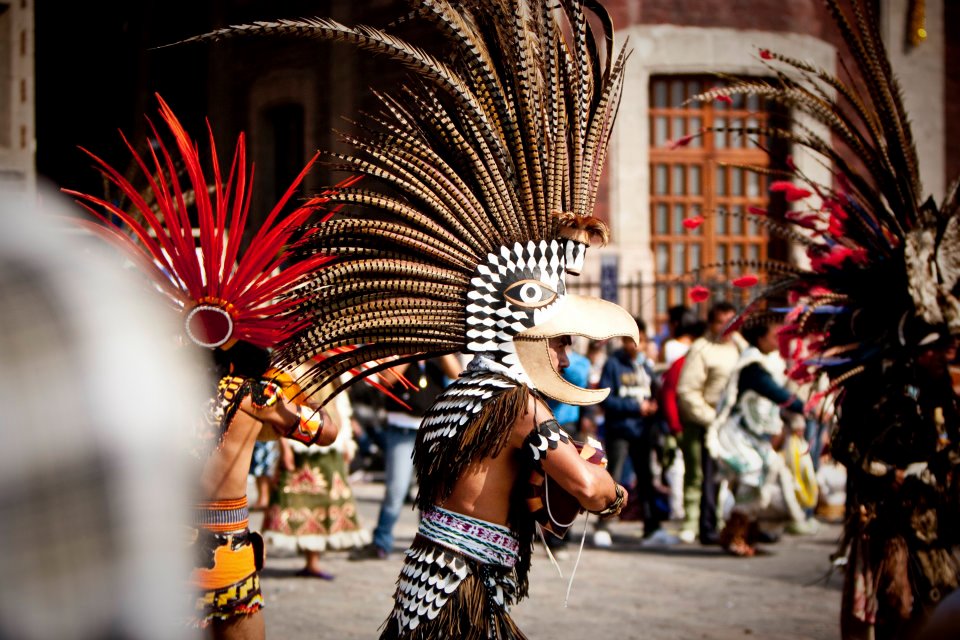
In the picture above, you can see that many of the pilgrims are dressed in elaborate Indian costumes. Ever since the beginnings of the honoring of the Virgin (this year, incidentally, is the 480th anniversary of her appearances to Juan Diego in 1531), indigenous ritual has been a prominent feature. Juan Diego was himself a devout Indian convert to Christianity, and the Virgin appeared to him as a mestiza; moreover, there's been a long-running debate over the extent to which (if, indeed, at all) the cult of the Virgin has appropriated rituals pertaining to Aztec deities. So, in and of itself, the presence of penitents dressed as Indians was not at all unusual; indeed, on my first visit to the Basilica on the feast day, I saw a fair number of them, but they were dressed very simply, as I recall. On this visit, though, I was struck by both the sheer number of these people and the elaborateness of their costumes. The pictures below are just a small sampling from the dozens the Mrs. took that day:


What follows here is some really superficial and underinformed speculation. I think that for a variety of reasons, indigenous issues (always a presence in Mexico, especially in the central and southern regions of the country) are particularly visible nowadays. Here in the States, we're familiar with the all-out war amongst the drug cartels and the Mexican government against them; less well known, though, is that the Zapatista Movement is still organizing indigenous peoples in various forms of resistance to the government and that paramilitary groups, with the tacit approval of the government, are capturing, beating and killing prominent indigenous community members. One such killing, according to a handbill given to us one night, had occurred earlier this month in the state of México--andthis cross, one of dozens set up in the Alameda in the heart of the city and likewise protesting recent atrocities in the state of México, was another, sobering reminder that for many, many people in Mexico, these are dark times. Given all this, then, it's hard to imagine a safer--and more appropriate--place for quiet affirmation of indigenous peoples than the Basilica, at least for the days surrounding the feast day. The Virgin appeared to an Indian, and as a mestiza at that; Miguel Hidalgo used a banner with the Virgin's image as his flag when he led his armies against the Spanish. She may yet again become--or perhaps already is becoming--a uniting symbol for Mexicans confronting these dark times.

More pictures from elsewhere below the fold.


What follows are cheerier pictures and reflections on what we saw.

Francisco I. Madero Street at dusk. Once a busy one-way street running from the Zócalo (the city's enormous main plaza) to the Alameda (a large park-like space half a mile away), it's now a pedestrian mall.


One could make the argument that no city should have 20 million people, but Mexico City's location makes it especially ill-suited for its size. Sitting well inland in its bowl-shaped valley over 6,000 feet high, rarely visited by prevailing winds of any real strength, whatever comes out of its smokestacks basically just sits there over the city. Back in the '80s, its air pollution was so bad that the U.S. considered its embassy there a hazardous-duty post; on my visits there while living in Durango back in those days, I certainly saw plenty of evidence to justify that designation. But things have slowly changed for the better since that time. There was still some smog, but nothing like the old days. Those older, dirtier-burning cars and trucks have left the roads. The city has greatly expanded its subway system and is also adding above-ground light rail systems that extend beyond the terminuses of the subway lines into outlying areas. It's in the process of building a bus system that runs in dedicated bus lanes along major arteries--thus, these buses won't be as susceptible to the city's traffic snarls as regular buses are. Just in the time since the Mrs. and I were last there, dedicated bike lanes have been installed, along with stands that rent bicycles that we saw lots of people using. And, as in the picture above, some streets have been converted into pedestrian malls.


Scenes from the Zócalo, which is decorated for Christmas and filled with people and activities (ice-skating rinks, a small fairground, dancers and singers) for the holidays.


El Palacio de Bellas Artes (The Palace of Fine Arts), which sits at the east end of the Alameda.


If there's one regret I had about this trip, it's that we didn't stay quite long enough to see the Alameda really geared up for Christmas. During the last two weeks of December, people set up elaborate Christmas-themed stands complete with their own Santa Clauses for kids to climb on and have their picture taken, and the park fills with food vendors selling Christmas tamales as well as more traditional street food. It's a joyous chaos of lights and smells and sounds, especially at night. But all in all, I think we did all right on this trip.

More pictures to come, these of some monuments and La Merced.

Read More...

Monday, February 02, 2009

More pictures from Mexico City

West side of the Zócalo, looking south. Larger image here.

After a hiatus, the Mrs. has recently been selecting pictures she took during our trip back in October and Photoshopping some of them into images more pleasing to the eye than what her cantankerous camera originally captured. In case you missed the earlier picture posts, here is the first one, and here is the second.

An atrium at the National Palace. Larger image here. The Mrs. has enhanced the pinks a bit in this picture, but yes: the walls were indeed a bright pink.

One of several enormous agaves at the National Palace's botanical gardens. Larger image here. To give you a sense of their size, the center of this plant is well over 15 feet from where the Mrs. stood to take this picture.

Part of a yet-to-be completed mural at the artesians' market at La Ciudadela. Larger image here. That's Frida Kahlo on the right. This market takes up an entire city block; the mural has a ways to go yet before it covers even half this wall's length. La Ciudadela ("Fortress"), by the way, is a neighborhood that takes its name from a structure that was once a large military installation.

More pictures below the fold.

A sculpture of John Paul II outside the Basilica of the Virgin of Guadalupe. Larger image here. John Paul visited the basilica twice as Pope, a measure of the Virgin's significance for the Church in Latin America.

El Lago, Chapultepec Park. Larger image here. Bosque de Chapultepec (Chapultepec Forest) is the largest urban park in Latin America. In addition to this large lake (those are paddle boats in the foreground) and Maximillian's palace, the park also has a large zoo, and two art museums and the enormous Museum of Anthropology are just across Reforma Avenue from the park. "Forest," by the way, is no misnomer: the shade from the tens of thousands of trees is dense and lush. A busy weekend at the park might consist of as many as a million people.

A woman catches a taxi. Larger image here. Few people (relatively speaking, of course, considering we're speaking of a city of 20 million or so people) own cars in Mexico City, but cheap public transit options and ubiquitous taxis make it easy for city-dwellers to get around. Besides, it's no exaggeration to say that people who live in the urban core are never more than a couple of blocks away from one or two small grocery stores, pharmacies, clothing stores, and other shops that easily meet most daily needs.

A closed shop, late night. Larger image here. The glowing quality of the doors is what makes this shot work.

Two pictures now from Cuernavaca:

"Cuernavaca Powerlines." Larger image here. This is by no means the most extreme example of wires running from a utility pole to be found in Cuernavaca, but this one was far enough away from buildings that it made for a nice silhouetted image.

A hotel entrance. Larger image here. The Mrs. had some fun with the colors here, but the picture's essence--the casual off-the-street entrance and that inviting green passage in the background that leads to the hotel proper--remains and entices yet. As does Mexico, still, for the Mrs. and me.

Read More...

Thursday, November 06, 2008

A brief adventure in New World iconography

Frieze depicting the Virgin of Guadalupe's appearance to Juan Diego, on the east side of the old basilica dedicated to the Virgin of Guadalupe, Mexico City. 1531-1709. Image taken by the Mrs. Click to enlarge.

What to do with stuff that turns up during sabbatical-related research that in all likelihood won't show up in the book project but which may yet be of interest to, oh, a dozen or so people besides myself?

What to do . . . what to do . . . ?

As regulars here know, I recently posted a discussion of a couple of paintings depicting the Virgin that I saw on my recent trip to Mexico City. I'll have more to say later regarding this façade within that context, but what I wanted to post on here is the depiction of Juan Diego. On the day we took the picture, I was more interested in the European-style hat on the ground directly below his kneeling figure and the maguey plant in the lower-right corner. (Pulque, a fermented drink made from the juice of the maguey, was drunk by the Indians on her feast day, December 12.) But as the Mrs. and I played around with cropping the image she had taken and we enlarged it, I really noticed for the first time the small animal to the left of the maguey plant.

We thought (at first) that it was a squirrel. However, in the course of Googling about for associations (if any) among squirrels and Christian and Aztec iconography and what any of that might possibly have to do with Juan Diego and/or the Virgin, I happened to run across this passage, from the Aberdeen Bestiary:

Of the beaver There is an animal called the beaver, which is extremely gentle; its testicles are are highly suitable for medicine. Physiologus says of it that, when it knows that a hunter is pursuing it, it bites off its testicles and throws them in the hunter's face and, taking flight, escapes. But if, once again, another hunter is in pursuit, the beaver rears up and displays its sexual organs. When the hunter sees that it lacks testicles, he leaves it alone. Thus every man who heeds God's commandment and wishes to live chastely should cut off all his vices and shameless acts, and cast them from him into the face of the devil. Then the devil, seeing that the man has nothing belonging to him, retires in disorder. That man, however, lives in God and is not taken by the devil, who says: 'I will pursue, I will overtake them...'(Exodus, 15:9) The name castor comes from castrando, 'castrate'. (Emphasis added; image found here)
The clear association here between beavers and living a chaste life reminded me that it is said of Juan Diego that he and his wife--both early converts to Christianity--after hearing a sermon on chastity, dedicated themselves to live chaste lives. Some say that this is the reason the Virgin chose to appear to him. At any rate, I went back to the image of the frieze and enlarged it some more; sure enough, the animal has a flat tail, rather than a bushy one. And now, I would love to know what that plant is that it is eating.

The beaver's appearance here in a depiction of a scene that it ostensibly has nothing to do with is at one level, that of iconography, perfectly understandable. Most of us are familiar with Renaissance-era depictions of animals or objects along with saints (think of Peter often shown with a set of keys, in reference to Matthew 16:19). What's intriguing here is the application of this principle to a depiction of Juan Diego. It speaks to the apparent need to assert or remind the visitor of his virtue and, thus, of his worthiness to receive a visitation from the Virgin. It causes me to wonder if certain visitors were considered to need this reminder more than others did (even in the decades immediately following the apparitions, elements within the Church questioned the veracity of the story). And as for what indigenous people made of the beaver . . . As of this writing, I have not been able to find what if any significance beavers held for the Aztecs, but somehow I doubt that chastity figures into their thinking.

In short, in this frieze is a not-yet-seamless fusing of iconic languages, as embodied by the beaver and the maguey plant, from two different religious traditions. In the associating of European images--the hat and the beaver--with the Indian Juan Diego, we see hesitancy in depicting some more overt sign of his Indianness to the viewer due to those signs' inevitable associations with the very religions that the Church sought to supplant. Besides, in the Church's eye, the fact of Juan Diego's Christianity would trump all other identities he might claim. Meanwhile, the maguey, a plant firmly linked to life before the arrival of the Spaniards, is a sturdy, literally rooted presence here. It's a strange visual space, this frieze. But then again, the New World is a strange place.

Read More...

Saturday, October 25, 2008

Pictures from Mexico City: Second batch

(First batch here.)

Actually, these come from Teotihuacan, the thousand-year-old, 83-sq.-km. archeological site about a half-hour to the northeast of the city. In this pic, you see Yours Truly half-way down a short but still vertigo-inducing incline at the temple dedicated to Quetzalcoatl, one of the smaller pyramids there. Click on the images to enlarge them.

I ask you: what is it with Meso-Americans and their love of pyramid stairs pitched at 60-degree inclines, with high risers and narrow treads?

Below the fold: a close-up of some steps showing their construction, and a shot of this same construction method as used for a wall.

Note the smaller rocks embedded in the mortar holding the larger stones in place.

Read More...

Friday, October 24, 2008

Pictures from Mexico City: First batch

As promised, here are some initial pictures of places we went, courtesy of the Mrs. She's played around with the color on some of these, you'll note; also, some of these are dark because, about half the time we were there, the day was exceedingly overcast and, at times, drizzly.

Click the images to enlarge them.

Monument to the Revolution of 1910. This Art Deco structure is a block away from the hotel where we stayed. It has a hulking rather than triumphant feel to it, but that's just me. Anyway, it is a rather odd coincidence that Mexico's war for independence from Spain and its proto-Socialist revolution occurred 100 years apart from each other; thus, in 2010 it will be celebrating both a bicentennial and a centennial. This structure and its grounds take up a city block but because it is near but not on a major street, its space lends itself well to large-ish gatherings of people; just in the five days we were there, it was the location for three such gatherings: a rally for breast cancer awareness, a gathering of striking teachers, and a government-sponsored function of some sort that was being set up during our last night there.

Atrium, National Palace. The National Palace, located on the Zócalo (the city's enormous main plaza), houses Mexico's legislative bodies and so is the equivalent of our U.S. Capitol. This structure has an exceedingly complex history, but it suffices to say by way of summary that some sort of structure housing a ruler or ruling body has stood on its site since at least the time of Montezuma, if not before--in fact, much of its building material was originally part of Montezuma's own palace. This atrium is noteworthy because, along two of its second-story sides are some extraordinary murals depicting Mexican history painted by Diego Rivera (some panels are here (you'll need to scroll down a bit to find them)). Beyond this atrium is another atrium which contains a botanical garden with examples of plants from throughout Mexico--from the deserts to the tropics. The Mrs. took some pictures of some of its extraordinary cacti; I hope they turned out.

Two more pictures below the fold.

Carlota's View. This view is from the balcony of the Castillo de Chapultepec, looking to the northeast, up the Paseo de la Reforma. Despite the gloomy light, the air was exceedingly clear that day: it was possible to see, about three miles distant, the corner of the Alameda that Reforma grazes before continuing on. This is a big deal; on a couple of past trips there, the smog was so bad that it was hard to see the Monument to Independence, a gleaming golden angel atop a 200-ft.-high column on Reforma just a mile away from Chapultepec.

In a city full of spots that in their essence serve as microcosms of the nation's history in miniature, Chapultepec is one of the most prominent ones. During the Aztecs' rule, they built an aqueduct to bring spring water from the hill to Tenochtitlan (though built on an island in a lake, the water was shallow and brackish). After Mexico's war for independence, a military academy was built on its summit; it was this structure that U.S. Marines sought to capture ("From the halls of Montezuma . . . ") in the final, decisive battle in the U.S.-Mexican War--and it was on that occasion that this place became a national shrine honoring the sacrifice of the Niños Héroes (whom I've mentioned recently). The six columns in the foreground comprise a monument to them, at the base of which is a tomb containing their remains. As a teaser to a future post: René told us something very intriguing about their story which I hadn't known before. For us in the U.S., the Castillo is perhaps best known as the residence of Maximilian and his wife Carlota during their rather quixotic 2-year reign as king and queen of Mexico. The story is that Carlota had Reforma constructed so that she could watch her husband return from the National Palace each afternoon (hence the title of this picture: Carlota's bedroom opens on to the balcony where the Mrs. stood to take this picture). Maximilian's odd, naïve arrogance is well-known: Mexico was its usual mid-19th-century basket-case of warring factions, thanks to the ubiquitous, insufferable Santa Anna, but in no way wanted a king; Napoleon III, though, believed it not only wanted but needed one, and Maximilian was foolish enough to believe it. Carlota, though, did her best to educate herself on the history and popular culture of Mexico--to her credit and, I learned on this trip, the annoyance of the society women she sought this information from. The story is that she went mad. At any rate, after their execution in 1867, the Castillo later became the official residence of Mexico's presidents until 1939, when Lázaro Cárdenas, unquestionably Mexico's most-revered President, declared it a National Museum of History.

Tlatelolco. This site is officially known as the Plaza de las Tres Culturas ("Plaza of the Three Cultures"), and this picture reveals why: in the foreground you see the remains of the pyramids and other structures that comprised Tlatelolco, which served as the Aztecs' central market prior to the Spaniards' arrival; in the middle ground are, from the left, the sanctuary and convent of Santiago Tlatelolco, built in the years immediately after the defeat of the Aztecs; and in the background (and surrounding the entire site) are government buildings and housing projects representative of the third culture, the Mexican. Considerably less-officially (though our guide that day is my source for this--as many times as I'd visited this place, I'd not head it before), this place is also known as the Plaza de los Tres Desastres ("Plaza of the Three Disasters"): It was here that the final battle for control of Tenocbtitlan was fought in 1521; on this same site occurred in 1968 the Tlatelolco Massacre, an event that still resonates in the Mexican psyche by a couple of orders of magnitude greater than the way the Kennedy assassination used to for us in this country; and in the massive earthquake of 1985, several large buildings in the area were destroyed, killing many of their occupants. I'll be honest: even knowing all this as I do, I can't imagine what visiting this place must be like for a Mexican given to prolonged thinking about his/her nation and its history. I'll have more to say about that as well in the above-mentioned future post.

In many more ways than the obvious, Mexico City is far away from, say, Cozumel.

More pictures and commentary to come.

Read More...