Showing posts with label Latin American literature. Show all posts

Tuesday, May 15, 2012

Carlos Fuentes, 1928-2012

Fuentes, standing in front of the Aztec Sun Calendar at the National Museum of Anthropology, Mexico City. Image found here.

Carlos Fuentes died today in his home town of Mexico City. He was 83. Here is a brief obituary in today's Los Angeles Times. His passing means that of that generation of Latin American writers of the "Boom" years of the '60s and '70s, only Colombia's Gabriel García Márquez and Peru's Mario Vargas Llosa are still alive.

Fuentes' work was very important to me early on in my intellectual life, such as it has been, and in my understanding of Mexico's history and how that history has shaped its people. Long ago, I posted a little something about his novel The Death of Artemio Cruz, how back in college it served as my introduction to both Mexico City before my first trip there and, later, via my preparing some notes for students who had been assigned it, something like the work that professors do before teaching something. A few years later, I found myself in Mexico City in a bookstore, staring at brand-spanking new copies of his novel Cristóbal Nonato (translated as Christopher Unborn and bought it without even looking inside the covers. I'd just finished reading García Márquez's Love in the Time of Cholera in Spanish; how hard could this one be? Well: If I'd known that novel was his own Mexican amalgamation of Tristram Shandy and Finnegans Wake . . . Still, struggling through that novel, my three dictionaries often stymied by its slang and invented Spanish, remains one of my favorite reading experiences.

It's safe to say that only Octavio Paz rivaled Fuentes' status as the preeminent man of letters of 20th-century Mexico. More than a novelist, Fuentes was also an accomplished essayist, and even served his country as a diplomat. Like Paz, his subject was Mexico, almost always; he once told me after a reading (in response to my asking about Faulkner's influence on his work), and has also mentioned elsewhere, that Balzac's attempt to document all of French society via his novels was a major source of inspiration for him (Fuentes). But whereas Paz returned in his work, again and again, to Mexico's indigenous civilizations and the Encounter with Spain in his efforts to understand the Mexican psyche, Fuentes looked more to Europe--it was, after all, Europeans who came up with that brilliant, ambiguous term "New World"**--and to Mexico's vexed history (political, economic, cultural) with the United States, and found political inspiration in both the New Deal and (like most every Latin American intellectual, at least for a while, in the Cuban Revolution. Compared to writers like Bolaño, and given Mexico's and Latin America's contemporary promise and problems, Fuentes' (and Paz's) humanist-laden late modernism/post-modernism (despite the tumult of events, he keeps returning to the Americas' intellectual foundations) can seem a bit quaint at times. But don't assume quaintness is tantamount to irrelevancy. One could do worse, still, than prepare for a trip to Mexico City by reading Artemio Cruz along with your Fodors.

_________________

**(Wednesday, May 16) Fuentes says somewhere (I couldn't find it last night) that the New World "was doomed to Utopia by the Old World"--that is, he argues, the New World, because it had in a sense always already existed in the imagination of Europeans (whose writing is filled with various Never-Never Lands), has never had a chance to imagine itself . . . until, he argues, García Márquez's One Hundred Years of Solitude begins that process.

I was lucky enough to hear and briefly talk to Fuentes three times back in the '80s and '90s. The first time was in San Antonio in '83 or '84, while I was still in college; Trinity University had hosted a public reading the night before (which I attended; he read "Borges in Action," which I mentioned here a while back), and the next day was a Q&A intended for Trinity folks but which I snuck into anyway. That was the time I asked him about Faulkner's influence on his work (Artemio Cruz seems, in some ways, a latter-day Thomas Sutpen); he said that while Balzac was more important to him personally, Faulkner was important for all Latin American writers, and he signed my copy of Artemio Cruz with "To the ghost of William Faulkner." The second time was again in San Antonio when I was working on my master's. I forget the exact occasion for his being there, but he read the opening chapter of Christopher Unborn. At the book-signing afterward, I told him that I'd read Christopher Unborn in Spanish, and he looked at me with a sort of sad, pitying, "you foolish little man" look (about which he was absolutely right). The third time was at Rice, which I conveniently happened to be attending at the time. This time, he was giving a lecture on U.S.-Latin American relations. At the Q&A afterward, I told him that this was my third time to have heard him speak; without hesitation, he said, "Yes--I remember you."

Read More...

Thursday, December 30, 2010

The Savage Detectives: Straight-line labyrinths and the nearly-blank book

Giuseppe Arcimboldo (1527-1593), The Librarian. Image found here. Arcimboldo is something of a preoccupation for Bolaño, about which more later.

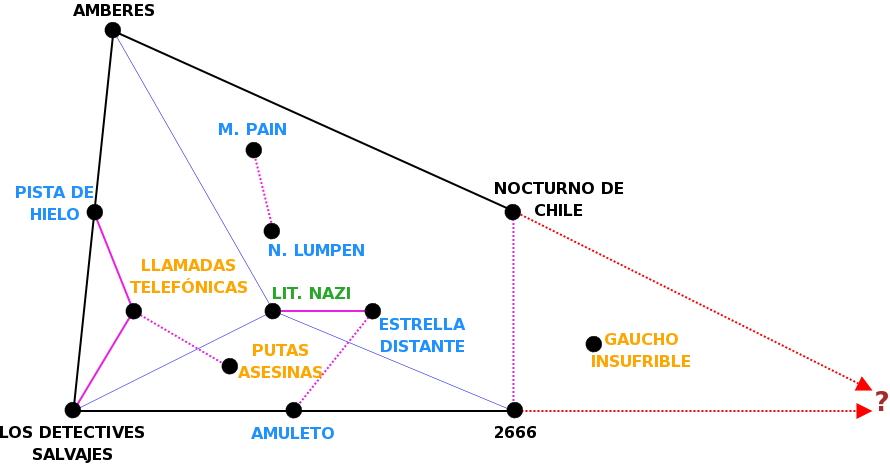
[UPDATE: Below, I discuss some of the interrelatedness of this novel with Bolaño's 2666; my good friend (and Bolaño fan) from Mexico City, René of Teoría del Caos, sent me a link to this diagram (explanation (in Spanish) here) that shows the interrelationships of all Bolaño's works. Fun to look at and ponder, for those interested.]

Roberto Bolaño, The Savage Detectives.

In his lively essay-as-fiction "Borges in Action," Mexican novelist Carlos Fuentes offers up in passing a succinct throwaway line that, back in the day, once described for some the essence of Latin American culture: "Mexicans descend from the Aztecs, and Argentinians descend from ships" (Myself with Others: Selected Essays, 152). This piece, set on Calle Amsterdam in Mexico City's Colonia Hipódromo, is a pastiche of stories and ideas of the grandfather of 20th century Latin American literature, Jorge Luis Borges . . . though, truth be told, for Borges "stories" and "ideas" amount to pretty much the same thing; it includes cameos by Borges, still alive at the time Fuentes wrote this, and the definitely-dead Erasmus. It's with Erasmus that "Fuentes" has the following conversation:

"Tell me [Erasmus says], where were we truly lost? In the maze [of the colonia] or in the pampa?" The question stunned me.

"Why, come to think of it, in the pampa. In the labyrinth." I hesitated. "In the maze I expected to be lost, but it was--you are right--so symmetrical; its sharp turns, its willful design: we were meant to be lost . . . "

"So we weren't: the maze is foreseeable," said the Dutchman. But the pampa isn't. But that is the real labyrinth: the straight line, you see."

Then you mean, Erasmus, that everything we have seen stands for something else: the maze is simple; the straight line is the true labyrinth, the true mystery . . . "

"And the true name of the garden of Eden, El Dorado, is Time. Do not go away impatiently without understanding this, you above all, you of the New World: you do have something more than an epic fatality; you do have a mythic chance." (156)


I don't want to claim that Roberto Bolaño has this essay in mind as he writes his semi-autobiographical novel, The Savage Detectives. But it is true that much of that novel's action is set in that broad midsection of Mexico City that ranges from the Zócalo to Chapultepec Park. (Colonia Hipódromo is near Chapultepec.) It is also true that The Savage Detectives' central action is the the story (often quite funny and, in places, Henry Miller-like) of the founding of an artistic movement called visceral realism and the tracking-down of a writer named Cesárea Tinajero, considered to be visceral realism's forebear and whose sole published poem, "Sión," is shown here (image found here). They search for her, moreover, not in the pampas but in the equally-labyrinthine deserts of northern Sonora. But Bolaño, a Chilean just old enough to do what he could to try to prevent Pinochet from taking power and feeling much more kinship with fellow South Americans-in-exile Borges and Julio Cortázar, would definitely take issue with Fuentes' Erasmus' hopeful "mythic chance" for the New World. Having finished reading The Savage Detectives only yesterday, I'm still thinking through this sprawling, thoroughly contemporary novel--magical realism, this is not. But one thing I think I can say about it is that, whereas in the novels of '60s-era Latin Americans like Fuentes and Gabriel García Márquez, the implicit assumption seems to be that the myth of Latin America has yet to be written, Bolaño would argue that, for better or for worse, there's no myth but only a Reality shaped by dark forces that is already written, that demands to be read and understood and which only Art can do and rail against . . . and perhaps, even prevail against.

More below the fold.

Some of you reading this may remember that back in June I posted on Bolaño's 2666. Reading The Savage Detectives is in many ways like revisiting that other novel: the pseudonymous writer Archimboldi, about whom much of 2666's action is concerned, gets referred to in passing here; moreover, the search for Tinejero takes Ulises Lima and Arturo Belano (the titular Detectives) to Santa Teresa, 2666's fictional border town; The Savage Detectives is as obsessive in locating the reader in Mexico City's actual streets as 2666 is in locating the reader in Santa Teresa's fictional ones. Each novel also moves forward and backward in time and has multiple narrative threads (The Savage Detectives is especially complex in this regard--you can trust me on this, or you can see a visual rendering of this here). Despite those intersections and structural similarities, though, The Savage Detectives is ultimately its own book, focused as it is on the literary culture of Mexico City and, more directly, with the lives and adventures of the Mexican poet Ulises Lima (note the first name) and Arturo Belano, a Chilean and Bolaño's stand-in, as they travel about Mexico City and, later, abroad.

I think also that, despite the fact that a quest to find the poet Arcimboldi is what begins 2666's action (and, for that matter, his life story concludes that novel), it was in the course of reading The Savage Detectives that the choice of the name Arcimboldi truly began to resonate with me. Like the painter's Librarian, Bolaño's writers and artists are known less by who they are than by what they have read and their embrace or rejection of those books . . . and, in this novel, what others remember of those same people (Lima and Belano may be our two central characters, but they never speak directly to the reader). We are what we read; we are what others can/choose to remember about us; but even what we write gets read, and read into, by others, and so we can never truly speak, directly and unfiltered.

As for Art itself, the Librarian's constructedness--he is made of books that are already written--is emblematic of the artist's dilemma: What to do in the face of Tradition? The visceral realists feel not inspired but trapped by Latin American literature's giants, embodied here by Octavio Paz and Pablo Neruda (perhaps significantly for our protagonists, a Mexican and a Chilean, respectively); moreover, they're of the opinion that the established writers, no matter their politics, have sold out artistically to curry favor with either those in power or those ultimately more interested in politics than in art. Power is power, whether emanating from the left or the right; real life and experience aren't found in the literary salons or cell meetings but in the streets and the lives of the people one finds there. Though the phrase "speak truth to power" does not appear in The Savage Detectives, the visceral realists would at least say that they agree that that is Art's goal.

In the end, it's also futile. Language betrays the writer through its ultimate inadequacy to say what he means; to be published, he must inevitably make some compromises, or starve for attention. Belano's stalking of Paz in a Mexico City park becomes something of an allegory for the attention the visceral realists crave but fail to achieve. Cesárea Tinajero thus becomes, for Lima and Belano, the closest thing to an artistic ideal they can find: one published poem--and a truly enigmatic, labyrinthine one that, title aside, must be read on its own terms--and that is the end of her literary career . . . though, as our protagonists will learn, she has not stopped writing.

Near the very end of the novel, Lima and Belano meet a woman, identified only as a teacher, who had known and worked with Tinajero. One day, the teacher tells them, she had gone to visit Tinajero in her spare apartment in Santa Teresa, and here is a little of what the teacher told them she saw:

And then the teacher saw or thought she saw a plan of the canning factory [where Cesárea was then working] pinned to the wall. And as she was listening to what Cesárea had to tell her, in words that were neither faltering nor rushed, words that the teacher would rather have forgotten, but that she remembers perfectly well and even understands, understands now anyway, her eyes were drawn to the plan of the factory, a plan that Cesárea had drawn with great attention to certain details, leaving other parts shadowy or vague, complete with notations in the margins, although sometimes what was written was illegible and other times it was all in capital letters and even followed by exclamation marks, as if Cesárea were seeing herself in her hand-drawn map, or seeing facts of herself that she had until then overlooked. And then the teacher had to sit down on the edge of the bed, although she didn't want to, and close her eyes and listen to what Cesárea was saying. And even though she was feeling worse and worse, she had the courage to ask Cesárea why she had drawn the plan. And Cesárea said something about days to come, although the teacher imagined that if Cesárea had spent time on that senseless plan it was simply because she lived such a lonely life. But Cesárea spoke of times to come and the teacher, to change the subject, asked here what times she meant and when they would be. And Cesárea named a date, sometime around the year 2600. Two thousand six hundred and something. And then, when the teacher couldn't help but laugh at such a random date, a smothered little laugh that could scarely be heard, Cesárea laughed again, although this time the thunder of her laughter remained within the confines of her own room. (633-634)


How much to read into this passage in relation to Bolaño's 2666? There is the pretty-clear nod in the direction of the title; and the scene just related occurs a good 20 years before the central action of 2666, but many of the murdered women in that novel are employed by Santa Teresa's maquiladoras, of which the canning factory is the first, we're told earlier. Those are the easy things to say, of course. But to argue only for the straight line between the two books is to assume there's no labyrinth to be negotiated by the reader. On the contrary: As I've been thinking about both these books this morning, they seem to me like two separate books that are parts of a larger, Archimbodian assemblage that, when completed, will tell us something more than the sum of its parts . . . or would have, had Bolaño not died so young. His novel Amulet, set on the campus of Mexico's National University during the 1968 student protests, is also part of that assemblage: its central narrator appears in The Savage Detectives and briefly relates what happened to her during that time. No doubt other of Bolaño's books are as well.

Another appropriate adjective to describe my sense of Bolaño's project would be "Faulknerian" in its intent to tell, in cumulative fashion, the story of a region and its contemporary moment. But whereas Faulkner searched through his fictions for a way to understand the origins of the South's tragedy, for Bolaño there seems to be no mystery to Latin America's tragedy. Pace, Fuentes' Erasmus, there's no mythic chance. For Bolaño, the mystery is whether Art will speak to, and be brave in the face of, Latin America's reality. That book is nearly blank, but this novel by Bolaño goes far in showing other writers how to fill up those pages.

Read More...

Thursday, June 10, 2010

The anti-Ulysses: Some thoughts on 2666

Roberto Bolaño. Image (along with a brief bio and good discussion of 2666) from here.

It seems appropriate to me to begin talking about this book by talking briefly about another book. Or, two.

I am early on in my bedtime reading of a very odd book by Adam Thirlwell whose full title is The Delighted States: A Book of Novels, Romances, & Their Unknown Translators, Containing Ten Languages, Set on Four Continents, & Accompanied by Maps, Portraits, Squiggles, Illustrations, & a Variety of Helpful Indexes. Also, "Mademoiselle O," a Story by Vladimir Nabokov, translated by Adam Thirlwell. Its equally-big subject is translation: from one language to another, of course; but also and more subtly, of a writer's style from one language to another and from one writer to another, both of whom are contemporaries and speak the same language; and, most crucially, of Life-as-experienced into literature. I'm still trying to figure out why Barnes & Noble had this book shelved in the Fiction and Literature section of the store; I confess that it's that lingering question in my mind, as much as anything else, that leads me to call this book "odd." It's not fiction, but it's most definitely not straight criticism, either. It's more like dramatized literary history that doesn't follow a strict chronology but, rather, a kind of analytical interior monologue. Sort of. But, I keep reading: even if I can't tell exactly where we're headed, it's pretty clear to me that Thirlwell knows.

Reading is always something of a faith act, isn't it?

Anyway, the section I'm in at present is one in which Thirlwell is discussing Gustave Flaubert's influence on the style of the first novel of his contemporary, Guy de Maupassant (Maupassant's "The Necklace," often gets credit for being the first modern short story); along the way, Thirwell says this within the context of Flaubert's Madame Bovary and that novel's influence on the novel as an art form:

Form in a novel is a matter of composition, of architecture. It is based on the repetition and variation of specific elements, not the unity of a linear story. This can mean that a novel can dispense with a plot almost entirely, so that Milan Kundera can state, in his novel The Book of Laughter and Forgetting, that the 'coherence of the whole is created solely [italics are Thirlwell's] by the unity of a few themes (and motifs), which are developed in variations'. In this way, its closest analogue is the composition of a piece of music, which is also a successive presentation of elements, structured on a basis of theme and motif. (57)

Thirlwell's claim about the novel's being able to dispense with a plot "almost entirely" and yet still have a form may seem surprising and perhaps even disturbing to fans of not just Jane Austen but, say, Ulysses, or fans of genre-fiction such as mysteries. But a little thought even about those novels will show that they are ordered or framed not by calendars but by the narrator's (or, in Ulysses, narrators') attentiveness to "the successive presentation of elements" at the point in time that they (and we) happen to find ourselves. In the case of Joyce's novel, not a heck of a lot happens; indeed, one way to think about Leopold Bloom's sections is that he's engaged in keeping something from happening: he deliberately delays his return home to avoid encountering his wife Molly and her singing manager Blazes Boylan, the two of whom he suspects of having a tryst. But in terms of being structured, it's difficult to think of a more obsessively-ordered book. Bloom has not just the above-mentioned preoccupation but several others that shape his movements and thoughts; the same is true of Molly (even though she never leaves the house) and Stephen Dedalus, the novel's third major character. And there's also the novel's most famous ordering structure, which those characters aren't even aware of: the superimposing of episodes and themes from the Odyssey over these characters and their activities, all set in a very real Dublin presented to the reader with meticulous attention to how it actually appeared on June 16, 1904.

2666 is a little longer than Ulysses; its title's significance never emerges in the book but instead lies in another book by Bolaño that one needn't have read beforehand (more about the title later); and most of its action is firmly located in a city that, though fictional, one could map with reasonable completeness. However, as I implied here a while back, it is in many ways Ulysses' opposite. Joyce's novel's difficulties arise, I think, essentially from the fact that most readers are pretty sure they're not catching all that architecture I referred to above. 2066's chief difficulty is that, apart from its attention to the layout of Santa Teresa, it appears to lack any such architecture--especially maddening given the subject that takes up most of the novel's physical space, the mostly-unsolved/unexplained murders of scores of young women in Santa Teresa. Santa Teresa is a fictional border town in the Mexican state of Sonora. If it were real, it'd be located near Nogales, but it's pretty clear that Bolaño has Ciudad Juarez in mind as its model--not least of which because, just before the open warfare among the drug gangs there that began a couple of years ago, Juarez experienced the unsolved murders of scores of young women over the course of several years.) As readers, we naturally want justice for these deaths, or at least an explanation for them. Except in a very few instances, none is forthcoming. Meanwhile, for the main characters with whom we spend the most time, the murders either barely rouse their curiosity or they can't seem to get others interested in them.

What in the name of all that is (traditionally-considered) novelistic is going on?

Some speculation below the fold.

2666, for reasons of style as well as its often very grim subject matter, is not easy going. I know/have read of some otherwise very good readers who struggle to see what it's up to, what its point is. I think that one way to approach it is to consider the fact that Bolaño's novel pushes Thirlwell's observation above to its breaking point--or, depending on your tastes, beyond it. And more: the central feature of this novel's textual physics is, well, no center. Santa Teresa has drawn all these people--not just the academics, writers and journalists we spend the most time with but also the murder victims--to itself for all sorts of deliberate and arbitrary reasons and, with very few exceptions, does not allow them to escape. It is a black hole for which we are provided no explanation but to which we are asked to bear witness.

This black hole is Henry Hitchings' image for the novel as well, as he reports in his review (linked to in the picture caption above). He also has this to say about the title:
The novel's cryptic title is one of its many grim jokes; there is no reference to this figure in its 900 pages. However, in another of his novels, Amulet, a road in Mexico City is identified as looking like "a cemetery in the year 2666". Why this particular date? Perhaps it's because the biblical exodus from Egypt, a vital moment of spiritual redemption, was supposed to have taken place 2,666 years after the Creation.
"Perhaps" is the crucial word here. It's hard to find signs of spiritual redemption in this novel . . . though, of course, any attentive reader of Exodus can tell you that the Israelites had exactly the same trouble, more often than not. There's also that "666" embedded in the number, thus suggesting as well that something ominous is on its way . . . or often, one gets the feeling while reading this bleak novel, has already cast its shadow on this narrative space--and, given its contemporary setting, on us as well.

But what exactly is is that slouches toward this particular Bethlehem? What is the nature of this new Jerusalem? The short answer is, 2666 doesn't say. Consider something I said earlier in this post: That, though a fictional space, Bolaño has provided sufficient details of Santa Teresa's layout and its relation to actual cities in Mexico and the U.S. that if one were so inclined, one could draw a reasonably-accurate map showing the city's major streets, the relative locations of its neighborhoods, and even some major and not-so-major points of interest and businesses. But whereas in Ulysses one can do the same thing because the narrator informs us of all this via Dedalus's and Bloom's movements through Dublin, in 2666 the map becomes possible because the reader is given fairly precise information regarding the location of, it seems, each and every one of the bodies of the murdered women--sometimes, down to the very street addresses. That's a most distressing thing, to be able to map a city not because of where the living reside and how they move about but because of where the dead are found--the city as cemetery. It's even more distressing when, as I mentioned earlier, the vast majority of these unsolved murders were committed in the same way. Someone/Something is at work here, but who/what? And why? We're never told. There's a terrible irony in the fact that, as Kant tells us, we create knowledge out of the connections we make between/among discrete phenomena--that is, we establish patterns--yet those murders which clearly establish a pattern are the ones that go unsolved.

As I was thinking about 2666's lack of a center, I found myself thinking about another bleak reading experience, Cormac McCarthy's Blood Meridian. Still, as horrifying a read as that novel is, at least McCarthy has judge Holden explain its violence with the mantra "War is god." That is a terrible notion to consider, but it nevertheless gives the reader an anchor in its seas and rivers of bloodshed--and, more importantly, an idea to assess and respond to. In 2666, though, we're not even offered the explanation of the absence of (a) god.

By now you've probably gathered that 2666 is not exactly the feel-good novel of the 21st century's first decade. That may keep you from giving it a try. Or, you may read that Bolaño died before he finished its final draft and assume, as some have, that its sense of lack due to that it isn't in fact as close to being finished as his literary executors claim it is; and that, in combination with the fact that the novel's five sections don't seem to add up to a whole, may keep you away. But I would still encourage you, especially if you've read this far, to try it anyway, keeping in mind that though its sections touch each other, if only tangentially, they aren't in chronological order relative to each other--as just one example, the murders will begin at some point during the novel's opening section; we just won't know when that is because this section opens in Europe: the characters we meet haven't even heard of Santa Teresa, much less know, for some years, that they'll be heading there. Each of its sections has its own plot, but they don't add up to a single plot. It is, in other words, a pretty daring experiment in form and a very odd reading experience in that we're made to feel as though we're truly on our own as we try to make sense of what we're being told. In that sense, this particular novel feels a lot like Life.

Read More...

Friday, January 15, 2010

Stuff I'm reading

The cover of Roberto Bolaño's novel, 2666, which, as you'll see below, is among the Stuff I'm Reading. Image found here.

Besides printouts of PowerPoint presentations being shown to us, memos, and drafts of new syllabi, I mean. Yes: It's week-before-Spring-Semester week, with all that entails. But in the evenings, I try to set aside some time to watch and think deep thoughts about Big XII basketball, and read other stuff. Here's a quick list:

Via Andrew Sullivan comes the reminder that Roger Ebert has a blog. This is a good thing in light of the fact that because of some recent surgery, he has lost the ability to speak--and, I learned yesterday, to eat and drink. What must that be like? Some excerpts from his response below:

[When I came to understand I could no longer eat or drink,] I dreamed. I was reading Cormac McCarthy's Suttree, and there's a passage where the hero, lazing on his river boat on a hot summer day, pulls up a string from the water with a bottle of orange soda attached to it and drinks. I tasted that pop so clearly I can taste it today. Later he's served a beer in a frosted mug. I don't drink beer, but the frosted mug evoked for me a long-buried memory of my father and I driving in his old Plymouth to the A&W Root Beer stand (gravel driveways, carhop service, window trays) and his voice saying "...and a five-cent beer for the boy." The smoke from his Lucky Strike in the car. The heavy summer heat.

For nights I would wake up already focused on that small but heavy glass mug with the ice sliding from it, and the first sip of root beer. I took that sip over and over. The ice slid down across my fingers again and again. But never again.

One day in the hospital my brother-in-law Johnny Hammel and his wife Eunice came to visit. They are two of my favorite people. They're Jehovah's Witnesses, and know I'm not. I mention that because they interpreted my story in terms of their faith. I described my fantasies about root beer. I could smell it, taste it, feel it. I desired it. I said I'd remembered so clearly that day with my father for the first time in 60 years.

"You never thought about it before?" Johnny asked.

"Not once."

"Could be, when the Lord took away your drinking, he gave you back that memory."

Whether my higher power was the Lord or Cormac McCarthy, those were the words I needed to hear. And from that time I began to replace what I had lost with what I remembered. If I think I want an orange soda right now, it is after all only a desire. People have those all the time. For that matter, when I had the chance, when was the last time I held one of those tall Nehi glass bottles? I doubt I ever had one from a can.

[snip]

Let me return to the original question: Isn't it sad to be unable eat or drink? Not as sad as you might imagine. I save an enormous amount of time. I have control of my weight. Everything agrees with me. And so on.

What I miss is the society. Lunch and dinner are the two occasions when we most easily meet with friends and family. They're the first way we experience places far from home. Where we sit to regard the passing parade. How we learn indirectly of other cultures. When we feel good together. Meals are when we get a lot of our talking done -- probably most of our recreational talking. That's what I miss. Because I can't speak that's's another turn of the blade. I can sit at a table and vicariously enjoy the conversation, which is why I enjoy pals like my friend McHugh so much, because he rarely notices if anyone else isn't speaking. But to attend a "business dinner" is a species of torture. I'm no good at business anyway, but at least if I'm being bad at it at Joe's Stone Crab there are consolations.

When we drive around town I never look at a trendy new restaurant and wish I could eat there. I peer into little storefront places, diners, ethnic places, and then I feel envy. After a movie we'll drive past a formica restaurant with only two tables occupied, and I'll wish I could be at one of them, having ordered something familiar and and reading a book. I never felt alone in a situation like that. I was a soloist.

[snip]

So that's what's sad about not eating. The loss of dining, not the loss of food. It may be personal, but for, unless I'm alone, it doesn't involve dinner if it doesn't involve talking. The food and drink I can do without easily. The jokes, gossip, laughs, arguments and shared memories I miss. Sentences beginning with the words, "Remember that time?" I ran in crowds where anyone was likely to break out in a poetry recitation at any time. Me too. But not me anymore. So yes, it's sad. Maybe that's why I enjoy this blog. You don't realize it, but we're at dinner right now.


I'm a couple hundred pages into Roberto Bolaño's magnum opus, 2666. What I know about it is chiefly through its 37-word summation (of a 900-page novel) on the back cover and both it and the author's reputation--in this country, gained after his too-early death; but what I can tell you so far is that this novel does not telegraph its destination(s?). I don't mean that in the sense of plot-twists, though. In what I've read, the disappearances of the women mentioned on the cover have certainly been mentioned and sort of talked about, but only in a sort of casual, making-conversation sort of way. They're by no means the narratives' (yes--more than one) focal points. "So far," please note. I have no sense of what will happen. But it is in that sense that I realized, as I was thinking about it this morning, that this novel reads like a poem: as a text that can't be segmented into scenes but has to be considered whole. That is a rare thing to be able to say about a novel. And a beautiful thing.

And, just to reassure (or horrify) those of you wondering (or hoping) if I may have forgotten about this, I'm a couple of chapters into Breaking Dawn. I seem to recall the Mrs. telling me that in Bella Swan, her main character, Stephanie Meyer wanted to capture, in large part, the voice of what she herself was like when she was nineteen (Bella's age).

I will just let that linger in the air for now. But I'll be coming back to it.

Read More...