What matters? Two very different responses
I'm still reading and grading papers (I have needy students this semester, about which more later), but I wanted to pass along links to a couple of things before I forget to later on.
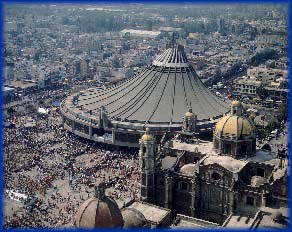
First of all: It's December 12, the feast day of the Virgin of Guadalupe, the patron saint of Mexico. This is a day when I am especially nostalgic for a place I love and spend more than a little time thinking on the terms "miracle" and "devotion." Long-time readers know that I've posted a couple of times about this day; in this one, I write about the time I was fortunate enough on a long-ago December 12th to visit the basilica in Mexico City dedicated to her. Apologies for the now-missing image from that post. To get a sense of the size of the the place I'm describing, go here.
Then, there's this long May 2007 review article by James Wood on Cormac McCarthy's The Road, "Getting to the End." Wood is a very attentive reader; you may not always agree with his take, but you can't argue that he's been slipshod in his reading. A sample follows:
It is the common weakness of novels such as Walter Miller's A Canticle for Leibowitz, Doris Lessing's The Memoirs of a Survivor, P.D. James's Children of Men, Kazuo Ishiguro's Never Let Me Go, or even Anthony Burgess's A Clockwork Orange and Orwell's 1984, that they are all to some extent science-fiction allegories in which the author extrapolates from the present, using hypothetical developments in the future to comment on crises that he or she sees as already imminent in his or her own time. . . .
McCarthy's vision is nothing like this. The Road is not a science fiction, not an allegory, and not a critique of the way we live now, or of the-way-we-might-live-if-we-keep-on-living-the-way-we-live-now. It poses a simpler question, more taxing for the imagination and far closer to the primary business of fiction-making: what would this world without people look like, feel like? From this, everything else flows. What would be the depth of one's loneliness? What kind of tattered theology would remain? What would hour-to-hour, day-to-day experience be like? How would one eat, or find shoes? These questions McCarthy answers magnificently, with the exception of the theological issue (about which more in a moment).
McCarthy's devotion to detail, his Conradian fondness for calmly described horrors, his tolling fatal sentences, make the reader shiver with fear and recognition. The Coke can is a good example: McCarthy is not afraid to stint the banal, and we are always aware of the contemporary American civilization that has been overthrown by events; it pokes up out of the landscape like fingerposts. There is a barn in a field "with an advertisement in faded ten-foot letters across the roofslope. See Rock City." (So we are in Tennessee, the scene of many of McCarthy's novels.) There are old supermarkets, and abandoned cars, and guns, and a truck the father and son sleep a night in, and even a dead locomotive in a forest. The narrative is about last-ditch practicality, and is itself intensely practical. In one of the houses they enter, the father goes upstairs, looking for anything useful. A mummified corpse is lying in a bed, a blanket pulled up to its chin. Without sensitivity, the man rips the blanket from the bed and thieves it. Blankets matter.