Showing posts with label Books. Show all posts

Tuesday, May 15, 2012

Self, image, self-image

The controversy over the claim that Vermeer used a camera obscura when painting now, with the recent discovery of this image, seems like pretty small potatoes. (Image found here.)

Grades are in (though some stragglers are still out there), my office is tidier than it's been for, well, a while, and the summer stretches ahead. Aside from some work for my school's Online Writing Lab, a trip south in June to see my daughters, getting some long-overdue exercise, and hanging out with the Mrs., my time is pretty much my own. What to do with this gift?

Well, at the top of my list this and every summer is "Get some writing done!!!" (the number of exclamation points increasing in direct proportion to the lack of excuses for not getting it done) This summer, I really have none. And there's that whole turning fifty thing, too. So. One project is to get a couple of chapters of my interminable book project knocked out. The other more directly involves good old Blog Meridian: a pulling-together and editing (and some rearranging) of selections from the Stretch of River pieces, along with some other things from the blog, that will make its appearance as a self-published book. Last year, I did a fair amount of the selecting; what remains, along with some further picking and choosing, is the editing.

 It's a tricky thing, looking into the mirror of one's own prose, but I find I generally like what I see there, allowing for the fact that, as Kurt Vonnegut once said when assessing his own work, there was once a writer named William Shakespeare.

So anyway. Here's hoping that I'll have more to say about that in a couple of weeks, so you'll be able to beat the Christmas rush.

Read More...

Wednesday, May 18, 2011

The Kid grows up in a trailer park: Wallace does McCarthy

This isn't one of the promised reviews; instead, I thought I'd pass along a little something before I head off to Topeka and thence to Austin for a week or so.

What follows isn't a review or commentary. Just a nod in the direction of a pretty good writer.

I've just started The Pale King, in part because, well, it's David Foster Wallace, and in part to see just how wrong I was about the Hamlet stuff. (Too early to say yet, in case you're wondering.)

To say this thing is multivoiced would be an understatement--I'm only 60 pages in, and already there have been a good half-dozen 3rd-person limited narrators speaking on behalf of people who are either already in Peoria or are headed there but don't yet know it . . . and, a peek ahead to the chapter that follows the one I'm in now shows that the author himself will be joining them. I already knew from Infinite Jest that Wallace's ear for dialogue is such that he can make himself sound like anyone, but in The Pale King it's his narrators who are multivoiced. As best I can recall, this is a new thing for him (though there are flashes of this ability in his short stories), and it's exciting and confusing and, if I dwell on it too long, more than a little sad that he didn't get to finish this thing.

Anyway. Here he is doing a pretty darn good Cormac McCarthy. The setting is one of several anonymous trailer parks (this one somewhere in the desert Southwest), and the central figure has a name--she is a young girl named Toni Ware--but the misery-filled childhood (though, here, with the smallest whiff of hope) is the same. Those familiar with the voice of Blood Meridian's opening chapter will know this voice, too:

The park's boys wore wide rumpled hats and cravats of thong and some displayed turquoise about their person, and of these one helped her empty the trailer's sanitary tank and then pressed her to fellate him in recompense, whereupon she promised that anything emerging from his trousers would not return there. No boy near her size had successfully pressed her since Houston and the two who put something in her pop that made them turn sideways in the air and she could not then fight and lay watching the sky while they did their distant business.

At sunset then the north and west were the same color. On clear nights she could read by the night sky's emberlight seated on the plastic box that served as stoop. The screen door had no screen but was still a screen door, which fact she thought upon. She could fingerpaint in the soot on the kitchenette's rangetop. In incendiary orange to the deepening twilight in the smell of creosote burning in the sharp hills upwind.

Her inner life rich and multivalent. In fantasies of romance it was she who fought and overcame thereon to rescue some object or figure that never in the reverie resolved or took to itself any shape or name.

After Houston her doll had been the mere head of a doll, its hair prolixly done and the head's hole threaded to meet a neck's own thread; she had been eight when the body was lost and it lay now forever supine and unknowing in weeds while its head lived on. (55)


In that final image of the doll, in combination with what precedes it here, it seems, as I sit here thinking about it, that young Toni is the inverse of McCarthy's kid in those opening pages of Blood Meridian. Sneaky and powerful.

But, as I note above, Toni Ware is only one of several characters. Some of the ones I've so far met in this book don't even have the faint whiff of hope about them.

I don't know yet if I'll do any actual book-blogging of this thing. I guess we'll both see, on down the road.

Oh (and I promise this next won't become a habit, because I'm not that kind of reader)--here's an early line that resonates beyond the world of the novel: "Two eventual suicides on this plane, one forever classed as an accident" (18).

Read More...

Thursday, December 30, 2010

The Savage Detectives: Straight-line labyrinths and the nearly-blank book

Giuseppe Arcimboldo (1527-1593), The Librarian. Image found here. Arcimboldo is something of a preoccupation for Bolaño, about which more later.

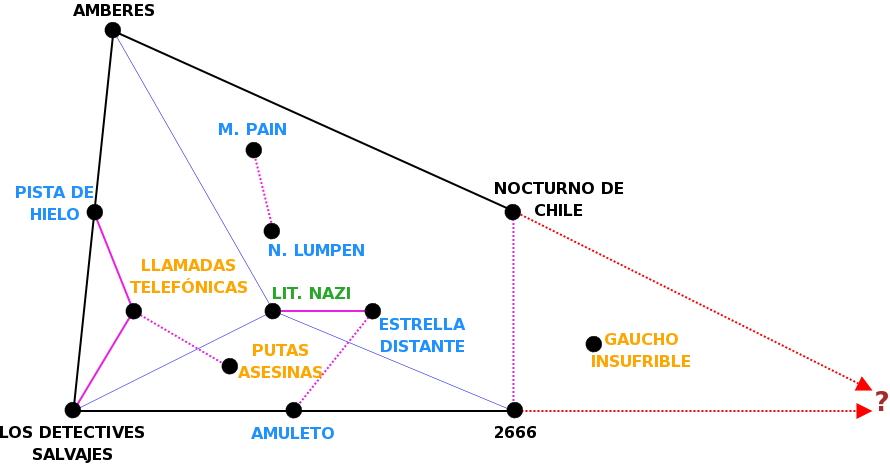
[UPDATE: Below, I discuss some of the interrelatedness of this novel with Bolaño's 2666; my good friend (and Bolaño fan) from Mexico City, René of Teoría del Caos, sent me a link to this diagram (explanation (in Spanish) here) that shows the interrelationships of all Bolaño's works. Fun to look at and ponder, for those interested.]

Roberto Bolaño, The Savage Detectives.

In his lively essay-as-fiction "Borges in Action," Mexican novelist Carlos Fuentes offers up in passing a succinct throwaway line that, back in the day, once described for some the essence of Latin American culture: "Mexicans descend from the Aztecs, and Argentinians descend from ships" (Myself with Others: Selected Essays, 152). This piece, set on Calle Amsterdam in Mexico City's Colonia Hipódromo, is a pastiche of stories and ideas of the grandfather of 20th century Latin American literature, Jorge Luis Borges . . . though, truth be told, for Borges "stories" and "ideas" amount to pretty much the same thing; it includes cameos by Borges, still alive at the time Fuentes wrote this, and the definitely-dead Erasmus. It's with Erasmus that "Fuentes" has the following conversation:

"Tell me [Erasmus says], where were we truly lost? In the maze [of the colonia] or in the pampa?" The question stunned me.

"Why, come to think of it, in the pampa. In the labyrinth." I hesitated. "In the maze I expected to be lost, but it was--you are right--so symmetrical; its sharp turns, its willful design: we were meant to be lost . . . "

"So we weren't: the maze is foreseeable," said the Dutchman. But the pampa isn't. But that is the real labyrinth: the straight line, you see."

Then you mean, Erasmus, that everything we have seen stands for something else: the maze is simple; the straight line is the true labyrinth, the true mystery . . . "

"And the true name of the garden of Eden, El Dorado, is Time. Do not go away impatiently without understanding this, you above all, you of the New World: you do have something more than an epic fatality; you do have a mythic chance." (156)


I don't want to claim that Roberto Bolaño has this essay in mind as he writes his semi-autobiographical novel, The Savage Detectives. But it is true that much of that novel's action is set in that broad midsection of Mexico City that ranges from the Zócalo to Chapultepec Park. (Colonia Hipódromo is near Chapultepec.) It is also true that The Savage Detectives' central action is the the story (often quite funny and, in places, Henry Miller-like) of the founding of an artistic movement called visceral realism and the tracking-down of a writer named Cesárea Tinajero, considered to be visceral realism's forebear and whose sole published poem, "Sión," is shown here (image found here). They search for her, moreover, not in the pampas but in the equally-labyrinthine deserts of northern Sonora. But Bolaño, a Chilean just old enough to do what he could to try to prevent Pinochet from taking power and feeling much more kinship with fellow South Americans-in-exile Borges and Julio Cortázar, would definitely take issue with Fuentes' Erasmus' hopeful "mythic chance" for the New World. Having finished reading The Savage Detectives only yesterday, I'm still thinking through this sprawling, thoroughly contemporary novel--magical realism, this is not. But one thing I think I can say about it is that, whereas in the novels of '60s-era Latin Americans like Fuentes and Gabriel García Márquez, the implicit assumption seems to be that the myth of Latin America has yet to be written, Bolaño would argue that, for better or for worse, there's no myth but only a Reality shaped by dark forces that is already written, that demands to be read and understood and which only Art can do and rail against . . . and perhaps, even prevail against.

More below the fold.

Some of you reading this may remember that back in June I posted on Bolaño's 2666. Reading The Savage Detectives is in many ways like revisiting that other novel: the pseudonymous writer Archimboldi, about whom much of 2666's action is concerned, gets referred to in passing here; moreover, the search for Tinejero takes Ulises Lima and Arturo Belano (the titular Detectives) to Santa Teresa, 2666's fictional border town; The Savage Detectives is as obsessive in locating the reader in Mexico City's actual streets as 2666 is in locating the reader in Santa Teresa's fictional ones. Each novel also moves forward and backward in time and has multiple narrative threads (The Savage Detectives is especially complex in this regard--you can trust me on this, or you can see a visual rendering of this here). Despite those intersections and structural similarities, though, The Savage Detectives is ultimately its own book, focused as it is on the literary culture of Mexico City and, more directly, with the lives and adventures of the Mexican poet Ulises Lima (note the first name) and Arturo Belano, a Chilean and Bolaño's stand-in, as they travel about Mexico City and, later, abroad.

I think also that, despite the fact that a quest to find the poet Arcimboldi is what begins 2666's action (and, for that matter, his life story concludes that novel), it was in the course of reading The Savage Detectives that the choice of the name Arcimboldi truly began to resonate with me. Like the painter's Librarian, Bolaño's writers and artists are known less by who they are than by what they have read and their embrace or rejection of those books . . . and, in this novel, what others remember of those same people (Lima and Belano may be our two central characters, but they never speak directly to the reader). We are what we read; we are what others can/choose to remember about us; but even what we write gets read, and read into, by others, and so we can never truly speak, directly and unfiltered.

As for Art itself, the Librarian's constructedness--he is made of books that are already written--is emblematic of the artist's dilemma: What to do in the face of Tradition? The visceral realists feel not inspired but trapped by Latin American literature's giants, embodied here by Octavio Paz and Pablo Neruda (perhaps significantly for our protagonists, a Mexican and a Chilean, respectively); moreover, they're of the opinion that the established writers, no matter their politics, have sold out artistically to curry favor with either those in power or those ultimately more interested in politics than in art. Power is power, whether emanating from the left or the right; real life and experience aren't found in the literary salons or cell meetings but in the streets and the lives of the people one finds there. Though the phrase "speak truth to power" does not appear in The Savage Detectives, the visceral realists would at least say that they agree that that is Art's goal.

In the end, it's also futile. Language betrays the writer through its ultimate inadequacy to say what he means; to be published, he must inevitably make some compromises, or starve for attention. Belano's stalking of Paz in a Mexico City park becomes something of an allegory for the attention the visceral realists crave but fail to achieve. Cesárea Tinajero thus becomes, for Lima and Belano, the closest thing to an artistic ideal they can find: one published poem--and a truly enigmatic, labyrinthine one that, title aside, must be read on its own terms--and that is the end of her literary career . . . though, as our protagonists will learn, she has not stopped writing.

Near the very end of the novel, Lima and Belano meet a woman, identified only as a teacher, who had known and worked with Tinajero. One day, the teacher tells them, she had gone to visit Tinajero in her spare apartment in Santa Teresa, and here is a little of what the teacher told them she saw:

And then the teacher saw or thought she saw a plan of the canning factory [where Cesárea was then working] pinned to the wall. And as she was listening to what Cesárea had to tell her, in words that were neither faltering nor rushed, words that the teacher would rather have forgotten, but that she remembers perfectly well and even understands, understands now anyway, her eyes were drawn to the plan of the factory, a plan that Cesárea had drawn with great attention to certain details, leaving other parts shadowy or vague, complete with notations in the margins, although sometimes what was written was illegible and other times it was all in capital letters and even followed by exclamation marks, as if Cesárea were seeing herself in her hand-drawn map, or seeing facts of herself that she had until then overlooked. And then the teacher had to sit down on the edge of the bed, although she didn't want to, and close her eyes and listen to what Cesárea was saying. And even though she was feeling worse and worse, she had the courage to ask Cesárea why she had drawn the plan. And Cesárea said something about days to come, although the teacher imagined that if Cesárea had spent time on that senseless plan it was simply because she lived such a lonely life. But Cesárea spoke of times to come and the teacher, to change the subject, asked here what times she meant and when they would be. And Cesárea named a date, sometime around the year 2600. Two thousand six hundred and something. And then, when the teacher couldn't help but laugh at such a random date, a smothered little laugh that could scarely be heard, Cesárea laughed again, although this time the thunder of her laughter remained within the confines of her own room. (633-634)


How much to read into this passage in relation to Bolaño's 2666? There is the pretty-clear nod in the direction of the title; and the scene just related occurs a good 20 years before the central action of 2666, but many of the murdered women in that novel are employed by Santa Teresa's maquiladoras, of which the canning factory is the first, we're told earlier. Those are the easy things to say, of course. But to argue only for the straight line between the two books is to assume there's no labyrinth to be negotiated by the reader. On the contrary: As I've been thinking about both these books this morning, they seem to me like two separate books that are parts of a larger, Archimbodian assemblage that, when completed, will tell us something more than the sum of its parts . . . or would have, had Bolaño not died so young. His novel Amulet, set on the campus of Mexico's National University during the 1968 student protests, is also part of that assemblage: its central narrator appears in The Savage Detectives and briefly relates what happened to her during that time. No doubt other of Bolaño's books are as well.

Another appropriate adjective to describe my sense of Bolaño's project would be "Faulknerian" in its intent to tell, in cumulative fashion, the story of a region and its contemporary moment. But whereas Faulkner searched through his fictions for a way to understand the origins of the South's tragedy, for Bolaño there seems to be no mystery to Latin America's tragedy. Pace, Fuentes' Erasmus, there's no mythic chance. For Bolaño, the mystery is whether Art will speak to, and be brave in the face of, Latin America's reality. That book is nearly blank, but this novel by Bolaño goes far in showing other writers how to fill up those pages.

Read More...

Sunday, December 05, 2010

Now you are aware of me!: A haphazard survey of recent books-as-objects

(Parts I and II)
A masterpiece of the book-as-object genre: the board-book version of Eric Carle's The Very Hungry Caterpillar. Image found here.

At the beginning of the film Objectified, which I posted on last month, a designer talks about how his idea for Oxo's vegetable peelers came to him. He mentions that a relative of his, who loved to cook, found it hard to grip her kitchen utensils for extended periods because of her arthritis. After playing around with various handle designs, he took an old outsized handlebar grip from a kid's bicycle and stuck it over the handle of his relative's peeler, and the rest is kitchen-utensil history. He then said something very interesting: that new designs initially seek to accommodate extreme situations--not the needs of the masses, but of special audiences and/or specialized needs. Yet, paradoxically, once we masses get our hands on an Oxo or Oxo-inspired peeler, it makes us wonder about those peelers with stamped-metal handles that our parents used and/or made us use--specifically, it makes us wonder if our forebears were masochists.

It's within the context of Objectified's observation about design that I've been thinking about these posts on the book-as-object, especially given the twin facts that of late there's been a fair amount of speculation about the future of books yet, on the other hand, that books whose physical design is meant to be considered as part of the making of meaning are appearing with some regularity. It occurs to me that perhaps these writers in some sense want to re-introduce us to books via those designs. Here's what they seem to be implying through their work: if a physical book is only a passive delivery system for a text, then we might as well read that same text off a screen. But if the book-as-device in some way contributes to or enhances not just reading a text but the making of that text's meaning, then maybe books won't disappear.

But then again, I was reminded recently that children's books haven't forgotten that reading for kids is a visual and tactile experience as much as it is an intellectual one. A couple of days ago by the front entrance at Barnes & Noble, I saw displayed copies of a children's book by Lane Smith called It's a Book. (Very short review: Cute--something like a re-writing of this--and the integrated page from an illustrated edition of Treasure Island is a nice surprise.) It's something of a meta-commentary on children's books' material attributes becoming part of the narrative, as with the Carle book pictured above (it was a favorite with my daughters when they were growing up; they loved to put their fingers in the holes as we counted all the things the caterpillar ate, and when at the end the caterpillar becomes a butterfly, I would flap the open book in imitation of that same butterfly: the book itself metamorphoses into the very object we had been told of via the book.

Well, okay: that book-flapping stuff was just Daddy being silly, back in the day.).

(Aside: I'm not sure just how pop-up books fit into this discussion. Their features require manipulation, of course, but the books themselves just need to be held open and their pages turned. For pop-up books, then, the book-as-book thus is a container, just as with more conventional texts. Or, at least, that's how they seem to me; I'm willing to listen to dissenting arguments.)

But though for adults there have been texts with adventurous typography and layouts ever since there have been texts, up to and including works of philosophy, it's not been till fairly recently that books have appeared in the mass market for grown-ups whose very materiality in some way(s) functions as part of the activity of meaning-making. These are very serious, even dark works, but the physical manipulation of the book in order to read it injects a sense of play into the reading experience--every reading experience is, in its essence, an act of imaginative play, the unifying of a collection of symbols and associating those symbols with things or ideas in the world to make meaning--that, precisely because having to do it is such an odd thing to have to do, should prompt us to ask, Why? What is gained here?

Below the fold is a fairly long-winded, arbitrary and incomplete survey (read: I know something about these) of books as objects, along with some pictures. Their more-frequent appearance--and, it must be said, their critical and financial success--give me hope that we'll see more books like these as writers attempt them and publishers are willing to print them. It is innovation at the margins that will help preserve all books, not just the stranger ones. We still have those awful metal-handle potato peelers, after all . . .

I am certain that other books of the sort I have been describing existed well before the 20th century, but the earliest I know of is Raymond Queneau's 1961 book,
Cent mille milliards de poèmes (One Hundred Thousand Billion Poems; image, and a description, found here). This book consists of ten sonnets, each of which follows not just the same rhyme scheme but whose lines all have the same rhyme sounds (that is, the first four lines of all the sonnets have an a b a b rhyme scheme, and all the a lines in all the poems will have the same sound) and each line of which is on its own strip of a page, thus making it possible to combine, say, any first line of a given poem with any combination of second lines, third lines, etc. from the other nine poems. Reading 24 hours a day, it would take a reader 200,000,000 years to read every possible combination (hence the title of the book). If you want a sense of how this all works, go here to see randomly-selected lines from the Poèmes; or, if you have about $100 lying around, buy a copy.

Here is an instance in which the book-as-object so disrupts that which we usually think of as "reading" that it's hard to say whether what one does with this book can be called reading. Though that means that for the vast majority of us such a book is fun to look at but is otherwise a curiosity, that's not a complaint. One way to think of the Poèmes is as something like a literalizing of the idea of the inexhaustible text, the idea that a given text can yield any number of possible meanings. But in a more accessible sense, we can say that the experience of the Poèmes is a concretizing of the idea that we never truly read any text in isolation, considering only the words on the page always and only in association with the other words on that page. The very act of being able to read is contingent on our experiences with words in other contexts, and with personal associations, too. In some sense, then, any reading of any text, in order to make sense of it, requires the piecing together of all of that and then telling ourselves that the result is "right there on the page." Reading as gathering, indeed.

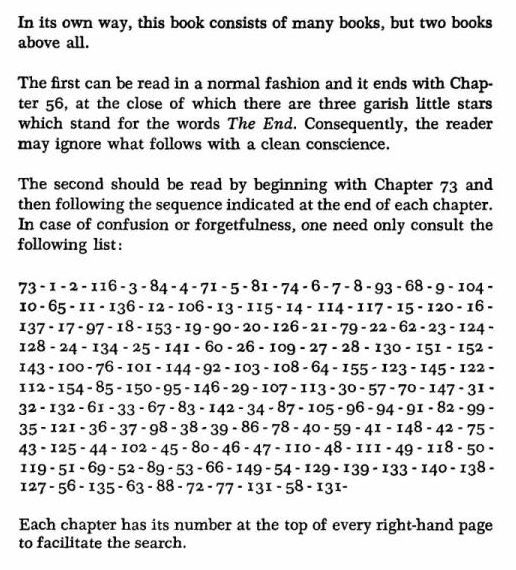
These all are interesting ideas to have foregrounded by a book's physical design; but as anyone who has browsed a bookstore in the past fifty years can tell you, the shelves aren't exactly groaning with Cent mille milliards de poèmes wanna-bes and also-rans. It could be argued, though, that some books began to appear that play around with them on a smaller scale. One book that comes to mind is Argentinian novelist Julio Cortázar's 1963 novel Rayuela (English title: Hopscotch), with its instructions to the reader (image found here) on how to read its two sections (the first section is a more-or-less conventional narrative; the second section consists of other bits that, according to the author, can either be ignored by the reader "with a clean conscience" or be read in conjunction with the first section but in an (out-of-numerical-order) sequence indicated by Cortázar). Even more interesting: one of those ways of reading leads to a textual infinite loop: the book doesn't "end" once the reader closes the cover. In that sense, it is the the anti-Quixote.

(Rather than prattle on further about Cortázar here, I'll just refer the curious to an earlier post of mine and say again here that this fellow's books are well worth knowing.)

The next books I'd like to mention here are those in Nick Bantock's Griffin & Sabine trilogy (image found here). Bantock's trilogy is in the grand tradition of that earliest novel form in English, the epistolary novel. However, as the picture here indicates, Bantock doesn't merely reproduce the texts of the exchange between the titular characters, he reproduces the postcards and includes actual envelopes containing physical facsimiles of their letters. The tactile experience of opening the envelope and pulling out and unfolding its letter and then, when done, refolding and replacing it back in its envelope creates in the reader the powerful sensation that we're reading other people's private correspondence in a way no other epistolary novel does. Moreover, I'd argue that as the correspondence becomes stranger and more complicated, those tactile acts create an emotional investment in the reader that actually enhances the tension felt in the narrative in ways that more conventional page-turning cannot. Who among us, after all, has not felt dread or nervousness upon seeing envelopes from certain addresses, to the point of not wanting to open them? These books show up on the shelves of the big chain stores all the time; if you don't already know them, seek them out. They're quick reads, but they're also beautiful (they sometimes show up in the artbook sections of stores).

Still and all, these books and others like them did not seem to lead to wider experiments with incorporating books' materiality into meaning-making. Given that fact, the gamble Pantheon took in choosing to publish Mark Z. Danielewski's 2000 novel, House of Leaves, (image found here) was an enormous one--indeed, they very well might never have taken it on if Danielewski, according to this long but very informative interview, hadn't typeset it himself. But Pantheon's gamble has paid off splendidly in the form of both critical and financial success; that, combined with newer softwares that make typesetting and complicated layouts much easier, has led to the appearance of many novels that experiment with the layout of text (or, in House of Leaves' case, texts) on a page and the incorporation of various kinds of images and, to a lesser extent, books-as-objects. Just as one example, it's difficult to imagine a major house like Penguin publishing a book like Reif Larson's beautiful 2009 book The Selected Works of T. S. Spivet if not for the example of House of Leaves.

House of Leaves confronts you with its strangeness before you even open it. The "cover image" you see above is, well, not quite the cover: the black portion of the image is what you'd call the cover, but that multicolored strip on the right-hand side is actually a separate page--essentially, the first page of the novel, though it appears even before the blurb page--on which you'll see a collage of various objects and handwritten and typed and word-processed texts. The front cover, in other words, doesn't quite cover the pages of the book, thus being analogous to one of the book's crucial settings, a house in Virginia that is larger on the inside than it is on the outside.

Opening the book just about anywhere, meanwhile--especially to its infamous Chapter IX--reveals the wide and wild variety of typographically-audacious pages that House of Leaves is known for. But for purposes of this post I'd like to look at two of its visually-simpler pages, pp. 440-441 (image found here; click on the image to enlarge it). As you perhaps can tell from the image, to read these two pages you must turn the book so that its left edge faces you and then read, line by line, from the new "bottom" of the page to the "top" of the facing page. The text, meanwhile, describes the character's ascension of a ladder. (To read the footnote on p. 441, then, you have to turn the book in the opposite direction.) So, while the words' layout evokes the climbing of a ladder, the fact of the book's being opened so that it is at its fullest length enhances our sense of the ladder's length as conveyed by the text. Well--as best it can, given that Navidson climbs this ladder for "hours and hours."

Despite moments like this and others in House of Leaves, it wasn't until his novel Only Revolutions appeared in 2006 that I became fully aware of how invested in the idea of the book as object Danielewski is. Its unusual textual layout (its parallel narratives begin at opposite ends of the book and are printed upside-down relative to each other--click on the image to enlarge it) require you to turn the book round and round in order to read each narrative; ruffle the pages with your thumb, and you'll see the page numbers in the circles orbit relative to each other; the hardback editions have two separate book ribbons to help you keep your place when reading each narrative; etc. This book, in other words, sometimes feels more constructed than written, to the point that some have found it emotionally chilly or wanting in terms of plot or character development.

I really admire this book's experimental bravery, but I will admit that its obsessiveness with, it seems, everything, from the things mentioned above to things like every page having exactly 360 words, can make reading Only Revolutions feel a bit odd for reasons quite apart from its adventurous language. (I say a little about that and about its American-ness here.) But then again, the book itself makes you aware of it in ways that even House of Leaves does not, let alone more conventional books. Anyway, Danielewski's obvious interest in thinking about books as more than empty vessels for texts inspired me to begin a discussion thread on that subject over at the Only Revolutions section of the MZD Forums.

This very odd book was also a finalist for the 2006 National Book Award. That sort of recognition, along next month's Tree of Codes by Jonathan Safran Foer, about which Olafur Eliasson says it is "a book that remembers it actually has a body," bodes well, I think, not just for those of us who love books that experiment with their material attributes, but for those of us who love books, period. Just as with the gene pools of living things, the more diversity we see in books, the healthier and longer-lived all kinds of books will be.

Read More...

Wednesday, November 24, 2010

Now you are aware of Me!: An inter-post on books as objects

A book illustration depicting the death of Don Quixote. I can't find where it appeared originally; my source for the image is here.

At the end of my last post, I promised some pictures of books whose physical design seems to me to contribute to the text's possible meanings. This isn't that post, but it does seek to provide an example of what I mean, as employed within the context of a conventionally-designed book. Well--at least, this is what I've told some students (though it wasn't from behind a lectern, so perhaps it doesn't count as Truth).

The rest is below the fold.

It was while writing that first post that I was reminded of my teaching excerpts from Don Quixote found in the Norton world literature anthology we used at my previous place of employ. Without going into detail here, let me just say that, my students be damned, Don Quixote is a hoot to teach for those interested in just about all the narratological paces through which a novel can be put, the postmodern ones included. That it also happens to ask us to think on very difficult questions and, besides, is a very good read, are bonus points.

The translation that follows wasn't the one in our text, but no matter; these are snippets from the conclusion of Don Quixote (tr. John Ormsby, 1885), which recounts Quixote's renunciation of knight-errantry, his will, and his death:

[T]urning to Sancho, he said, "Forgive me, my friend, that I led thee to seem as mad as myself, making thee fall into the same error I myself fell into, that there were and still are knights-errant in the world."

"Ah!" said Sancho weeping, "don't die, master, but take my advice and live many years; for the foolishest thing a man can do in this life is to let himself die without rhyme or reason, without anybody killing him, or any hands but melancholy's making an end of him. Come, don't be lazy, but get up from your bed and let us take to the fields in shepherd's trim as we agreed. Perhaps behind some bush we shall find the lady Dulcinea disenchanted, as fine as fine can be. If it be that you are dying of vexation at having been vanquished, lay the blame on me, and say you were overthrown because I had girthed Rocinante badly; besides you must have seen in your books of chivalry that it is a common thing for knights to upset one another, and for him who is conquered to-day to be conqueror tomorrow."

"Very true," said Samson, "and good Sancho Panza's view of these cases is quite right."

"Sirs, not so fast," said Don Quixote, "'in last year's nests there are no birds this year.' I was mad, now I am in my senses; I was Don Quixote of La Mancha, I am now, as I said, Alonso Quixano the Good; and may my repentance and sincerity restore me to the esteem you used to have for me; and now let Master Notary proceed.

* * *

And said most sage Cide Hamete [the chronicler said to be the source for the story of Don Quixote; Cervantes poses as its translator] to his pen, "Rest here, hung up by this brass wire, upon this shelf, O my pen, whether of skilful make or clumsy cut I know not; here shalt thou remain long ages hence, unless presumptuous or malignant story-tellers take thee down to profane thee. But ere they touch thee warn them, and, as best thou canst, say to them:

Hold off! ye weaklings; hold your hands!
Adventure it let none,
For this emprise, my lord the king,
Was meant for me alone.

For me alone was Don Quixote born, and I for him; it was his to act, mine to write; we two together make but one, notwithstanding and in spite of that pretended Tordesillesque writer who has ventured or would venture with his great, coarse, ill-trimmed ostrich quill to write the achievements of my valiant knight;- no burden for his shoulders, nor subject for his frozen wit: whom, if perchance thou shouldst come to know him, thou shalt warn to leave at rest where they lie the weary mouldering bones of Don Quixote, and not to attempt to carry him off, in opposition to all the privileges of death, to Old Castile, making him rise from the grave where in reality and truth he lies stretched at full length, powerless to make any third
expedition or new sally; for the two that he has already made, so much to the enjoyment and approval of everybody to whom they have become known, in this as well as in foreign countries, are quite sufficient for the purpose of turning into ridicule the whole of those made by the whole set of the knights-errant; and so doing shalt thou discharge thy Christian calling, giving good counsel to one that bears ill-will to thee. And I shall remain satisfied, and proud to have been the first who has ever enjoyed the fruit of his writings as fully as he could desire; for my desire has been no other than to deliver over to the detestation of mankind the false and foolish tales of the books of chivalry, which, thanks to that of my true Don Quixote, are even now tottering, and doubtless doomed to fall for ever. Farewell."

Don Quixote is a man of books in the most literal of senses, I would tell my students: it was due to his reading tales of knight-errantry in the first place that he comes to believe that he, too, is the latest in that noble lineage; we, for our part, would never have heard of him if not for all that. (The opening chapters make clear that La Mancha is something like the Tattooine of Spain.) So, imagine yourself as a reader, reaching these passages only a page or two from its end and reading Sancho's pleas that Quixote not die but go on more adventures--that is, go on living, and then Cid Hamete's declaration at the very end that Quixote has indeed died and that another writer's "resurrecting" him would be tantamount to violating a grave . . . and then imagine closing the cover of the book on all this. As I would tell my students: Sure. It's the cover of a book--what else are we supposed to do but close it? But imagine that cover as something like the lid closing Quixote's coffin, or perhaps the soil covering that coffin, filling in his grave. The reader's physical act of closing the book makes him a participant in Don Quixote's burial--the burial of a man who, for the reader, comes into existence because he (Quixote and/or the reader--take your pick) opens a book, and now dies because of his renunciation of the very books he had opened--in effect, he himself closes those books, and figuratively closes his own coffin lid. And so also do we close that lid, too, though (Cervantes hopes, I think) with something like Sancho's sadness.

Read More...

Sunday, November 21, 2010

Now you are aware of me!: Some comments on the value of books as objects


From top down: a page from the Book of Kells (page found here); a page from Tom Phillips' "treated novel," A Humument (its history is here; the image was found here); the interior of Jonathan Safran Foer's January 2011 release, Tree of Codes (image found here).

And when I would have to look at them day after day, each with his and her secret and selfish thought, and blood strange to each other blood and strange to mine, and think that this seemed to be the only way I could get ready to stay dead, I would hate my father for having ever planted me. I would look forward to the times when they faulted, so I could whip them. When the switch fell I could feel it upon my flesh; when it welted and ridged it was my blood that ran, and I would think with each blow of the switch: Now you are aware of me! Now I am something in your secret and selfish life, who have marked your blood with my own for ever and ever.

* * *

And so when Cora Tull would tell me I was not a true mother, I would think how words go straight up in a thin line, quick and harmless, and how terribly doing goes along the earth, clinging to it, so that after a while the two lines are too far apart for the same person to straddle from one to the other; and that sin and love and fear are just sounds that people who never sinned nor loved nor feared have for what they never had and cannot have until they forgot the words. Like Cora, who could never even cook.
--Addie Bundren, from As I Lay Dying by William Faulkner

I think Addie would have hated the idea of the Kindle or the Nook. (Bear with me. This makes sense in my head . . . ) Her despair regarding the abyss between words and the deeds they "say at" (her phrase) is akin to the experience I feel at times when reading a text off a screen as compared to reading it off a sheet of paper. Even the ability, in this digital mode, to cut and paste a word or phrase or pages and pages of text just isn't the same thing as holding a piece of paper with words on it, underlining or circling those words or, as I often have occasion to do, re-type words in physical books into electronic documents of whatever sort. I'm not sure why that is, but a clue might possibly be here, worth reproducing in full (emphasis added):
O.E. rædan (W.Saxon), redan (Anglian) "to explain, read, rule, advise" (related to ræd, red "advice"), from P.Gmc. *raedanan (cf. O.N. raða, O.Fris. reda, Du. raden, O.H.G. ratan, Ger. raten "to advise, counsel, guess"), from PIE base *rei- "to reason, count" (cf. Skt. radh- "to succeed, accomplish," Gk. arithmos "number amount," O.C.S. raditi "to take thought, attend to," O.Ir. im-radim "to deliberate, consider"). Connected to riddle via notion of "interpret."

Words from this root in most modern Germanic languages still mean "counsel, advise." Transference to "understand the meaning of written symbols" is unique to O.E. and (perhaps under English influence) O.N. raða. Most languages use a word rooted in the idea of "gather up" as their word for "read" (cf. Fr. lire, from L. legere). Sense of "make out the character of (a person)" is attested from 1610s. The noun meaning "an act of reading" is recorded from 1825. Read up "study" is from 1842; read-only in computer jargon is recorded from 1961.

To be sure, most of the work of reading is intellectual; still, at some level for me the idea of reading as a partly-physical activity is important, too. At its best, the reading experience requires a held object that bears the weight of the ink that appears in the shapes of the words I'm reading. The book is the container of gathered language; even more important, those words themselves have a basic material existence, thereby making them ever so slightly less abstract than they would be otherwise.

I don't want to lose the physicality of reading that holding a book imposes on the reader. Something important, even fundamental about reading itself would thereby be lost.

Maybe we won't. Moreover, there's reason to hope that we won't. That's what this post and the one to follow will explore in my usual meandering fashion.

Some initial thoughts below the fold.

A while ago, in the comments on this post, my long-time online friend Kári spoke of scrolls and books as modes of delivery for texts, noting that the act of reading text off a computer screen is something of a throwback to how readers of scrolls encountered texts. Meanwhile, Kindles and Nooks attempt to imitate electronically the experience of reading a paper text . . . even as, ironically, it's pretty easy to find articles these days not so much wondering if books will disappear as taking bets on when they'll disappear.

With my usual think-from-the-hip manner, when that discussion was going on I thought, "I love books as objects, and my local Barnes & Noble's been so crowded the past few times I've visited that it's no longer convenient to just sit among the stacks and read as I once did, so of course books will live on." But, keep in mind, that statement comes from someone who misses rotary-dial telephones. But my recently learning of the coming release of Foer's audacious experiment not just with text but with our basic assumptions about what the physical surface of a page should look like has caused me to think a little more about the question of book as objects, what sort of thinking would lead to their demise, and what might keep them alive.

That we're even having discussions about the death of books is due precisely to their resounding success as designed objects: as I noted in my most recent post, good design doesn't call attention to itself; the vast, vast majority of books have no need to call attention to their mass in order to function well, much less to be taken into consideration as helping shape a text's meaning. In fact, as I tell my students, you know you have a good book when you forget that you're reading a book. Obviously, though, that sort of thinking is what leads to death-of-the-book talk: if what matters is the text, why not dispense with the physical object?

What might help keep books alive is revisiting their design, by which I mean our basic assumptions about what the physical surfaces of the book-as-object "should" look like. But in this instance, rather than making the interaction between reader and object as frictionless as possible, those books whose physical attributes call attention to themselves in such as way as to cause the reader to revisit the fundamental subject of the reading dynamic itself as it applies to that book--those books might just rejuvenate interest in (or at least subconsciously remind us) of books' inherent value as objects in their own right and not meaningless containers of words. The mere existence of something as materially audacious as Foer's new book by someone with Foer's prominence is itself evidence enough, I'd say, that publishers aren't quite ready to give up on physical books as a medium; in truth, though, for the past ten or so years there's been a fair number of books by major publishers that, in various ways, compel their readers to think about books as objects.

This makes me happy.

In the next post, we'll have a look at some recent books whose designs, it seems to me, are part of their respective texts' messages.

Read More...

Thursday, September 09, 2010

"One imagines": A review of Passing Strange

The cover of Passing Strange, by Martha A. Sandweiss. Image found here.

Try to imagine, if you will, a nineteenth-century American man who was regarded by his peers--among them being the grandson of Presidents and another who would serve as a secretary of state--as being an exemplar of the best and brightest that America had to offer, whom his friends thought could have been a full-time man of letters had he chosen to be, whose geological survey work would be instrumental in the building of the Transcontinental Railroad and, more broadly, the settling of the West after the Civil War, who but for a few bad financial breaks could easily have been as wealthy as he was esteemed by his peers. Imagine that this man had business and scholarly interests that caused him to travel, it seemed, incessantly across the U.S. and into Mexico. Imagine, moreover, that this man never married, despite the efforts of his friends, though he was clearly interested in women and, when younger, was briefly engaged.

Now: Imagine learning upon this man's death that, for the last two decades of his life, he had not only been secretly married to a black woman and fathered children by her, he had also hidden all his (very) public life from her by passing as a black man whose jobs (which required frequent and extended absences from home) were a Pullman porter and a travelling steel-worker.

This all reads like a fanciful romance novel, but it is, in fact, all true. The man was publicly known and, it seems, universally admired as Clarence King; but he was known to his wife Ada and their children as "James Todd," and it's the story of their relationship that is the subject of Martha A. Sandweiss's book Passing Strange, which I recently finished reading.

The story of this marriage is so extraordinary that I am glad that Sandweiss felt compelled to tell it: as she notes, stories of whites passing as black during the post-Reconstruction era are less well known (and less common) than those of blacks passing as white; and it's through the contemplating of this story of a white man who risked an extraordinary amount to maintain two fictitious lives that we can perhaps see more clearly what even the allegedly-privileged had to go through in order to be with someone they loved who inconveniently happened not to be members of their own race. Another way to put this: King gained zero material or social advantage via his marriage to Ada--indeed, he put his already-considerable advantages at extraordinary risk because of that marriage; as his letters to her make clear, though, he gained "only" the deep, passionate love of this woman and their children.

All that said, this book reads a bit strangely: Sandweiss wrote this book to tell the story of "James Todd" and his wife, yet very little extant documentation of that relationship exists. There are the common-law marriage certificate, census records, birth records of the children (from which she can determine, more or less, when "James" had visited his wife and family), and some of his letters to her (none of hers to him exist), and that's about it. Moreover, Ada was born around 1860 somewhere near West Point, Georgia--in other words, she was born into slavery, and so next to nothing certain is known of her until her arrival in New York in the late 1870s. Sandweiss is honest about all this; she mentions in her prologue that she will have to read between the lines of the historical record and what was generally known about the lives of blacks of Ada's generation, both those who lived in the South and those who migrated North or to the Midwest and the Plains. A favorite phrase of Sandweiss's, as she describes Ada's and "James's" home life, is "One imagines." But none of this is Sandweiss's fault, and it's not a shortcoming. It's just that in those sections devoted to Ada's life and her relationship with her husband, the book reads a little more like recreated history than straight history.

But it's the very sketchiness of her subject that proves what I take to be her book's larger implicit point: people indeed defied anti-miscegenation laws, going, as in the case of Clarence King, to extraordinary lengths to do so. The fact that someone as prominent as King left such a meager paper trail regarding his own illegal marriage can't help but cause one to imagine all those others we may never know of who were also living such lives. This is one very odd and most unfamiliar story--but also very, very American.

EDIT: I forgot to mention that I owe knowing about this book to Sandweiss's recent NPR interview.

Read More...

Tuesday, August 17, 2010

Back to school

Faculty meetings for the new semester began yesterday, and in today's presentation our guest speaker, yet another in a long procession of guest speakers over the years whose job it has been to tell us about Kids These Days, told us about Kids These Days. One of the things about Kids These Days: They have all these gadgets whose chief purpose seems to be to enable their tendencies toward ADD-ness. Moreover, as we know, their most frequent encounters with written language occur not via paper but via electronic screens of various sorts.

I get that, and I am comfortable with that. Or I thought I was until, via The Daily Dish, I ran across this article by Alan Jacobs, in which he announces that he's begun to read David Foster Wallace's Infinite Jest on Kindle.

Here's the bit that tripped me up:

So I bought the Kindle version. All the above problems [chiefly, the paperback's bulk] solved . . . but . . . I found that I was missing the visual cues that codexes offer. I don't often miss them, or not all that much anyway, but in this case I miss them. Wallace goes off on these long riffs, but on the Kindle it’s hard to tell how long they are; whereas when holding the codex I could flip ahead to see how long I should be prepared to keep my concentration before I can expect a break.


In case you didn't catch it, Jacobs does not use the word book; he uses the word codex. To see why this pulled me up short, have a look below at the definition I know for codex, along with a picture of one:

co·dex (kdks)
n. pl. co·di·ces (kd-sz, kd-)
A manuscript volume, especially of a classic work or of the Scriptures.
[Latin cdex, cdic-, tree trunk, wooden tablet, book, variant of caudex, trunk.]
Word History: Latin cdex, the source of our word, is a variant of caudex, a wooden stump to which petty criminals were tied in ancient Rome, rather like our stocks. This was also the word for a book made of thin wooden strips coated with wax upon which one wrote. The usual modern sense of codex, "book formed of bound leaves of paper or parchment," is due to Christianity. By the first century b.c. there existed at Rome notebooks made of leaves of parchment, used for rough copy, first drafts, and notes. By the first century a.d. such manuals were used for commercial copies of classical literature. The Christians adopted this parchment manual format for the Scriptures used in their liturgy because a codex is easier to handle than a scroll and because one can write on both sides of a parchment but on only one side of a papyrus scroll. By the early second century all Scripture was reproduced in codex form. In traditional Christian iconography, therefore, the Hebrew prophets are represented holding scrolls and the Evangelists holding codices. (Thanks, Free Dictionary; image found here.


Add to this my recent reading in which Aztec codices get mentioned with some frequency and, well, maybe you can see why seeing a novel published in 1996 referred to as a codex was a bit startling. You can gather that this usage is brand new to me. Is it for you as well?

But more to the point, I found myself wondering about the implications of this term's application to an object that's usually not called a codex. Books are indeed an ancient technology, but are books themselves ancient--which is to say, passé? Is the choice to call them codices meant to honor them or to draw attention to their jalopy-ness? And what might be implied here regarding those of us who still prefer to read off paper rather than off screens? Are we just slightly-hipper versions of these guys?


As you no doubt have determined by this point, I have no conclusions one way or another about this, aside from the usual truisms: Usages change. But it's hard not to be tempted to read this particular one as a kind of commentary on the position printed text now holds in our culture, that now some (many?) consider it to be on some sort of par with hand-written and illuminated manuscripts. That is a strange thing to contemplate as I once again face the necessity of explaining to students why having a book for the class is a good, if quaint, notion.

Read More...

Monday, July 12, 2010

Some postcards from The Delighted States

Adam Thirlwell, in his native habitat. Image found here.

A while back, I mentioned that I was reading The Delighted States: A Book of Novels, Romances, & Their Unknown Translators, Containing Ten Languages, Set on Four Continents, & Accompanied by Maps, Portraits, Squiggles, Illustrations, & a Variety of Helpful Indexes. Also, "Mademoiselle O," a Story by Vladimir Nabokov, translated by Adam Thirlwell. and promised that I'd post a little something from/on it as I continued to read. Well, here I am, very nearly at its end, no posts in the meantime . . . and what to say by way of summary about this book that does it justice?

I'm not sure I can. So, what follows isn't even a Fodor's Guide but more like a back-of-the-book-style blurb followed by some passages that I found to be especially compelling observations on novels and, more particularly, Thirlwell's book's elusive prey, that thing called "style." Thirlwell's method is not by any means straightforward; but, as I hope to show below, that is to purpose. He is nothing if not, um, thorough in his writing (some might less-charitably describe it as repetitious). But lovers of reading and literary anecdote, and anyone who has ever wondered about the question of literary influence and/or has ever thought about the art of translation, will find much to reward them in this book.

As I mentioned in that earlier post, The Delighted States' is among the odder literary histories you're ever likely to encounter. Most books of that genre use as their starting point a nation, a language or an intellectual period or movement; Thirlwell's book, in both its arguments and form, deliberately militates against those traditional frames and their chronological and spatial assumptions. It begins with Flaubert, via letters to his mistress, articulating what he is trying to achieve in the book that would become Madame Bovary, but it then jumps ahead to Joyce and then to Polish novelists trying to grasp what Joyce is up to via French translations of Ulysses; it moves back in time to Laurence Sterne's Tristram Shandy and Miguel de Cervantes' Don Quixote, then forward to Nabokov; then back to the French, and Joyce . . . oh, and there's Proust and Tolstoy and some other folks I'm forgetting, along with the fact that the Nabokov translation begins at the book's back and is printed upside-down in relation to its front (it's kinda hard to explain) and . . . you get the idea. Imagine Sterne's Tristram writing a literary history of the novel and style and translation, and you'd get something like The Delighted States.

The rest is below the fold to spare the incurious. If you find that description more intriguing than off-putting, then read on--you'll get to learn how the book got its title, along with a few passages I think are worth thinking about.

Here's the origin of the title:

Bohumil Hrabal was a Czech novelist in the twentieth century. One of his last books was a collection of autobiographical letters to an American girl called April Gifford, christened Dubenka by the drinkers in the Golden Tiger pub, since April, in Czech, is duben, the oak month. And April herself came up with her own reciprocal pun in translation, when the drinkers in the Golden Tiger pub asked her where she was from--'Ze "spokojeneých" stáu . . . From the "Delighted" States . . .' Because normally the United of the United States, in Czech, would be spojené--without the extra spike of spokojeny--the Czech word for happy. (31)

A nice story--and, coincidentally, it's reminiscent of how I would explain to Mexicans I met in Mexico how to pronounce my unusual last name. It also introduces a basic fact of translations that we're all aware of: that due to the nature of language (and, for that matter, languages), the completely-transparent translation does not, can never exist. Thirlwell knows this as well, of course, but his book's subject isn't the futility of translation but what is it that survives translation (or, ideally, should survive it) that works its influence on the writers who are reading in translation. Here's his book's central thesis, as near as I can determine it:
[In an essay on Joyce's Finnegans Wake, Samuel Beckett] came up with this catchy conclusion: 'His writing is not about something; it is that something itself [Beckett's italics].

But Beckett's conclusion is not just catchy: it is also impossible.

A sign is not the same thing as the thing it represents. Because this is the case, it is possible to create more and more precise signs--since the gap between the sign and real life is infinite. And this is why there are values in literature--marking the moments when novelists working in the art of the novel invent more precise styles. Often, it is true, the more precise the style, the more form and content are inter-related. But this intertwining of form and content does not entail that a style is so precise in its relation to real life as to be the thing it is describing. All novels, after all, are smaller than real life. They are all miniaturisations. They are never real life itself. Real life is always elsewhere.

And this is why translation is always still possible. The style of a novel, and a novelist, is a set of instructions, a project: it is never able to create an entirely unique, irreplaceable object.

The novel--this art of the precise, the authorial, the deliberate--is also an art of repetition, of reproduction. (14-15)


Style is not merely form + content; in literature it is more accurately described as an author's way of paying attention: thus, Hemingway's reticence, Joyce's accretions of pure data, Kafka's slowing the passage of time down to a crawl in combination with the deliberate withholding of the word "dream" as a descriptor of what's going on in his narratives, etc. This is also why, for example, Nabokov Russian-izes his translation of Alice in Wonderland: whatever else it may be about, Nabokov realized that Carroll's novel is rooted in the sort of Englishness that only the English--not even, necessarily, English-speakers--would grasp. What matters in that novel is the quality of that novel's attention to Alice's (or Anya's) adventures. One doesn't have to be English to attend to the world in that way.

Hence Thirlwell's book's eschewing of the traditional forms that literary histories take. They may be orderly, but authors' readings are not nearly so scripted. It's all a bit like a juggling exercise for the reader--and for him as a writer; toward the end of his book he finds himself questioning some of his former claims, but surely that too is in keeping with The Delighted States' larger claim about the inevitable slippage between language and its subject.

Here are a few more passages worth thinking about. This book is so full of such moments, though, that I'll be saving a few for another set or two of postcards.

[Pastiche] is a way of testing out the limits of a style. It is a form of map-making.

And this becomes more acute in translation. Every question of style can also become a question of translation; every theory of the relation between form and content contains its corresponding theory of how these might be reproduced. And another description of an accurate translation, I think, can be a voluntary pastiche, a reproduction of the style.

But translations are often acts of fragile restoration. Because there is nothing style can do about time, nothing it can do about the possible comic and unpredictable betrayals.

In translation, for instance, a style is often an anachronism. It is in thrall to its ephemeral subject matter. (88-89)


The last two episodes of Ulysses are remarkable for two apparently contradictory things: they are comprehensive, and reticent. On the one hand, these episodes are huge, and full of detail. But these episodes refuse to make any form of selection among detail. And this is why they are also reticent: this mass of detail does not respect any detail's relative importance. Some of the most important things are therefore barely said. (108)


Everything conceals a potential narrative.

In this way, [French novelist Georges] Perec worked on the plan for his last and best novel, La Vie mode d'emploi (Life: A User's Manual), a title which in its vacuous pragmatism flaunts its refusal of the idea that literature should teach, should be a moral or everyday guide. Instead, it was an affirmation of real life, of the multiple novels contained in an apartment block. Which is why, as well as its title, Perec added a subtitle to his novel: Romans.

Not a novel: Novels.

For this was the discovery of James Joyce, with his multiple styles, structured on a network of detail. The everyday was infinite. (114)


More later.

Read More...

Tuesday, April 06, 2010

Still still here

Those Four Horsemen known as Work, Computer Travails, Other and Stuff have kept me away from here and will continue to do so for the next few weeks, I'm sorry to say. In the meantime, though, here's a little something to read and, if you're so inclined, respond to at your respective places.

The big thing for some of the smarter bloggers out there of late has been to follow Tyler Cowen's lead and post a list of books that have influenced their thinking. Here is Matthew Yglesias' list; he links to Cowen's list, and the comments section has a good discussion of both the list and alternates for inclusion. Looking over the list made me want to join in the fun. So, here's mine.

These aren't necessarily favorite books (NB: some non-books included); they're books that, for better or for worse, have shaped my way of thinking about stuff. Most of these won't surprise long-time readers of this blog (again, for better or for worse).

1) Paul Tillich, Dynamics of Faith. This was required reading in my Intro. to Theology class, which I took in my first semester of college. Taught me not just that it's okay for a believer to doubt, it's necessary if his faith is to survive and grow stronger.

2) M. M. Bakhtin, The Dialogic Imagination: Four Essays. Essential for its discussion of heteroglossia (multivoiced-ness) in the novel--an important idea for me, in that it taught me how to listen to novels, not just read them.

3) William Faulkner, Go Down, Moses. "The Bear," this book's long center-piece, may have been the first thing by Faulkner that I read, back when I was a freshman in college. Years later, a re-reading of "Delta Autumn" would serve as the starting point for my dissertation/book-in-progress.

4) Henry David Thoreau, Walden. A book whose prescience about our own "the railroad runs us" times, elegance, wit, and firm conviction that life is best when experienced in its least-complicated form continually rewards--and challenges.

5) Wallace Stevens, "The Idea of Order at Key West." Yes, it's a poem and not a book, but not only is it the essential Stevens poem, it also made me realize, more powerfully than anything else I've ever read, the power (and, for that matter, the impulse) of the human mind to so shape our understanding of the world that it becomes very difficult to understand the world as it is apart from our perception of it.

6) Edward Snow, A Study of Vermeer. Snow is an English professor at Rice (he teaches Shakespeare and Milton classes), but he's best known for his translations of Rilke. I never took a class with him, but I did hear him give a talk on Brueghel's Peasant Dance that made me realize I had no idea how to look at paintings. I still don't, really, but this book helped me do it less-poorly. It also teaches the larger lesson that, as with so many other things, patience in academic criticism is a virtue.

7) Gabriel García Márquez, One Hundred Years of Solitude. Other books came before (Carlos Fuentes' The Death of Artemio Cruz) or are more analytical in their approach (Octavio Paz's The Labyrinth of Solitude), and, as I was reminded recently while reading Roberto Bolaño's 2666, magical realism now seems a bit dated given certain contemporary, brutal realities. Still, García Márquez's novel was still that book that, when I re-read it while living in Mexico, made emotional sense of the place I found myself.

8) Martin Luther, The Small Catechism. The simplest, most direct explanation of the essential expressions of Christian doctrine that you'll find. As Luther himself says, "This is most certainly true."

As I said above, if the spirit moves you, consider yourselves tagged; I hope you'll let me know if you decide to post your own list.

See y'all around.

Read More...

Friday, February 12, 2010

Leafing through TNR's The Book

Berryman, friends, is interesting: John Berryman, drunk and in a hotel room in Dublin, recites his "Dream Song #29" (text here). Via The Book's video section.

The New Republic's online site has a new place for me to spend time, The Book. As its title suggests, it is a place where people offer up reviews of fiction, poetry and books on various other subjects. It's only been up for a couple of weeks, so it doesn't yet have a great deal of content; I'm also a bit disappointed that some of the reviews haven't been a bit more substantive. In something of an irony, The Book announced its arrival by noting that there's a lack of book-review sites on the Web and that it seeks to fill that particular niche, but some of the reviews I've read there--not just their brevity but also their lack of close examination of the texts--seem shaped by the medium (the Web does seem to favor, or create pressures forcing writing in the direction of, the miniature; perhaps reviewers, too, succumb to those dynamics). At any rate, the New York Review of Books, for better or for worse, this is not. And yes, yes, I see that this post is itself The Book in miniature . . .

That said, the range of books it promises to cover is indeed impressive; moreover, there's a feature called Lost and Found: New Looks at Old Books, which provide short visits to books long forgotten but perhaps worth our time. And the video feature is fun as well and, in the case of Arthur Miller and Marilyn Monroe announcing their pending marriage, a reminder that the world is stranger than anything most of us can imagine.

[To come: more substantive posts on the Irreproducible, Joyce and irony, etc.]

Read More...

Friday, January 15, 2010

Stuff I'm reading

The cover of Roberto Bolaño's novel, 2666, which, as you'll see below, is among the Stuff I'm Reading. Image found here.

Besides printouts of PowerPoint presentations being shown to us, memos, and drafts of new syllabi, I mean. Yes: It's week-before-Spring-Semester week, with all that entails. But in the evenings, I try to set aside some time to watch and think deep thoughts about Big XII basketball, and read other stuff. Here's a quick list:

Via Andrew Sullivan comes the reminder that Roger Ebert has a blog. This is a good thing in light of the fact that because of some recent surgery, he has lost the ability to speak--and, I learned yesterday, to eat and drink. What must that be like? Some excerpts from his response below:

[When I came to understand I could no longer eat or drink,] I dreamed. I was reading Cormac McCarthy's Suttree, and there's a passage where the hero, lazing on his river boat on a hot summer day, pulls up a string from the water with a bottle of orange soda attached to it and drinks. I tasted that pop so clearly I can taste it today. Later he's served a beer in a frosted mug. I don't drink beer, but the frosted mug evoked for me a long-buried memory of my father and I driving in his old Plymouth to the A&W Root Beer stand (gravel driveways, carhop service, window trays) and his voice saying "...and a five-cent beer for the boy." The smoke from his Lucky Strike in the car. The heavy summer heat.

For nights I would wake up already focused on that small but heavy glass mug with the ice sliding from it, and the first sip of root beer. I took that sip over and over. The ice slid down across my fingers again and again. But never again.

One day in the hospital my brother-in-law Johnny Hammel and his wife Eunice came to visit. They are two of my favorite people. They're Jehovah's Witnesses, and know I'm not. I mention that because they interpreted my story in terms of their faith. I described my fantasies about root beer. I could smell it, taste it, feel it. I desired it. I said I'd remembered so clearly that day with my father for the first time in 60 years.

"You never thought about it before?" Johnny asked.

"Not once."

"Could be, when the Lord took away your drinking, he gave you back that memory."

Whether my higher power was the Lord or Cormac McCarthy, those were the words I needed to hear. And from that time I began to replace what I had lost with what I remembered. If I think I want an orange soda right now, it is after all only a desire. People have those all the time. For that matter, when I had the chance, when was the last time I held one of those tall Nehi glass bottles? I doubt I ever had one from a can.

[snip]

Let me return to the original question: Isn't it sad to be unable eat or drink? Not as sad as you might imagine. I save an enormous amount of time. I have control of my weight. Everything agrees with me. And so on.

What I miss is the society. Lunch and dinner are the two occasions when we most easily meet with friends and family. They're the first way we experience places far from home. Where we sit to regard the passing parade. How we learn indirectly of other cultures. When we feel good together. Meals are when we get a lot of our talking done -- probably most of our recreational talking. That's what I miss. Because I can't speak that's's another turn of the blade. I can sit at a table and vicariously enjoy the conversation, which is why I enjoy pals like my friend McHugh so much, because he rarely notices if anyone else isn't speaking. But to attend a "business dinner" is a species of torture. I'm no good at business anyway, but at least if I'm being bad at it at Joe's Stone Crab there are consolations.

When we drive around town I never look at a trendy new restaurant and wish I could eat there. I peer into little storefront places, diners, ethnic places, and then I feel envy. After a movie we'll drive past a formica restaurant with only two tables occupied, and I'll wish I could be at one of them, having ordered something familiar and and reading a book. I never felt alone in a situation like that. I was a soloist.

[snip]

So that's what's sad about not eating. The loss of dining, not the loss of food. It may be personal, but for, unless I'm alone, it doesn't involve dinner if it doesn't involve talking. The food and drink I can do without easily. The jokes, gossip, laughs, arguments and shared memories I miss. Sentences beginning with the words, "Remember that time?" I ran in crowds where anyone was likely to break out in a poetry recitation at any time. Me too. But not me anymore. So yes, it's sad. Maybe that's why I enjoy this blog. You don't realize it, but we're at dinner right now.


I'm a couple hundred pages into Roberto Bolaño's magnum opus, 2666. What I know about it is chiefly through its 37-word summation (of a 900-page novel) on the back cover and both it and the author's reputation--in this country, gained after his too-early death; but what I can tell you so far is that this novel does not telegraph its destination(s?). I don't mean that in the sense of plot-twists, though. In what I've read, the disappearances of the women mentioned on the cover have certainly been mentioned and sort of talked about, but only in a sort of casual, making-conversation sort of way. They're by no means the narratives' (yes--more than one) focal points. "So far," please note. I have no sense of what will happen. But it is in that sense that I realized, as I was thinking about it this morning, that this novel reads like a poem: as a text that can't be segmented into scenes but has to be considered whole. That is a rare thing to be able to say about a novel. And a beautiful thing.

And, just to reassure (or horrify) those of you wondering (or hoping) if I may have forgotten about this, I'm a couple of chapters into Breaking Dawn. I seem to recall the Mrs. telling me that in Bella Swan, her main character, Stephanie Meyer wanted to capture, in large part, the voice of what she herself was like when she was nineteen (Bella's age).

I will just let that linger in the air for now. But I'll be coming back to it.

Read More...