Sunday, September 02, 2012

Ghost Dances: A review

Hello, all. It's been fairly busy around here as the new semester approached and has now arrived and, moreover, combined with a dearth of much of anything "interesting" to pass along in this space. However, some engaging books, films and music have arrived here at the Meridian manse, and I will be posting about them in the next few days and weeks.

A word about the review below: About a month ago, a PR person at Little, Brown emailed me to ask if I would like to read and post a review of Ghost Dances on my blog. I said Sure, and not too long afterward an advance copy arrived in the mail. I'm not entirely sure how or why Little, Brown picked us for this honor, but ours is not to question why.


What follows is a tinkered-with and expanded-upon version of my review on Amazon.

Image found here.

Josh Garrett-Davis, Ghost Dances: Proving Up on the Great Plains

I want to begin by saying that I really wanted to like this book. Why it never really caught on with me is something I've given a lot of thought to. All memoirs by their very nature are self-centered, so that's not the problem with this book. But most memoirs are written by people who, at least according to the texts they write, have arrived at a point in their lives from which they can survey their pasts and be able to discern a path to their respective presents. The center, whatever we may think of its particulars, is fixed. Josh Garrett-Davis' book, however, is very upfront about the fact that he so far isn't able to do this in his life and that Ghost Dances is his gathering up of autobiography and various historical and literary narratives from the Great Plains that, in their common themes of migrating to and from that place, lead him to realize that, as he puts it, "I belong to that country precisely because I don't belong there: The currents in and out, the streams and storms and contamination, define the ocean of grass" (9). Well, fine. But--for me, at least--the end result is that, with all this literal and figurative coming and going, Garrett-Davis--and, thus, his book--are not so much self-centered as de-centered. His picking and choosing of Plains narratives and his constant claiming to identify bits of his biography with those narratives, no matter how tenuous the connections, finally don't cohere for the reader, because they never seem to cohere for him. They speak to him; he wants them, in some sense, to speak for him; but finally the reader is asked to accept that all these narratives add up to a whole because Garrett-Davis says so, and not because the reader can discern that they do independent of Garrett-Davis' claim. And there are long stretches here, as when he recounts reunions with distant relatives, which he clearly finds moving and important for him and which I respect for those reasons but which I otherwise find tedious.

I confess that a large part of my frustration with this book arises from my having read this spring another, far superior book about the Great Plains area, William Least-Heat Moon's PrairyErth, a book whose method Garrett-Davis' book seems to draw on at times (both, for example, share the idea of creating a Commonplace Book for their respective subjects). While reading Ghost Dances, I often asked myself why PrairyErth is so clearly a better book. I think the answer is that Least-Heat Moon's book is so firmly rooted in its geographical location of Chase County, Kansas--which also happens to be near the geographical center of the 48 contiguous states. It thus becomes a kind of commonplace book about all of us in our commonality as Americans and not of a county of around 600 people an hour from Wichita and two hours from Kansas City. Meanwhile, though Least-Heat Moon is clearly present in his book, he is not its subject. People speak in their own voices; they tell the stories they want to tell. He is their scribe--he's in search of a sense of this place and not of himself. Garrett-Davis' book, though, never acquires a sense of center beyond that of the person writing it who is himself searching for his own center.

Ghost Dances works best for me in those moments when Garrett-Davis stays out of the way of the stories he tells. For example, he relates well the material about the titular Ghost Dances, a subversive movement among Indians in the final decades of the 19th century (of which the massacre at Wounded Knee is the best-known of those events). Also, he seems genuinely moved by the material on the buffalo that he includes in his book. In the end, though, this book doesn't read like a completed book but like a collection of notes for a book. Which, again, I understand is part of its point. But just because it succeeds on its own terms does not mean that it must perforce succeed for the reader.

Read More...

Friday, July 27, 2012

Ghosts in Our Own Machines: A Review of Naqoyqatsi

It's been pretty quiet 'round these parts as the summer begins to wind down and August and the new semester approach. But I recently posted the following review on Amazon, and I thought I'd post it here (with some minor editing) as well.

Breughel's The Tower of Babel, which also serves as the opening image from Naqoyqatsi. Image found here.

This film, the third and last of the Qatsi trilogy, is every bit as visually and sonically spectacular as its predecessors. But, though it clearly belongs with them, it is finally a less hopeful film than the first two. I suspect, though, that that's part of director Godfrey Reggio's point. Any film that opens with an image of the Tower of Babel is probably not going to be very hope-filled.

In Koyaanisqatsi ("Life Out of Balance") and Powaqqatsi ("Life in Transformation"), the two realms being compared and contrasted (respectively, natural and urban spaces, and indigenous and Western ways of living) were given fairly equivalent amounts of screen time, suggesting (to me, at least) the possibility of an equilibrium being achieved between the two--if not within the space of the film, then among viewers as they ponder how best to live. Perhaps that is why I prefer the first two films. Naqoyqatsi, released 14 years after Powaqqatsi, seems to suggest that that possibility of equilibrium has been lost: Technology, as signified in the film by its recurring sequences of strings of binary numbers, not to mention the digital generation and/or alteration of the vast majority of what we see on the screen, has ceased being only a tool by and through which we interact with nature. It has become, in significant ways, our surrogate for nature, blurring our traditional notions of what is "natural" and what is "artificial." The short sequence in which we see the head of Dolly the sheep (image found here)
encapsulates this idea for me: as she moves her head from side to side, the image blurs, doubling and tripling, raising in a visual way the philosophical questions raised by our ability to clone animals.

Technology, this film seems to argue, is the worst sort of dystopia: one that we don't entirely realize we live in because we can no longer be entirely sure whether what we see is the world as it is, or whether it's been tweaked to our liking or convenience.

As if in counterpoint to all this, though, Philip Glass's score floats over all of what we see; it's scored for a small orchestra and isn't as heavy (or heavy-handed) as was his music for the first two films. Lovers of cello will want to hear in particular Yo-Yo Ma's elegant performances.

I will be showing this film to my students this fall. I am hoping one of them will note the film's outdated computer graphics; I'm hoping he'll say that we have better graphics now. "Better? In what way?" "Ours are more realistic." "Yes--and? Is a near-invisible line between the real and the computer-generated necessarily a good thing?"

Read More...

Saturday, July 14, 2012

Some notes on the opening of The Conversation

Over at his excellent film blog, Scanners, Jim Emerson has an ongoing feature called the Opening Shots Projects. Here's its rationale, in brief:

1) The movie is about what happens to you while you watch it. So, pay attention -- to both the movie and your response. If you have reactions to, or questions about, what you're seeing, chances are they'll tell you something about what the movie is doing. Be aware of your questions, emotions, apprehensions, expectations.

2) The opening shot (or opening sequence) is the most important part of the movie... at least until you get to the final shot. (And in good movies, the two are often related.)

The opening shot can tell us a lot about how to interpret what follows. It can even be the whole movie in miniature.

(The full (I assume) list of films discussed is here.)

In the spirit of these examinations, I want to try my hand at writing one of these for the opening shot of Francis Ford Coppola's 1974 film The Conversation.

The short review, first of all: This is a first-rate, tightly-constructed suspense film worthy of Hitchcock. (Indeed, at a couple of moments it seems to pay quick homage to Vertigo via the films' shared San Francisco setting, but that's a subject for another post.) Its real subject, though, is its central figure, Harry Caul (Gene Hackman), and his gradual emotional investment in the task he's been given despite his usual ability to remain detached from his assignments. For a couple of reasons, I am considering showing The Conversation to my Comp classes in lieu of the Hitch films I've been showing, and the only thing that makes me hesitate is the film's slow-paced middle section: most of it does nothing to advance the story, but it's absolutely vital for our understanding of Harry.

Here's the clip, via Turner Classic Movies (you might want to follow the link to see the full image as it plays):


The discussion is below the fold.

This high overhead shot of Union Square has to be one of the slowest zoom-ins in cinema. Lately, I've become fascinated by how static and nearly-static cameras hold our attention in ways that rapid cutting does not; this film is filled with such shots, and so the opening is already preparing us to be patient and watchful. Our eyes sweep the space we're shown; we look for something without (yet) having any clue as to what that something is.

The credits play an interesting role in all of this via their placement on the screen relative to the scene: though the frame is, at first, centered on the median that forms the square's central axis, the credits appear in in the lower-right corner of the frame, balanced by the grey space of the promenade that, as the shot tightens, will come to dominate the entire left-hand side of the frame. Thus, the viewer's attention keeps getting pulled back and forth between that space and the text of the credits. Thus, the credits' distracting us from watching the square creates in us, before this movie about surveillance has even begun, the great fear that we're missing something. (Why else would the camera be taking its own sweet time zooming in?) From about the 1:10 mark on, though, the shot has become tight enough that the credits--now listing those unimportant people who, you know, actually made the film--are now superimposed over the median, which allows our attention to shift over to the promenade. Perhaps for the first time, we now notice the mime; perhaps, we wonder, he will be this sequence's subject, at least for a little while.

The audio for this shot is surprisingly quiet; its ambient, faraway quality befits the positioning of the camera high above the proceedings, isolating us emotionally even as we wonder what, if anything, we are looking for. The first clear sound we hear is a small jazz ensemble playing in a Dixieland style, the most prominent instruments being the clarinet and tenor sax. The tenor sax, we'll learn, is Harry's instrument of choice--and,

and, we'll learn, forms an aural bookend for the film. (Image found here.)

For a little over a minute, all we hear is the ambient noise drifting up to us from the square; then, at the 1:05 mark, we suddenly hear a bubbling electronic sound of some sort that ends as abruptly as it has begun. We're given no explanation for it. We'll hear a similar sound at around 1:45, again with no clue as to what we're hearing, but from then on it will recur more frequently in the scene--clearly, then, it is something of significance for this scene--and, well learn, for the film.

During all this time--from about 1:10 to about 2:12--the camera's attention, or at least that of our eyes, has been on the mime, who keeps in nearly constant motion, moving both with and against the general flow of traffic in the square. At the 2:12 mark, though, the mime begins to circle a man on the edge of the crowd. This man is balding, he's wearing classes and a grey translucent raincoat. (It's a cool but sunny December day.) Harry Caul's raincoat effectively names him before we actually know his name; he wears it even when he's lying in bed with his girlfriend Amy (Teri Garr). Moreover, in scene after scene some sort of membrane-like material will be interposed between Harry and the audience. There is much more to say about this coat, but we don't yet know this.

From 2:12 till about 3:04, Harry will begin to walk away from our vantage point, the mime following him for a bit. At the 3:04 mark, the point of view suddenly shifts: we seem to be at or near ground level, looking up (perhaps Harry's perspective?) toward the large City of Paris sign on a rooftop, a man sitting under it. Another cut, and now we're on the roof observing the man; he's pointing what appears at first to be a rifle but is really a specialized microphone with a rifle scope on it. A few seconds more, and we'll peer through the scope with him as he watches a couple (Frederic Forrest and Cindy Williams), the earlier electronic sounds burbling in earnest now. This unintelligible sound, we suddenly realize, is why we're here, but as to what it means . . .

These three-and-a-half minutes here are the film's essence in a nutshell: the introduction of the plot and principle characters; the establishing of jazz as a leitmotif that will run up to and including the last scene of the film; the introduction of its central themes of surveillance and the decoding of language. It's brilliant in and of itself; as a kind of Cliff's Notes for the entirety of the film, it's hard to imagine how it could be more effective.

Read More...

Wednesday, July 11, 2012

"A track-repairer somewhere in the orbit of the earth":Thoreau and late capitalism

A stretch of the railroad between Fitchburg and Concord. Image found here.

One would think that there'd be no need to write something like a post with the title that this one has: that a fairly attentive reading of Walden or, less directly, "Life Without Principle" would reveal to the reader pretty clearly what the Concord Curmudgeon would have to say about such things.

Just as a refresher, though, here's a bit from Walden's first chapter, "Economy," that should make my point: "I cannot believe that our factory system is the best mode by which men may get clothing. . . . [their] principle object is, not that mankind may be well and honestly clad, but, unquestionably, that the corporations may be enriched. In the long run, men hit only what they aim at. Therefore, though they should fail immediately, they had better aim at something high." For Thoreau, the essence of capitalism--by which I mean, what drives capitalism--is not to make stuff that people need but to cause people to want stuff enough to pay money for it. That these two dynamics might actually overlap, as in the public's need to be clothed and factories' producing of clothes, is incidental.

But then a few weeks ago, I read Crispen Sartwell's piece, "My Walden, My Walmart"; and, you know, what better do I have to do this summer than respond to dumb arguments about my man Thoreau?

Here's the essence of Sartwell's piece (forgive the length--he rambles a bit, which is actually appropriate to his argument):

We are at a cultural moment when living in close proximity and having many close friends and a ceaseless embracing community are thought to be unalloyed goods. “Bowling alone” is our shorthand for personal despair and social disintegration.

However, as I dare say you — like Jean-Paul Sartre — have noticed, people can be annoying. We need distance from, as much as we need association with, one another. Thoreau tried for both: he would walk from Walden Pond to Concord, hang out with his dear friends the Emersons and the Alcotts, and then retreat to his hovel to be fairly happily alone.

If on such occasions Thoreau was thinking in his reflective way that human beings are animals and that what we do is natural, then he did not consider his stroll into Concord a departure from nature but an exploration of a bit of it. And this is the way I feel about Walmart, which — big-box island in a blacktop sea — is a perfectly natural object, as much an environment as my woods.
[snip]
Unlike Thoreau, I have cable. Yet Thoreau and I commune, more or less the same way that Greg [an acquaintance Sartwell mentions earlier] and I do, across space and time. And that’s how I can assure you that, if Thoreau were around today, he’d be pushing a cart through a Walmart three miles from Walden Pond with a bag of socks, a gallon of milk and a Blu-ray player, nodding pleasantly at people he sort of recognizes.


Now, keep in mind: Given my job as a professor of English who teaches composition classes, I have seen my fair share of bad arguments. I'm not thin-skinned as far as that is concerned. However, that Sartwell makes such claims and also earns his living as a professor of philosophy is, um, disconcerting. My most charitable reading of this piece is that Sartwell is working from a fading memory of Thoreau. Otherwise, it's very very hard to see how he would have come to these conclusions after a recent and/or attentive reading of Walden. Or, maybe he sees Walmart's ads' current tag-line, "Save money. Live better," as Thoreauvian in quality. To that I'd say, Well, yes; but I think it fair to say that each arrives at very different means by which to accomplish those ends.

No, there were no Walmarts in Concord. But there were railroads. And I think one can argue that in Thoreau's meditation on the Fitchburg railroad--its physical attributes, the work required to build and maintain it, and the physical and socioeconomic work it performs (and performs on us, as well)--we can catch a glimpse of what Thoreau might have to say about Walmart.

The railroad is about a quarter-mile from Thoreau's cabin and he writes that he often uses its roadbed as his route into Concord, so it is a recurring presence in Walden; however, Thoreau discusses it at length in Chapter 4, "Sounds." These several pages are an ambivalently-mixed bag. On the one hand, Thoreau writes, "I am refreshed and expanded when when the freight train rattles past me[. . . ] I feel more like a citizen of the world at the sight of the palm-leaf which will cover so many flaxen New England heads the next summer, the Manilla hemp and cocoa-nut husks, the old junk, gunny bags, scrap iron, and rusty nails. This car-load of torn sails is more legible and interesting now than if they should be wrought into paper and printed books. Who can write so graphically the history of the storms they have weathered as these rents have done? They are proof-sheets that need no correction." And so on, in this vein, for a while. Yet even in this ostensibly positive passage, we catch a glimpse of something that Thoreau will say much more directly, both in this chapter and elsewhere: that the railroad facilitates and participates in capitalism's transforming of raw or discarded materials into new goods that as a result hide their materials' origins--and, not coincidentally, their human costs.

In "Economy," Walden's first chapter, Thoreau talks about goods in terms not of their price but of their cost: "the cost of a thing is the amount of what I will call life which is required to be exchanged for it, immediately or in the long run." For Thoreau, this clearly extends to the labor performed to achieve something that is more likely to benefit people other than those who have built it--and, moreover, this idea of cost extends even to the supposed beneficiaries of these goods or services. Thoreau's chief example of this, throughout Walden, is the railroad. Witness, as just one example (from "Where I Lived, What I lived For," his extended punning on the old name for railroad ties:
We do not ride on the railroad; it rides upon us. Did you ever think what those sleepers are that underlie the railroad? Each one is a man, an Irishman or a Yankee man. The rails are laid on them, and they are covered with sand, and the cars run smoothly over them. They are sound sleepers, I assure you. . . . I am glad to know that it takes a gang of men for every five miles to keep the sleepers down and level in their beds as it is, for this is a sign that they may sometime get up again.


I don't think it takes a great deal of imagination to apply this sort of critique to Walmart: its efforts to reduce prices for its customers serves to hide the costs of those efforts on its own workers and those of the companies who have made those goods, just as the railroad's enormous capacity for hauling goods overwhelms with its power and at the same time makes harder to see that that same capacity makes obsolete the drovers and wagoneers formerly needed to deliver those same goods. Why Sartwell thinks that Thoreau would contentedly push his cart around Walmart, instead of, at the very least, performing a silent cost-benefit analysis of the sort with which Walden is shot through, makes me wonder if Walmart has indeed succeeded in hypnotizing him with the allure of cheap tube socks.

Read More...

Tuesday, May 15, 2012

Carlos Fuentes, 1928-2012

Fuentes, standing in front of the Aztec Sun Calendar at the National Museum of Anthropology, Mexico City. Image found here.

Carlos Fuentes died today in his home town of Mexico City. He was 83. Here is a brief obituary in today's Los Angeles Times. His passing means that of that generation of Latin American writers of the "Boom" years of the '60s and '70s, only Colombia's Gabriel García Márquez and Peru's Mario Vargas Llosa are still alive.

Fuentes' work was very important to me early on in my intellectual life, such as it has been, and in my understanding of Mexico's history and how that history has shaped its people. Long ago, I posted a little something about his novel The Death of Artemio Cruz, how back in college it served as my introduction to both Mexico City before my first trip there and, later, via my preparing some notes for students who had been assigned it, something like the work that professors do before teaching something. A few years later, I found myself in Mexico City in a bookstore, staring at brand-spanking new copies of his novel Cristóbal Nonato (translated as Christopher Unborn and bought it without even looking inside the covers. I'd just finished reading García Márquez's Love in the Time of Cholera in Spanish; how hard could this one be? Well: If I'd known that novel was his own Mexican amalgamation of Tristram Shandy and Finnegans Wake . . . Still, struggling through that novel, my three dictionaries often stymied by its slang and invented Spanish, remains one of my favorite reading experiences.

It's safe to say that only Octavio Paz rivaled Fuentes' status as the preeminent man of letters of 20th-century Mexico. More than a novelist, Fuentes was also an accomplished essayist, and even served his country as a diplomat. Like Paz, his subject was Mexico, almost always; he once told me after a reading (in response to my asking about Faulkner's influence on his work), and has also mentioned elsewhere, that Balzac's attempt to document all of French society via his novels was a major source of inspiration for him (Fuentes). But whereas Paz returned in his work, again and again, to Mexico's indigenous civilizations and the Encounter with Spain in his efforts to understand the Mexican psyche, Fuentes looked more to Europe--it was, after all, Europeans who came up with that brilliant, ambiguous term "New World"**--and to Mexico's vexed history (political, economic, cultural) with the United States, and found political inspiration in both the New Deal and (like most every Latin American intellectual, at least for a while, in the Cuban Revolution. Compared to writers like Bolaño, and given Mexico's and Latin America's contemporary promise and problems, Fuentes' (and Paz's) humanist-laden late modernism/post-modernism (despite the tumult of events, he keeps returning to the Americas' intellectual foundations) can seem a bit quaint at times. But don't assume quaintness is tantamount to irrelevancy. One could do worse, still, than prepare for a trip to Mexico City by reading Artemio Cruz along with your Fodors.

_________________

**(Wednesday, May 16) Fuentes says somewhere (I couldn't find it last night) that the New World "was doomed to Utopia by the Old World"--that is, he argues, the New World, because it had in a sense always already existed in the imagination of Europeans (whose writing is filled with various Never-Never Lands), has never had a chance to imagine itself . . . until, he argues, García Márquez's One Hundred Years of Solitude begins that process.

I was lucky enough to hear and briefly talk to Fuentes three times back in the '80s and '90s. The first time was in San Antonio in '83 or '84, while I was still in college; Trinity University had hosted a public reading the night before (which I attended; he read "Borges in Action," which I mentioned here a while back), and the next day was a Q&A intended for Trinity folks but which I snuck into anyway. That was the time I asked him about Faulkner's influence on his work (Artemio Cruz seems, in some ways, a latter-day Thomas Sutpen); he said that while Balzac was more important to him personally, Faulkner was important for all Latin American writers, and he signed my copy of Artemio Cruz with "To the ghost of William Faulkner." The second time was again in San Antonio when I was working on my master's. I forget the exact occasion for his being there, but he read the opening chapter of Christopher Unborn. At the book-signing afterward, I told him that I'd read Christopher Unborn in Spanish, and he looked at me with a sort of sad, pitying, "you foolish little man" look (about which he was absolutely right). The third time was at Rice, which I conveniently happened to be attending at the time. This time, he was giving a lecture on U.S.-Latin American relations. At the Q&A afterward, I told him that this was my third time to have heard him speak; without hesitation, he said, "Yes--I remember you."

Read More...

Self, image, self-image

The controversy over the claim that Vermeer used a camera obscura when painting now, with the recent discovery of this image, seems like pretty small potatoes. (Image found here.)

Grades are in (though some stragglers are still out there), my office is tidier than it's been for, well, a while, and the summer stretches ahead. Aside from some work for my school's Online Writing Lab, a trip south in June to see my daughters, getting some long-overdue exercise, and hanging out with the Mrs., my time is pretty much my own. What to do with this gift?

Well, at the top of my list this and every summer is "Get some writing done!!!" (the number of exclamation points increasing in direct proportion to the lack of excuses for not getting it done) This summer, I really have none. And there's that whole turning fifty thing, too. So. One project is to get a couple of chapters of my interminable book project knocked out. The other more directly involves good old Blog Meridian: a pulling-together and editing (and some rearranging) of selections from the Stretch of River pieces, along with some other things from the blog, that will make its appearance as a self-published book. Last year, I did a fair amount of the selecting; what remains, along with some further picking and choosing, is the editing.

 It's a tricky thing, looking into the mirror of one's own prose, but I find I generally like what I see there, allowing for the fact that, as Kurt Vonnegut once said when assessing his own work, there was once a writer named William Shakespeare.

So anyway. Here's hoping that I'll have more to say about that in a couple of weeks, so you'll be able to beat the Christmas rush.

Read More...

Sunday, May 06, 2012

". . . and its beauty was not lost on him": An open letter to Terence Malick

Terence Malick and Christian Bale, Austin, Texas, September 2011. Image found here.

Dear Mr. Malick,

I'm under no illusions here. You almost certainly will never read this. For one thing, who the heck am I to you? For another, you don't strike me as the sort of guy who has a publicist who Googles for mentions of you. Finally, and most important, you are pretty busy right now, it appears, what with a film just finished last year and two that you're shooting this year. But I still feel compelled to say a little something that's directed toward you, so I'll get right to the point so that you can decide whether to read further.

I think you should direct the film adaptation of Blood Meridian.

I admittedly don't know a whole lot about you, but I do know this: Back in March, at some point during my watching The Tree of Life, I remember thinking, This guy should be making films of Cormac McCarthy novels. Maybe that thought was prompted by how you film Nature and landscapes as though you take seriously Emerson's descriptions of wooded areas as plantations of God. Maybe it was during one of those scenes in which Brad Pitt's character Mr. O'Brien isn't saying too much but the viewer can sense his frustration and even anger--but not in/with that particular moment per se, but with the totality of his life that has brought him to that moment and not some other, more preferable one. Or it simply may have been my growing awareness that you take seriously and head-on the enormous questions of how and in what we find meaning in human existence without making it all sound sappy or easy--and, by the way, doing so via rich, lyrical--yes, McCarthy-esque--language. Anyway, it wasn't long after I had cast you as my preferred director of McCarthy's work that I thought, Yes: Blood Meridian is the film you should be making--this despite the very obvious fact that that novel and The Tree of Life don't have a whole heck of a lot in common on the surface.

Recently, though, my colleague Larry the Movie Guy lent me his copy of your film The Thin Red Line (IMDB), and I watched it. As the Wikipedia entry makes clear, it's a bit of a mess, especially with all the cameos of Stars We've Heard Of and, "offstage," the upset egos surrounding all those other performances that were truncated or cut altogether. But as I watched your war film, I felt that my earlier judgment about you was vindicated: the opening sequence with the AWOL soldiers living in a Gauguin-esque South Pacific world; the scenes in which soldiers crawling through the tall grass can barely see through it a yard ahead of them; the scene in which a squad silently contemplates the brutally-mutilated bodies of two Army Rangers (the power of this scene, for me, is not in the horror of what was done to these bodies but in the men's contemplation of them); the chaotic scene in which the squad takes the hill from the Japanese; the fleeting recollections Private Bell has of his love for his wife; and through it all, again, those unapologetically gorgeous voice-overs contemplating the good and evil in each of us, asking about their origins and what causes which to be revealed--all of these things caused me to think about corresponding moments in McCarthy's novel and how you might render them and I found myself thinking Yes. Yes.

According to both Wikipedia and IMDB, the film adaptation of the novel is languishing in whatever the Hollywood equivalent of an "In" box is. In a way, I'm glad that's the case. When I'd read, some years back, that Ridley Scott had initially been chosen to direct it, I confess that my heart sank a little; much as I admire Blade Runner--a comparable narrative, to my mind--I think Blood Meridian requires a lighter touch. (And yeah, you Blood Meridian fans--I know just how that sounds.) As for the other names associated with adapting it and bringing it to the screen--Todd Field, James Franco and Nicolas Winding Refn (whose Drive was one of last year's Best Picture nominees)--I admit to not knowing their work. Maybe they'd be adequate to the task. But I feel certain that you would be.

Here's why: There's no getting around the fact that Blood Meridian is filled not just with violence, but with scene after scene of the most extraordinarily brutal violence in, perhaps, all of American literature. Everyone who reads McCarthy gets that part, and any film version of this novel has to depict that inflinchingly. But McCarthy's goal here is not to depict violent acts for their own sake but to say something about the nature of the people--and peoples--committing it: how the very people sitting around campfires arguing against Violence in the abstract can, the next day, commit themselves so fervently to horrific acts of violence the next day; and how it cannot be an accident that McCarthy has included in his narrative Delaware Indians--members of the tribe that had raised James Fenimore Cooper's Natty Bumppo--and, shall we say, thoroughly de-romanticizes them in the process. And on and on.

But there are two final things that I think most people miss about this novel but you, Mr. Malick, would not, and would make sure to make present in your film version. In fact, these features are what help me get through this thing whenever I read it--because, I must be honest, even after having known and admired Blood Meridian for so long, it has become no easier to read because of its violence. The first is that, while this novel is not long on depictions of introspection on the part of its characters, those moments are there, and you'd be certain to reveal them, as, for example, in the novel's opening scene as the kid listens to his father's drunk ravings about his wife's death while giving birth to the kid or, in the briefest of biographies of Glanton, when we learn that he is married and will never see his wife again. In both The Thin Red Line and The Tree of Life, you make powerful use of brief flashbacks that reveal the interiority of your characters, revealing them to be more complex than they would otherwise appear; these flashbacks are crucial in the novel, and would be equally crucial in any film version, in making these characters more than unthinking killing machines. The other thing is something of a corollary to the first: page after page of McCarthy's novel contain richly-described scenes of weather and landscape. The scalp-hunters often don't notice their surroundings except insofar as it reveals something of the Indians they're seeking, but someone certainly notices, or else they wouldn't be in the novel. Vereen Bell, in The Achievement of Cormac McCarthy (the first book-length study of the writer's work (but only up to Blood Meridian); no longer in print, but I'd assume most university libraries would have it) makes the (to me) persuasive argument that the novel "is haunted by the mystery that its own language challenges the very nihilistic logic that it gives representation to" and that we see this most clearly in its "reverence for nature and for the way in which nature corresponds to an imagined condition of being that the facts of life otherwise contradict" (128). As one of his examples, he quotes a scene in which the scalp-hunters are riding through an aspen grove that has turned golden in the fall: "The leaves shifted in a million spangles down the pale corridors and Glanton took one and turned it like a tiny fan by its stem and held it and let it fall and its perfection was not lost on him" (qtd. in Bell 128-129, my emphasis). These are the sorts of thing--subtle but crucial to the novel--that you would not miss: neither these richly-described landscapes, nor the text's (and its characters') occasional noticing of them. There are also various surreal set pieces (the Comanche attack; the Judge and the idiot as they hunt the kid in the desert; the kid's encounter with an old Indian woman; the saloon scenes at Ft. Griffin at the end of the novel; etc., etc., etc.) that you'd be able to handle without making them ridiculous-looking.

So what do you say, Mr. Malick? I am not certain of too many things, but I am absolutely convinced that you'd not mess up this job, which would be oh-so-easy even for a skilled director to mess up. If you want to know more, I have no "people" to talk to. Just let me know. One last thing: even if you don't take up this project, thank you for making such extraordinary films.

Sincerely,

John B.

Read More...

Thursday, April 26, 2012

At the mid-point of the Meridian Century . . .

. . . it's okay if it passed without your knowing. No fireworks, no mass rallies, not even a mention on the cable news chyrons. It was pretty quiet even for the person whose century's midpoint was passed. He marked it by doing some teaching, eating a delicious ribeye grilled by the Mrs., going to choir rehearsal, and (second night in a row) dozing off towards the end of The Colbert Report (which was a shame this time around because he really wanted to hear this guy.

It was a good day (except for the dozing off part).

Yesterday morning while walking Scruffy, I gave some thought to posting some "midpoint of my life's journey" stuff and that, unlike Dante, I didn't find myself in a dark wood. But then, on the way home from choir practice, I heard this, and I said, This. No resistance to what's coming, but no despair either.

Read More...

Sunday, April 22, 2012

Just start calling me Rip Van Meridian

Your correspondent's arrival to last Tuesday's department meeting? Naah--it's really Tompkins H. Matteson's Rip Van Winkle's Return (1860). Image found here.

Apparently, part of turning 50 (which for me will occur next week) is that one feels the uncontrollable impulse to begin lots of sentences with "In my day . . ." or "I remember when"--not to mention, in my particular instance, a certain rueful recollection of earlier times when I'd hear someone older begin talking like that and think, "C'mon, old man--stop living in the past."

(There's a strange poetry of confluence between that impulse and the upcoming annual colo-rectal exams I'll soon begin undergoing, but I'll leave that for another time.)

During Tuesday's meeting, at which we walked through the process by which we are to build not a single, department-wide e-text but our own, individual customized e-texts for use as anthologies in our rhetoric/research classes beginning this fall, I felt a lot like that hunched-over old guy in the painting above. I found myself wandering back in time to my undergrad days (almost 30 years ago now) when I first seriously used an IBM Selectric typewriter and wondering how producing a text would get any cooler than that and, later, when working on my master's, trying to compose a short paper on an Apple IIe--in those days, you just about had to program the thing to produce text (by this time, Macs existed, but we didn't have one in the tutoring office)--and thinking, Man, screw this: I'll just keep using a typewriter for my work once I get to a doctoral program. In short, I of course clearly remember how things got done back when I first entered college, but in comparing that time to this one, we might as well have been monks in medieval monasteries.

(Mind you, I don't feel nostalgia for those days, enjoyable as they were--after all, I wrote a fair number of terms papers and my dissertation using WordPerfect 5.1 . . . for which, every time nowadays that I wrassle with Word's presets, I admit to feeling more than a little nostalgia.)

But then again, maybe I'm still dreaming . . . As I played around with the software for my own e-text, I ran across an article titled "Could Written Language Be Rendered Obsolete, and What Should We Demand in Return?." It speculates that as researchers perfect mind-to-machine interfaces, we can someday (perhaps by 2050) essentially do away with that clunky old technology known as written language and convey what we want to communicate via just thinking it. I will have more to say about that piece later on in another context. For now, though, I'll just say that, that day, as I played around with the interface and read this article, I found myself wondering, "Just what kind of place are we preparing our students for? I am having trouble imagining it."

Read More...

Friday, April 20, 2012

People to visit: The Odd Sandwich

Lee's caption: "Mary Alice and Fluffles, the morning they pulled the big bank job."

Tumblr accounts, you may have heard, are the Hot New Thing on the Interwebs. I'm drawing your attention to The Odd Sandwich because its host, Lee Ingalls, is a friend and he's drumming up eyeballs for his place. And because I like his wry captions for these vintage pictures, some of them quite odd, from online archives. This particular picture is here, though, because it's by Nickolas Muray, whom I posted about a few years ago in a context about as different from cute kids and kittens as one can imagine.

Anyway, I hope you'll go have a look.

Read More...

Saturday, April 14, 2012

"Full of many things except boundaries": Aloneness, Transcendentalism, and PrairyErth

Room for the Sky, taken somewhere in Chase County, Kansas, by Dave Leiker. Click on image to enlarge. Image found here.

As mentioned in my most recent post, I've begun reading William Least-Heat Moon's PrairyErth. What follows is a particularly compelling snippet of writing from it. It'd be quite easy to create post after post consisting of such snippets--Least-Heat Moon has this way of turning on a stylistic dime from literally and figuratively pedestrian writing (he's a strong advocate, as you'll see in a bit, for spending as much time on foot in the Flint Hills as possible) to turning the landscape he sees into a metaphysical vastness that, if not the equal of Emerson, certainly is a worthy participant in the Transcendentalist tradition.

Still, PrairyErth's version of Transcendentalism has an edge to it that Emerson's doesn't. In Chapter I of Emerson's essay "Nature," Emerson describes landscapes as "charming" (in a book in which the author quotes a 19th-century pioneer woman as saying that the word "prairie" is too pretty a word to describe the Flint Hills, I'm willing to bet that "charming" will not put in an appearance in PrairyErth as part of a description of landscape) and says things like "The greatest delight which the fields and woods minister, is the suggestion of an occult relationship between man and the vegetable. I am not alone and unacknowledged. They nod to me and I to them." (Cue "Zippity Doo Da.")

I find myself wondering how Emerson's "Nature" might have looked if its author had lived in the prairie.

But that same first chapter of "Nature" also finds Emerson saying, "But if a man would be alone, let him look at the stars." Emerson here means "alone" in the sense of one's being at a remove from people and people's ideas ("a man needs to retire as much from his chamber as from society") in order to begin to perceive one's essential bond with Nature. There's plenty of aloneness in PrairyErth, too, but whatever Emersonian sensibilities Least-Heat Moon's aloneness might have are tempered by Naturalism's understanding of Nature as, at best, indifferent to human beings (Stephen Crane's "A Man Said to the Universe" is all you need to read about that). So, we end up, in the end, with a passage like this, in which Least-Heat Moon delivers a quiet but firm response to Emerson's famous "transparent eye-ball" moment in a clearing in the woods:

Hiking in the woods allows a traveler to imagine comforting enclosures, one leading to the next, and the walker can possess those little encompassed spaces, but the prairies and plains permit no such possession. Whatever else prairie is--grass, sky, wind--it is most of all a paradigm of infinity, a clearing full of many things except boundaries, and its power comes from its apparent limitlessness; there is no such thing as a small prairie and more than there is a little ocean, and the consequences of both is this challenge: try to take yourself seriously out here, you bipedal plodder, you complacent cartoon. (82)

Read More...

Tuesday, April 10, 2012

"Some old compass in the blood": On PrairyErth and place

Skyline of Cottonwood Falls, the county seat of Chase County, Kansas. Click on image to enlarge. The courthouse is the oldest government building in continuous use in Kansas. Image found here.

The origin myths of ancient cultures, including our own Judeo-Christian one, are as much about the land as they are about anything else. This is also true of that new-ish, caterwauling, still-naïve culture we call "American," a culture still groping for its own myth (not a history--we already have that), what Emerson called an original relationship with the universe. Thoreau says somewhere in Walden that, though nodding with Emerson when he says that no one can own the landscape, wherever he (Thoreau) might sit down the landscape would radiate from him accordingly. William Least-Heat Moon finds himself on a hill in Chase County, Kansas, and realizes he's not too far away from the geographical center of the 48 contiguous states; he looks around at the prairies and realizes that it was in just such a place, among the tall grasses on another continent, that some hominids learned to walk upright in order to survive and, in so doing, took the far more significant figurative steps toward becoming human beings.

I've just begun reading Moon's PrairyErth, his "deep map" study of Chase County, Kansas, which is located about 40 miles northeast of Wichita in the heart of the Flint Hills. It is a much longer version of what John Graves is doing for the upper reaches of the Brazos in his book Goodbye to a River (which I posted on here), and it is another in a long line of American books about specific places whose beginning is Walden but, really, could just as justifiably start with Cabeza de Vaca's Castaways, the extraordinary narrative of Cabeza de Vaca and four companions as they wandered for eight years (1528-1536) through southern Texas and northern Mexico before being rescued by fellow Spaniards. It's a line, moreover, that could easily include numerous works of fiction as well as non-fiction--Faulkner's Yoknapatawpha novels and short stories are as much about place ("my little postage-stamp of native soil," he famously called his fiction's subject) as they are about people. Maybe more so. Least-Heat Moon, meanwhile, notes that Chase County's north-to-south-oriented rectangle is shaped like any given page of the very book the reader holds, its major rivers and creeks running through it like the splayed fingers of the reader's hand, palm placed on the right-hand side of the page. There's something distinctly American--and, well, human--in that image of the hand on the page forming a map of the place, the (con)fusion of the artificial and the topographical, the complication of the familiar meaning of the term "man-made."

As I said earlier, I'm not too far into PrairyErth; in some ways, it's a little foolish to post on it at this stage. Already, though, I wonder if the book could use a little updating: Least-Heat Moon writes of the locals' resistance to a national park that would preserve one of the last sizable stands of tallgrass; that park is now open and developing, a cooperative venture between the National Park Service and the Nature Conservancy. Cottonwood Falls seems to be undergoing a bit of a renaissance in its downtown; the same Emma Chase Cafe is now open daily; every Friday night, locals gather there for an informal sing-along (the Mrs. and I were fortunate enough to have participated in this a few years back). But in another sense, these sorts of things--the way things are/were, nostalgia--aren't the book's real subject. THAT subject is impressing upon the reader that in this place, once one realizes that all that is there are the four ancient elements, then one can truly begin to see it as it is, rather than what it lacks.

As this blog's long-time friend Randall Sherman of the (for now) suspended Musings from the Hinterland once eloquently put it somewhere in one of his numerous comments at my place, "Place matters, dammit!" Yessir. The roots of the prairie grasses grow as deep as 8 feet. They would not long survive if this were not so. Too many of us these days lack that deep understanding of the idea of rootedness, or even of feeling called back to the place of our own origins, what Least-Heat Moon so eloquently calls "some old compass in the blood." Maybe, just maybe, we would do well to get those bearings.

Read More...

Saturday, April 07, 2012

Caravaggio and Lent

Caravaggio, The Calling of St. Matthew, 1599-1600. Click on image to enlarge. Image (and a lengthy discussion of the painting) found here.

With Good Friday being last night and Easter to come tomorrow and a gloomy sky accompanying Scruffy and me this morning, I found myself thinking about Lent's demand of us that we take its questions as serious, inevitable ones. Just before Ash Wednesday this year, I half-seriously said to someone that Lent is a church season that anyone, regardless of belief, could participate in. Perhaps this is something of an overstatement, since Lent supplies an answer to those questions that won't be to many non-Christians' liking (and, perhaps, not even really to the liking of some Christians), but its starting place--You are mortal--and its question--What will you do with that fact?--are, there's no debating, unavoidable ones.

This is why I've placed Caravaggio's great painting at the beginning of this post. As I thought this morning about what if anything I've learned during this season, this image and John Berger's comments about it came to mind. The power of this painting and Caravaggio's other religious art is that it creates, in me at least, a sense that I too am being called but, really, to who knows what? Nor does Caravaggio pretty up what that calling can lead to: have a look, for example, at The Crucifixion of St. Peter with its strong sense of arrested motion, its figures' limbs arranged like spokes in a wheel moving inexorably forward--as though Peter's long-ago choice to be a disciple has even, before this moment, also in that same past obligated his executioners to be where they are, now.

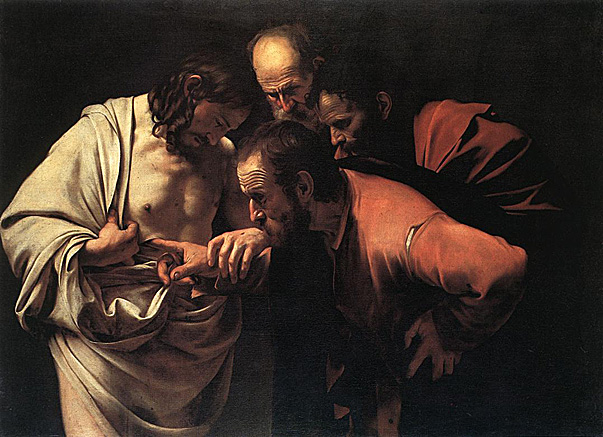
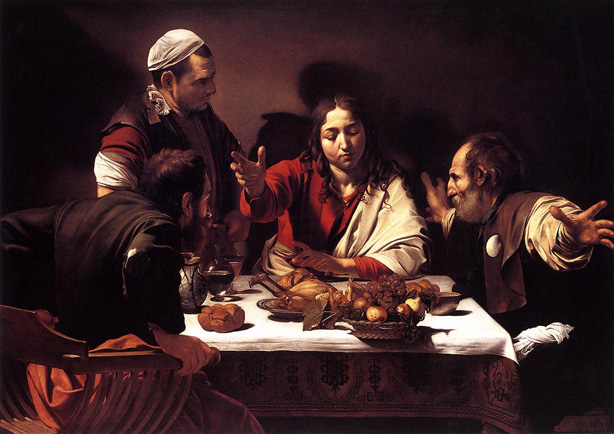
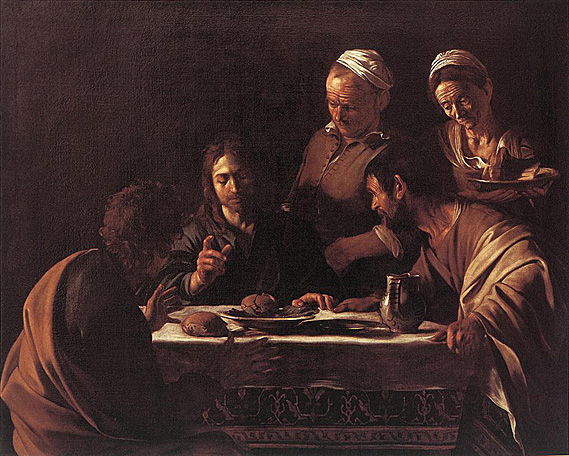
I do not know if Caravaggio ever painted Jesus' resurrection. It would be fitting, somehow, if he had not. (The closest we get, so far as I can determine, are The Incredulity of St. Thomas and his two versions of the supper at Emmaus.) Christ's resurrection, Christians believe, is a prefigurement of our own rescue from death. But it is not yet lived experience. Caravaggio, at his most compelling, painted what he knew.

In this excerpt from his essay "Caravaggio: A Contemporary View," we have Berger discussing Caravaggio's painting within the context of Berger's understanding of him as a champion of the underclass--which, by the way, I think it safe to say Jesus was and is, too--certainly, that is an idea I have found myself returning to many times this Lent. At any rate, what follows is one of my favorite discussions of one of my favorite paintings. Easter is coming, in more ways than one; there will be time aplenty for that. For me today, though, it feels right to be ending Lent on this note.

Once I was asked to name my favourite painter. I hesitated, searching for the least knowing, most truthful answer. 'Caravaggio'. There are nobler painters and painters of greater breadth of vision. There are painters I admire more and who are more admirable. But there is none, so it seems - for the answer came unpremeditated - to whom I feel closer.

The few canvases from my own incomparably modest life as a painter, which I would like to see again, are those I painted in the late 40s of the streets of Livorno. This city was then war-scarred and poor, and it was there that I first began to learn something about the ingenuity of the dispossessed. It was there too that I discovered that I wanted as little as possible to do in this world with those who wield power. This has turned out to be a life-long aversion.

The complicity I feel with Caravaggio began, I think, during that time in Livorno. He was the first painter of life as experienced by the popolaccio, the people of the back streets, les sans-culottes, the lumpenproletariat, the lower orders, those of the lower depths, the underworld. Interestingly enough, there is no word in any traditional European language which does not either denigrate or patronise the urban poor it is naming. That is power.

Following Caravaggio up to the present day, other painters - Brower, Ostade, Hogarth, Goya, Gericault, Gultuso - have painted pictures of the same social milieu. But all of them - however great - were genre pictures, painted in order to show others how the less fortunate or the more dangerous lived. With Caravaggio, however, it was not a question of presenting scenes but of seeing itself. He does not depict the underworld for others: his vision is one that he shares with it.

[snip]

His chiaroscuro allowed him to banish daylight. Shadows, he felt, offered shelter as can four walls and a roof. Whatever and wherever he painted he really painted interiors. Sometimes - for 'The Flight into Egypt' or one of his beloved John the Baptists - he was obliged to include a landscape in the background. But these landscapes are like rugs or drapes hung up on a line across an inner courtyard. He only felt at home - no, that he felt nowhere - he only felt relatively at ease inside.

His darkness smells of candles, over-ripe melons, damp washing waiting to be hung out the next day: it is the darkness of stairwells, gambling corners, cheap lodgings, sudden encounters. And the promise is not in what will flare against it, but in the darkness itself. The shelter it offers is only relative, for the chiaroscuro reveals violence, suffering, longing, mortality, but at least it reveals them intimately. What has been banished, along with the daylight, are distance and solitude - and both these are feared by the underworld.

Those who live precariously and are habitually crowded together develop a phobia about open spaces which transforms their frustrating lack of space and privacy into something reassuring. He shared those fears.

'The Calling of St. Matthew' depicts five men sitting round their usual table, telling stories, gossiping, boasting of what one day they will do, counting money. The room is dimly lit. Suddenly the door is flung open. The two figures who enter are still part of the violent noise and light of the invasion. (Berenson wrote that Christ comes in like a police inspector to make an arrest.)

Two of Matthew's colleagues refuse to look up, the other two younger ones stare at the strangers with a mixture of curiosity and condescension. Why is he proposing something so mad? Who's protecting him, the thin one who does all the talking? And Matthew, the tax-collector with a shifty conscience which has made him more unreasonable than most of his colleagues, points at himself and asks: is it really I who must go? Is it really I?

How many thousands of decisions to leave have resembled Christ's hand here! The hand is hold [sic] out towards the one who has to decide, yet it is ungraspable because so fluid. It orders the way, yet offers no direct support. Matthew will get up and follow the thin stranger from the room, down the narrow streets, out of the district. He will write his gospel, he will travel to Ethiopia and the South Caspian and Persia. Probably he will be murdered.

And behind the drama of this moment of decision is a window, giving onto the outside world. In painting, up to then, windows were treated either as sources of light, or as frames framing nature or an exemplary event outside. Not so this window. No light enters. The window is opaque. We see nothing. Mercifully we see nothing because what is outside is threatening. It is a window through which only the worst news can come; distance and solitude.


[UPDATE: If, however, someone would like some Easter reading to lighten the shadows, here is something from a while back that I'm still happy with.]

Read More...

Sunday, April 01, 2012

Midnight in Paris and nostalgia

Marion Cotillard (left) and Owen Wilson in a typical shot from Midnight in Paris. Image found here.

Midnight in Paris (2011; dir. Woody Allen).

Thanks to my colleague (and film buff) Larry the Movie Guy, the Mrs. and I watched Midnight in Paris this past Friday night. The Mrs.' quickie review: "That wasn't as terrible as I had expected." (She had said earlier that she has had trouble understanding Woody Allen films in the past and was afraid this might be the case again with this one.) As for me, I confess to not being too excited about seeing this one; I'd read a positive review last summer that, even so, made its time-warp sequences sound to me, in that precise film-critique term, "flaky." But because I still have yet to see many Woody Allen films and because the first R-rated film I ever saw was Manhattan (I was mesmerized; I'd never seen a film like that before), and because Midnight in Paris was nominated for Best Picture last year, I thought I'd give this one a go.

I liked it, too, though it's not a film I absolutely must own a copy of. But something about it nagged at me and, as I sit here thinking about what nagged at me, I think also that that feeling just may be intentional on the film's part.

T.S. Eliot called London "Unreal city" in "The Waste Land;" that's probably the best way to think of Allen's Paris in the "now" of this film. The film's 4-minute-long opening sequence of shots of Paris progressing from morning to late afternoon, some scenes more familiar than others, all of them looking like images for travel posters, their colors looking a whole like any number of Impressionist paintings you've seen, sets the mood for the rest of the film. This is pretty ironic when you think about it: the Impressionists sought to paint exactly what they saw in the instant that they saw it, unedited. But of course paintings, no matter how spontaneous their creation, are themselves a mediated medium, just as all art is. For those of us whose sole experience of this city comes via photographs and paintings, these images become "Paris" for us; Paris the actual city, where millions of people live and work, not all of them especially happily, recedes from us. Towards the end of the opening sequence, we hear Owen Wilson's Gil Bender in voice-over, waxing rhapsodic about turn-of-the-(20th-)century Paris, and Gil's fiancée Inez (Rachel McAdams) tells him that he's not in love with a city but with a fantasy, and we'll eventually come to realize that what we've been seeing is Gil's image of what he imagines must have been the ideal time to have been in Paris, not the actual place. (Unless I'm forgetting something, the most contemporary structure we see in the opening sequence is the glass pyramid in front of the Louvre.) We've just been shown a Paris, in other words, that is the result of Gil's fashioning from things he has read and seen of it from a time that he admires.

This post was going to be a bit of a rant about how we have here yet again a film in which Americans glide across the surface of a place, never seeing it on its own terms, for good or for ill; that this film asks us to prefer Gil's culture tourist to Inez's and her parents' (Kurt Fuller and Mimi Kennedy) chilly, cash nexus-driven engagements with the place, yet Gil's back-in-time midnight perambulations aren't any more genuine. Nor is the desire of the flapper Adrianna (Marion Cotillard) to stay in the warp that deposits her and Gil in the Belle Epoque of late 19th-century Paris. That is, her desire is genuine, but that which she seeks to achieve through its pursuit is not.

As I first thought about this film, I thought it was diving into some pretty, and pretty deep, nostalgia-wallowing. In thinking about it more, though, I see that it pulls out of that dive. These desires for times other than Now, as Gil rather wordily tells Adrianna towards the end of the film, are pursuits of happiness rather than of genuineness--just as Inez in her own way had told him near the beginning of the film. Inez isn't well-suited for Gil, but she knows him better than he knows himself.

I think to say much more would be to spoil some things, so I will stop here. But I will say that Midnight in Paris is a sly meditation on the seductiveness--and, thus, the perils--of nostalgia. Worth seeing, or borrowing from someone.

Read More...

Thursday, March 22, 2012

The obligatory picking-through-the-ashes-of-one's-bracket post

Image found here.

Well, we gave it a go. I can take some comfort in the knowledge that very, very few people picked Missouri to lose to Norfolk State; I'm pleased that I picked Lehigh to beat Duke and that, as I had originally picked, Ohio U. is in the Sweet Sixteen. But the upshot is that only half of my Sweet Sixteen selections are actually going to play tonight and tomorrow. This saddens me, since I do have a small wager on all this with my in-laws: the winner gets six-packs of the beer of his/her choice from the losers.

But there may be hope yet for those three six-packs of Shiner Bock. My mother-in-law has proposed the following: that we keep all our correct choices thus far AND re-set our brackets beginning with the new rounds. This pleases me because, she informed me, I am at present in the lead but, under the old bracket, soon would not be due to the fact that none of my original Final Four selections even remains in the tournament (for your amusement: VCU, Missouri, Florida State and Belmont).

So, beginning in about an hour, we'll get to see how my following picks do, placed under the fold to spare the uninterested:


SOUTH Regional:
Kentucky over Indiana; Baylor over Xavier; Baylor over Kentucky

[Baylor is one of the tallest teams in the tournament; that fact and their athleticism keep them in most games. IF Baylor shows a little more aggressiveness in its interior play and IF their perimeter game holds up, they just might put a stop to all this send-the-trophy-to-Lexington talk.]

WEST Regional:
Michigan St. over Louisville; Marquette over Florida; Marquette over Michigan St.

[Louisville and Florida are good when they're on, but they can be inconsistent in the face of a good solid team. Marquette gets the Final Four nod due to its superior guard play.]

EAST Regional:
Wisconsin over Syracuse; Ohio St. over Cincinnati; Ohio St. over Wisconsin.

[Wisconsin forces everyone to play at its speed, and it has superior perimeter shooting; Ohio State, though, seems comfortable playing either uptempo or half-court.]

MIDWEST Regional:
Ohio over North Carolina; Kansas over NC State; Kansas over Ohio

[I really like Ohio's inside-out game, which I think the Tarheels might be susceptible to. I confess to picking KU over the Wolfpack because I haven't seen NC State play yet and because I have married into a family of rabid Jayhawks fans. But Kansas will have its hands full with Ohio in the Elite Eight game; the Bobcats do. Not. Quit. But KU has size--and, after the Purdue game, Bill Self should have his players' attention.]

FINAL FOUR:
Marquette over Baylor; Kansas over Ohio State
Marquette over Kansas

[Marquette is really playing good, consistent basketball, whereas Baylor is like the little girl with the little curl right in the middle of her forehead. After beating Kentucky, the Bears may think their work is done. Kansas and Ohio State seem pretty evenly matched, except inside: KU has two pretty good big men to the Buckeyes' one. Of the four, Marquette is, again, the most consistent team here.

Now . . . you may very well see an image of the Hindenburg leading off next week's basketball post.

Read More...

On "snobbishness" and higher education

"To my astonishment, I was informed on leaving college that I had studied navigation!--why, if I had taken one turn down the harbor I should have known more about it." --Thoreau, Walden.

Thoreau's feigned dismissiveness of the value of formal education notwithstanding (he himself was a Harvard man), he does have a point: There indeed do exist any number of human activities which can be learned more effectively by doing them than by sitting in a classroom and reading and talking about them--activities, by the way, I and others a lot more thoughtful about these things than I am contend, that one doesn't necessarily have to have a college degree to become qualified to do.

It's from that angle that I find myself sorta nodding with Rick Santorum's recent remarks that treats as snobbishness President Obama's oft-stated goal of ensuring that as many people as possible have a chance to get a college education. Before a few days ago, I confess to not having thought too hard about Santorum's remarks beyond dismissing them as bald attempts to occupy the anti-elitist, colleges-seek-to-turn-everyone-into-godless-liberals seat of the GOP bandwagon. But a few days ago, Andrew Sullivan linked to two articles which take seriously Santorum's recent comments, though not quite for his given reasons. In other words, they (and I) think Santorum is right, but for the wrong reasons.

(And for the record: There are any number of ideas I'd love for my students to entertain that are probably at variance with their own, but it's been my experience that they seem to have very little practice in really thinking about the ideas they bring to the classroom in the first place, and that--the thinking part--is what we end up spending more time on.)

Besides: By Santorum's standards, it's not just Obama who is elitist--more and more, it is the work world that has become thus. I have had more than one student tell me that they have more than enough work experience to advance in their places of employment, but they are in school because they lack a BA or BS, which are stated requirements for those higher positions. The subject matter is irrelevant, they have told me; the company just wants them to have that piece of paper. (Which, come to think of it, isn't so elitist a position after all, but that of course begs the question of what sort of value that piece of paper actually signifies for the company that work experience does not, since they don't seem to care what it might signify for the employee.)

So anyway, I find myself in a quandary. I'm obviously sympathetic toward the idea, in the abstract, that students go to college. However, as pleased as I am, again in the abstract, that Obama has spoken so frequently of the value of community colleges in our nation, I have reservations, often stated in this blog in the past, about pushing too hard the college-is-for-everyone theme. At least as we do things at my place of employ, all too often my colleagues and I see students who simply aren't ready even for community college. I'm not speaking here merely of intellectual preparation; I'm also referring to the lack of discipline and desire to do what is asked of students, not to mention impediments arising from family, employment, etc. Adding to my quandary is that my understanding of Obama's rhetoric regarding community colleges is that he thinks of them as chiefly providing voc-ed training--which I wish were both more nuanced and accompanied by a companion argument for beefing up academic preparation and restoring the legacy of voc-ed training in high schools, as advocated for in the articles linked to above (and as I posted on here a while back).

But. We live in the world we live in. And in that world, or my corner of it at least, we're beginning to hear rumblings that colleges and universities may some day be held financially accountable in some way for the numbers of students they graduate. The argument runs like this: Given colleges' ever-growing socioeconomic importance and the state and federal monies that fund higher ed, it stands to reason that government wants to see some sort of positive return on investment in the form of a certain percentage of students clutching diplomas within a reasonable period of time after they enroll as dewy-eyed freshmen. Completion of degree=Successfully-educated person.

Neither of us has time for me to recount the number of ways in which this is a terrible idea (many of those reasons will just sound elitist anyway), so I'll just stick with the one that I hope will demonstrate its terribleness, by the very standards described above.

The Chronicle of Higher Education has up an interactive website showing graduation rates for all public, private, 2- and 4- year schools, both non-profits and profits. It's kind of fun to look at, but a little thinking about all this data soon reveals that we have to have better ways of measuring "student success"--which is to say, a broader metric or set of metrics--than graduation rates.

I know a little more about Kansas 2-year schools than I do about those of other states, so I'll be discussing this data. So, apologies in advance for the Inside-Baseball quality of some of what follows. But even allowing for the fact (and crying shame) that some schools' low graduation rates indeed do reflect that those schools are failing to serve their students in important ways, I hope to show that for some schools--like my own--those low rates may in fact not be anything to be ashamed of. Moreover, I strongly suspect that what is true of Kansas schools is equally true of many other schools throughout the country.

If you follow the link above, you'll see that good old Butler Community College leads the pack of the Kansas 2-year schools with the lowest graduation rates. Butler is the second-largest community college in the state; Johnson County (located in the Kansas City metro area and with a much lower graduation rate than we have) is the first largest. We, they, and the other schools with the lower graduation rates have one very big thing in common: The vast majority of the students we see never intend to graduate from these schools in the first place. They are there for a semester or a year, intent on earning transfer credit before enrolling in a four-year school in the area; they are there to earn a certificate in some sort of training that doesn't require them to actually take a degree; many are part-time; many, because of other obligations, want to take a degree but won't be able to complete it in two years. If such students, in the "Completion of degree=Successfully-educated person" formulation, are somehow equated with high school dropouts and/or that their leaving without completing a degree is seen as an institutional failure, I would argue that such a judgment is unfair to both the college and the student. Assuming that students have indeed achieved what they enrolled for in the first place (and actually learned some things besides), I would argue that we have served those students well, and on their own terms at that.

And here's where the "college-for-all=snobbery" dynamic cuts in a way other than that intended by Santorum. I assume that a President Santorum would be in favor of holding colleges accountable in some way for their "success" in educating students. I would simply say, though, that as long as students are still not obligated to attend college, it would be equally snobbish if state and federal governments were to devise some way of measuring student success that did not also try to take students' academic goals into account. To neglect or negate those measures would be to neglect or negate that which is an implicit assumption of a college education--and, indeed, what gives it its real value: that students' choices initiate and perpetuate (or not) that thing called a college education and that they therefore can be held accountable for the choices that follow from that. For the state to behave otherwise infantilizes and disempowers grown men and women who are seeking to take charge of their educational lives.

(None of this, I hope you understand, argues against colleges' not being held accountable for things that are under the control of faculty and administration. Obviously.)

You can see where this is going, I hope. I'm all for the educational nanny state to do its thing up to and including high school, and that is why I'm in favor of high schools that, as they once did, provide a basic education their graduates will need for entry into the adult world. High schools would once again seem relevant and important to all concerned. Employers should encourage this thinking.

College, meanwhile, should be for adults, and the ways in which the states evaluate what colleges do should in part reflect that no one who is there has to be there, or is there for exactly the same reason.

Read More...

Tuesday, March 13, 2012

The obligatory March Madness post

An ad that appeared in this morning's Washington Post. Despite the ad's immodesty, Virginia Commonwealth just might be able to back it up. Image found here.

I've had nothing to say this season about college basketball, but (thanks/curses to cable in the Meridian household) I've seen a lot of it. It's been a strange season, in my mind, and this bracket--actually, the saner of my two brackets--is a reflection of that strangeness. [UPDATE: There is an entry at that link, but apparently only I can look at it. Or maybe you can. I no longer know. If you you can, great; if you can't, just trust that the remarks below reflect what's on the bracket.]

To spare the uninterested, I've placed some comments on my bracket below the fold. But here are a few teasers:

National champion: Missouri.

I have Kansas being beaten by yet another small school whose name begins with a "B."

I have 9 2-digit seeds upsetting higher seeds in the first round of games; I have two 2-digit seeds in my Final Four.

I know it sounds nuts. It probably is, truth be told. But there really is, this season, a lot of parity in college basketball. Just about anything could happen.

For what it's worth, of this year's teams, I've seen 23 of them play at least one half of a game. And so, as I looked over this year's pairings, I kept thinking how, with very few exceptions, so many of these first-round games will be between teams that, on paper and/or according to my own "eyeball test," are very evenly matched. Case in point: the opening-round game between Wichita State and VCU. Before the announcement of the brackets, I was thinking the hometown team would have a very decent shot at a deep run--they have the sort of team that seems to be able to play any style of basketball; they have good size; they defend pretty well. But when I saw that they would be paired with VCU for their first game, I amended my thinking. VCU is young, but they press relentlessly and they're deep. I am no longer so certain of Wichita State's chances; indeed, I've picked them to lose . . . but they could just as easily win, if they handle the press well. (I have the Shockers winning in my other bracket.) To my mind, game after game is like this, where you'd do pretty well just by flipping a coin.

Of this year's top teams, Kentucky and Syracuse have the better players, and then there's everybody else. But those teams have weaknesses that make them vulnerable if they get matched up with the wrong team. Kentucky, for example, doesn't handle being pressed well; a team like VCU, which presses aggressively, could give Kentucky (or any team) fits. Syracuse, despite its size, doesn't rebound well, and its zone makes it susceptible to perimeter shooting. I don't think either will make it to the Final Four; I have VCU indeed busting brackets again and ending up beating Kentucky in the regional final, and Vanderbilt (who, remember, just beat Kentucky in the SEC Tournament's championship game) beating Syracuse and then being beaten in turn by Florida State.

I think that of the #1 seeds, Michigan State and North Carolina are the best teams, but Michigan State seems susceptible to quickness, while North Carolina is susceptible to teams that play good defense. So, I have Missouri beating Michigan State in the regional finals, and Belmont beating the Tarheels in their regional final.

Now, some comments on Big XII teams:

Kansas and Missouri are 2-seeds. The Jayhawks are an enigma this year: they are talented; but, as anyone who saw their tournament game with Baylor can attest, they have moments when they don't look bad so much as disinterested, which is even worse than bad. If the other team wants it badly enough, KU is vulnerable. I've also noticed that KU isn't especially good in games dominated by half-court play. Finally, given Kansas' recent tournament history against smaller schools whose names begin with a "B" (recall the Jayhawks' defeats at the hands of Bradley and Bucknell), it can't be a good thing that Belmont appears in their sub-regional bracket, especially given that Belmont is an experienced team that almost beat Duke in Cameron this year and plays aggressive defense.

As for Missouri, when they are hitting their shots, they more than compensate for their short height and short bench . . . and of late, they've been hitting their shots. Texas came close to beating them in Austin this year with aggressive perimeter defense, and a good defensive team like Michigan State could beat them. Missouri's quickness, though, should stand them in good stead throughout the tournament . . . assuming they keep shooting lights-out.

Baylor is a 3-seed. I really want to like them in this tournament. They are are the sort of team that should do well--they are all long and rangy; they seem comfortable playing both up-tempo and more deliberately--except for their really lousy zone defense (their length makes them much more effective in man-to-man). But, when they're not good, they're like KU's doppelganger: they always seem interested when they play, but they often just look bad.

Kansas State and Iowa State are both 8-seeds. Both these teams can (and did) beat anybody in the conference this year; K-State in particular has overachieved, beating Missouri twice in the regular season. Iowa State has the misfortune of drawing UConn as its first opponent, though, and the Cyclones' perimeter game will have to be clicking if they want to advance. Meanwhile, though K-State should beat Southern Miss in its first game, they will (most likely) meet Syracuse in their next game. K-State rebounds much better than the Orange, but Syracuse has size and experience on its side.

And then there are my Longhorns, an 11-seed matched up with Cincinnati in the opening round. Texas is a young team--they start a senior, a junior and three freshmen--talented players, but they are still learning how to play together. They show flashes of goodness, if not greatness, on offense; they can defend pretty well, and for once they are hitting free throws more consistently. (I long ago lost count last year of how many games they could have won if not for missed free throws.) A couple of weeks ago, after they blew an 11-point halftime lead to lose to Baylor, coach Rick Barnes publicly said his team doesn't listen to him about in-game situations. Frankly, I'm a little surprised to see them in the tournament. I'm glad for them. But I think their stay will be a short one. I've not seen Cincinnati play, but from what I've read they have been playing pretty well of late.

So. In re-reading all this, I sound like I know a lot more than I actually do. I have a feeling that this year's tournament will make many people look foolish. I'm kinda looking forward to that.

Read More...