Showing posts with label Cormac McCarthy. Show all posts

Sunday, May 06, 2012

". . . and its beauty was not lost on him": An open letter to Terence Malick

Terence Malick and Christian Bale, Austin, Texas, September 2011. Image found here.

Dear Mr. Malick,

I'm under no illusions here. You almost certainly will never read this. For one thing, who the heck am I to you? For another, you don't strike me as the sort of guy who has a publicist who Googles for mentions of you. Finally, and most important, you are pretty busy right now, it appears, what with a film just finished last year and two that you're shooting this year. But I still feel compelled to say a little something that's directed toward you, so I'll get right to the point so that you can decide whether to read further.

I think you should direct the film adaptation of Blood Meridian.

I admittedly don't know a whole lot about you, but I do know this: Back in March, at some point during my watching The Tree of Life, I remember thinking, This guy should be making films of Cormac McCarthy novels. Maybe that thought was prompted by how you film Nature and landscapes as though you take seriously Emerson's descriptions of wooded areas as plantations of God. Maybe it was during one of those scenes in which Brad Pitt's character Mr. O'Brien isn't saying too much but the viewer can sense his frustration and even anger--but not in/with that particular moment per se, but with the totality of his life that has brought him to that moment and not some other, more preferable one. Or it simply may have been my growing awareness that you take seriously and head-on the enormous questions of how and in what we find meaning in human existence without making it all sound sappy or easy--and, by the way, doing so via rich, lyrical--yes, McCarthy-esque--language. Anyway, it wasn't long after I had cast you as my preferred director of McCarthy's work that I thought, Yes: Blood Meridian is the film you should be making--this despite the very obvious fact that that novel and The Tree of Life don't have a whole heck of a lot in common on the surface.

Recently, though, my colleague Larry the Movie Guy lent me his copy of your film The Thin Red Line (IMDB), and I watched it. As the Wikipedia entry makes clear, it's a bit of a mess, especially with all the cameos of Stars We've Heard Of and, "offstage," the upset egos surrounding all those other performances that were truncated or cut altogether. But as I watched your war film, I felt that my earlier judgment about you was vindicated: the opening sequence with the AWOL soldiers living in a Gauguin-esque South Pacific world; the scenes in which soldiers crawling through the tall grass can barely see through it a yard ahead of them; the scene in which a squad silently contemplates the brutally-mutilated bodies of two Army Rangers (the power of this scene, for me, is not in the horror of what was done to these bodies but in the men's contemplation of them); the chaotic scene in which the squad takes the hill from the Japanese; the fleeting recollections Private Bell has of his love for his wife; and through it all, again, those unapologetically gorgeous voice-overs contemplating the good and evil in each of us, asking about their origins and what causes which to be revealed--all of these things caused me to think about corresponding moments in McCarthy's novel and how you might render them and I found myself thinking Yes. Yes.

According to both Wikipedia and IMDB, the film adaptation of the novel is languishing in whatever the Hollywood equivalent of an "In" box is. In a way, I'm glad that's the case. When I'd read, some years back, that Ridley Scott had initially been chosen to direct it, I confess that my heart sank a little; much as I admire Blade Runner--a comparable narrative, to my mind--I think Blood Meridian requires a lighter touch. (And yeah, you Blood Meridian fans--I know just how that sounds.) As for the other names associated with adapting it and bringing it to the screen--Todd Field, James Franco and Nicolas Winding Refn (whose Drive was one of last year's Best Picture nominees)--I admit to not knowing their work. Maybe they'd be adequate to the task. But I feel certain that you would be.

Here's why: There's no getting around the fact that Blood Meridian is filled not just with violence, but with scene after scene of the most extraordinarily brutal violence in, perhaps, all of American literature. Everyone who reads McCarthy gets that part, and any film version of this novel has to depict that inflinchingly. But McCarthy's goal here is not to depict violent acts for their own sake but to say something about the nature of the people--and peoples--committing it: how the very people sitting around campfires arguing against Violence in the abstract can, the next day, commit themselves so fervently to horrific acts of violence the next day; and how it cannot be an accident that McCarthy has included in his narrative Delaware Indians--members of the tribe that had raised James Fenimore Cooper's Natty Bumppo--and, shall we say, thoroughly de-romanticizes them in the process. And on and on.

But there are two final things that I think most people miss about this novel but you, Mr. Malick, would not, and would make sure to make present in your film version. In fact, these features are what help me get through this thing whenever I read it--because, I must be honest, even after having known and admired Blood Meridian for so long, it has become no easier to read because of its violence. The first is that, while this novel is not long on depictions of introspection on the part of its characters, those moments are there, and you'd be certain to reveal them, as, for example, in the novel's opening scene as the kid listens to his father's drunk ravings about his wife's death while giving birth to the kid or, in the briefest of biographies of Glanton, when we learn that he is married and will never see his wife again. In both The Thin Red Line and The Tree of Life, you make powerful use of brief flashbacks that reveal the interiority of your characters, revealing them to be more complex than they would otherwise appear; these flashbacks are crucial in the novel, and would be equally crucial in any film version, in making these characters more than unthinking killing machines. The other thing is something of a corollary to the first: page after page of McCarthy's novel contain richly-described scenes of weather and landscape. The scalp-hunters often don't notice their surroundings except insofar as it reveals something of the Indians they're seeking, but someone certainly notices, or else they wouldn't be in the novel. Vereen Bell, in The Achievement of Cormac McCarthy (the first book-length study of the writer's work (but only up to Blood Meridian); no longer in print, but I'd assume most university libraries would have it) makes the (to me) persuasive argument that the novel "is haunted by the mystery that its own language challenges the very nihilistic logic that it gives representation to" and that we see this most clearly in its "reverence for nature and for the way in which nature corresponds to an imagined condition of being that the facts of life otherwise contradict" (128). As one of his examples, he quotes a scene in which the scalp-hunters are riding through an aspen grove that has turned golden in the fall: "The leaves shifted in a million spangles down the pale corridors and Glanton took one and turned it like a tiny fan by its stem and held it and let it fall and its perfection was not lost on him" (qtd. in Bell 128-129, my emphasis). These are the sorts of thing--subtle but crucial to the novel--that you would not miss: neither these richly-described landscapes, nor the text's (and its characters') occasional noticing of them. There are also various surreal set pieces (the Comanche attack; the Judge and the idiot as they hunt the kid in the desert; the kid's encounter with an old Indian woman; the saloon scenes at Ft. Griffin at the end of the novel; etc., etc., etc.) that you'd be able to handle without making them ridiculous-looking.

So what do you say, Mr. Malick? I am not certain of too many things, but I am absolutely convinced that you'd not mess up this job, which would be oh-so-easy even for a skilled director to mess up. If you want to know more, I have no "people" to talk to. Just let me know. One last thing: even if you don't take up this project, thank you for making such extraordinary films.

Sincerely,

John B.

Read More...

Wednesday, May 18, 2011

The Kid grows up in a trailer park: Wallace does McCarthy

This isn't one of the promised reviews; instead, I thought I'd pass along a little something before I head off to Topeka and thence to Austin for a week or so.

What follows isn't a review or commentary. Just a nod in the direction of a pretty good writer.

I've just started The Pale King, in part because, well, it's David Foster Wallace, and in part to see just how wrong I was about the Hamlet stuff. (Too early to say yet, in case you're wondering.)

To say this thing is multivoiced would be an understatement--I'm only 60 pages in, and already there have been a good half-dozen 3rd-person limited narrators speaking on behalf of people who are either already in Peoria or are headed there but don't yet know it . . . and, a peek ahead to the chapter that follows the one I'm in now shows that the author himself will be joining them. I already knew from Infinite Jest that Wallace's ear for dialogue is such that he can make himself sound like anyone, but in The Pale King it's his narrators who are multivoiced. As best I can recall, this is a new thing for him (though there are flashes of this ability in his short stories), and it's exciting and confusing and, if I dwell on it too long, more than a little sad that he didn't get to finish this thing.

Anyway. Here he is doing a pretty darn good Cormac McCarthy. The setting is one of several anonymous trailer parks (this one somewhere in the desert Southwest), and the central figure has a name--she is a young girl named Toni Ware--but the misery-filled childhood (though, here, with the smallest whiff of hope) is the same. Those familiar with the voice of Blood Meridian's opening chapter will know this voice, too:

The park's boys wore wide rumpled hats and cravats of thong and some displayed turquoise about their person, and of these one helped her empty the trailer's sanitary tank and then pressed her to fellate him in recompense, whereupon she promised that anything emerging from his trousers would not return there. No boy near her size had successfully pressed her since Houston and the two who put something in her pop that made them turn sideways in the air and she could not then fight and lay watching the sky while they did their distant business.

At sunset then the north and west were the same color. On clear nights she could read by the night sky's emberlight seated on the plastic box that served as stoop. The screen door had no screen but was still a screen door, which fact she thought upon. She could fingerpaint in the soot on the kitchenette's rangetop. In incendiary orange to the deepening twilight in the smell of creosote burning in the sharp hills upwind.

Her inner life rich and multivalent. In fantasies of romance it was she who fought and overcame thereon to rescue some object or figure that never in the reverie resolved or took to itself any shape or name.

After Houston her doll had been the mere head of a doll, its hair prolixly done and the head's hole threaded to meet a neck's own thread; she had been eight when the body was lost and it lay now forever supine and unknowing in weeds while its head lived on. (55)


In that final image of the doll, in combination with what precedes it here, it seems, as I sit here thinking about it, that young Toni is the inverse of McCarthy's kid in those opening pages of Blood Meridian. Sneaky and powerful.

But, as I note above, Toni Ware is only one of several characters. Some of the ones I've so far met in this book don't even have the faint whiff of hope about them.

I don't know yet if I'll do any actual book-blogging of this thing. I guess we'll both see, on down the road.

Oh (and I promise this next won't become a habit, because I'm not that kind of reader)--here's an early line that resonates beyond the world of the novel: "Two eventual suicides on this plane, one forever classed as an accident" (18).

Read More...

Friday, April 08, 2011

Quote of the day

"[I'm a pessimist,] but there's no point in being miserable about it."

--Cormac McCarthy

Imagine: Cormac McCarthy, Werner Herzog, and Lawrence Krauss (director of Arizona State University's Origins Project), for an hour, talking about the intersections between art and science. That's what NPR's Science Friday treated its listeners to this afternoon. Highlights: McCarthy is up to speed on subatomic particle research and cave paintings (Herzog's 3-D film of recently-discovered 30,000-year-old cave paintings looks spectacular); Herzog reads a long passage from All the Pretty Horses; each waxes philosophical on how to think about and respond to the given, inarguable facts of our species'--and the planet's--eventual, inevitable demise.

Here's the link to the audio. It's an hour long, but you'll want to hear it. It's a very few pennies of your tax dollars at work. If this contributes to our nation's coming financial apocalypse, well, I'm really quite okay with that.

Read More...

Saturday, December 12, 2009

What matters? Two very different responses

I'm still reading and grading papers (I have needy students this semester, about which more later), but I wanted to pass along links to a couple of things before I forget to later on.

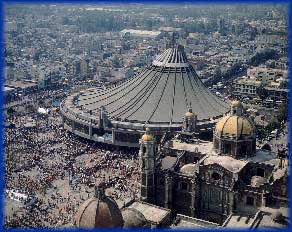
First of all: It's December 12, the feast day of the Virgin of Guadalupe, the patron saint of Mexico. This is a day when I am especially nostalgic for a place I love and spend more than a little time thinking on the terms "miracle" and "devotion." Long-time readers know that I've posted a couple of times about this day; in this one, I write about the time I was fortunate enough on a long-ago December 12th to visit the basilica in Mexico City dedicated to her. Apologies for the now-missing image from that post. To get a sense of the size of the the place I'm describing, go here.

Then, there's this long May 2007 review article by James Wood on Cormac McCarthy's The Road, "Getting to the End." Wood is a very attentive reader; you may not always agree with his take, but you can't argue that he's been slipshod in his reading. A sample follows:

It is the common weakness of novels such as Walter Miller's A Canticle for Leibowitz, Doris Lessing's The Memoirs of a Survivor, P.D. James's Children of Men, Kazuo Ishiguro's Never Let Me Go, or even Anthony Burgess's A Clockwork Orange and Orwell's 1984, that they are all to some extent science-fiction allegories in which the author extrapolates from the present, using hypothetical developments in the future to comment on crises that he or she sees as already imminent in his or her own time. . . .

McCarthy's vision is nothing like this. The Road is not a science fiction, not an allegory, and not a critique of the way we live now, or of the-way-we-might-live-if-we-keep-on-living-the-way-we-live-now. It poses a simpler question, more taxing for the imagination and far closer to the primary business of fiction-making: what would this world without people look like, feel like? From this, everything else flows. What would be the depth of one's loneliness? What kind of tattered theology would remain? What would hour-to-hour, day-to-day experience be like? How would one eat, or find shoes? These questions McCarthy answers magnificently, with the exception of the theological issue (about which more in a moment).

McCarthy's devotion to detail, his Conradian fondness for calmly described horrors, his tolling fatal sentences, make the reader shiver with fear and recognition. The Coke can is a good example: McCarthy is not afraid to stint the banal, and we are always aware of the contemporary American civilization that has been overthrown by events; it pokes up out of the landscape like fingerposts. There is a barn in a field "with an advertisement in faded ten-foot letters across the roofslope. See Rock City." (So we are in Tennessee, the scene of many of McCarthy's novels.) There are old supermarkets, and abandoned cars, and guns, and a truck the father and son sleep a night in, and even a dead locomotive in a forest. The narrative is about last-ditch practicality, and is itself intensely practical. In one of the houses they enter, the father goes upstairs, looking for anything useful. A mummified corpse is lying in a bed, a blanket pulled up to its chin. Without sensitivity, the man rips the blanket from the bed and thieves it. Blankets matter.

Read More...

Saturday, January 10, 2009

It's a Blood Meridian kind of Saturday morning

Oh noes! He's in the egez uv yur mas kultur, shapin yur kidz thotz!

Image found here.


Just some things I've happened to bump into this morning regarding this blog's namesake:

Via the Cormac McCarthy Society's forum, I ran across this: Six Versions of Blood Meridian

The "versions" are by six artists with very different styles--from Basquiat-like images to woodcuts to lush drawings of creatures that don't exist in this world--who have selected pages from McCarthy's novel to illustrate. Apparently, this is a work in progress, but if you're a fan of the novel or of McCarthy's work generally, I think you'll like seeing these. A couple of the images are, um, intense, but that shouldn't surprise readers of the novel.

WARNING: While you can enlarge each image by clicking on it, hitting your "Back" arrow takes you away from the site and sends you to wherever you had been previously. This is most annoying--so much so, in fact, that if I hadn't been so intrigued by their work I would have stopped looking at it far before I did.

It was while looking for some online, directly-linkable images from this site that I learned, Hey! There's a band named after the novel, too. They're a Canadian band working the Southern gothic genre of rock familiar to fans of bands like 16 Horsepower, though without that band's intensity. "Let It Come Down" is a good example of their work. (Quick assessment: They're okay; they sound like a rough-around-the-edges Jayhawks.)

Also found: a black-metal band called Earth has an album called Hex: Or, Printing in the Infernal Method (this image is the album's cover art), an album whose songs take their titles from passages in McCarthy's novel. All I've heard of this album's music is this, "Radford (The Felon Wind)", an 8-minute-long metal-ambient-drone-y, dread-inducing thing that, though it's not my usual sort of thing to listen to, does set a mood appropriate for much of the novel. It's probably something better not listened to if you're feeling anxious about the world and/or your place in it.

And, there's an album titled Blood Meridian by a electronica/dance band called Numb, though the title track, at least, is not a dance song.

I of course knew that this novel has gained immensely in prominence over the past decade and a half, but I was surprised to find the number of direct responses to it that I did. Of course, all these folks are responding to different aspects of it, and in ways that at times are, to put it charitably, superficial. But it's out there.

Read More...

Thursday, July 31, 2008

No Children's Story for Old Men? (Caption contest)

Sample caption: "That depends, Voldemort. Can you see me?"

An excerpt from "Cormac McCarthy Sends in His Treatment of the Final Harry Potter Movie,", by John Jasper Owens:

Harry stirs his cauldron but does not understand and Snape stalks his class and is pleased that Harry does not understand. Ron whispers about quidditch because Ron always discusses quidditch. When the Dark Lord returns he will pluck Ron’s liver with his gory talons and Ron will scream. He will scream about quidditch. Hermione is perfect and her work is perfect and the potion within her cauldron is perfect. It stirs itself as she stares at it and she does not blink. She does not blink. Snape arrives and he glances into Harry’s cauldron. Snape sneers. Fifty points from Gryffindor. Draco and Goyle gibber laughter. Goyle’s head is a pumpkin carved by an idiot and Draco’s teeth are wealthy and white and should be fangs but they are not fangs. They are not fangs.

Some comments below the fold.

Diclaimer: Your mileage may vary, of course.

I'll be honest: This is here in large measure because of the picture, which I think is inspired. The rest . . . ehh.

This is one of those instances of parody in which the two choices to be married in the piece are so inspired as to produce envy in those of us who find ourselves inclined on occasion toward writing parody, yet for some reason this just doesn't quite work. Speaking as someone who has tried and failed miserably in the attempt, McCarthy's style is very hard to parody. His combination of vocabulary and the King-James-Version cadences of his sentences is what's missing here. I think also Owens chooses scenes that aren't terribly McCarthyesque in quality--which is a shame because in Deathly Hallows there's plenty of material of the sort that, in the contexts of his own novels, McCarthy deals with all the time. "Deathly Hallows" itself has a McCarthy-like sound to my ear.

And there's no spitting. The other caption for the picture that I was considering was "Expectorare!" (or, more accurately, whatever the imperative form for that verb is--Grobie?)

Anyway: Please don't consider my choice of caption for this picture as the final word. I hope you'll submit your own captions in comments.

Read More...

Thursday, May 22, 2008

More on "Outlawyers": A note on inadequacy

In its immediate context, an affirming statement . . . but imagine Anton Chigurh wearing this. Image found here.

I was distracted by yesterday's posts and so didn't get around to posting this: Apologies for not earlier acknowledging Zunguzungu's kind mention of a post of mine here. His post (about which more below) is of the sort that makes you wish that your own work were worthy of mention there but you feel that maybe a little merit-by-association accrues to yours thereby via that mention. Anyway, some people have found their way here via that post and his cross-post over at The Valve. If you're here via those routes, welcome.

Zunguzungu's post, titled "You Know Who I Blame? The System!: The Wire, Barack Obama, and Omar for President," indeed covers all that and more: it ends up being a meditation on a version of the American archetype of the Rugged Individualist as embodied by Omar, who is Barack Obama's favorite character on The Wire. After noting some affinities between such characters and my idea of the Outlawyer, Zunguzungu gets to his post's central claim:

[A] true American is someone who makes his own justice.

In this sense, Indians are never the real villains of cowboy movies (and The Wire is not innovative in encouraging us to sympathize with the state‘s enemies); exactly because of the inevitability of their deaths, Indians could even become a figure of romantic attachment, valued almost precisely because every death seems to signify a step forward for progress. No, the real villain in Westerns, gangster movies, noir, and Mafia films is the same villain as in The Wire: “institutions” or an even more amorphous “the system.” And you don’t have to dig very deep into The Wire’s dvd commentaries or interviews with the creators to discover a very basic and overriding cynicism about the possibility of positive reform; as David Simon put it (in a quote I got here), The Wire “overtly suggests that our political and economic and social constructs are no longer viable, that our leadership has failed us relentlessly, and that no, we are not going to be all right.” These failures are, again and again and again, attributed to “institutions.”
I've not seen any episode of The Wire, but the bit here about "institutions" and The System being villainous made me think back on my Outlawyer post and No Country (and, for that matter, McCarthy's work generally) and realize that the Outlawyer doesn't find the System villainous. Rather, it's the System that finds itself inadequate even to articulate, let alone deal with, the parallel universe that is the code of the Outlawyer.

More below the fold.

In the novel, though not the film, Sheriff Bell says something to the effect that it's not that the people he's dealing with disrespect the law--it's that "they don't even think about it." Exactly: even disrespect for the law would signify a tacit admission that the System, ideally, will ultimately judge their behavior. In McCarthy's take on things (as I quickly survey his novels in my mind), the System is so ignored as to be finally rendered irrelevant and thus inadequate, impotent, pitiable: a neutered villainy. We, too--those of us who say the System still has relevancy--are to blame for this in McCarthy's mind because we collectively pay little more than lip-service to the notion of relevancy. It's a reiteration of Nietzsche (and, in her own way, Flannery O'Connor): "God is dead. God remains dead. And we have killed him." Perhaps it's this that lies at the heart of McCarthy's works' power: the realization that he may just be right about this and, holy you-know-what, what the hell are we going to do about it?

This theme is most forcefully given expression in Blood Meridian, chiefly in this cheery little homily by judge Holden:
Here there can be no special pleading. Here are considerations of equity and rectitude and moral right rendered void and without warrant and here are the views of the litigants despised. Decisions of life and death, of what shall be and what shall not, beggar all questions of right. In elections of these magnitudes are all lesser ones subsumed, moral, spiritual, natural. (Vintage paper edition, 250)
Because language is expressive of Systems (in case anyone cares, if I have an a priori theoretical point of reference, it's Structuralism), language, too, will be found inadequate in the face of that which occurs beyond our Systems' abilities to account for them, as I've tried to get at before. To circle back to something I noted in the Outlawyer post: this inadequacy of language is analogous what I was getting at with regard to the near-absence of a soundtrack--a film's world's language, its unspoken road-map for the viewer regarding how to respond to what s/he sees--in No Country. Or, as I put it to Lynnea the movie-lady as we talked about No Country at graduation this past Saturday, compared to other Coen Brothers films (which, according to Tim Blake Nelson in the "making of" featurette on the O Brother, Where Art Thou? DVD, look as though "they've been directed within an inch of their lives"), it's as though No Country "has no director." I meant that as a compliment, by the way.

None of this is to say that finding a System inadequate is always a bad thing, as my choice for an image for this post indicates, I hope. Indeed, as part of my project over at Domestic Issue I'll be fleshing out the claim that, if squinted at in a certain way, the term "New World" is a potential undoing of the the ultimate System, History (as embodied for my argument by the term "Americas"). Historicizing certainly has value for the establishing of immediate contexts, but too often (certainly in literary studies and, perhaps, in our politics as well) the tendency is to become emsnared by that past to the point that everything, no matter the point in time, seems a perpetual Present--to miss the very particulars that the goal of historicizing was to reveal to us in the first place: "'Twas always thus." What is bad about finding a System inadequate is if we have no adequate substitute for the inadequate one:
"Will there be something else?"
"I don't know--will there?"


UPDATE: As it happens, 3 Quarks Daily, almost exactly on point, has posted this poem by Czeslaw Milosz.

Read More...

Friday, July 20, 2007

Cormac McCarthy and the Deathly Hallows

Today is some sort of literary Harmonic Convergence: One of this country's very best writers is celebrating his 74th birthday on a day or, more precisely, an evening, that in the general vicinity of bookstore registers will be like D-Day but without the shooting and the sand.

It is a good day indeed for booklovers, I would say.

I was going to try to write a parody based on the title of this post, but the title was the best part of what I came up with--not a good sign. So instead I thought I'd link to two older posts of mine, coincidentally written within a week of each other in July of 2005: this one, in which I mark McCarthy's 72nd birthday by writing about Blood Meridian; and this one, which recounts the trip the Mrs. and I made to Wal-Mart(!?) to buy our copy of Harry Potter and the Half-Blood Prince (I know, I know--read to see why).

A quick word about the latter post: It seems that with the release of each Potter book there has also come along a peripheral discussion on the topic of, if I may broadly characterize it, "But is it any good?" (Embedded in that discussion is, inevitably, "Is it any good for us?") The same has been true this time around as well, though I'm deliberately avoiding a lot of the chatter this year lest I accidentally bump into spoilers and I, too, be reduced to tears. But that post says all that I would want to say about the matter anyway, so why repeat myself?

In yet another strange confluence, though, that same post mentions Oprah's Book Club and its influence on book marketing . . . and we all know what just happened in that little corner of the cosmos . . .

Anyway: Happy Birthday, Mr. McCarthy, and many happy returns of the day to you. Thank you for the gifts of your novels, which harrow the soul and give us not just glimpses but the most intense sorts of meditations on our darker and better natures. Thanks also for not yet beating me up over the title of this humble blog. And to Ms. Rowling, thank you for giving countless people--in particular my daughters--not just pleasure but much of consequence to think about, and thank you most particularly for treating children everywhere with such genuine respect and care.

Read More...

Tuesday, June 26, 2007

Accounting for things

More duties of the sort I described here require me to be away from "here" again for the next day or so, but I have the urge to post some little something, for some reason. More substantive posting to appear here when I return.

A couple of weeks ago, the Mrs., her father and I watched the last episode of The Sopranos together (we'll just set aside for the moment the strangeness of watching that episode when I've never seen a single Sopranos episode in its entirety), and somehow afterward we got on the subject of Cormac McCarthy's novel No Country for Old Men. My father-in-law said it sounded like something he'd like to read, so last week we got him a copy. And this past Saturday, my baby-wrangling duties greatly reduced, I went over to his place to help him assemble his hydraulic above-ground lift for cars (10- and 15-foot sections of cast iron of sufficient thickness to lift and support full-size cars and trucks (one of the top six models here) are really, really heavy), and while there, he told me that he was "addicted to that book."

Good to hear but otherwise unremarkable, you are thinking. Well, yes, except for that fact that the Mrs. later pointed out to me that in her memory she had never before seen her father read a book for pleasure. She's happy that he's enjoying the novel but can't get her head around the fact that this man she thought she knew has so caught her by surprise. Personally, I think it's her surprise that is the surprise here; though not highly educated, her father is an intelligent, thoughtful man. For his part, if he is also surprised by his enjoying the novel, he hasn't shared that with us. Even so, there's still the fact that her father has not been a reader for most of his adult life and now, seemingly out of the blue, he appears to want to become one (on Sunday, he asked me more about McCarthy, and after describing The Road to him, he said he thought he might like to read that as well). How to account for that?

My theory is that while, as he more than proved on Saturday, at 63 my father-in-law is much stronger than I have ever been or will ever be, he mentioned that day and in the past that his strength is not what it once was. But he's not willing, when the day eventually comes, just to fill the hours by plopping down in front of the television, either--he doesn't merely enjoy physical activity; his projects are of the problem-solving sort. They engage him intellectually every bit as much as they do physically. So, books. Maybe.

I know that one's more temporal predilections can change over time. But what about their underlying foundations--one's personality: apart from the experience of severe emotional or physical trauma, does that change as well? Or is the personality more like a sort of partly-exposed geological formation: as we grow older and experience more, different "sides" of us emerge, always there but, till a certain time, unexposed even to ourselves?

Well. It's not like my father-in-law's (apparent) new appreciation for books is causing us to think we need to lock our doors at night or something. Whatever the explanation, this is a Good Thing--for him obviously, and for the Mrs. and me because it presents us with a whole range of gift-giving options that we hadn't had before.

Two more tidbits having to do with Accounting for Things:

Via Clusterflock comes something called the Dunning-Kruger Effect, defined as "the phenomenon whereby people who have little knowledge systematically think that they know more than others who have much more knowledge." "Knowledge," by the way, doesn't pertain here only to the factual: "Across 4 studies, the authors found that participants scoring in the bottom quartile on tests of humor, grammar, and logic grossly overestimated their test performance and ability. Although test scores put them in the 12th percentile, they estimated themselves to be in the 62nd." (my emphasis)

Here's my question: we've all run into people who think they're funnier than they in fact are, and painful encounters they are, too. But how can one measure a sense of humor empirically? I've been puzzling over this all morning.

The other tidbit: Via the comments section for this post at Acephalous comes my first awareness of something called the Erdös-Bacon Number: "the sum of one's ErdÅ‘s number—which measures the 'collaborative distance' in authoring mathematical papers between that individual and Hungarian mathematician Paul ErdÅ‘s—and one's Bacon number—which represents the number of links, through roles in films, by which the individual is separated from actor Kevin Bacon." This is, in the grand scheme of things, a lesser piece of information to have than that concerning the Dunning-Kruger Effect--imagine hurling that little phrase at your blow-hard colleagues the next time you win, say, a debate over "who/whom" usage--but it's still fascinating to ponder the concept of the leisure time required to come up with such things.

He says, as he prepares to post yet another entry to a blog that is one day short of being 3 years and 4 months old.

Read More...

Tuesday, June 05, 2007

"You are a different kind of author"

Those were Oprah Winfrey's parting words to Cormac McCarthy in her interview with him, which aired here this afternoon. Them words're the God's honest truth, right there.

Back in March, some of you may recall that I posted about this; I said that though Winfrey's selection of The Road and his agreeing to be interviewed for television were more than a little surprising, I thought that on the whole it at worst would do no harm to him and at best would benefit her audience and other serious American writers.

Well. While no interviewers/interviewees were harmed during the making of the interview, I'm still not sure, despite the montage of images intended to evoke The Road's setting, that Winfrey's repeatedly saying that it would make a wonderful Father's Day gift quite conveyed to her audience what this novel is like. I mean, I don't necessarily disagree with that, but I don't think we're likely to see displays of this book set up by the Hallmark card racks. Nor did McCarthy come across today like the darker-visioned cousin of Melville that he has in the past. I mean, did he really say, "Life is pretty damn good"? Yeah: I wrote it down. But if that's the message of The Road, it's the hardest-won "Life is pretty damn good" that I've ever come across.

So. No mention of cannibals. I anticipate some surprised papas come Father's Day.

But it was less what was said about the book and more about what McCarthy revealed about how he works and what he thinks that I found fascinating. In his first interview (to promote All the Pretty Horses, he said that writing was pretty low on his list of interesting things to talk about; so, about all he revealed was that he writes on a portable Olivetti typewriter (and still does, I learned today). He wasn't much more forthcoming today, but he did say that he doesn't plot before beginning a novel. "Just trust," he says. As he writes, he has in mind an "image of perfection . . . [an] interior image of something absolutely perfect" that, nevertheless, he can never achieve. Spoken like a true Modernist.

Other bits:

He has a strong Tennessee accent and is surprisingly soft-spoken. His voice is a little reminiscent of Truman Capote's--an unfortunate association, because I found I couldn't get rid of it and it would occasionally get in the way of my listening. On the whole, he seemed surprisingly at ease.

Oprah mentioned that she has also read Blood Meridian(!) and No Country for Old Men. Out of her mentioning that, she asked him why he doesn't have many prominent women characters in his novels. "Women are tough. . . . I don't pretend to understand women." He said he thinks most men find them "mysterious."

When she asked him why, back in the days when he truly had little or no money, he would turn down invitations to be paid to give talks at universities, he said, "I was busy." That was probably the most McCarthyesque thing he said--either that, or "You gotta have food and shoes."

He was "busy," by the way, being a writer. He didn't say this, but in a couple of ways he made it clear that talking about writing is not part of the work of being a writer. Talking about writing is a kind of journalism, I think he would say; he said at the beginning of the interview that he doesn't despise reporters, it's just not what he himself engages in: "You work your side of the street, I'll work mine."

"I don't think you have to have a clear idea about who or what God is in order to pray."

So, no, it wasn't horrible. But let me close by relating to you a secret wish of mine as I watched today:

McCarthy wrote the screenplay for a film made in the '70s called The Gardener's Son (no IMDB listing, sorry; let's just say that it's out of print for a reason). One of its characters is a man with a wooden leg up to his hip. There's a scene in the film in which this man is riding in the back of a buckboard wagon with a young boy who doesn't know about the man's leg. The boy is just staring, staring at the man (who is, it must be admitted, a bit scary looking). Anyway, finally the man has had enough of this, so he suddenly pulls out his knife and stabs himself in the thigh of the wooden leg. And smiles. That cures the boy of his desire to stare.

That is the best scene in the film. Spare yourself the search.

Anyway, I hope I'll be excused for secretly wanting a moment like this to have occurred in today's interview, something so evocative of the man and his art as to impress on Oprah and her audience just how "different" this writer is.

______________
For those interested, Clusterflock is home to a bunch of serious McCarthy fans. There's a pretty good discussion of the interview going on there, too.

Read More...