Showing posts with label Aesthetics. Show all posts

Monday, July 04, 2011

"A potential model of freedom": An excerpt from "The Work of Art"

Jasper Johns, Three Flags (1958). Click on image to enlarge. Brief commentary here. Image found here.

Happy Fourth, reader(s)! Here's wishing you a safe and enjoyable consumption of food and beverages and fireworks-watching . . . and, yes, if you need it, history.

In keeping with the spirit of the day, my long-time online friend Pam of Tales from the Microbial Laboratory has posted a collection of four, very different performances of "The Star-Spangled Banner." All of them, I personally would say, are respectful performances, but it's easy to see how some could take issue with the appropriateness of a couple of them. The fact that two of these versions are by the same person makes watching them even more intriguing.

While watching these performances on Independence Day, I began thinking about the tension between the idea of artistic freedom and our assumptions about how the anthem "should" be performed. The artist who chooses to perform our anthem has a question to answer that seems simpler than it is: "Should I perform this piece of music? Or can I interpret it?" What is/are the expectation(s) accompanying a performance of the anthem, and how constrained should the artist feel by it/them? The dilemma is that the anthem is a piece of music that, like any music, must be performed in order to be fully realized. At the same time, though, the anthem is a piece of public art, just like any monument that seeks to memorialize an event or person from our history . . . except that, as noted, the anthem lacks a full existence until it's performed. It's not like, say, the Lincoln Memorial. Regarding the anthem, I think most people would say that ideally, the performance shouldn't ultimately be about the performer; those times in the past when performers have run into trouble for their versions, for whatever reason, have been when the performance in some way detracts from the "work" of the anthem. [Aside: Do other nations have discussions of the sort that some of us had after Christina Aguilera's forgetting the lyrics to the anthem when she performed it at this year's Super Bowl?] But that doesn't necessarily mean that only "straight" performances of the anthem "work" well or should be the only kind of performances permitted. Or does it? Put another way: Should performances of the anthem simply be, or should they, in J.T. Kirkland's phrase, "do something"?

This post started out this morning with my thinking on Kirkland's phrase and asking myself what exactly it is that Art does or "should" do; my questions about the anthem seemed to me to want to participate in all that. Kirkland phrase "doing something" (his italics) appears in his meditation on the directions his art is taking in this post. I really like that phrase. Like Kirkland, I'm not quite sure what it means; but like him (though speaking from my perspective as a viewer), I know it's happening when I see it: Art itself is intrinsically kinetic, and the interaction between art and audience is something like a dialogue. Anyway, while looking for something else by Berger, I found "The Work of Art" (in his Selected Essays. Berger's great power for me as a writer and critic is that he is completely invested in his subject and persuaded of its importance to people like you and me; as I phrased it here long ago, he believes "art and its appreciation can and should be something that you don't have to wear black and stroke your chin significantly in order to do." Even more important and vital an idea: that at its best, art "imitates a creation, something to propose an alternative world, sometimes simply to amplify, to confirm, to make social the brief hope offered by nature. Art is an organized response to what nature allows us to glimpse occasionally" ("The White Bird"; fuller context here). The making and appreciation of art, in other words, are essential to the establishing of community and as such are vital human social activities.

As for "The Work of Art" itself, its occasion is a response to Nico Hadjinicolaou's book Art History and Class Consciousness, an attempt to articulate a scientific Marxist art history. Shorter Hadjinicolaou: "There's no such thing as 'art history' or 'schools' or 'style'--there's only 'visual ideology,' the manifestation of those various environmental influences working on an individual artist at the time s/he engages in 'the production-of-pictures' [his preferred term for Art]." Shorter Berger: "[Hogwash]." Berger's politics makes him sympathetic to the need for a valid Marxist aesthetic theory; he notes that Marx himself, valorizing the empirical and the scientific as he did, could not account for why, despite the changing tastes of the centuries, we still think of centuries-old works as being that very unscientific thing, "beautiful." But for Berger the solution is not just to surrender the discussion of aesthetics to the bourgeoisie.

In the passage below, Berger lays out what's at stake in these discussions before going on to give his accounting of the artistic act. What's interesting to me is that, as per the title of his essay, his rhetoric conceives of that act as physical as well as intellectual labor:

The [Marxist] refusal of comparative judgments about art ultimately derives from a lack of belief in the purpose of art. [. . .] If paintings have no purpose, have no value other than their promotion of a visual ideology, there is little reason for looking at old pictures except as specialist historians. [. . .]

The culture of capitalism has reduced paintings, as it reduces everything which is alive, to market commodities, and to an advertisement for other commodities. The new reductionism of revolutionary theory, which we are considering, is in danger of doing something similar. [. . .] Both eliminate art as a potential model of freedom, which is how artists and the masses have always treated art when it spoke to their needs.

When a painter is working, he is aware of the means which are available to him–-these include his materials, the style he inherits, the conventions he must obey, his prescribed or freely chosen subject matter–as constituting both an opportunity and a restraint. By working and using the opportunity he becomes conscious of some of its limits. These limits challenge him, at either an artisanal, a magical or an imaginative level. He pushes against one or several of them. According to his character and historical situation, the result of his pushing varies from a barely discernible variation of a convention–changing no more than the individual voice of a singer changes a melody–to a fully original discovery, a breakthrough. Except in the case of the pure hack, who, needless to say, is a modern invention of the market, every painter from palaeolithic times onward has experienced this will to push. It is intrinsic to the activity of rendering the absent present, of cheating the visible, of making images.

Ideology partly determines the finished result, but it does not determine the energy flowing through the current. And it is with this energy that the spectator identifies. Every image used by a spectator is a going further [Berger's italics] than he could have achieved alone, towards a prey, a Madonna, a sexual pleasure, a landscape, a face, a different world. (434-435)


The idea of Art keeping us free through its constant firing of the collective imagination is really compelling to me today. I hope it might be for some of you, too.

Read More...

Sunday, June 13, 2010

Richard Serra and the Irreproducible: The aesthetics of fear

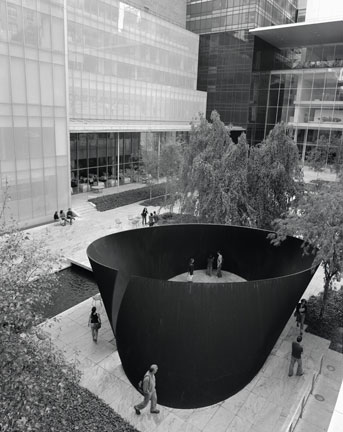
Richard Serra's Torqued Ellipse IV (1998), MOMA Sculpture Garden, New York, taken by Alexandra P. Spaulding. I like this picture because the viewer gets some sense of the scale Serra works on, as well as the weight of those sheets of steel (note the thickness of the edge). Here, by the way, is a shot that places this sculpture in its spatial context.

(My initial post on Serra is here.)

In no particular order, what follows are some bits and pieces that, with a little teasing out and squinting just so, might help push some ideas in that January post a little bit closer to, at least, field goal range.

**From John Berger's "A White Bird," which I discussed here back in February:

Art does not imitate nature, it imitates a creation, something to propose an alternative world, sometimes simply to amplify, to confirm, to make social the brief hope offered by nature. Art is an organized response to what nature allows us to glimpse occasionally. Art sets out to transform the potential recognition into an unceasing one. It proclaims man in the hope of receiving a surer reply . . . the transcendental face of art is always a form of prayer.


**In a comment on the first Serra post, Jim of This Analog Life noted that Serra's work summons adjectives like "monumental" and "memorial"-- and then asked, what's being memorialized?

**Somewhere, I read that Serra had once said that Robert Smithson's Spiral Jetty is "pictorial."

**Serra again, this time referring to the site-specific nature of his own work: "If you move it, you destroy it."

**Ralph Waldo Emerson, "Nature": "Why should we not also enjoy an original relation with the universe? . . . . Enbosomed for a season in nature, whose floods of life stream around and through us, and invite us by the powers they supply, to action proportioned to nature, why should we grope around the dry bones of the past, or put the living generation into masquerade out of its faded wardrobe? The sun shines to-day also."

**Walter Benjamin, "The Work of Art in the Age of Mechanical Reproduction":
"Even the most perfect reproduction of a work of art is lacking in one element: its presence in time and space, its unique existence at the place where it happens to be. This unique existence of the work of art determined the history to which it was subject throughout the time of its existence. This includes the changes which it may have suffered in physical condition over the years as well as the various changes in its ownership. (Illuminations 210)


In the comments for that first Serra post, I (half-)jokingly said my next post on this subject would contain "contributions from Emerson and This Is Spinal Tap." This is because I got to thinking of a place like Stonehenge within the context of the ideas of monuments and irreproducibility, and how the notion of irreproducibility would seem somehow to run counter to the idea of art as something that is reproducible--though not (as Benjamin argues and this scene illustrates) without some sort of loss. So, the gathering of the above bits is an attempt to ground that remark.

I know that Benjamin does not have Stonehenge in mind in his essay, but I think that it serves as a pretty expansive example of what he's addressing in the passage above. Stonehenge (I'm referring here to the site as originally built, not its current state) is not merely the stones but their placement--and not just in relation to the other stones but precisely where each stone is placed--and, moreover, on that hill, and not some other, neighboring hill. Stonehenge's physical location is included in the work called Stonehenge. But, given one of Stonehenge's apparent functions as an observatory built to mark and celebrate the beginnings of the seasons, it is not about itself alone, nor is it mimetic, a gesture in the direction of some other, immediately-recognizable object. Rather, it's a space in which we're asked to take seriously our relation to the cosmos in the moment in which we find ourselves at that place, not later at the pub or while we're posting pics of the place on Facebook. If Stonehenge is having its proper effect on us, we shouldn't be looking only at it. Otherwise, we're not seeing it.

I hope I'm not bastardizing Berger's meaning too much when I say this: Stonehenge is, like art more generally, "an organized response to what nature allows us to glimpse occasionally"--in Stonehenge's particular case, finding comfort and meaning in the ability to see beyond the Here and Now of our particular moment and be able to see rhythms and patterns in the sky beyond the sun's daily reappearance or, even, its yearly appearances in certain parts of the sky but be able to say, with as much certainty as possible, This will always be. Hence Stonehenge's irreproducibility: Stonehenge is not merely an arrangement of objects but an invitation that it can't extend except via our physical presence there to ponder an implicit metaphysical claim about the most essential questions of human existence. You have to be there.

[Aside: I wonder how a work like Walter De Maria's The Lightning Field fits into this discussion, especially given that its curators state that, despite its name, "A full experience of The Lightning Field does not depend upon the occurrence of lightning[.]" Whereas Stonehenge's existence and design are predicated upon the predictability (and affirmation of the importance) of a natural phenomenon, The Lightning Field's purpose is more like an invitation to consider and be open to nature's arbitrariness. Maybe. I have to think about this more, and elsewhere.]

I'm getting to Serra. Really.

The vast majority of art--even overtly-religious art--no longer extends such invitations to its viewers, nor has it for a really long time. (Maybe that's always been the case?) (This is true, these days, even of entire buildings built for expressly religious purposes: all one has to do is consider the office building-like quality of so many contemporary churches to see that this is so.) It engages us intellectually and perhaps even emotionally but not at the level of physical sensation, the idea that we're in its space and we must address its contribution to the intellectual and emotional dialogue between us and it as we look at it. This isn't due to the devaluing of the original in our age of mechanical reproduction but, rather, that its makers, for whatever reason, simply aren't interested in doing so. Or maybe I'm wrong about that (and I'd like to be) but that it's the rare piece of art that can make us forget we're seeing it in a museum or gallery or a classroom--that is, in an artificial space. To be sure, I have that flatness of experience far more often with sculpture than with paintings, as I noted in the first Serra post--paradoxically, most sculpture to me feels so self-contained, so much, ultimately, about itself, that despite its three-dimensional quality my chief preoccupation is how to get around the piece without bumping into it or other people. Again, I'm speaking for myself. Whatever the case, that flatness of response is a sad thing. I don't want to move around art. I want it to move me.

Perhaps, just perhaps, the monumental and memorializing quality of Serra's work arises from his attempt to hearken back recreate something of that "you have to be there" feeling in the audience, the feeling of tension one feels in the presence of genuinely great art that one can sense even when looking at pictures of it but which can't be fully replicated via pictures. But Serra's audience is far different from that of the builders and keepers of Stonehenge. Most of the self-identifying devout among us are thoroughly secularized, even in our religious lives; we have difficulty, I suspect, in fully grasping that structures designed for religious ceremony, not so long ago, were explicitly designed to elicit and shape a response in the visitor . . . and, in the case of ancient sites of worship such as Stonehenge, those structures likewise are constructed in accordance with natural phenomena that its builders wanted to draw attention to and offer implicit comment on. But. God may have created the cosmos, but Western religious expression is not predicated on seeing Him made manifest in its rhythms and patterns. How, then, to create a palpable emotional tension, verging on the physical, between the work and the viewer that can lead to a response verging on at least the existential, if not the spiritual?

Well, just look at Serra's pieces: You build something that looks like it might kill you if you get too close to it or if the wind blows--or, hey, if the earth moves--even as its very design requires that you get close to it. Judging from Jim's experiences with The Matter of Time at the Guggenheim in Bilbao, the fact that these pieces are in galleries and thus (we assume/hope) are deemed safe to be around doesn't mean that we believe that, no matter whether we know it (at the intellectual level). As Robert Hughes says of Serra's work, "It addresses the body through anxiety, and this is a thoroughly legitimate though long-repressed function of sculpture at its most archaic level." Serra's forms may be non-representational in the traditional sense of that term, but in another sense they evoke apprehension, if not fear . . . and not as abstraction but as an all-too-present, felt experience. Indeed, maybe part of Serra's point as well is that fear should be more present in our lives than it in fact is. And how can that idea be reproduced except by being in the presence of something that causes the viewer not just to muse on that idea but to genuinely feel it?

Serra's work is thus both contemporary in its forms and ancient in its concerns. But--assuming all this I've been speculating on here is even remotely true--is there in Serra's work also an accompanying catharsis of that fear? Not having seen any Serras in person, I can't say; I hope that someone will be able to speak to that question.

Read More...

Thursday, February 04, 2010

Excerpts from "The White Bird"

Image found here.

What follows are a few passages from John Berger, "The White Bird" (my source is Selected Essays). They might have some relation to some things I was trying to get at in my post on Serra and the Irreproducible. Maybe. But even if they don't, many thanks to Jim, in his comment on that post, for pointing me in this essay's direction. Reading Berger is always invigorating in its own right. Apologies for the length, but I want to show how Berger arrives where he does, and Berger is nothing if not a patient writer, showing his work. Especially in the case of the arts, anyone can declaim. Berger's great appeal for me is that he explains.

Everything not bracketed is Berger's own.

Urban living has always tended to produce a sentimental view of nature. Nature is thought of as a garden, or a view framed by a window, or as an arena of freedom. Peasants, sailors, nomads have known better. Nature is energy and struggle. It is what exists without any promise. If it can be thought of by man as an arena, a setting, it has to be thought of as one which lends itself as much to evil as to good. Its energy is fearsomely indifferent. The first necessity of life is shelter. Shelter against nature. The first prayer is for protection. The first sign of life is pain. If the Creation was purposeful, its purpose is a hidden one which can only be discovered intangibly within signs, never by the evidence of what happens.

It is within this bleak natural context that beauty is encountered, and the encounter is by its nature sudden and unpredictable. The gale blows itself out, the sea changes from the colour of grey shit to aquamarine. Under the fallen boulder of an avalanche a flower grows. Over the shanty town the moon rises. I offer dramatic examples so as to insist on the bleakness of the context. Reflect upon more everyday examples. However it is encountered, beauty is always an exception, always in despite of. This is why it moves us.

[snip]

[T]here seem to be certain constants which all cultures have found 'beautiful': among them--certain flowers, trees, forms of rocks, birds, animals, the moon, running water . . .

One is obliged to acknowledge a coincidence or perhaps a congruence. The evolution of natural forms and the evolution of human perception have coincided to produce the phenomenon of a potential recognition: what is and what we can see (and by seeing also feel) sometimes meet at a point of affirmation. This point, this coincidence, is two-faced: what has been seen is recognized and affirmed and, at the same time, the seer is affirmed by what he sees. For a brief moment one finds oneself--without the pretensions of a creator--in the position of God in the first chapter of Genesis . . . And he saw that it was good. The aesthetic emotion before nature derives, I believe, from this double affirmation.

Yet we do not live in the first chapter of Genesis. We live--if one follows the biblical sequence of events--after the Fall. In any case, we live in a world of suffering in which evil is rampant, a world whose events do not confirm our Being, a world that has to be resisted. It is in this situation that the aesthetic moment offers hope. That we find a crystal or a poppy beautiful means that we are less alone[; . . .] its form, perceived as such, becomes a message that one receives but cannot translate because, in it, all is instantaneous. For an instant, the energy of one's perception becomes inseparable from the energy of the creation.

[snip]

[. . . .]Art does not imitate nature, it imitates a creation, something to propose an alternative world, sometimes simply to amplify, to confirm, to make social the brief hope offered by nature. Art is an organized response to what nature allows us to glimpse occasionally. Art sets out to transform the potential recognition into an unceasing one. It proclaims man in the hope of receiving a surer reply . . . the transcendental face of art is always a form of prayer.

UPDATE (February 8): Over at Musings from the Hinterland, Randall pursues Berger's ideas in a couple of fruitful and compelling directions. Go and read.

Read More...

Sunday, October 26, 2008

"What if" vs. "As if"": A coda to "Why read something made up . . . ?"

Stanley Kauffmann's piece, "Departures, Arrivals", dated November 5, 2008 but now available at The New Republic's website, addresses Paul Newman's recent passing, a new documentary about the 1972 plane crash in the Andes whose survivors were forced to resort to cannibalism (we in this country best know this story as Alive), and a review of a vampire film from Sweden that, it seems, Ingmar Bergman might have approved of in some sense. Disparate subjects, to be sure, but within each subject Kauffmann returns, in some sense, to questions of belief and knowledge, broadly defined: precisely the questions that the best art should raise in its audiences as, while in its presence, we seek to square it with what we know or believe to be true of the world. As I read, it seemed like something of a revisiting, and an addendum, to this post from, coincidentally, almost exactly a year ago.

As the theme of belief and knowledge apply to Newman, the theme is, implicitly, manifest in the usual big question about Newman (which is not to dismiss its validity as a question): How could such attractiveness and talent have co-existed in one person? Once past his homage, though, Kauffmann digs deeper. On the power of Stranded: I've come from a Plane That Crashed on the Mountains, the documentary:

To read about what followed or to see it played by actors would be grim enough. But to hear about it from the aging survivors themselves, all men who are clearly civilized human beings, is disturbing in an unexpected way. We look at people who ate people--bits of bodies anyway--and we feel stripped of a veneer. All moral dilemmas are inevitably weighed against our judgment of what we ourselves would have done. No one wants to be asked the question that this film implicitly asks, yet facing the question is strangely salutary. We are a bit less fraudulently sure of ourselves afterward.
One might say after reading this that Kauffmann is making precisely the point that my student was in that earlier post. I would counter, though, that as Kauffmann puts the matter here, this documentary is doing more than most documentaries do--it is more than a mere recounting of events. In fact, when I read this passage I was instantly reminded of the questions raised by the core moment in Toni Morrison's novel, Beloved (a novel, by the way, based on an actual event): Having run off the plantation with your children and, now, facing recapture, what lengths would you go to to attempt to spare your children that return to the plantation? Who among us has the right (not to say the ability) to dispassionately judge the choice that Sethe makes?--which, by the way, is not to suggest that Sethe has made the correct choice, since the novel is also about that question as well.

Somewhere in the introduction to his book The Western Canon, Harold Bloom says something to the effect that great art's power is to make the world look strange as a result of having experienced it. One can, of course, argue with any number of particulars in that book, and I'd happily join you; that definition, though, has struck me as a valuable way of beginning to think about what I've experienced in the presence of something someone has told me has aesthetic merit. Has it moved me from the hypothetical--"What if . . . ?"--to the transformative--"As if . . . "--in its aftermath?

And that leads to Kauffmann's take on Let the Right One In, the Swedish vampire film:
When we see a rampantly commercial film made by people who we know are capable of better work, we understand that livings must be made, lives must be occupied, places in the scheme of things must be maintained. But Let the Right One In begins like a truly serious picture, a possible addition to the Swedish film treasury. (Sweden was one of the first countries where film was sometimes treated as more than entertainment.) More: this film continues seriously, in structure, look, tone. Nonetheless, it is a vampire story. We are forced to assume not that all these gifted people were just making a living, but that they believed in this picture. (Indeed, the central vampire elements wind through sequences that, in gravity and temper, seem to belong in another film.) That is the puzzle.

[snip]

The blood and the troubles meet in a finish that lifts commonplace childhood matters far up into the supernatural. Nothing is ever explained. That appears to be part of the point. If the picture has a theme, it might be that the inexplicable can burst into the midst of dailiness. Still, any puzzling about the why and wherefore of this picture cannot dim admiration for Alfredson's directing, especially of the two excellent youngsters, Kåre Hedebrant and Lina Leandersson. I wonder what Kåre and Lina dreamed about at night during the months of shooting.
These passages are so striking to me because--speaking for myself--even when experiencing a film that I genuinely admire, I don't often find myself wondering, consciously at least, whether this piece was also a transformative experience, however different from mine it may have been, on its makers as well. There is such a made-ness to film, such a sense of control over what the viewer sees, I tend to assume an emotional distance between the maker and the made: actors, writers, techies and, even, the director, in their ways like the workers on an assembly-line, work together to make something that is bigger than any one of them. At times one will read or hear those folks talk about the labor of making the film--the work--as being transformative, but not story that that work strives to make manifest. But that detachment, I know from having read enough stories of artists in other media, is a false one more often than not; so why would it not also be false, at times, for the makers of film as well?

I have no way of concluding this neatly except by saying that, come the spring and my Intro. to Lit. class, I look forward to raising all this at least on the first day, if not beyond.

Read More...

Thursday, July 24, 2008

"Beautiful Conundrum": Some musing on "ugliness" in art

The other night I was listening to iTunes when Sigur Rós' exquisitely beautiful "Ágætis byrjun" came on. As you listen, please read the following by my bloggy friend Camille of 327 Market (from here):

The model was so beautiful that he was difficult to draw. Artists often prefer drawing ugly things because then no one is going [to] judge us for failing at some standard of beauty. We love the fat, the rolls, the dimples, the hair and the scars. No inner voices are going to accuse us of misrepresenting that mound of flesh. But when we have something beautiful, all of a sudden, it is Eric Satie falling at the Altar of Beauty. Auguste is staring over our shoulders snorting derisively. Not only am I uncomfortable joining the worshipers, but I have enough doubts about my own skills. The horror of coming up short is something that can't even be looked at in the face. Just think of all the terrible, hack portraits of beautiful women floating around, at the garage sales, behind people's couches, on the walls of adolescent boy's rooms-- its a ring of Art Hell that should remain unspoken. (my emphasis)
I got to wondering, with respect to the song, if sometimes viewers and listeners are drawn to "ugly things" as well--though in a different sense. Is not "Ágætis byrjun" made more beautiful by the quite-loud sound of the fingers moving up and down the steel strings of the guitar? It comes between the notes of the melody, breaking the surface of the tune and causing me to re-focus my attention on the music once the sound goes away; in my case, I then find myself sort of listening ahead, wondering about, anticipating, the next time we'll hear that sound, exactly in the same way that one listens ahead when anticipating the rhymes in a poem--but in this case also listening closer to this gorgeous melody made all the more gorgeous by that impending irruption of sound into that for which we traditionally listen to music.

If not for that sound--that "ugliness"--I would not hear the song's music quite so clearly, or appreciate it nearly as much.

[UPDATE: Edited to correct the spelling in the title. Sheesh!]

Read More...

Saturday, May 10, 2008

Some speculation about Inuit art

Eli Inukpaluk, Shaman with a Bird Spirit, 1967-1968. Whalebone. From the Albrecht Collection at the Heard Museum. Image found here.

Press release put out by the Wichita Art Museum.


When I went a couple of weeks ago to see Arctic Spirit, a touring exhibit of Inuit art from the Heard Museum in Phoenix, I wasn't sure what to expect. But I do know that I didn't anticipate much of what I saw and learned on that visit.

I had assumed I would see a collection of older pieces--and, there are indeed a few century-old pieces of simple scrimshaw-like pieces. Imagine my surprise, then, when I saw at the entrance to the exhibit the piece you see here, accompanied by the following introductory text on the wall next to it:

From its humble beginnings in the 1950s as a way to wean Canadian Inuit (Eskimos) off welfare, contemporary Inuit art has blossomed almost miraculously into an art form symbolizing the resilience, ingenuity and vision of a people.
The part I really couldn't get past was the introductory clause: apparently, what I was about to see was the product of a culture whose contemporary aesthetic vocabulary had little or no precedent . . . and, even more importantly, had its origins in the most-worthy goal of helping this culture become economically self-sustaining.

I really was intrigued now. But something perhaps even more surprising awaited me further on. The subject of the piece you see pictured above is a popular one in this exhibit: shamans and shape-shifters in various stages of transformation. That in and of itself wasn't so surprising, nor was it surprising to learn that most Inuit had long ago converted to Christianity. But this, from another placard in the exhibit, was:
Contemporary Inuit art has given visual representation to the spirit world for the first time. A few artists depict their own experiences, but most rely on their imaginations or the stories of elders. (My emphasis)
Coming as we do from a culture that long ago worked out a visual vocabulary for depicting the gods and figures from the Judeo-Christian tradition--so long ago, in fact, that we're forgetting how to read it--to encounter a people who only within the past 50 years began to develop such a language is indeed a fascinating thing to witness, no matter that these pieces were, most likely, not intended as offerings of devotion to the spirit world but as exercises of the imagination.

Below the fold, some comments on what (I think) all this might mean.

The piece you see at the beginning of the post is a fine summation of many tendencies I noted in the works. For one thing, though it's hard to tell from the picture, this worked whale vertebra isn't very worked at all: it shows some polishing, some minimal carving and shaping, but that's it. Just as the piece depicts the bird spirit emerging out of the shaman, so also does the artwork seem to emerge from the bone but without much changing the bone itself. Many of the other pieces were very much like this: the artists let the shape of the material have a say in the final form of the pieces, thus giving them something like the quality that "found" art has. That tendency, of course, fits very well with the pieces' subject-matter of shape-shifting figures in mid-transformation, but the sensibility at work here is something very different from that of, say, Bernini's Apollo and Daphne, in which the sculptor ignores--discards, even--the original marble's outer shape. The overall feel of these pieces is an organic, fluid one, rather than one in which the piece feels removed from or resistant to the material it's made of.

This fluidity showed up in other ways in other, more constructed pieces. One, by Noami Ity, called Life on the Land, As It Used to Be, is an approximately 6' X 5' blanket with appliqués on it. The appliqués are of men, igloos, sleds pulled by dogs, wolves, walruses, whales, and seals, not placed so as to suggest divisions between land and sea. Instead, the figures seem to float in space, as if to suggest the interrelatedness of all these entities. I wondered at this. Is the absence of a horizon somehow evocative of the shape-shifting landscape--the annual thawing and freezing of the sea and tundra--the Inuit live in? Is the lack of segregating of these figures into their "proper" spheres an implicit commentary on the Inuits' history as subsistence hunters and the fact that they would travel on the ocean as well as the land to find their prey?

These remain questions, I'm sorry to say. If there's a disappointment about this exhibit, it's in the utter lack of explanatory text accompanying the names of the pieces and their makers. I would hope the exhibition catalogue has more information, but I didn't take the time that day to look in it. Or, perhaps, contemporary Inuit art is still so new that its aesthetics are still being worked out. The exhibit did note two facts worth mentioning here, though. For one thing, the tendency used to be that artists wouldn't spend more than a few days on a piece. The pieces are far from unfinished-looking, but as a result of this tendency, as I noted earlier, the outer, original form of the material used is integrated into the piece, contributing to its overall meaning. The other note is that, as Western influences have become better-known among Inuit artists and a market for these pieces becomes larger, newer pieces tend to have a more worked feel to them. The exhibit even has a couple of traditional landscape paintings, another reflection of that influence.

It's hard for me, an obvious outsider to this culture, to know how to respond appropriately to this latter point, especially given this art's recent emergence. One risks romanticizing these people by engaging in a more-PC version of wanting to find the Noble Savage embodied in and evoked by these pieces; and I have to confess that one of my favorite pieces in the show, a recent large print titled Hundreds and Hundreds. Herds of Caribou, shows what might be a strong Escher influence. Also, it's important to remember that this art came into being in the first place with the intention of its being sold. That's true of much art, of course, but the experience of seeing pieces in museums minus their price tags allows us to put aside speculation about the market the artist was aiming for and instead concentrate more on loftier thoughts such as Meaning and Creativity and Representation. So, then, this exhibit, quite apart from showing some wonderful pieces of art made by a people from this hemisphere whom I, at least, know little about, also indirectly raises questions about art that exhibitions usually don't address. That, too, is all to the good.

Read More...

Saturday, April 28, 2007

American aesthetics I: Bingham's Lion


George Caleb Bingham, Fur Traders Descending the Missouri, 1845

In an earlier post, I initiated a discussion whose eventual goal is to articulate whatever it is that informs an American aesthetic (assuming there is an aesthetic that is identifiably American). It had as its starting point a (to my mind) thought-provoking passage from this post by Gawain at his most-excellent arts and culture blog, Heaven Tree:

My third observation is that all the eclectics I have ever known have all been Americans. I have never heard a Chinese, a Japanese, or a European argue for the equality of pop and classical (or interchangeability of Andrew Lloyd Webber and Claudio Monteverdi). What is it about Americans which makes it possible for them to believe such things? Indeed, to experience them? Is their ideological commitment to imagined equality of everything so strong as to make them blind to obvious emotional stimuli? Or do they have congenitally different brains? I don’t know. I really do not know. It is one of those ways in which my American friends (of whom many I love dearly) will remain to me inscrutable ciphers. A human mystery.

Wittgenstein once said: If a lion could speak, we would not understand him.

Well, yes. (Emphasis added)

By way of response to this passage, I said that that there was some truth here but that it needed teasing out. This is the the beginning of that, in which, below the fold, I'll make an argument that American aesthetics more properly rests on the principle of pastiche than of eclecticism.

As I have thought about this passage and how to respond, it struck me that the aesthetic egalitarianism Gawain attributes to Americans in the above passage is a bit off-target. Americans have historically had the cultural attitude of not "What is the best that has been thought and said?" but "What is at hand?"--it is something of a plein air approach to aesthetics, as Emerson argues we should have:
Banks and tariffs, the newspaper and caucus, Methodism and Unitarianism, are flat and dull to dull people, but rest on the same foundations of wonder as the town of Troy and the temple of Delphi, and are swiftly passing away. Our log-rolling, our stumps and their politics, our fisheries, our Negroes and Indians, our boats and our repudiations, the wrath of rogues and the pusillanimity of honest men, the northern trade, the southern planting, the western clearning, Oregon and Texas, are yet unsung. Yet America is a poem in our eye; its ample geography dazzles the imagination, and it will not wait long for meters. . . . [W]hen we adhere to the ideal of the poet, we have our difficulties even with Milton and Homer. Milton is too literary, and Homer too literal and historical. ("The Poet")

In the same essay Emerson says he "look[s] in vain for the poet whom [he] describes[s]," though he had at hand the examples of Irving, Cooper, Longfellow and Bryant--all of whom made use of just the materials Emerson lists in their poems and narratives. Perhaps Emerson felt their art was still too beholden to European models. Whatever the case, Emerson also had available to him the by-then 300-year-old example of Latin American Baroque art and architecture, a "What is at hand?" aesthetic sensibility if there ever was one, as Miguel Rojas Mix's article "The Angel with the Arquebus: Baroque Art in Latin America" makes clear.

Here is that article's concluding paragraph:
Baroque art in Latin America is not a mere transposition of Spanish or Portuguese art. It is a hybrid art. And it embraces more than two cultures, for along with the Spanish tradition it received the Arab heritage in the form of the mudejar style. It is said that the Indian contribution is shown in a preference for a range of pure colours and in the use of abstraction in the portrayal of figures. But the Black influence can also be seen, both in the dark complexion of angels and Virgins and in the syncretism of African gods with the traditional Christian saints. A marvellously enriched style emerged from all these influences, the style of an art that was fundamental to a new world. Such is the art we know as 'Latin American Baroque'.

What's described here is not eclecticism but pastiche. As I understand the term, eclecticism is an appreciation for diverse cultural expressions but also a recognition of their integrity. That's not the same thing as saying all artforms are created equal. Pastiche, on the other hand, is the realm of syncretism, of miscegenation, of hybridity. It's the creative dynamic of a space that can produce a Natty Bumpo; a novel that is simultaneously a sea-faring tale, a work of naturalism, and metaphysical quest; a space in which the Virgin can appear as a mestiza; a place with stone-carved Christs on crosses girded with loincloths decorated with indigenous symbols.

These days, the tendency is to talk of pastiche as a feature of postmodernism, as a sign of our cultural distrust in past genres to signify what they used to. In this sense, then, pastiche is actually a destructive force. In the case of American aesthetics, though, pastiche is profoundly, radically creative. It is (or at least once was) driven by the sense that something new was being made in this hemisphere; the old forms, European or indigenous or African, would not serve.

Bingham's painting captures this sense well, I think. The men, garbed in a fusion of Western and indigenous garb, regard us warily. They are heading downstream--toward a town--to sell their furs. Compared to the Plains and Rockies, might Civilization be riskier still for them? The cat and his reflection in the water miraculously balance the composition--and in more ways than one. Sitting placidly in the bow of the canoe as he does, he seems like a bit of Civilization taken into the wilderness by these men. Look closer, though, and we see he's tethered. Is he a flight risk? A danger, perhaps, to the men he accompanies?

On the water's almost-blank surface, almost any narrative might be written.

Read More...

Tuesday, April 10, 2007

Eclecticism as an American aesthetic: A lion's preliminary throat-clearing

I don't have time to develop this just now, but between now and when I do, I'd like to encourage my reader(s) to comment on something, either here or elsewhere.

Gawain of Heaven Tree frequently posts on aesthetics and the notion of taste. A central assumption of his on these issues is that the values and standards giving shape to these matters are not, in the end, culturally- or historically-determined but are both discoverable and universal. He has clearly done more--and more careful--thinking and writing about these matters than I have, and I greatly respect that fact about his work, even as I wonder sometimes whether he's right. Sometimes, as in a passage from this post on the implications of evolutionary psychology for aesthetics, he can write so eloquently that, even if I'm not sure he's right, I find myself wanting him to be right:

my primitive intuition (and that of most of us) that when I (we) find something beautiful, there really is something there, something beyond the social ambiance of the work, something unrelated to power structures and religious meaning and media manipulation, role of education and museums, something unquestionable and immovable and immutable. Something which makes us completely powerless, something which rules and overcomes us. That there is something not arbitrary but, on the contrary, ultimately indisputably really beautiful about some works of art. Some element, however miniscule, of beauty pure and simple, unalloyed and independent of its religio-politico-sioco-econo-moral associations.

It's been some time ago that I first read his provocatively-titled post, "Why I hate pop music, or the mystery of eclectic tastes", but the passage below has recently come back to mind:
My third observation is that all the eclectics I have ever known have all been Americans. I have never heard a Chinese, a Japanese, or a European argue for the equality of pop and classical (or interchangeability of Andrew Lloyd Webber and Claudio Monteverdi). What is it about Americans which makes it possible for them to believe such things? Indeed, to experience them? Is their ideological commitment to imagined equality of everything so strong as to make them blind to obvious emotional stimuli? Or do they have congenitally different brains? I don’t know. I really do not know. It is one of those ways in which my American friends (of whom many I love dearly) will remain to me inscrutable ciphers. A human mystery.

Wittgenstein once said: If a lion could speak, we would not understand him.

Well, yes.
Now: I'll just say here by way of marking out some territory that I'll build on later that a) I think there is some truth embedded in this paragraph but needs some teasing out; and b) while Gawain's tone here smacks a bit of that old joke, "The natives are revolting."/"Yes--they certainly are," I'd argue that eclecticism (of a sort other than Gawain's characterization here) is not some congenital condition that causes my countrymen to fail their Art Appreciation classes but, instead, is nothing to be ashamed of--if, that is, we want to call ourselves "Americans."

What think y'all? I hope those of you who are so inclined, whether or not you're from the States, will comment here or initiate a discussion at your own places. If you choose the latter option, I hope you'll link to this post so that I won't miss your posts.

Thanks in advance.

UPDATE: Another nugget to chew on regarding this topic: Sorry to be vague as to the sourcing, but I was only half-listening to the radio when the announcer said this by way of quoting someone else: "Duke Ellington is of the belief that that there are two kinds of music: "Good," and "The other kind."

Read More...