Showing posts with label Richard Serra. Show all posts

Sunday, June 13, 2010

Richard Serra and the Irreproducible: The aesthetics of fear

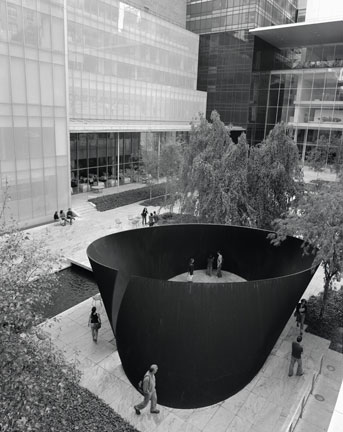
Richard Serra's Torqued Ellipse IV (1998), MOMA Sculpture Garden, New York, taken by Alexandra P. Spaulding. I like this picture because the viewer gets some sense of the scale Serra works on, as well as the weight of those sheets of steel (note the thickness of the edge). Here, by the way, is a shot that places this sculpture in its spatial context.

(My initial post on Serra is here.)

In no particular order, what follows are some bits and pieces that, with a little teasing out and squinting just so, might help push some ideas in that January post a little bit closer to, at least, field goal range.

**From John Berger's "A White Bird," which I discussed here back in February:

Art does not imitate nature, it imitates a creation, something to propose an alternative world, sometimes simply to amplify, to confirm, to make social the brief hope offered by nature. Art is an organized response to what nature allows us to glimpse occasionally. Art sets out to transform the potential recognition into an unceasing one. It proclaims man in the hope of receiving a surer reply . . . the transcendental face of art is always a form of prayer.


**In a comment on the first Serra post, Jim of This Analog Life noted that Serra's work summons adjectives like "monumental" and "memorial"-- and then asked, what's being memorialized?

**Somewhere, I read that Serra had once said that Robert Smithson's Spiral Jetty is "pictorial."

**Serra again, this time referring to the site-specific nature of his own work: "If you move it, you destroy it."

**Ralph Waldo Emerson, "Nature": "Why should we not also enjoy an original relation with the universe? . . . . Enbosomed for a season in nature, whose floods of life stream around and through us, and invite us by the powers they supply, to action proportioned to nature, why should we grope around the dry bones of the past, or put the living generation into masquerade out of its faded wardrobe? The sun shines to-day also."

**Walter Benjamin, "The Work of Art in the Age of Mechanical Reproduction":
"Even the most perfect reproduction of a work of art is lacking in one element: its presence in time and space, its unique existence at the place where it happens to be. This unique existence of the work of art determined the history to which it was subject throughout the time of its existence. This includes the changes which it may have suffered in physical condition over the years as well as the various changes in its ownership. (Illuminations 210)


In the comments for that first Serra post, I (half-)jokingly said my next post on this subject would contain "contributions from Emerson and This Is Spinal Tap." This is because I got to thinking of a place like Stonehenge within the context of the ideas of monuments and irreproducibility, and how the notion of irreproducibility would seem somehow to run counter to the idea of art as something that is reproducible--though not (as Benjamin argues and this scene illustrates) without some sort of loss. So, the gathering of the above bits is an attempt to ground that remark.

I know that Benjamin does not have Stonehenge in mind in his essay, but I think that it serves as a pretty expansive example of what he's addressing in the passage above. Stonehenge (I'm referring here to the site as originally built, not its current state) is not merely the stones but their placement--and not just in relation to the other stones but precisely where each stone is placed--and, moreover, on that hill, and not some other, neighboring hill. Stonehenge's physical location is included in the work called Stonehenge. But, given one of Stonehenge's apparent functions as an observatory built to mark and celebrate the beginnings of the seasons, it is not about itself alone, nor is it mimetic, a gesture in the direction of some other, immediately-recognizable object. Rather, it's a space in which we're asked to take seriously our relation to the cosmos in the moment in which we find ourselves at that place, not later at the pub or while we're posting pics of the place on Facebook. If Stonehenge is having its proper effect on us, we shouldn't be looking only at it. Otherwise, we're not seeing it.

I hope I'm not bastardizing Berger's meaning too much when I say this: Stonehenge is, like art more generally, "an organized response to what nature allows us to glimpse occasionally"--in Stonehenge's particular case, finding comfort and meaning in the ability to see beyond the Here and Now of our particular moment and be able to see rhythms and patterns in the sky beyond the sun's daily reappearance or, even, its yearly appearances in certain parts of the sky but be able to say, with as much certainty as possible, This will always be. Hence Stonehenge's irreproducibility: Stonehenge is not merely an arrangement of objects but an invitation that it can't extend except via our physical presence there to ponder an implicit metaphysical claim about the most essential questions of human existence. You have to be there.

[Aside: I wonder how a work like Walter De Maria's The Lightning Field fits into this discussion, especially given that its curators state that, despite its name, "A full experience of The Lightning Field does not depend upon the occurrence of lightning[.]" Whereas Stonehenge's existence and design are predicated upon the predictability (and affirmation of the importance) of a natural phenomenon, The Lightning Field's purpose is more like an invitation to consider and be open to nature's arbitrariness. Maybe. I have to think about this more, and elsewhere.]

I'm getting to Serra. Really.

The vast majority of art--even overtly-religious art--no longer extends such invitations to its viewers, nor has it for a really long time. (Maybe that's always been the case?) (This is true, these days, even of entire buildings built for expressly religious purposes: all one has to do is consider the office building-like quality of so many contemporary churches to see that this is so.) It engages us intellectually and perhaps even emotionally but not at the level of physical sensation, the idea that we're in its space and we must address its contribution to the intellectual and emotional dialogue between us and it as we look at it. This isn't due to the devaluing of the original in our age of mechanical reproduction but, rather, that its makers, for whatever reason, simply aren't interested in doing so. Or maybe I'm wrong about that (and I'd like to be) but that it's the rare piece of art that can make us forget we're seeing it in a museum or gallery or a classroom--that is, in an artificial space. To be sure, I have that flatness of experience far more often with sculpture than with paintings, as I noted in the first Serra post--paradoxically, most sculpture to me feels so self-contained, so much, ultimately, about itself, that despite its three-dimensional quality my chief preoccupation is how to get around the piece without bumping into it or other people. Again, I'm speaking for myself. Whatever the case, that flatness of response is a sad thing. I don't want to move around art. I want it to move me.

Perhaps, just perhaps, the monumental and memorializing quality of Serra's work arises from his attempt to hearken back recreate something of that "you have to be there" feeling in the audience, the feeling of tension one feels in the presence of genuinely great art that one can sense even when looking at pictures of it but which can't be fully replicated via pictures. But Serra's audience is far different from that of the builders and keepers of Stonehenge. Most of the self-identifying devout among us are thoroughly secularized, even in our religious lives; we have difficulty, I suspect, in fully grasping that structures designed for religious ceremony, not so long ago, were explicitly designed to elicit and shape a response in the visitor . . . and, in the case of ancient sites of worship such as Stonehenge, those structures likewise are constructed in accordance with natural phenomena that its builders wanted to draw attention to and offer implicit comment on. But. God may have created the cosmos, but Western religious expression is not predicated on seeing Him made manifest in its rhythms and patterns. How, then, to create a palpable emotional tension, verging on the physical, between the work and the viewer that can lead to a response verging on at least the existential, if not the spiritual?

Well, just look at Serra's pieces: You build something that looks like it might kill you if you get too close to it or if the wind blows--or, hey, if the earth moves--even as its very design requires that you get close to it. Judging from Jim's experiences with The Matter of Time at the Guggenheim in Bilbao, the fact that these pieces are in galleries and thus (we assume/hope) are deemed safe to be around doesn't mean that we believe that, no matter whether we know it (at the intellectual level). As Robert Hughes says of Serra's work, "It addresses the body through anxiety, and this is a thoroughly legitimate though long-repressed function of sculpture at its most archaic level." Serra's forms may be non-representational in the traditional sense of that term, but in another sense they evoke apprehension, if not fear . . . and not as abstraction but as an all-too-present, felt experience. Indeed, maybe part of Serra's point as well is that fear should be more present in our lives than it in fact is. And how can that idea be reproduced except by being in the presence of something that causes the viewer not just to muse on that idea but to genuinely feel it?

Serra's work is thus both contemporary in its forms and ancient in its concerns. But--assuming all this I've been speculating on here is even remotely true--is there in Serra's work also an accompanying catharsis of that fear? Not having seen any Serras in person, I can't say; I hope that someone will be able to speak to that question.

Read More...

Sunday, January 31, 2010

Richard Serra and the Irreproducible

[UPDATE: The title for this post, I should have noted, has its origin in a comment by Jim: "Ok. Yes, Serra looks cool photographed. But I think there’s something very thought-out & challenging to how we — ok, I — tend to experience art these days in the way that he creates experiences that by virtue of their construction cannot be reproduced." [his italics]

Richard Serra, The Matter of Time (Guggenheim Museum, Bilbao). Image found here.

Follow the link just above, and you'll see that Jim Sligh of This Analog Life "scanned [this image] from a postcard a visiting friend bought for [him] in the giftshop." What you see is a copy of a scan of a photograph, itself reproduced who knows how many times and in how many places. If you read Jim's post, you'll see that he has linked to other, really good photos of Serra's work but in the same breath tells you that looking at pictures is "the dumbest way to experience Serra ever." He is right. This picture itself tells you this implicitly: "You have to be 'here' (which is really 'there')."

Well, I'm not. Bilbao is out of reach just now for various temporal and material reasons. But as I told Jim in a comment on his post, I keep returning to his post to keep looking at this picture, that I find it compelling in a way I find very little sculpture, of any sort (an idea I hadn't realized I thought, and one which caught me by surprise), and I keep trying to figure out why that is. This post is an attempt to do that.

It will probably fail; that's why the rest of it is below the fold.

As long-time readers of this blog know, I post fairly frequently on art, but the vast majority of those posts deal with paintings and drawings. They almost never mention sculpture, and then only in passing. I'd never really thought--at all--about why that is before a couple of days ago, when I first saw the post on Serra at Jim's blog and said, Wait a minute . . .

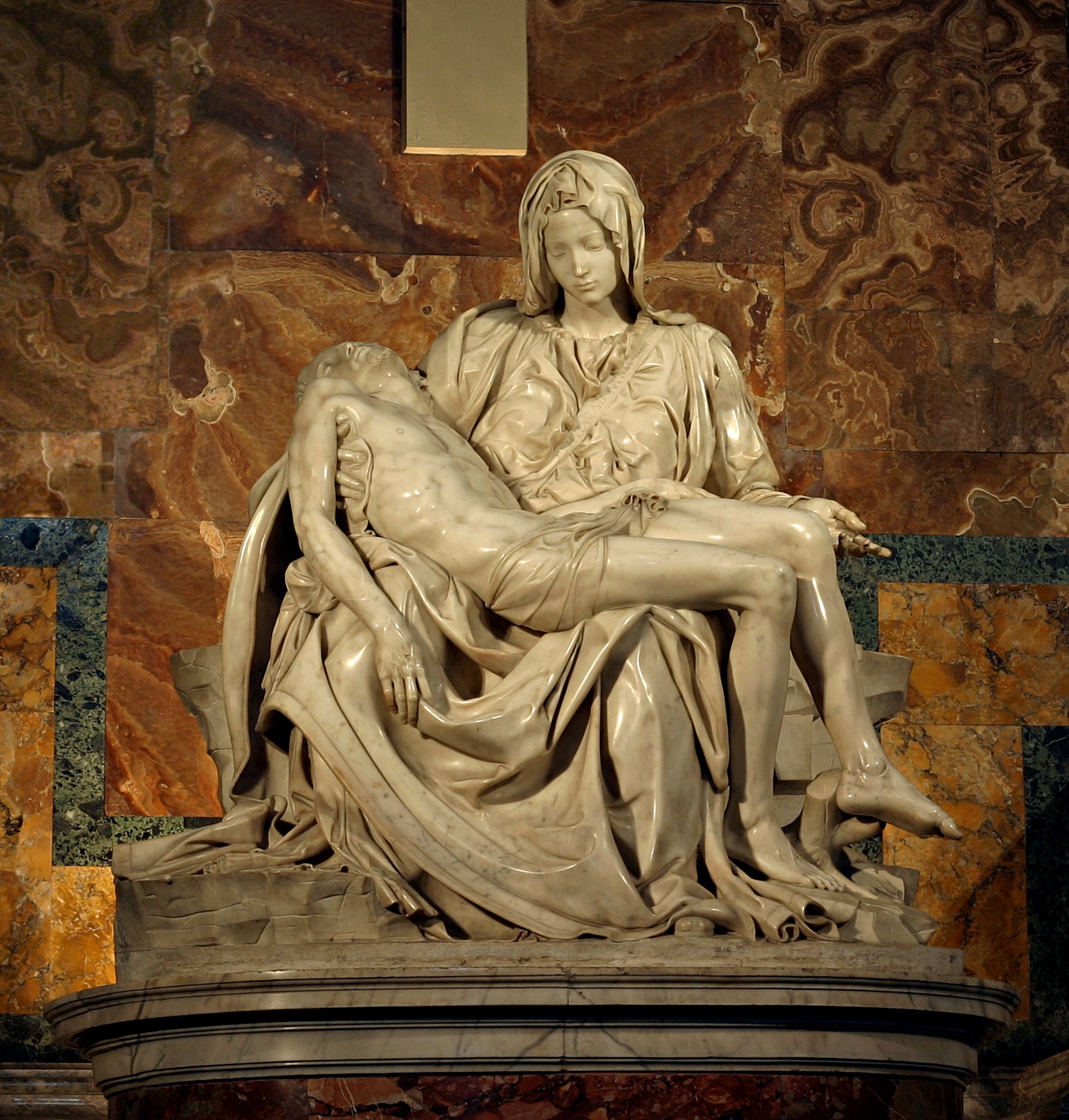
I like sculpture well enough. When my Humanities students and I meet in Kansas City at the Nelson-Atkins, as we will again this May, I make it a point to show them the full-size bronze cast of Rodin's The Thinker on the south side of the museum. We walk around the plinth it sits on, looking up as we do (the top of the plinth is about head-height; the sculpture itself sits on that and is itself around 7' or so from its base to its highest point); we talk about things such as the figure's distended, gnarled toes and Rodin's attempt to make the bronze look as though it had been carved rather than poured. It's cool to see this famous sculpture. But that's about it, as far as my engagement with that or just about any other sculpture is concerned. I get the idea that sculpture's there-ness, its occupying of space, makes its viewer have to deal with it in some way, if only to avoid it or walk around it. But then that makes our interaction with sculpture sound like the piece is like one of those people we have to interact with out of politeness--if we must. Which is to say, there's no genuine interaction except at the level of What's Expected of Us. It remains in its space, posing no ultimate challenge to mine. Even pieces as undeniably beautiful as Michelangelo's Pieta or Bernini's Ecstasy of St. Teresa, if this make sense, confront me without moving me. Or, put another way: Even though I very much enjoy looking at them, I don't feel the need to keep looking at them. Paintings, on the other hand, I will return to again and again, the Nelson's Rembrandt, for example: they don't engage my physical space, but they engage my imagination as very few sculptures do.

There are exceptions, of course. I've never seen Rodin's Burghers of Calais (scroll to the bottom of the page for a brief discussion of the sculpture) in person, but I get the feeling that I would want to walk around and around it and want to come back to it again. The reason: It photographs terribly. It has no "good side," which is to say that no one side presents itself to the viewer as the side to be seen. It--that is, the experience of seeing it in person--is irreproducible because it is so designed that it requires us to move around it. (The Thinker, by comparison, is a depiction of a very large naked guy sitting on a rock. He is shown in three dimensions and so has a back side to him, but that back side is, of course, the least interesting of his sides. So, take a picture of him from the front or in profile and, apart from its massiveness and the subtleties of texture you've reproduced a surprising amount of the reason to see it. This is not meant to be dismissive of a justly-famous sculpture; it's simply so.)

Though I've not seen the Burghers in person, I have seen a sculpture that I think owes much to Rodin's work, the sculpted soldiers at the Korean War Veterans Memorial in Washington, D.C. This one photographs poorly as well, but I can attest that seeing it in person is a very moving experience. You can't actually walk among the sculptures, but you can get so close to them that their size (each figure is well over 7' tall) creates the sense that you are. Moreover, their very different expressions and attitudes give the space a sense of tension and urgency that very few war memorials do that I've ever visited. These men are not on parade but on patrol. We are in their way.

Is the nearby Vietnam Memorial also sculptural in its treatment and shaping of the space the visitor occupies? The way that the visitor begins at ground level, the wall of names just a few inches tall; then, as the years progress and the wall of names gets taller, taller as the path gradually declines, till the visitor reaches the angle and the wall--one's reflection and the names on it--is all one can see? I had of course seen pictures of the Memorial and pictures of people weeping at it. I assumed that those people were grieving friends and family they had lost; I assumed that I would not be so moved if I ever visited it. And then I visited it. I lost no family or friends in that war; I was a child then, even now vividly recalling the nightly reports of dead and injured but otherwise unmoved by the war; yet that day I visited, the only thing I could think as I reached that place was, I am in a tomb. How can one not keep from getting teary-eyed there? I would like to know the secret, because I find myself really reluctant to visit it again, even though I want to.

It's an emotionally-dangerous space.

Also in Washington is a space made to feel physically-dangerous by a sculpture: the atrium of the East Wing of the National Gallery of Art, over which hangs Alexander Calder's enormous Mobile #3. The first time I saw it, I was standing in a queue to be admitted to a big Art Nouveau exhibit in that wing; since the queue was a couple hundred people long, I had a nice long time to contemplate Calder's work. It looks light and delicate . . . and then you look more closely at the shaft and hook from which it hangs--it looks like something from a construction site--and it suddenly loses a lot of its gossamer-like quality. But not all of it, of course. It's beautiful to look at, in the same way that an airplane in flight is beautiful to look at. But the physics of each, the forces required to keep each in the air, are very real, very much also part of what we're looking at--indeed, those forces are required to be present so that these things keep on being beautiful. And that makes us more attentive to our space, our place in that space.

This is also Serra's territory as a sculptor: the creating of a silent dialogue among the viewer, his materials and the forms they take, and not the defiance of physics (the way so much constructed metal sculpture can feel) but the implicit reminder to the viewer who moves among these pieces, via the fact that they don't come toppling on him, that despite the way things seem in the world, here the very oldest laws of the world are at work. By way of illustrating, here are two short passages on Serra's work that I want to put in proximity with each other:

At the dawn of the 21st century, an era of cyberspace, reproduction and the Internet, no one is doing more to make work that stands for the ancient and mysterious power of the real. --from a Time review of a documentary on the making of Matter of Time, found here via Jim's post.

"[T]he main character of Serra's work [is] its scariness. You are never allowed to forget the weight of Serra's metal. The possibility of being crushed by it is part of its sculptural effect. It addresses the body through anxiety, and this is a thoroughly legitimate though long-repressed function of sculpture at its most archaic level." --Robert Hughes, American Visions: The Epic History of Art in America, p. 568

It is hard to articulate all this because you can't reproduce via pictures, and barely through words, what's at work here. I suppose that that's the reason I find myself returning to the picture at the top of this post--it is like reading a poem whose meaning eludes one (Wallace Stevens says in his poem "Man Carrying Thing" that "the poem must resist intelligence/Almost successfully"). The sculptor made these forms, yes; but they signify something other than themselves. Or, more accurately, they can fully signify only with our physical, irreproducible presence there.

I don't mean to imply a religious or spiritual significance for these pieces, but I keep returning in my mind to Stonehenge and other monumental ancient solar calendars as a way to begin thinking about Serra's work. Without human agency, the movements of the sun and moon and stars would have no transcendant meaning. Those movements would be no less real, but they would not signify what the ancients said they signified. Serra doesn't build sun calendars; but, like the sun, his works obey the laws of physics even as they push those laws very, very hard. As the shapes of his pieces compel the viewer to move around and into them, their sides leaning this way and that and their tops opening wide or converging, light and sound changing as the viewer moves about, those laws become more present in our experience: they alter so as to be noticed, and the viewer changes as well. Something even more primitive than "ancient" occurs--indeed, you can't get any more ancient, or irreproducible, than "real."
__________
Bonus: A collection of short videos of Serra's work and interviews with him from the Museum of Modern Art's 2007 exhibition of Serra sculptures. The videos are shorter than I would like, but they do give something of the sense of what it's like to move around/between/through these pieces.


If you've read this far, you may be interested in my continuation of this discussion, here.

Read More...