Showing posts with label Wichita. Show all posts

Friday, January 09, 2009

Wichita, we have a problem. Fortunately, I have a solution

"Come hither," beckons that steam. Image found here.

(Updated below the fold with musical proof of what I speak.)

From Yahoo!.com, via A California Girl in Kansas (thanks, Bobby--about whom, by the way, you local folks need to know, if you don't already) comes a list of the 10-Best and -Worst U.S. Cities for Dating. The best? Austin (duh!). Second-worst? The Peerless Princess of the Prairie, and here's why, in part:

Latte, Anyone?: Wichita (overall No. 79) and Greensboro (overall No. 75) are among those cities that are home to the least number of coffee shops per capita, leaving few good places for young people to converge and trade stories after a fun night out.
Now: It's true that Wichita tends to rank high on lists of best cities to raise a family and livability in general, but I would hope there's no correlation between our dearth of coffeeshops and our overall pleasantness as a place to live. That would be not only Just. Weird., but more than a little sad, good coffee, like beer, being proof that God loves us and wants us to be happy.

Hey . . . hmmm. God? Coffee? Happiness? The possibility of finding one's future mate?

Paging Ariel . . .

My long-time bloggy friend Ariel is not only a devoted man of God, he also has a serious coffee jones--in his current post, in fact, he laments the fact that he doesn't presently have the means to roast his own beans. It also so happens that he is in the early stages of establishing a church in the arts district of Kansas City. He has my moral support in this, and I wish I could send him a little financial support as well.

But, Ariel: Wichita's need is at least as large as KC's, which (I know, I know) happens to rank #1 on the 10-Worst Dating list but, apparently, does not lack for coffeeshops. So, while I do wish you well over there in KC, just know that the single folks of Wichita are not sufficiently caffeinated, un-hooked-up, AND unchurched. They--we all--could use you here.

UPDATE: Bring me java, bring me joy:


Read More...

Monday, September 08, 2008

In which the Meridian ponders his place in the Wichita blogosphere

I recently learned via the indispensable-for-Wichita Douglas and Main that there is now an interactive map of Wichita websites, done London Tube style, that shows and links to the city's most-visited sites and blogs. It's attractive-looking and functional besides.

Anyway, good old Blog Meridian, it appears, is among those sites, thanks to you reading these words and to those who find their way here via search engines and folks kind enough to have linked to me in the past. It's a surprise and an honor to appear alongside those other, very good blogs. But relatively little of this blog's traffic comes from Wichita, or even from Kansas. Because of that, and because this blog isn't focused exclusively on Wichita, I have mused at various times in the past on just in what sense this is a "Wichita blog." The obvious answer--that its writer lives in the city--after all seems at variance with the notion of a blogosphere, doesn't it? By that I mean that a blog's "location" is its subject matter, its preoccupations, and not where the writer sits down to post to it.

Ah, well. Whatever the answer to those questions, it's nice to have one's presence in said blogosphere noticed, and in a positive sense at that. So thanks, good people of 2wichita, and thanks for calling attention to this thing called the Wichita blogosphere.

Read More...

Thursday, July 31, 2008

I ask you, fellow global citizens . . .

Do you give the teeniest, tiniest rat's you-know-what about transportation issues in Wichita?

Of course you do. Search your respective souls, and you'll find you do.

You need not be present (in Wichita) to participate--so here's your chance to impose your collective will, U.N.-like, on transportation policy priorities for a part of the world you most likely have no interest in ever visiting but about which you care deeply.

I do hope you'll take a few minutes and participate.

Read More...

Wednesday, July 09, 2008

Cycling and the fostering of community

Through Today at the Mission (hat-tip: Ariel) comes news of an organization called Africycle, a Canadian-based charitable organization dedicated to both raising money for providing quality used bicycles to people in Malawi and maintaining bicycle repair shops in Malawi.

From the website: "Many Malawians experience difficulty accessing quality bicycles, due to economic constraints and the limited availability of affordable, reliable bicycles in the local market. Africycle believes that by providing bicycles it can be a catalyst for sustainable and effective development in Malawian communities."

Granted, Wichita is not Malawi, and the statement above refers overtly to economic development. But yesterday morning, as I did a bit of errand-running via my bike (in a moderate but steady rain), I gave the Wichita version of this some thought. The nearest full-service grocery store is now about 3 miles from where I live (until this spring when it closed, there had been one just a mile away). But as I rode about in my neighborhood, I noted that I can meet just about any other basic or recurring need I might have within an easy ride of where I live. Case in point: I'm due for a haircut. I'd gotten into the habit of going to Wal-Mart to get it cut there (decent--I'm not particular about haircuts--and cheap). But on my route yesterday I passed two barbershops that offer cheaper haircuts. Moreover, there are two good used bookstores in the neighborhood (one of which I'd not noticed until yesterday). And so on. Also, I got to greet some people in the neighborhood as I rode past their houses.

You see where I'm going with this, I hope. Before, when I was going on all Walden-like about this, I'd focused on the personal and (true, infinitesimal in and of themselves) global benefits of my cycling about town. Something I'd not really considered, though, is that by making more purchases here in this part of town, I can do my small part to help keep some folks in business (some of them look like they could use the revenue). I'll also feel more like I do more than just sleep here--I'll feel like I live here.

UPDATE: Apropos of cycling in urban areas, via this Matthew Yglesias post noting the death of a cyclist in Washington, D.C., comes the new-to-me notion of bike boxes. Portland, Oregon, already one of the bike-friendliest cities in the U.S., is beginning to install them. These are already used in some European cities; I hope those of you from Europe can comment on what expenses are involved with creating bike-boxes, aside from having to repaint some intersections.

Read More...

Saturday, May 17, 2008

A stretch of river XLVII: Morning haiku

Image found here.

Flying, the heron's
feet punctuate the water:
An ellipsis trail.

Read More...

Sunday, April 20, 2008

Telling choices: Some musing on the writing (and reading) of history

A grass house typical of Wichita Indians, painted by George Catlin, 1834. Image found here.

Some of you may remember this post, now almost a year old, in which I compared and contrasted the contents of two brief paragraphs from different sources that cover those years in the 1860s in which the Wichita Indians began their dealings with the first white settlers in this area: the years that led to the founding of Wichita. While I hadn't forgotten about picking up the tale, I just hadn't gone back to it.

Today, though, while Googling about for something entirely else, I ran into the Official Site of the Wichita and Affiliated Tribes. It has a page devoted to the history of the tribes, from which the text below is taken.

Although a reservation and agency were established, the Wichita people were not able to remain in this land [west-central Oklahoma]. In 1863, they were forced by Confederate troops to leave their reservation and flee north to Kansas. While in Kansas from 1863 to 1867, the Wichitas had no land to farm and few friends to help them in their time of trouble. Many people starved. Others suffered from smallpox and cholera epidemics that swept through their villages. Only 822 people returned to Indian Territory in 1867.

The "musing" part is below the fold.

With this third text we can set up a continuum of the descriptions, their placement determined by their respective contents' emphasis on Indian-white relations. The City of Wichita site's text is focused more on the early white settlers in the area, chiefly on "their" first industry of the cattle trade. The tribe's account focuses on the Indians, in particular on its forced removals to and from the Wichita area and on its hunger, impoverishment and disease--though in some ways (such as not mentioning the plaque's detail about Skeleton Creek) it is muted in its recounting of that suffering. The plaque in the park occupies the middle position, though--unsurprisingly, given that the plaque is titled "Wichita Indians"--its frame of reference is more Indian-oriented. The tribal history and the plaque both mention that suffering; the plaque and the city's history both mention the cattle trade.

Three narratives of the same short span of time and small space which do not agree with each other in all particulars. I have no way of knowing which of these narratives provides the truest account of those years; and even if I did know, I'm not at all interested in playing a game of historical "gotcha." Also, it's obvious that it's not the intention of any of these accounts to offer exhaustive narratives of that time. Still, here in miniature, we can see something at work: what to include or leave out, and why, are the two basic questions all historiographers must constantly confront when writing history (and, for that matter, every blogger who decides to say a little something about his or her day or childhood or what have you). Michel de Certeau, in his book The Writing of History, describes that dynamic in the Introduction:
In the past from which it [that is, the "present" in which a historiographer works] is distinguished, it promotes a selection between what can be understood and what must be forgotten in order to obtain the representation of a present intelligibility. But whatever this new understanding of the past holds to be irrelevant--shards created by the selection of materials, remainders set aside by an explication--comes back, despite everything, on the edges of discourse or in its rifts and crannies: "resistances," "survivals," or delays discreetly perturb the pretty order of a line of "progress" or a system of interpretation. These are lapses in the syntax constructed by a law of a place. Therein they symbolize a return of the oppressed, that is, a return of what, at a given moment, has become unthinkable in order for a new identity to become thinkable. (4)
de Certeau's putting things thusly drives home something that it can be easy to forget regarding the production of historical narratives: that, being narratives, their writers have to make decisions not only on what to include or exclude, they also must decide how to talk about that which they include. As just one example, the two texts that refer to the cattle trade talk about it in very different ways. Why their authors made those choices in their respective tellings, I cannot say, beyond that those choices are just as interesting to speculate on as why the Wichita tribes' website makes no mention of the cattle trade.

Just as Mark Twain famously wrote that the man with one watch always knows what time it is but that the one with two watches is never sure, I find myself today, having acquired a third brief paragraph describing the same material in very distinct ways, being still more uncertain as to the truth of that time. Is that truth not in any one text but in the accretion and distillation of their contents and that of others I will find and read? Well, yes. But as de Certeau points out by implication, a history by its very nature cannot be all-inclusive, or it will be unintelligible. Therefore, to be true to one's subject (broadly defined), even that historiographer most desirous to be an honest broker must, inevitably, commit numerous betrayals.

Read More...

Tuesday, March 11, 2008

Adventures at the Wichita Art Museum #2

Steven Graber, Pelayo, charcoal and watercolor (really) on paper. Image found here. A Graber seascape similar to this appeared in the Emprise exhibit.

Though a simple student of the humanities, even my limited math skills are sufficient to help me determine that this will not come to pass this coming weekend. Ah well. I will find some other way to amuse myself. As a consolation prize of sorts, then, I went to the Wichita Art Museum this past Saturday to see what there was to see, since I had not been in a month or so. I am here to tell you that I'm very glad I went, and all 2 or so of my local readers should get over there soon, too.

Three really fine exhibits are mounted there as we speak: The Art of Emprise, which will end on March 23; an exhibit of prints by two former instructors in printmaking at Wichita State, John Boyd and David Bernard, that will end April 20th; and, in the Living Room (an interactive space where kids can make their own art), mobiles and kinetic art.

Details below the fold.

First of all, I'm ashamed to say that it'd been quite a while since I had visited the museum's website because it had been so impoverished. I'm very pleased to say, though, that that's no longer the case: the homepage is snazzier, and the Collections page offers the curious much more to see than had been the case in the past. Go and see.

As the promotional material for the Emprise exhibit notes, corporate art collections are noteworthy chiefly in their lack of variety and their desire not to offend potential/current clients. Though no one would call anything on exhibit in this show "edgy" (except, perhaps, for Laurent Guérin's large-format photograph Danseuses Etoiles, which shows three young teenage girls in spangled ballerina outfits standing in a restaurant that, aside from the girls' broad, genuine smiles, strongly evoked for me Manet's A Bar at the Folies-Bergere--another visitor there, who happened to know people involved in buying pieces for the collection, said some people have said that the girls look "exposed"), there's no questioning the variety here. Emprise, being a Kansas-based bank, has as its basic collecting principle the buying of works by artists "with a Kansas connection"; thus, the works here range across time and media and genre, from photorealism and abstract expressionism to mixed media of various sorts and sculptures and constructions in/of various materials. The show provides the viewer with a crash course in mainstream movements in American art from Modernism to the present, not to mention (for me, at least), a fine introduction to the work of some very talented contemporary artists.

Highlights of the show include a large self-portrait by Patrick Duegaw, whose work I've posted on before; by Richard Slimon, a large abstract called Ruins (very similar in style to these and evocative of, though less overtly structured than, Richard Diebenkorn's Ocean Park series of paintings); a study for a mural painted for the 1942 Wisconsin State Fair by John Steuart Curry (best known for this painting); photographs (conventional and digital) by the above-mentioned Laurent Guérin (examples of his work here; more photographs by Michael Eastman (who does for photographs of cacti and succulents what Georgia O'Keeffe did for paintings of flowers) and Gordon Parks (best known as a prominent photographer for Life and as the director of Shaft; some samples of his work here); and Albert Bloch (examples here).

Boyd and Bernard, the exhibit by retiring WSU faculty member John Boyd and recently-deceased instructor David Bernard, mixes the very different print-making styles of these two men. Boyd's work, as he notes here, draws inspiration from his rural Arkansas roots and seeks to achieve a flat, "primitive" style. There is much humor in his work, too: my favorite work in the show, Western Gothic, depicts a parlor with a man, wearing jeans but no shirt and one boot off, being shot by a woman, another man standing in a darkened doorway, and by a figure in a portrait hanging on the far wall of the parlor. It's Beavis and Butthead meets Deadwood in its feel. Bernard's work, of whichEarth Cruiser (image found here) is one example, emphasizes geometric form but clearly located in the realm of the representational.

And finally, there is the exhibit of mobiles and kinetic art, some of which are pictured here, in the Living Room. If you're like me, your knowledge of mobiles-as-Art pretty much begins and ends with Alexander Calder, and some of the mobiles on display there definitely owe their look to Calder's more famous constructions. But the highlight for me was the kinetic art. Several large, very different pieces will hold your attention: a motorized stylus tracing patterns in a large pit of colored sand; two large screens whose kaleidescope-like images one can manipulate with buttons in front of the screen; Drum Tower by Tom McGuire (16 found objects of various sizes with remote-controlled mallets wired to them, arranged in a tower, that will play various pre-programmed rhythms when you step on a small pedal in in front of it; and two wall-length installations you can see in the picture linked to above. Great fun to watch.

The rest of the year promises to be a good one for visitors to the WAM: Upcoming exhibitions include Arthur Drooker's photographs of ruined buildings, an exhibition of Inuit art from the Heard Museum, prints by David C. Driskell, an exhibition of Goya's print series Los Caprichos, a set of which the museum owns (you see one here, "El sueño de la razón produce monstruos" ("The Dream of Reason Produces Monsters")), and an overlapping exhibition of textiles from Central America and photographs of Frida Kahlo by Nickolas Muray. Good stuff, as they say.

Some house-keeping now: we're in the midst of the mid-semester grading period, so this will be the last post for a few days. I'll see you on the other side of the coming weekend.

Read More...

Sunday, December 02, 2007

A survey of Not to Scale

Patrick Duegaw, Juste Pour Reir (click on the image to enlarge it); image from Strecker-Nelson Gallery, Manhattan, Kansas

On the last Friday evening of each month, some of the local art galleries in Wichita hold open houses and receptions called, appropriately, Final Friday. This is something I have known about for some time now but had never attended before; however, now that circumstances in my personal life leave me with some extra time on my hands, I've attended the last two. Blustery weather and the promise of rain kept attendance down for November's Final Friday, but I'm glad I went, for that night I was introduced to the work of Patrick Duegaw. (The faces in the triptych you see here are self-portraits.)

Duegaw's new work, exhibited at the Fisch Haus, a multipurpose artists' collective and exhibit/performance space in Wichita's warehouse district, is called Not to Scale: The Construction of Two Rooms. Local folks need to know that, now, this show is on view by appointment until December 15. Here is Fisch Haus's description of the show; here is a sympathetic review of the show in the Wichita Eagle. The triptych isn't part of the show, but its media and look and feel are very much in keeping with the works in the show.

Below the fold: a description of the show's layout, and some observations.

As the linked pieces above relate, Not to Scale consists of over 40 separate works--a combination of "blueprints" for the "rooms" referred to in the title, self-portraits of "The Builder" (Duegaw himself), false starts, depictions of tools used--and some described as "wrong tools for the job," texts referring to the construction process, and a diptych of the finished rooms, each with a seated figure, one a woman and the other a man.

What makes this show so effective to my mind is the interaction between the pieces and the exhibition space. Usually, the small foyer of the Fisch Haus serves as just that; for Duegaw's show, though, the first thing the attendee sees, on the wall opposite the entrance, is two large (approximately 5' X 5') blueprints for the room to be constructed; elsewhere in the room are some of the above-mentioned false starts (one, for example, contains a text discussing the inherent dangers in building a time machine) and an amusing self-portrait of The Builder that shows 3/4 of his face and wearing a dust mask and safety glasses. The much larger multi-use space contains the depictions of tools, other self-portraits, and the diptych of the finished rooms. The first thing that struck me about the exhibit is that the titles for the pieces weren't on the near-ubiquitous Little White Cards that one usually sees; instead, the titles were chalked out on the floor of the space itself, along with guidelines of the sort that carpenters use for marking the placement of boards or other features. In other words, the exhibition space did more than just provide wall space for the works. It became the construction site for the "rooms"--that is, the exhibition. The works themselves contribute to that feel. They consist of multiple layers of images drawn onto pieces of sheetrock that are imperfectly fitted together, as though someone working a jigsaw puzzle is trying out the pieces to see if they might fit, yet all contained within a precisely-measured space. Appropriately, the depictions of tools used in the "construction" all are on 18" X 18" squares; those tools designated as "wrong tools for the job," though, are on rectangles of varying sizes--these don't "fit" this particular job or its requirements. The resulting feel is that of a workspace, a tension, a movement back and forth between an in medias res under-construction-ness and a finishedness.

The diptych, the resulting "construction of two rooms," with its man and woman together yet separate from each other and accompanying text which implies a failure on someone's part (the Builder's? The couple's?) is poignant to look at. The rooms are there, constructed: the Builder appears to have succeeded at the material, empirical level, his blueprints brought to fruition. But rooms have functions, too, both literal and figurative ones; and those functions, their success or failure, depend in some measure on the people who will put those rooms to use. As I understand the diptych, that ultimate success or failure is still in abeyance and so is, in the moment, uncertain. Of course, it's no great leap, either, to read the exhibition as a sort of allegory for the creative process of the sort that Hemingway's The Old Man and the Sea sometimes gets read as: as one in which the artist's final realization of his work inevitably falls short of what he had originally envisioned.

Almost all the pieces in the show are for individual sale; and while I certainly appreciate that Duegaw is a working artist and has to eat like the rest of us, I found myself wishing that there were some way of keeping the entire show together. Together, each of these works, even the false starts and the Wrong Tools, "construct" the whole. But then again, I suspect that keeping this exhibition intact in a sense works against the grain of one of its points. After all, a Wrong Tool for this job will, sooner or later, be a Right Tool for another job . . . and in any case, tools are means to ends and not ends in themselves. And one doesn't have to know what went into the "construction" of the two rooms to appreciate the finished diptych of those rooms.

Duegaw, like all serious artists, is interested in craft; what makes his work (what I've seen of it, at any rate) intriguing to me is that "craft," in its sense of "making" and "construction," is as much a subject of his work as the actual images his work depicts. In Not to Scale, the images' foregrounding the ideas that Art both is work and performs a kind of work . . . and then, once the particular work of this exhibit is done, the artist's sanctioning its breaking up to perform other work in other places, add up to what was a thought-provoking Friday evening.

Read More...

Sunday, May 20, 2007

A stretch of river XXXVIII: In which Scruffy and the Meridian read some history, with an assist from Richard Slotkin

Keeper of the Plains, which stands on the point where the Little Arkansas empties into the Arkansas

History sleeps all around us here on the banks of the Little Arkansas. Some of it is prettied up for us--case in point is the sculpture you see here, now the center of a beautifully-landscaped plaza and located just a hairpin bend in the Little Arkansas away from where I write these words. Some is not as pretty but intriguing nonetheless, like the old brick I noticed the other day gradually eroding its way out of the raised embankment on the top of which Scruffy and I walk our daily walk; it led me to wonder what downtown building had met its demise well over a century ago, it must have been, judging by the size of the trees that grow out of the embankment now, in order to contribute to the greater good of safeguarding the houses along the river from floods.

Well--maybe "sleeps" isn't quite the word. It's more like, History is here, but those managing it have done their best not to call attention to it, lest it unsettle us unduly. The new plaza celebrates Indian culture but makes almost no mention of the coming of the Spaniards and, later, Americans: it is Chamber-of-Commerce-friendly, touchy-feely History, made physically easy to consume as well by virtue of the two pedestrian suspension bridges spanning each river to convey people to the plaza. Riverside Park has a 1/4-mile running track with plaques at various intervals that denote milestones in the park's history beginning in the late 1870s--it quite literally is white people's history. However, in a reach back to prehistoric times, the park also has a working solar calendar1. But you won't find any direct mention of the Indians in the park except for a marker of 171 words which, though writ small, nevertheless bridges the historical void created by the reticences of the plaza, the park's history and the solar calendar.

I'd made note of that marker before here at good old Blog Meridian and even promised to return to it, but other things led me away from it. But a few days ago I read this over at Jimmy's place, The New York Minute, and the memory of that marker stirred in me--so much so that this morning Scruffy and I actually did a little of what one could call Research on our walk. In my mind, I invited Richard Slotkin to join us. Slotkin, I think you'll find, is a most appropriate companion for this initial journey into the history of my little stretch of domesticated river.

Below the fold: What we encountered, on foot and online, as we searched for the Encounter.

Here again is the text of the marker:

In 1864, about 1500 Wichita Indians, favoring the Union, returned to their ancestral lands and settled along the Little Arkansas River which offered protection from the Confederate tribes until the Civil War ended. The Wichita Indians (consisting of Wichitas, Wacos, Towacanis, Taovayas, and Kechis) are credited with the founding of Wichita. Aside from lending their name, which means "scattered lodges," it was their supply needs that brought traders and eventually settlers. Because of the war, food and supplies for the Indians were meager. This lead [sic] to an illegal yet profitable cattle trade and the development of the Chisolm Trail to connect Wichita and Indian Territory (now Oklahoma). When the Civil War was over, the Indians were ordered to relocate to Oklahoma in October. They were not given ample supplies and their trek was devastating. So many died along the way that Skeleton Creek was named after them. In 1927, the Wichita Indians built a grass lodge on Mead Island (near 13th) as an expression of goodwill to the citizens of Wichita.
I still vividly recall the sensation of reading that last sentence and feeling pulled up short, frankly not sure whether to laugh or weep. You don't have to be an especially attentive reader to note that, apart from their being permitted to resettle in the area during the Civil War, the previous sentences are pretty thin on expressions of goodwill toward the Wichita. All this seems especially bitter given the fact that the Wichita's presence here is given credit for being the reason the first cattle drives began--a period of history that this part of the state still invokes with enormous pride. But in all that invocation, at least that which I have heard over the years, the Wichita merit nary a mention . . . except on this marker--and (here is the bitterness) then only to serve, pretty much, as capitalistic cannon-fodder.

To be fair to the first white settlers, the Wichita were, by the 1860s, already in serious decline as a people, as the Wikipedia article makes clear. But I think it's accurate to say that events of the latter half of the 1860s made more precipitous that decline.

In doing some further reading after we returned from our walk, I came across the "Wichita History" page of the City of Wichita's official website. What follows is the paragraph that covers the span of time covered by the marker in the park:
The first recorded permanent settlement was a collection of grass houses built in 1863 by the Wichita Indians. Due to the tribe’s pro-Union sentiment in the midst of the Civil War, the Wichita moved north from Indian Territory (Oklahoma) under the protection of the U.S. government. J. R. Mead, among others, established profitable businesses trading with the Wichita and supplying the government agency charged with their protection. When the region’s native peoples were "removed" to Indian Territory in 1867 to open the area for white settlement, the trading business followed them, using the Wichita site as a base and establishing the Chisholm Trail as a route of transport.


A little comparing and contrasting of these two city-sanctioned texts reveals some intriguing interstices where the joins between them are less than snug:

*The marker calls the cattle trade with the Indian Territory, established during the war, "illegal yet profitable;" the city's website describes trading with the Indians as "profitable" but doesn't mention the cattle trade until after the Indians' were "removed" (curious, those quotation marks, which are on the page itself, by the way) in 1867.

*The marker says the Wichita were "ordered to relocate" in October of 1865; the city's website, as mentioned above, gives the date as 1867. I don't (yet) know the reason for the difference in dates.

*In any event, the marker gives a sense of the horrors of that relocation; the website has them disappearing over the site's textual horizon, traders following them and thus establishing the Chisholm Trail, and white settlers moving into the area.

I have no further details than these. Still, I don't think one has to be terribly PC in one's thinking to see the story here, in between the combined, not-quite-contradictory lines of the marker and the website page: Once the first inhabitants of this land and then ordered into Indian Territory, the Wichita were (I assume) graciously offered sanctuary in Kansas from the Confederacy-allied tribes to the south. After the war, though, with land to be settled and, more crucially, money to be made through the now-legitimate cattle trade, the Wichita became competitors to be disposed of. "Thank you for establishing this community. Now git th' hell outta Dodge. [As it were.] Oh--and mind if we use your name for this community?"

One last thing, to be picked up in a future post: J(ames). R. Mead (the namesake of the island mentioned on the marker and credited as Wichita's founder) has now become a Person of Interest for me--especially after learning that it appears he is the author of a two-page article entitled "Camps of Prehistoric People in Sedgwick County, Kansas," published in 1889-1890.

Hunting that article will have to wait for another day. But if I'm lucky, his article might double the word count of the marker and that one paragraph from the website.

Also later: more about the Wichita as I learn about them. I hope, though, that readers who happen across this post and know more about any of this will share what they know via e-mail or in the comments section.

1I learned in my reading today (but had forgotten to add until just now) that archeologists estimate that the land where the Little Arkansas meets the Arkansas has been inhabited for at least 11,000 years.

Read More...

Friday, April 20, 2007

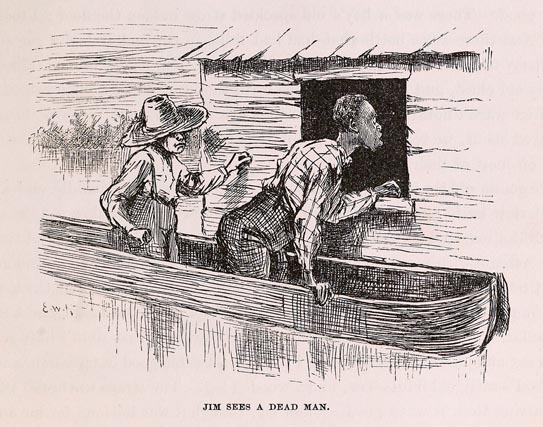
A stretch of river XXXV: "Here comes a frame-house down on the west side."

(Go here for the source for the title of the post)

Well, okay. No house came floating down our stretch of the Little Arkansas this past week, much less one with a dead man inside it. But from Saturday to Wednesday the river slowly rose, due to the rain and snow we've had in town and in the river's watershed to the north and west of Wichita, to about a foot and a half higher than usual. Though that doesn't sound like much, the rise led to two things: 1) The river flowed much faster than it usually does; 2) Just as Huck notes in Huckleberry Finn, when the river rises, all sorts of things came floating down it that one usually doesn't see in this or, I suspect, in most any river. So for those few days Scruffy and I vicariously made like Huck and Jim on our walks (the analogues being, in case you're wondering, pretty fluid, and this out of necessity since, as Jim has Huck acknowledge elsewhere in the novel, a cat is not a man).

This made for occasionally interesting, curious viewing those few days. But little romance arose from the accretion of debris. It was, to borrow Frost's phrase from another context, "a diminished thing."

Without a doubt, the strangest thing we saw in the river was on Saturday morning: a sofa cushion floating majestically down its center, sitting so high on the surface that it appeared to have been inflated. After that came, on succeeding days, the inventory of a small sporting goods store: a basketball, a football, and a soccer ball. All were cheap, and all had seen better days. There was a fair amount of driftwood to see, too, some of it surprisingly large. The rest was the usual sort of garbage (literally) that one would expect to see floating on a river in flood that flows through an urban area: liquor bottles; beer and soda-water cans; pieces of styrofoam chests . . . you get the idea.

Perhaps I am jaded: I know, if I account for Huck's adolescent-boy's filter on his narrator's lens, that he's just looking at river trash, too. I must also account for the fact that his river is the Mighty Mississip' while mine is the Little Arkansas. Or is this an example of a failure of the imagination--that if I squinted in just the right way I could see magic or fancy in that debris. But no. The imagination can invent only so much; as Wallace Stevens notes, making a poetic career out of doing so, it has its starting place in reality (whatever that was). It cannot invent ex nihilo.

Well: Huck's having seen the house means that I can, too: its extravagance is something I can attest to as well, if only vicariously. A whole house--and Scruffy and I had seen a cushion from one of its sofas. A diminished thing, yes. But something. Enough.

Read More...