Showing posts with label Huckleberry Finn. Show all posts

Saturday, December 29, 2007

Going to Hell: Some speculation regarding Huck Finn and slave-holding culture

Edwin Hergesheimer’s map of Southern slavery, September 1861, found here. Visit the link to see and explore an enlargeable image. Found via Matthew Yglesias.

(EDIT: Now, I hope, a bit more precise in wording.)

Whenever I teach or otherwise talk about Huckleberry Finn, I am quick to note the centrality of the Mississippi River to that novel--not just as its setting but how the basic fact of its flowing southward determines, and even forces, the novel's climax: his decision to help Jim escape from slavery. Huck, to be sure, never talks about the river in these terms; yet, given that it is literally true that the river has brought him to the place where he makes that decision, it's no great stretch to say that it has brought him there figuratively as well.

It wasn't until I saw this map for the first time yesterday, though, that it occurred to me that perhaps, just perhaps, something else just as unremarked upon in the novel but just as present gives shape and direction to Huck's thinking. Huck is not innocent of slave-holding culture; on the contrary, the world he lives in is so shaped by that culture that, for much of the novel, he literally cannot even imagine, much less accept, some truth other than that culture's central a priori assumption of the sub-human nature of black people. But the population of the county Huck hails from, Rawls County, Missouri (the location of Hannibal, and three counties north of where the Missouri flows into the Mississippi), was about 30% slaves according to the map I linked to (caveat for this and for what follows: Huckleberry Finn is set in the 1840s, so what I hope to suggest here is more like an indication of scale rather than actual facts). Considering that most of those slaves would have been on farms outside Huck's St. Petersburg and Huck himself lived in town, Huck would not have had occasion to see on a daily basis the full manifestation of slave-holding culture. Relatively speaking, he would know of that culture more than he would know it.

Now, compare Rawls County to those counties of northeastern Louisiana on the Mississippi, one of which is where the Phelps place is located and where Huck and Jim's southward journey ends: none of those counties has a percentage of slaves relative to total population of less than 68%, and one of them appears (it's hard for me to tell) to have a population consisting of at least 90% slaves. Again, if what's being considered here is the relative scale of slave-holding rather than strict accuracy regarding verifiable, actual numbers during the time of the novel, I think it's safe to say that in Louisiana Huck is confronted with the fullest expression of slave-holding culture he's ever seen. The Phelps place is no Tara, but it is a working plantation. In a "no-camels-mentioned-in-the-Koran" kind of way, that never gets expressed directly in the novel; but it's hard to resist thinking, as with the Mississippi's southward flow--a fact so simple that it doesn't even merit direct mention--that this fact can't help but give shape and form to Huck's admittedly evanescent thinking regarding Jim's humanity and what his response to that should be.

Chapter 31 of Huckleberry Finn is, as readers know, the climax of the novel. Its thematic significance is clear enough and needs no pointing out here. However, this chapter--in particular, the passage below--takes on a new resonance for me in light of the map. Setting, after all, is more than just geography; "the world of the novel" refers to cultural, as well as the usual kind, of topography. In the world Huck finds himself in as he describes his dilemma, the drama of his choice is all the more heightened: he knows what he "should" do in a world that demands it of all its members, in the courts and from the pulpit: "'There was the Sunday-school, you could a gone to it; and if you'd a done it they'd a learnt you there that people that acts as I'd been acting about that nigger goes to everlasting fire.'" It's as though, there in northeastern Louisiana, the phrase "sold down the river," the literal fear of slaves from upriver, is for Huck, now, inextricably combined with a glimpse of an eternity of agony for such as himself.

And yet.

The most metaphysical Huck ever gets is when he says, in this same chapter, "You can't pray a lie." So it's entirely appropriate that in a world that considers the word "abolitionist" about the worst thing you could call someone, Huck avoids philosophical abstraction entirely: he confronts the hellish fact of slavery with the fact of Jim's decency toward him as they float downstream into that hell:

. . . I knowed I could pray now. But I didn't do it straight off, but laid the [letter he's just written to Aunt Polly] down and set there thinking -- thinking how good it was all this happened so, and how near I come to being lost and going to hell. And went on thinking. And got to thinking over our trip down the river; and I see Jim before me all the time: in the day and in the night-time, sometimes moonlight, sometimes storms, and we a-floating along, talking and singing and laughing. But somehow I couldn't seem to strike no places to harden me against him, but only the other kind. I'd see him standing my watch on top of his'n, 'stead of calling me, so I could go on sleeping; and see him how glad he was when I come back out of the fog; and when I come to him again in the swamp, up there where the feud was; and such-like times; and would always call me honey, and pet me and do everything he could think of for me, and how good he always was; and at last I struck the time I saved him by telling the men we had small-pox aboard, and he was so grateful, and said I was the best friend old Jim ever had in the world, and the ONLY one he's got now; and then I happened to look around and see that paper.

It was a close place. I took it up, and held it in my hand. I was a-trembling, because I'd got to decide, forever, betwixt two things, and I knowed it. I studied a minute, sort of holding my breath, and then says to myself:

"All right, then, I'll GO to hell" -- and tore it up.
The point of all this? Just that, in our relatively more-enlightened but racially-hypersensitive times, it's become harder to "read" this great novel, to see the great moment on the raft as hugely significant and not as a "well, duh!" moment. It is a realist novel par excellance, and that is its great strength and its great weakness. Huck Finn--character and novel--are rooted firmly in a time and place so utterly different from our own (thankfully so, in many ways) that, unfortunately, some end up assuming the wrong things about those differences, reading them as they do through today's lenses, and therefore presume the worst about the novel . . . with the result that we forget there is much this novel still has to tell us about ourselves as Americans--and not only about the past, either. The trees of anachronism cause some of us to lose its forest of truths.

Read More...

Sunday, May 20, 2007

The Known World: A review

This, the 2004 winner of the Pulitzer and a finalist for the National Book Award, is a magnificent novel by any standard. As a first novel, it's truly astonishing, especially given its subject matter and the way it approaches that subject matter. For various reasons, it took me a long time to finish The Known World. In retrospect, though, I'm glad it did. This is a novel meant not so much to be read as to be lingered over, pondered.

Based on the lives of actual people in antebellum Manchester County, Virginia, the novel begins with the death of Henry Townsend, a respected slaveholder, and is overtly concerned with subsequent events on his plantation in the days and weeks after he dies. What makes this of more than passing interest is that Townsend is a free black whose own parents, we learn later on, had worked to buy him from his owner after they themselves had worked to earn their freedom. How does such a thing happen? Henry is as puzzled by his parents' reaction when they learn that he owns slaves as his parents are baffled by what they've learned about their son. And we, in turn, are baffled that Henry is puzzled. A free black, own slaves? This should not be . . . yet it is so.

You might expect a novel on such a topic to be rather wild-eyed or at least reach for the occasional scene of Faulknerian or Morrisonian high drama, but you would be disappointed. Horrific, brutal, dehumanizing things happen in this novel to be sure, but The Known World is the calmest novel about race and slavery that I have ever read. Having read more than my share of such novels for my dissertation, I know something whereof I speak. That in and of itself isn't a point in its favor, yet its quiet, controlled tone, working as it does against our expectations, doesn't weary the reader but, instead, keeps the reader reading in expectation of the usual fireworks.

So, rather than engage in appropriate but expected outrage, The Known World takes a different tack, somewhat as Uncle Tom's Cabin does: each novel shows how distorted, how perverted human behavior turns in a slave-holding culture. Stowe's novel shows how slave-holding infects and corrupts the behavior of even the most benign of slaveholders; Jones' novel shows how, in a world where slaveholders have power and status, it becomes perfectly acceptable, if not the norm, for free blacks to participate in that world. In the imaginative economy of this world, Henry Townsend's owning slaves is as much an acceptable--and achievable--possibility as his parents' working to free themselves and him is. Perversely, in fact, it is via owning slaves that Henry has gained the (grudging, at times puzzled) respect of the white community, constructed as it is around the single principle of protecting "property" and the interests of those who own it. The commodification of human beings is the a priori assumption giving shape to Henry's parents' decisions as well as to Henry's.

Perhaps even more impressively, the novel's narrative style, though its main thread has a forward motion to it, frequently though briefly flashes backward and forward in time. The flash-forwards, in fact, are somewhat reminiscent of the visual style of the 1999 film Run Lola, Run. Some of those flash-forwards, in fact, serve to link our world with that one, chiefly via references to various historians' examining census records from Manchester County: about the most dispassionate sort of text I can conceive of. Yet they link us to this unimaginable-yet-true world.

I want to quote and comment on a few passages now to give you a sense of this writer's quiet, controlled style and subtle, complex vision.

The first passage, coming not quite at the novel's middle, reveals the origins of the phrase "The Known World." Skiffington, the sheriff for the county, is in reluctant conversation with a slave-trader named Broussard, presently being held on suspicion of the murder of his partner:

[Broussard] pointed to the left wall where Skiffington had hung a map, a browned and yellowed woodcut of some eight feet by six feet. The map had been created by a German, Hans Waldseemuller, who lived in France three centuries before, according to a legend in the bottom right-hand corner. "I live where they make that beautiful map. I know who make them, Monsieur Sheriff, and I can get you better, bigger map. I can do it to show how I appreciate."

"That one will do fine," Skiffington said. A Russian who claimed to be a descendant of Waldseemuller had passed through the town and Skiffington had bought the map from him. He wanted it as a present for [his wife] Winifred but she thought it too hideous to be in her house. Heading the legend were the words "The Known World." Skiffington suspected the Russian, a man with a white beard down to his stomach, was a Jew but he could not tell a Jew from any other white man.

"I get you better," Broussard said. I get you better map, and more map of today. Map of today, how the world out together today, not yesterday, not long ago." The Russian had told Skiffington that it was the first time the word America had ever been put on a map. The land of North America on the map was smaller than it was in actuality, and where Florida should have been, there was nothing. South America seemed the right size, but it alone of the two continents was called "America." North America went nameless.

"I'm happy with what I got," Skiffington said. The map had come from the Russian in twelve parts, each weighing about three pounds, and Skiffington had had a hard time putting it together. He did it while Winifred and Minerva [their black servant] were away at Clara's, and when Winifred returned and told him she did not want it in her house, he had to dismantle it and reassemble it again in the jail.

"You see, Monsieur Sheriff," Broussard said. "I get you better. I get you more better map." (174-175)

The strong suggestion here is that Skiffington wants to keep the map more because of the trouble he had gone through, not just in assembling it, twice, but with Winifred as well, than because he actually likes it. The map, three centuries old, its depictions of landforms hopelessly inaccurate, becomes a metonymy of the novel's world, itself to be replaced in the not-too distant future.

The second passage may be the grandest moment in the entire novel, not just for what it expresses but, given the times and culture, the way in which the speaker has no choice but to say it. Like reading an especially-challenging Dickinson poem, its difficult expression is part of the point of that being expressed.

A man named Barnum, a patroller (civilians deputized to ride the roads at night, looking for slaves), has just confessed to Skiffington that Augustus Townsend, Henry's father and a free man, had been kidnapped and taken south to be sold. Barnum is distraught that he had not been brave enough to have confessed this before, for the reason he will try to make clear to Skiffington:

"Now I don't want you to take me tellin you all this as my becomin a nigger kisser or somethin like that. It ain't that. You know me, John. But they sold that Augustus and they sold his mule." It was twilight and the stars were quite evident in the sky. The moon, still low, was behind Skiffington and only Barnum could see it.

"I know you, Barnum."

"But he was a free and clear man, and the law said so. Augustus never hurt me, never said bad to me. What Harvey done was wrong. But tellin you don't put me on the nigger side. I'm still on the white man side, John. I'm still standin with the white. God help me if you believe somethin else about me." He shifted in the saddle once more. The moon was just above the horizon now, a large, dusty orange point, but barnum did not raise his head high enough to see it. "It's just that there should be a way for a body to say what is without somebody sayin he standin on the nigger side. A body should be able to stand under some . . . some kinda light and declare what he knows without retribution. There should be some kinda lantern, john, that we can stand under and say, 'I know what I know and what i know is God's truth,' and then come from under the light and nobody make any big commotion bout what he said. He could say it and just get on about his business, and nobody would say, 'He be stickin up for the nigger, he be stickin up for them indians.' The lantern of truth wouldn't low then to say that. There should be that kinda light, John. I regret what happened to Augustus."

"Yes, Barnum, I know." The merchant came out of the store and tipped his hat to Skiffington and Skiffington nodded and the merchant went home.

"A man could stand under that light and talk the truth. You could hold the lantern with the light right from where you standin, John. Hold it so I could stand under it. And when nobody was talkin, was tellin the truth bout what they know, you could keep the lantern in the jail, John. Keep it safe in the jail, John." Barnum closed his eyes, took off his hat, opened his eyes and studied the brim. "But don't keep the lantern too near the bars, John, cause you don't want the criminals touchin it and what not. You should write the president, you should write the delegate, and have em pass a law to have that lantern in every jail in the United States of America. I would back that law. God knows I would. I really would, John."

"I would, too, Barnum," Skiffington said. (303-304)

It's difficult to convey not just how powerful this scene is but how skillful it is. Barnum, like Huckleberry Finn, is a basically decent person whose thought is shaped by the world he lives in, a world in which race trumps all. He cannot imagine a color-blind world, hence his palpable anxiety that Skiffington understand him and continue to see him not as a man but as a white man. Huck's fear is similar, though he chooses to embrace his world's rejection: "All right, then--I'll go to hell!" What Twain had to remember for Huck and what Jones has to remember for Barnum is not to turn their respective characters into Freedom Riders. Twain succeeded so well that Huckleberry Finn continues to run afoul of people more content to count N-words than actually read it. Jones succeeds equally, I would say, as he turns Barnum's fear and anguish into something very close to poetry.

Read this novel. Jones is a master writer writing novels and stories about race with a subtlety that I haven't seen since Beloved. Especially in these times, we need writers of this ability and complexity who don't browbeat or proselytize but who make their readers think and want to tell others about what they have to say. Jones is indeed that kind of writer, and The Known World is that kind of novel.

Read More...

Friday, April 20, 2007

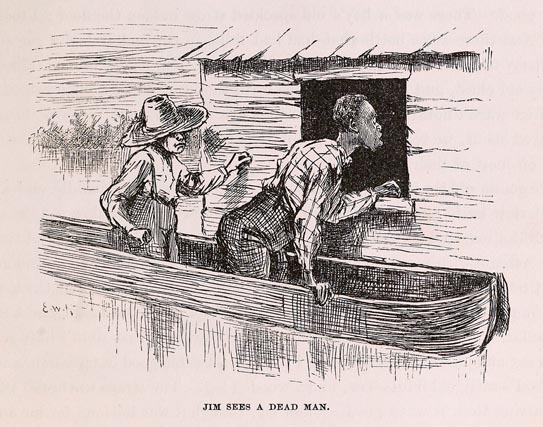
A stretch of river XXXV: "Here comes a frame-house down on the west side."

(Go here for the source for the title of the post)

Well, okay. No house came floating down our stretch of the Little Arkansas this past week, much less one with a dead man inside it. But from Saturday to Wednesday the river slowly rose, due to the rain and snow we've had in town and in the river's watershed to the north and west of Wichita, to about a foot and a half higher than usual. Though that doesn't sound like much, the rise led to two things: 1) The river flowed much faster than it usually does; 2) Just as Huck notes in Huckleberry Finn, when the river rises, all sorts of things came floating down it that one usually doesn't see in this or, I suspect, in most any river. So for those few days Scruffy and I vicariously made like Huck and Jim on our walks (the analogues being, in case you're wondering, pretty fluid, and this out of necessity since, as Jim has Huck acknowledge elsewhere in the novel, a cat is not a man).

This made for occasionally interesting, curious viewing those few days. But little romance arose from the accretion of debris. It was, to borrow Frost's phrase from another context, "a diminished thing."

Without a doubt, the strangest thing we saw in the river was on Saturday morning: a sofa cushion floating majestically down its center, sitting so high on the surface that it appeared to have been inflated. After that came, on succeeding days, the inventory of a small sporting goods store: a basketball, a football, and a soccer ball. All were cheap, and all had seen better days. There was a fair amount of driftwood to see, too, some of it surprisingly large. The rest was the usual sort of garbage (literally) that one would expect to see floating on a river in flood that flows through an urban area: liquor bottles; beer and soda-water cans; pieces of styrofoam chests . . . you get the idea.

Perhaps I am jaded: I know, if I account for Huck's adolescent-boy's filter on his narrator's lens, that he's just looking at river trash, too. I must also account for the fact that his river is the Mighty Mississip' while mine is the Little Arkansas. Or is this an example of a failure of the imagination--that if I squinted in just the right way I could see magic or fancy in that debris. But no. The imagination can invent only so much; as Wallace Stevens notes, making a poetic career out of doing so, it has its starting place in reality (whatever that was). It cannot invent ex nihilo.

Well: Huck's having seen the house means that I can, too: its extravagance is something I can attest to as well, if only vicariously. A whole house--and Scruffy and I had seen a cushion from one of its sofas. A diminished thing, yes. But something. Enough.

Read More...