Showing posts with label Modernism. Show all posts

Sunday, August 21, 2011

"For a long time . . . ": On asparagus

Adriaen Coorte (c. 1663-after 1707), Still Life (Asparagus) (1697), Rijksmuseum, Amsterdam. Image found here.

For a long time (since my college days, in fact) I have owned the hardback 3-volume C. K. Scott Moncrieff and Terence Kilmartin translation of Proust's A la recherche du temps perdu, and for a long time now I have been promising myself that I would read it in its entirety. Uh-huh. Long ago, I once taught (and have since forgotten a good deal of) Swann's Way. Long ago, I was younger, too.

A couple of weeks ago, therefore, I started rereading Swann's Way as my bedtime reading, and the plan is to make Proust my bedtime reading till I finish the thing. This may take a while; but then again, this thing is not meant to be rushed through. Example: Last week, the Mrs. regaled me with a lengthy recounting of events in The 19th Wife, which she was then reading (and which she would recommend, by the way). She didn't ask me, So what's going on in Swann's Way? I told her later that day that, had she asked, I would have told her, "Well, I've just read 4 pages of description of the stained glass windows in Combray's church of Saint-Hilaire . . . "

And so it goes with Proust. It's not what one would call plot-driven. Rather, it immerses the reader in the daily, the ordinary; at its best (assuming, of course, you are a reader who is predisposed toward such writing), you get so caught up in the richness of Marcel's (our narrator's) descriptions that you don't notice that anything is, you know, happening. And yet, things are happening. Life is happening. Pay attention to it, too, Proust seems to argue implicitly--this is the space, after all, in which we spend the vast majority of our lives. That's pretty simple, I know, but it's all I have for the moment.

Anyway. From time to time, you may see bits and pieces of Proust "here" over the coming months as I read this thing.

As this post's title and picture suggest, you'll now hear a bit about asparagus:

I would stop by the table [in the kitchen], where the kitchen-maid had shelled them, to inspect the platoons of peas, drawn up in ranks and numbered, like little green marbles, ready for a game; but what most enraptured me were the asparagus, tinged with ultramarine and pink which shaded off from their heads, finely stippled in mauve and azure, through a series of imperceptible gradations to their white feet--still stained a little by the soil of their garden-bed--with an iridescence that was not of this world. I felt that these celestial hues indicated the presence of exquisite creatures who had been pleased to assume vegetable form and who, through the disguise of their firm, comestible flesh, allowed me to discern in this radiance of earliest dawn, these hinted rainbows, these blue evening shades, that precious quality which I should recognise again when, all night long after a dinner at which I had partaken of them, they played (lyrical and coarse in their jesting as the fairies in Shakespeare's Dream) at transforming my chamber pot into a vase of aromatic perfume.

Poor Giotto's Charity, as Swann had named her, charged by Françoise with the task of preparing them for the table, would have them lying beside her in a basket, while she sat there with a mournful air as though all the sorrows of the world were heaped upon her; and the light crowns of azure which capped the asparagus shoots above their pink jackets were delicately outlined, star by star, as, in Giotto's fresco, are the flowers encircling the brow or patterning the basket of his Virtue at Padua. (I:131)

[I don't know whether it is a good thing or a bad thing that there's little room in the world of ad copy for writing like this.]

Over the course of many, many pages, Marcel reveals Françoise, the chief housekeeper at the house in Combray, to be a complex character. He admires her but knows that she can be hard on those in her charge--hence the kitchen-maid's virtuous, even beautiful weariness in the passage above. But it's the extent of Françoise's harshness that Marcel does not (yet) recognize:
There is a species of hymenoptera observed by Fabre, the burrowing wasp, which in order to provide a supply of fresh meat to her offspring after her own decease, calls in the science of anatomy to amplify the resources of her instinctive cruelty, and, having made a collection of weevils and spiders, proceeds with marvellous knowledge and skill to pierce the nerve-centre on which their powers of locomotion (but none of their other vital functions) depends, so that the paralysed insect, beside which she lays her eggs, will furnish the larvae, when hatched, with a docile, inoffensive quarry, incapable of flight or of resistance, but perfectly fresh for the larder: in the same way Françoise had adopted, to minister her unfaltering resolution to render the house uninhabitable to any other servant, a series of stratagems so cunning and so pitiless that, many years later, we discovered that if we had been fed on asparagus day after day throughout that summer, it was because their smell gave the poor kitchen-maid who had to prepare them such violent attacks of asthma that she was finally obliged to leave my aunt's service. (I:134-135)

This sort of organizing of information--the initial memory or composite of memories, then its later, fuller explication--occurs again and again in Remembrance of Things Past. I'll have more to say about that, via an early symbol of it in Swann's Way, in my next post on this novel.

Read More...

Saturday, April 16, 2011

The Pale King and the unweeded garden

I am often slow of study. Only today did it occur to me that it's entirely appropriate to publish on April 15th a novel that's set in an IRS facility. Moreover, it's very appropriate this tax season due to the fact that, though the 15th fell on a Friday this year, this year's deadline is the 18th due to the Washington, D.C. holiday. For weirdness within an allegedly coherent, even boring system is, apparently, one of this unfinished work's big subjects.

I've not read this yet (that will have to wait a little while) and I've certainly not read all the reviews, but while all sorts of modern and contemporary "systems-novelists" (think Pynchon, DeLillo, Gaddis) have been named-checked in those reviews, the link I'm surprised no one has made is with Hamlet--which, of course, is also the origin of the phrase "infinite jest." The phrase "pale king" does not appear in Shakespeare's play, but a pale king certainly does (as does a dead father in The Pale King)--and, moreover, to reveal that the outwardly-tranquil (read: boring, bureaucratic) world of Elsinore is, in fact, as corrupt as Hamlet's image of the unweeded garden hints that it is. And, as in Hamlet, a big theme of The Pale King is delayed action: this review of the novel quotes from Wallace's notes identifying its "central deal": “Realism. Monotony. Plot a series of set-ups for stuff happening, but nothing actually happens.”

I've probably over-speculated on this novel that I have yet to read a page of, so I'll stop here for now. But by way of parting (and in celebration of tax season), I'll leave you with this pondering of an existential dilemma:

“Our tax system, as it currently exists, faces challenges,” [Evanston, Ill., accountant Stephen] Lacy wrote [to Wallace], before offering a “philosophical analogy”: “Imagine someone who wants to have a purely realistic and Aristotelian outlook and metaphysic and wants to avoid thinking of how some of the radical insights of Gödel, Wittgenstein, Davidson, Derrida and Deleuze might chip away at his system. The complexity of language and its nature of being contradictory and deconstructing are there all the time. . . . Sooner or later this person’s world view will have major problems. Our tax system wants to be a ‘modernist’ enterprise in an increasingly ‘postmodernist’ world.”

Read More...

Tuesday, June 16, 2009

Happy Bloomsday

James Joyce's sketch of Ulysses' hero, Leopold Bloom. The line in Greek is the opening line of The Odyssey: "Tell me Muse, of the man of many devices, who over many ways…” Image found here.

It is June 16th again. If there's a literary equivalent of solar calendars, surely one of the days by which it would be oriented would be this day. Ulysses is one of those books which, even if you haven't read it, you have inescapably read books which owe their forms and strategies to it. (And just for the record, I'm saying that like it's a good thing.)

By way of celebrating the day, here's Kate Bush's video for the title track of her 1989 album, The Sensual World. It's not quite 1904 Dublin, but listen closely and you'll hear some very familiar language:


Also, by (the Mrs.') request, this blast from the past.

Read More...

Tuesday, October 02, 2007

A stretch of river XLIII: Wind and Wallace Stevens

This was going to be about the wind that Scruffy and I experienced and of the various roarings beneath the wind--traffic, airplanes, cooling units--and the indefinable Something that I could hear that was framing all this noise and motion. But as it happens, today is Wallace Stevens' birthday (thanks, Mr. Keillor), and Stevens was the sort of poet for whom wind is an important image. So: a favorite Stevens poem of mine in which wind figures prominently. (And a promise of a more substantial post soon.)


The Snow Man

One must have a mind of winter
To regard the frost and the boughs
Of the pine-trees crusted with snow;

And have been cold a long time
To behold the junipers shagged with ice,
The spruces rough in the distant glitter

Of the January sun; and not to think
Of any misery in the sound of the wind,
In the sound of a few leaves,

Which is the sound of the land
Full of the same wind
That is blowing in the same bare place

For the listener, who listens in the snow,
And, nothing himself, beholds
Nothing that is not there and the nothing that is.

Read More...

Friday, April 20, 2007

A stretch of river XXXV: "Here comes a frame-house down on the west side."

(Go here for the source for the title of the post)

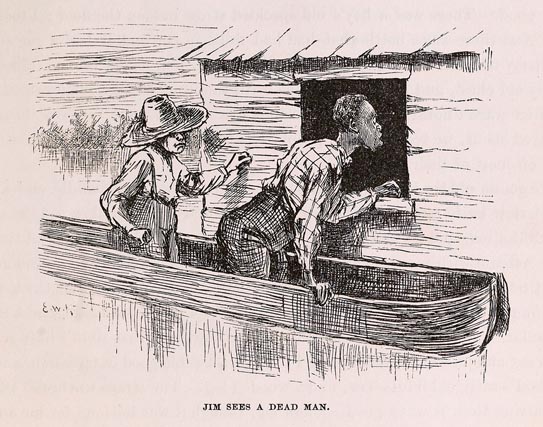
Well, okay. No house came floating down our stretch of the Little Arkansas this past week, much less one with a dead man inside it. But from Saturday to Wednesday the river slowly rose, due to the rain and snow we've had in town and in the river's watershed to the north and west of Wichita, to about a foot and a half higher than usual. Though that doesn't sound like much, the rise led to two things: 1) The river flowed much faster than it usually does; 2) Just as Huck notes in Huckleberry Finn, when the river rises, all sorts of things came floating down it that one usually doesn't see in this or, I suspect, in most any river. So for those few days Scruffy and I vicariously made like Huck and Jim on our walks (the analogues being, in case you're wondering, pretty fluid, and this out of necessity since, as Jim has Huck acknowledge elsewhere in the novel, a cat is not a man).

This made for occasionally interesting, curious viewing those few days. But little romance arose from the accretion of debris. It was, to borrow Frost's phrase from another context, "a diminished thing."

Without a doubt, the strangest thing we saw in the river was on Saturday morning: a sofa cushion floating majestically down its center, sitting so high on the surface that it appeared to have been inflated. After that came, on succeeding days, the inventory of a small sporting goods store: a basketball, a football, and a soccer ball. All were cheap, and all had seen better days. There was a fair amount of driftwood to see, too, some of it surprisingly large. The rest was the usual sort of garbage (literally) that one would expect to see floating on a river in flood that flows through an urban area: liquor bottles; beer and soda-water cans; pieces of styrofoam chests . . . you get the idea.

Perhaps I am jaded: I know, if I account for Huck's adolescent-boy's filter on his narrator's lens, that he's just looking at river trash, too. I must also account for the fact that his river is the Mighty Mississip' while mine is the Little Arkansas. Or is this an example of a failure of the imagination--that if I squinted in just the right way I could see magic or fancy in that debris. But no. The imagination can invent only so much; as Wallace Stevens notes, making a poetic career out of doing so, it has its starting place in reality (whatever that was). It cannot invent ex nihilo.

Well: Huck's having seen the house means that I can, too: its extravagance is something I can attest to as well, if only vicariously. A whole house--and Scruffy and I had seen a cushion from one of its sofas. A diminished thing, yes. But something. Enough.

Read More...

Friday, April 30, 2004

A rambling discourse on discourse; or: Free-floating signifiers, indeed

Today I kept bumping into situations and texts that brought home to me yet again, as if, in my profession, I needed further reminding of it, that language is a slippery fish . . . and that, if some are correct in their thinking, it will only become more so.
First up today was the Sears auto repair shop.  I had learned, to my considerable joy and relief, that Sears could do the remaining work my car required.  This pleased me because I actually have a little credit remaining with them.  So, I arrived there and began to tell them what I had been told at Pep Boys regarding what my car needed.  When I mentioned that it needed "a CV . . . something or other," it suddenly occurred to me that not only had I forgotten the full name for the part (it's a CV half-shaft, by the way), I had no idea what exactly it was that I was talking about--that is, what its function was.  Yet at Pep Boys the fellow told me that I needed a new one "before your wheels fall off."  That, of course, I understand; and that simply made my ignorance of this piece even more painful and embarrassing to bear.  After all: it's not as though this piece was merely some piece of automobile esoterica; it was vital not just to the functioning but also the saftey of my car, and yet I hadn't the foggiest notion of its existence, let alone its job.  At first I thought, rather simply, that this was yet another instance of what happens when any of us wanders into an area of knowledge that has its own language and we're not familiar with it.  But whereas in those other instances my ignorance doesn't unnerve me, in this case it did, profoundly so.  I felt disconneceted from a part of the world that both was and was not connected with mine, one that I should know more about and yet did not.  The automobile is ubiquitous; we here in this nation have relandscaped open spaces and (re)built whole cities to accommodate it.  It's so ubiquitous that we don't even SEE it any more--it no longer registers on our conscience how it has utterly altered the world's topography and, now, climate.  Yet here I was, about to pay $500 to have a part of my car replaced that I hadn't even known existed before Sunday and yet was vital to its operation.  Without knowing it, I got a small intimation of that state I would be reading about later in the introduction to Hannah Arendt's The Human Condition.
CV, I came to learn when the part arrived, stands for "constant velocity."  The CV shafts transfer the power generated by the pistons to the front wheels of the car to push them forward when one steps on the gas pedal.  Once the mechanic explained that, I instantly understood why I'd hear a very loud clicking noise only when I would accelerate.  No more clicking noise now, except in my little brain when I was able to explain the noise my car had been making.  Education is expensive.  I don't know if the lesson I learned has a value equivalent to the $500 I paid; but given the alternative (a car with its wheels falling off while I'm driving it), an ounce of prevention . . .
While I was waiting for my car to be fixed, I read some more in Bhabha's The Location of Culture.  As I noted in my entry about this book, Bhabha continues to say everything I want to argue about the New World as a miscegenated culture, except that he (still) has so far said nothing about miscegenation.  I've not gotten to it yet, but he has a chapter on the New World, so we'll see if he addresses it there.  At any rate, in what I read for today he discusses a small portion of Arendt's The Human Condition.  Arendt is one of those thinkers whose work I bump into with some regularity via other people's work but otherwise know little about.  But of what I HAVE read, I'm always impressed by her levelheadedness, her way of making things sound obvious and profound at the same time.  So today, I decided to go to my favorite Barnes & Noble in town (we actually have two on my side of town) to look for her book and at least read the introduction.  But of course, when I got there, I browsed and found some other things to look at and, in the meantime, forgot all about Arendt.  For the time being, at least. 
At any rate, one of the things I found was a book of art criticism in the John Berger vein by Rebecca Solnit called As Eve Said to the Serpent: On Landscape, Gender, and Art.  I read her essay called "Noah's Alphabet," which consists of musings triggered by a visit to Dublin's museum of natural history.  The visit caused two central responses in her: 1) her appreciation for the animals' forms, which, curiously, she said she could appreciate more in their stuffed, posed states better than she could when the animals are alive (she said that in zoos she hopes to glimpse wildness but is usually disappointed; in the museum, she has no such expectation and so can concentrate on the animals' shapes); 2) (the more sustained and richer of her responses) the museum's displays of animals which were once native to Ireland but no longer exist in the wild causes her to meditate on the fact that the earth is fast losing its wild animals and that even its domesticated animals are no longer as easily seen in rural areas as they once were but are now raised in what we might as well call factories.  She thinks back on bestiaries and how, while we have vestiges of such books in children's ABC books ("aardvark to zebra"), animals are fast losing their privileged place in our cultural conscience as a source of metaphor--in other words, as sparks for the imagination.  My image of language as being a slippery fish, for example, would not help us visualize a certain quality of language if we were no longer familiar with the actual feel of fish.  The results are not just a further impoverishment of our languages' resources but also a further psychic detachment of humans from the very world that nurtures us--what Fredric Jameson describes as "modernism" (postmodernism is/will be that state in which there is no nature--that is, that nature will be of no consequence in our daily living).  The scene Solnit closes with drives this last point home most effectively: she describes a display at one end of a long hall consisting of skeletons of an orangutan, a chimpanzee, a baboon and a human.  The ape skeletons are standing but hunched over, supported by rods as though they were invertebrates; the human skeleton, though, stands ramrod-straight--or hangs, rather, because it is actually suspended from the ceiling by a golden chain that penetrates its skull.  A visual argument against evolutionary theory, at the very least; one could go further, Solnit says, and imagine that that chain links humans to God, keeping us from being grounded on the earth.
Something in that essay, for some reason, reminded me that I had wanted to look at The Human Condition, so I went off to find it.  I turned to Arendt's Prologue, and there I find writing that, though written in the late 1950s, may be even more apropos of our own time--and it seemed especially pointed in my direction today.  She says she started the inquiry that led to this book by attempting to answer a simple question: "What are we doing?"  Her occasion for asking it is the Russians' launching of Sputnik: the first sending out of a manmade object into space and thus, for her, the first concrete sign of technology's ultimate, unspoken purpose--to help us to quite literally escape the earth and its claims on us.  Because technology intervenes between us and nature, we paradoxically find it hard to talk about technology's effects even though it is of us, and this poses a danger to us as social animals: "Whatever men do or know or experience can make sense only to the extent that it can be spoken about."  Yes indeed.  Language helps us make sense: we convey and create meaning through language that we can then transfer to another conscience; and because technology separates us not just from Nature but from each other, language--and thus our attempts to think about the implications of technology--will suffer.
So also suffers our notion of work.  The other blessing/curse of technology is that it is designed to reduce or eliminate the need for human labor.  Arendt must have known, having written one of the definitive studies of totalitarianism, how the following argument would sound to certain ears; nevertheless, she indeed does raise a vital question by implication:
It is a society of laborers which is about to be liberated from the fetters of labor, and this society does no longer know of those other higher and more meaningful activities for the sake of which this freedom would deserve to be won. . . . What we are confronted with is the prospect of a society of laborers without labor, that is, without the only activity left to them.  Surely, nothing could be worse.
She is right in the sense that we've created a leisure class (or, a class with more leisure than it's ever had before) whose members have no sense of what could/should be done with that leisure: "Here we are now/Entertain us."  And the computer now causes many people to believe they are now freed from having to perform even the labor of thinking.  People don't calculate; machines do--that's the most benign example of what I mean.  But each semester I must remind my students that spell-checks only confirm the correctness of a word, not its rightness.  Imagine, then, their imprecision with language generally, impeding comprehension.  I have had two students this semester who, in different ways, held ME accountable because I was not able to convey to them that the words on their page didn't say what they were telling me they intended to say.  Yet such students are in college with the goal of avoiding "labor."  Be sure not to ask them to perform much while in school.
Rambling, indeed.
This was Book Talk, two days early.  Tomorrow: some notes on Joe Henry's album, Tiny Voices.

Those wishing to see the comments for the original LiveJournal post can go here.

Read More...

Sunday, April 04, 2004

Daylight Savings Time; Eternal Sunshine of the Spotless Mind; King Crimson

A rather crowded agenda for this entry . . . just making up for lost time.
Fearful Syzygy's recent entry on the Dane/Danish fellow/Dansker (which is it nowadays?) who attributes some of Denmark's fiscal rotteness to that nation's version of Daylight Savings Time inspires the first part of this blog.  As of 2 a.m. this morning, we have sprung forward here, "here" signifying most of the U.S.  Arizona opts out of Daylight Savings Time entirely; even stranger, though, is the case of Indiana, which not only is bifurcated by the Eastern and Central time zone lines but also has individual COUNTIES on BOTH sides of that line which have chosen not to spring forward or fall back.  It becomes more than a little complicated to rise with the chickens there in the Hoosier State.And that last line leads me to argue against Daylight Savings Time as well, though for a reason different than the one offered by the fellow in Denmark.  I don't know why DST was initiated there, but here it was proposed by Benjamin Franklin as a way maximizing daylight hours during the winter, when the days grow shorter, for the benefit of farmers.  With the rise of mechanization on farms (one of the simplest signs of that being tractors with headlights on them), that reason no longer applies.  No doubt someone in this country makes arguments in support of DST, but I truly can't imagine what they would be.  At least the chief argument in favor of raising speed limits on major highways to 70 mph was that some people want to drive faster than 65.  So then, at least from my myopic perspective, we keep DST around for the same reason that most school districts keep the 9-month school year: a tradition dating back to our agrarian roots.  Nothing wrong with that, I suppose.  Much can be said in support of the idea that our agrarian society, without sentimentalizing it, was in most respects a healthier society: poor diets, yes, but the labor performed on farms resulted in less obesity in the population; only the upper classes could complain of boredom--now, of course, even the poor are so media-saturated that boredom permeates all societal levels of our culture; and I do think that the sort of communal labor that gets performed in such cultures leads to the sustaining of societies whose people do give at least a small darn about the welfare of their neighbors.  But DST, even in our mostly-agrarian past, didn't nurture the strengths mentioned above.  It didn't save time, the way most machines are supposed to do; it saved daylight so that there was "more" of it for working.  It paradoxically didn't allow farmers to keep time with the rhythms of the sun and seasons but actually tied them more tightly to the workings of gears inside clocks: "Well, the clock says 6, no  matter what the sun says."Could one make an argument that DST, far from aiding farmers in their work, is actually, if not a cause, then at least symptomatic of my nation's move away from agrarianism and toward an urban society?  That and the railroads, whose invention created the need for standardized time zones in the first place?I have no proof for any of the above.  I think Thoreau would dig this, though (I've been teaching a brief excerpt from Walden in my comp classes recently).  We can't revert from urbanism, and I'm not arguing that we should.  But the fact remains, as Thoreau argues and demonstrates so eloquently, that our self-removal from participation in daily and the seasonal rhythms via the Machine has the long-term effect of emptying our lives of a simpler and more genuine meaning for our living.
Speaking of thought-provoking ideas: two weeks ago, I went to see the most recent Charlie Kaufman-written film, Eternal Sunshine of the Spotless Mind (starring Jim Carrey, Kate Wimslet, Kristen Durst, and Elijah Wood in a decidedly anti-Frodo role).  In an earlier entry, the Blog mentioned some favorite directors, but inexplicably left off the list was Spike Jonze's work with Kaufman: Being John Malkovic and Adaptation are really imaginative films in the fullest sense of that adjective, I think, not just for their quirkiness but also in that (and this is especially true of the first one) they at their hearts tell familiar tales but make them appear fresh: What's it like to see the world through the eyes of another person?  What if we could in some way remove ourselves from our decidedly subjective point of view and THEN, in effect, see the world as we see it, but this time from that outsider's perspective?  And, in Adaptation, just where IS that boundary between the writer and his work. It took seeing Eternal Sunshine . . . to see these matters more clearly, to see these films' quirkiness as means to their respective ends.  This is a romance, in both the movie genre AND the Hawthornian senses of that word (In his preface to The Blithedale Romance, Hawthorne says that in romances, the "work is not exactly put side by side with nature," thus permitting "a license with regard to every-day Probability, in view of the improved effects which [the author] is bound to produce thereby.")  Via decidedly sci-fi means--kinda like The Matrix, but this time we're inside individual minds rather than (maybe, maybe not) computers--this film examines the relationship between love and memory: what is it exactly that love is?  Is love the result of memory, or is memory the result of love?  How is love (or memory, for that matter?) preserved?  Is that solely an act of the individual who remembers his/her lover, or does it come from somewhere else, ie., outside the individual?  Once we gain our narrative sea-legs in the plot, we root for the lovers, as we're supposed to do in all movie romances; but when approached from the Hawthornian angle, the film becomes less about the particulars of the lovers' relationship and more about a metaphysics of love, a dynamic of love, that we couldn't examine, one suspects, without the literal invasion of a decidedly anti-R/romantic Machine into the plot.  I'm afraid to say much more here for two reasons: 1) The film surprises in many ways, not the least of which is the richness produced by its explorations of that metaphysics of love, and I don't want to spoil that for the potential viewer; 2) If I keep talking about this intellectually and visually magical film, I'll never get to King Crimson in Arkansas today.  Perhaps I can continue that discussion, though, with those who see fit to comment on this entry.
The drive from Wichita to where my children live is 14 hours, so I take along a selection of CDs to listen to.  I try for a variety of things; my selections for the spring break trip were: the Branford Marsalis Quartet, Romare Bearden Revealed; Led Zeppelin, Presence; King Crimson, THRAK; The Rough Guide to Samba; Lizz Wright, Salt; and Yes, The Yes Album.  Oddly, I want to talk about THRAK because it disappointed me.  I like very much early Crimson--the debut album and Red especially stand out, I think--and one of my favorite albums, period, is Discipline.  All these albums have an elegance to them: an emphasis on melody and precision.  Discipline in particular works because of its impossibly tight rhythm section of Tony Levin (bass) and Bill Bruford ("batterie").  More recent Crimson, though, is different.  From this period I have THRAK and The ConstruKction of Light, and each of these albums explores the possibilities of imposing noise over simpler song constructions (and I'm certain there's a better way to say this).  As a comparison: maybe an artier Sonic Youth or Dinosaur Jr.?  I don't mind noise, but what I found myself noticing on THRAK was a lack of melodic variety and, despite a couple of "quiet" songs, an emphasis on heaviness.  It became tedious, wearying to listen to: not the sort of thing one wants one's music to be when driving through the flatlands of the Mississippi alluvial plain.  As for lyrics, one of the refreshing things about Discipline is the wit of Adrian Belew's lyrics--after all this time, they still make my brain smile.  But in THRAK, the words sound forced or tired.  I suppose, then, that it disappoints because it's not the Crimson that I prefer; one could say that it's unfair not to permit a band that's been around for so long the license to experiment with its sound . . . would that Yes would do a bit more of that in its newer work even as it settles into the stage persona of prog-rock oldies band.  But it IS fair for fans not to especially approve of the results of those experiments.I like better The ConstruKction of Light; as its title suggests, to these ears, at least, there's a return to an intricate melodicism underlying the heaviness--you can see why they toured with Tool for about a month a couple of years ago.
Susan and I continue our discussion of Flemish/Dutch painting; more talk of that will be forthcoming.

Those wishing to read the comments from the original LiveJournal post can go here.

Read More...

Monday, March 08, 2004

The Shock of the New

At long last, I'm getting to Sunday's entry even though it's almost Tuesday. Tonight's entry will be brief due to the lateness of the hour, in part, but also because I admit to be making this entry so as to try to maintain the discipline of keeping this thing going. Another matter is that I intend for the book entries to be on literary works, but at this hour, I'm not sure I can summon the energy.
Enough apologies.
I certainly haven't seen all the studies on modern art out there, but it would be difficult to imagine a better introductory study than The Shock of the New, by Robert Hughes. This book is the print companion to the PBS series of the same name he did some years back, and a quick check at amazon.com seems to indicate that it's even been updated. Not that I'm an expert in art criticism, but it seems to me that the hostility of some of the reviewers toward Hughes' work comes from some weird place outside the text. The reviewers call the text either difficult or lazy; my choice would be "as provocative as the images themselves."
Hughes pursues his subject in roughly chronological but overlapping chapters dealing with themes (samples include "The Mechanical Paradise," "Trouble in Utopia," "Culture as Nature," and "The Future That Was") rather than periods, which seems to me a perfectly sane way to talk about a century that saw a profusion of new modes of expression appear and, at least to my eye, has yet to discard any of them.
Speaking of "my eye," one of the reviewers--the same one who called Hughes "lazy"--takes him to task for his uneducated observations. Maybe my problem is that I freely admit to being hugely ignorant about art generally, but in my mind Hughes writes powerfully and persuasively about the images he's chosen and is, yes, a bit breezy about contextualizing them, but he IS writing for a TV audience, keep in mind. At least he DOES contextualize them--and for my money, his first few pages of the opening chapter, "The Mechanical Paradise," could not be more succinct in developing the idea that, by the end of the 19th century, the Machine had changed forever how the artist sees nature.
In short: I have learned much from this book. Perhaps that makes me a simpleton as well, but I think that, taken as an introduction to its subject (which it is), you will not be disappointed.

Read More...