Sunday, December 05, 2010

Now you are aware of me!: A haphazard survey of recent books-as-objects

(Parts I and II)
A masterpiece of the book-as-object genre: the board-book version of Eric Carle's The Very Hungry Caterpillar. Image found here.

At the beginning of the film Objectified, which I posted on last month, a designer talks about how his idea for Oxo's vegetable peelers came to him. He mentions that a relative of his, who loved to cook, found it hard to grip her kitchen utensils for extended periods because of her arthritis. After playing around with various handle designs, he took an old outsized handlebar grip from a kid's bicycle and stuck it over the handle of his relative's peeler, and the rest is kitchen-utensil history. He then said something very interesting: that new designs initially seek to accommodate extreme situations--not the needs of the masses, but of special audiences and/or specialized needs. Yet, paradoxically, once we masses get our hands on an Oxo or Oxo-inspired peeler, it makes us wonder about those peelers with stamped-metal handles that our parents used and/or made us use--specifically, it makes us wonder if our forebears were masochists.

It's within the context of Objectified's observation about design that I've been thinking about these posts on the book-as-object, especially given the twin facts that of late there's been a fair amount of speculation about the future of books yet, on the other hand, that books whose physical design is meant to be considered as part of the making of meaning are appearing with some regularity. It occurs to me that perhaps these writers in some sense want to re-introduce us to books via those designs. Here's what they seem to be implying through their work: if a physical book is only a passive delivery system for a text, then we might as well read that same text off a screen. But if the book-as-device in some way contributes to or enhances not just reading a text but the making of that text's meaning, then maybe books won't disappear.

But then again, I was reminded recently that children's books haven't forgotten that reading for kids is a visual and tactile experience as much as it is an intellectual one. A couple of days ago by the front entrance at Barnes & Noble, I saw displayed copies of a children's book by Lane Smith called It's a Book. (Very short review: Cute--something like a re-writing of this--and the integrated page from an illustrated edition of Treasure Island is a nice surprise.) It's something of a meta-commentary on children's books' material attributes becoming part of the narrative, as with the Carle book pictured above (it was a favorite with my daughters when they were growing up; they loved to put their fingers in the holes as we counted all the things the caterpillar ate, and when at the end the caterpillar becomes a butterfly, I would flap the open book in imitation of that same butterfly: the book itself metamorphoses into the very object we had been told of via the book.

Well, okay: that book-flapping stuff was just Daddy being silly, back in the day.).

(Aside: I'm not sure just how pop-up books fit into this discussion. Their features require manipulation, of course, but the books themselves just need to be held open and their pages turned. For pop-up books, then, the book-as-book thus is a container, just as with more conventional texts. Or, at least, that's how they seem to me; I'm willing to listen to dissenting arguments.)

But though for adults there have been texts with adventurous typography and layouts ever since there have been texts, up to and including works of philosophy, it's not been till fairly recently that books have appeared in the mass market for grown-ups whose very materiality in some way(s) functions as part of the activity of meaning-making. These are very serious, even dark works, but the physical manipulation of the book in order to read it injects a sense of play into the reading experience--every reading experience is, in its essence, an act of imaginative play, the unifying of a collection of symbols and associating those symbols with things or ideas in the world to make meaning--that, precisely because having to do it is such an odd thing to have to do, should prompt us to ask, Why? What is gained here?

Below the fold is a fairly long-winded, arbitrary and incomplete survey (read: I know something about these) of books as objects, along with some pictures. Their more-frequent appearance--and, it must be said, their critical and financial success--give me hope that we'll see more books like these as writers attempt them and publishers are willing to print them. It is innovation at the margins that will help preserve all books, not just the stranger ones. We still have those awful metal-handle potato peelers, after all . . .

I am certain that other books of the sort I have been describing existed well before the 20th century, but the earliest I know of is Raymond Queneau's 1961 book,
Cent mille milliards de poèmes (One Hundred Thousand Billion Poems; image, and a description, found here). This book consists of ten sonnets, each of which follows not just the same rhyme scheme but whose lines all have the same rhyme sounds (that is, the first four lines of all the sonnets have an a b a b rhyme scheme, and all the a lines in all the poems will have the same sound) and each line of which is on its own strip of a page, thus making it possible to combine, say, any first line of a given poem with any combination of second lines, third lines, etc. from the other nine poems. Reading 24 hours a day, it would take a reader 200,000,000 years to read every possible combination (hence the title of the book). If you want a sense of how this all works, go here to see randomly-selected lines from the Poèmes; or, if you have about $100 lying around, buy a copy.

Here is an instance in which the book-as-object so disrupts that which we usually think of as "reading" that it's hard to say whether what one does with this book can be called reading. Though that means that for the vast majority of us such a book is fun to look at but is otherwise a curiosity, that's not a complaint. One way to think of the Poèmes is as something like a literalizing of the idea of the inexhaustible text, the idea that a given text can yield any number of possible meanings. But in a more accessible sense, we can say that the experience of the Poèmes is a concretizing of the idea that we never truly read any text in isolation, considering only the words on the page always and only in association with the other words on that page. The very act of being able to read is contingent on our experiences with words in other contexts, and with personal associations, too. In some sense, then, any reading of any text, in order to make sense of it, requires the piecing together of all of that and then telling ourselves that the result is "right there on the page." Reading as gathering, indeed.

These all are interesting ideas to have foregrounded by a book's physical design; but as anyone who has browsed a bookstore in the past fifty years can tell you, the shelves aren't exactly groaning with Cent mille milliards de poèmes wanna-bes and also-rans. It could be argued, though, that some books began to appear that play around with them on a smaller scale. One book that comes to mind is Argentinian novelist Julio Cortázar's 1963 novel Rayuela (English title: Hopscotch), with its instructions to the reader (image found here) on how to read its two sections (the first section is a more-or-less conventional narrative; the second section consists of other bits that, according to the author, can either be ignored by the reader "with a clean conscience" or be read in conjunction with the first section but in an (out-of-numerical-order) sequence indicated by Cortázar). Even more interesting: one of those ways of reading leads to a textual infinite loop: the book doesn't "end" once the reader closes the cover. In that sense, it is the the anti-Quixote.
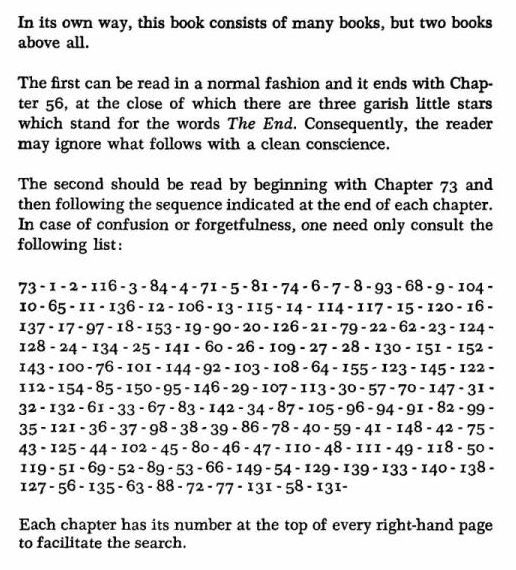
(Rather than prattle on further about Cortázar here, I'll just refer the curious to an earlier post of mine and say again here that this fellow's books are well worth knowing.)

The next books I'd like to mention here are those in Nick Bantock's Griffin & Sabine trilogy (image found here). Bantock's trilogy is in the grand tradition of that earliest novel form in English, the epistolary novel. However, as the picture here indicates, Bantock doesn't merely reproduce the texts of the exchange between the titular characters, he reproduces the postcards and includes actual envelopes containing physical facsimiles of their letters. The tactile experience of opening the envelope and pulling out and unfolding its letter and then, when done, refolding and replacing it back in its envelope creates in the reader the powerful sensation that we're reading other people's private correspondence in a way no other epistolary novel does. Moreover, I'd argue that as the correspondence becomes stranger and more complicated, those tactile acts create an emotional investment in the reader that actually enhances the tension felt in the narrative in ways that more conventional page-turning cannot. Who among us, after all, has not felt dread or nervousness upon seeing envelopes from certain addresses, to the point of not wanting to open them? These books show up on the shelves of the big chain stores all the time; if you don't already know them, seek them out. They're quick reads, but they're also beautiful (they sometimes show up in the artbook sections of stores).

Still and all, these books and others like them did not seem to lead to wider experiments with incorporating books' materiality into meaning-making. Given that fact, the gamble Pantheon took in choosing to publish Mark Z. Danielewski's 2000 novel, House of Leaves, (image found here) was an enormous one--indeed, they very well might never have taken it on if Danielewski, according to this long but very informative interview, hadn't typeset it himself. But Pantheon's gamble has paid off splendidly in the form of both critical and financial success; that, combined with newer softwares that make typesetting and complicated layouts much easier, has led to the appearance of many novels that experiment with the layout of text (or, in House of Leaves' case, texts) on a page and the incorporation of various kinds of images and, to a lesser extent, books-as-objects. Just as one example, it's difficult to imagine a major house like Penguin publishing a book like Reif Larson's beautiful 2009 book The Selected Works of T. S. Spivet if not for the example of House of Leaves.

House of Leaves confronts you with its strangeness before you even open it. The "cover image" you see above is, well, not quite the cover: the black portion of the image is what you'd call the cover, but that multicolored strip on the right-hand side is actually a separate page--essentially, the first page of the novel, though it appears even before the blurb page--on which you'll see a collage of various objects and handwritten and typed and word-processed texts. The front cover, in other words, doesn't quite cover the pages of the book, thus being analogous to one of the book's crucial settings, a house in Virginia that is larger on the inside than it is on the outside.

Opening the book just about anywhere, meanwhile--especially to its infamous Chapter IX--reveals the wide and wild variety of typographically-audacious pages that House of Leaves is known for. But for purposes of this post I'd like to look at two of its visually-simpler pages, pp. 440-441 (image found here; click on the image to enlarge it). As you perhaps can tell from the image, to read these two pages you must turn the book so that its left edge faces you and then read, line by line, from the new "bottom" of the page to the "top" of the facing page. The text, meanwhile, describes the character's ascension of a ladder. (To read the footnote on p. 441, then, you have to turn the book in the opposite direction.) So, while the words' layout evokes the climbing of a ladder, the fact of the book's being opened so that it is at its fullest length enhances our sense of the ladder's length as conveyed by the text. Well--as best it can, given that Navidson climbs this ladder for "hours and hours."

Despite moments like this and others in House of Leaves, it wasn't until his novel Only Revolutions appeared in 2006 that I became fully aware of how invested in the idea of the book as object Danielewski is. Its unusual textual layout (its parallel narratives begin at opposite ends of the book and are printed upside-down relative to each other--click on the image to enlarge it) require you to turn the book round and round in order to read each narrative; ruffle the pages with your thumb, and you'll see the page numbers in the circles orbit relative to each other; the hardback editions have two separate book ribbons to help you keep your place when reading each narrative; etc. This book, in other words, sometimes feels more constructed than written, to the point that some have found it emotionally chilly or wanting in terms of plot or character development.

I really admire this book's experimental bravery, but I will admit that its obsessiveness with, it seems, everything, from the things mentioned above to things like every page having exactly 360 words, can make reading Only Revolutions feel a bit odd for reasons quite apart from its adventurous language. (I say a little about that and about its American-ness here.) But then again, the book itself makes you aware of it in ways that even House of Leaves does not, let alone more conventional books. Anyway, Danielewski's obvious interest in thinking about books as more than empty vessels for texts inspired me to begin a discussion thread on that subject over at the Only Revolutions section of the MZD Forums.

This very odd book was also a finalist for the 2006 National Book Award. That sort of recognition, along next month's Tree of Codes by Jonathan Safran Foer, about which Olafur Eliasson says it is "a book that remembers it actually has a body," bodes well, I think, not just for those of us who love books that experiment with their material attributes, but for those of us who love books, period. Just as with the gene pools of living things, the more diversity we see in books, the healthier and longer-lived all kinds of books will be.

Read More...

Wednesday, November 24, 2010

Now you are aware of Me!: An inter-post on books as objects

A book illustration depicting the death of Don Quixote. I can't find where it appeared originally; my source for the image is here.

At the end of my last post, I promised some pictures of books whose physical design seems to me to contribute to the text's possible meanings. This isn't that post, but it does seek to provide an example of what I mean, as employed within the context of a conventionally-designed book. Well--at least, this is what I've told some students (though it wasn't from behind a lectern, so perhaps it doesn't count as Truth).

The rest is below the fold.

It was while writing that first post that I was reminded of my teaching excerpts from Don Quixote found in the Norton world literature anthology we used at my previous place of employ. Without going into detail here, let me just say that, my students be damned, Don Quixote is a hoot to teach for those interested in just about all the narratological paces through which a novel can be put, the postmodern ones included. That it also happens to ask us to think on very difficult questions and, besides, is a very good read, are bonus points.

The translation that follows wasn't the one in our text, but no matter; these are snippets from the conclusion of Don Quixote (tr. John Ormsby, 1885), which recounts Quixote's renunciation of knight-errantry, his will, and his death:

[T]urning to Sancho, he said, "Forgive me, my friend, that I led thee to seem as mad as myself, making thee fall into the same error I myself fell into, that there were and still are knights-errant in the world."

"Ah!" said Sancho weeping, "don't die, master, but take my advice and live many years; for the foolishest thing a man can do in this life is to let himself die without rhyme or reason, without anybody killing him, or any hands but melancholy's making an end of him. Come, don't be lazy, but get up from your bed and let us take to the fields in shepherd's trim as we agreed. Perhaps behind some bush we shall find the lady Dulcinea disenchanted, as fine as fine can be. If it be that you are dying of vexation at having been vanquished, lay the blame on me, and say you were overthrown because I had girthed Rocinante badly; besides you must have seen in your books of chivalry that it is a common thing for knights to upset one another, and for him who is conquered to-day to be conqueror tomorrow."

"Very true," said Samson, "and good Sancho Panza's view of these cases is quite right."

"Sirs, not so fast," said Don Quixote, "'in last year's nests there are no birds this year.' I was mad, now I am in my senses; I was Don Quixote of La Mancha, I am now, as I said, Alonso Quixano the Good; and may my repentance and sincerity restore me to the esteem you used to have for me; and now let Master Notary proceed.

* * *

And said most sage Cide Hamete [the chronicler said to be the source for the story of Don Quixote; Cervantes poses as its translator] to his pen, "Rest here, hung up by this brass wire, upon this shelf, O my pen, whether of skilful make or clumsy cut I know not; here shalt thou remain long ages hence, unless presumptuous or malignant story-tellers take thee down to profane thee. But ere they touch thee warn them, and, as best thou canst, say to them:

Hold off! ye weaklings; hold your hands!
Adventure it let none,
For this emprise, my lord the king,
Was meant for me alone.

For me alone was Don Quixote born, and I for him; it was his to act, mine to write; we two together make but one, notwithstanding and in spite of that pretended Tordesillesque writer who has ventured or would venture with his great, coarse, ill-trimmed ostrich quill to write the achievements of my valiant knight;- no burden for his shoulders, nor subject for his frozen wit: whom, if perchance thou shouldst come to know him, thou shalt warn to leave at rest where they lie the weary mouldering bones of Don Quixote, and not to attempt to carry him off, in opposition to all the privileges of death, to Old Castile, making him rise from the grave where in reality and truth he lies stretched at full length, powerless to make any third
expedition or new sally; for the two that he has already made, so much to the enjoyment and approval of everybody to whom they have become known, in this as well as in foreign countries, are quite sufficient for the purpose of turning into ridicule the whole of those made by the whole set of the knights-errant; and so doing shalt thou discharge thy Christian calling, giving good counsel to one that bears ill-will to thee. And I shall remain satisfied, and proud to have been the first who has ever enjoyed the fruit of his writings as fully as he could desire; for my desire has been no other than to deliver over to the detestation of mankind the false and foolish tales of the books of chivalry, which, thanks to that of my true Don Quixote, are even now tottering, and doubtless doomed to fall for ever. Farewell."

Don Quixote is a man of books in the most literal of senses, I would tell my students: it was due to his reading tales of knight-errantry in the first place that he comes to believe that he, too, is the latest in that noble lineage; we, for our part, would never have heard of him if not for all that. (The opening chapters make clear that La Mancha is something like the Tattooine of Spain.) So, imagine yourself as a reader, reaching these passages only a page or two from its end and reading Sancho's pleas that Quixote not die but go on more adventures--that is, go on living, and then Cid Hamete's declaration at the very end that Quixote has indeed died and that another writer's "resurrecting" him would be tantamount to violating a grave . . . and then imagine closing the cover of the book on all this. As I would tell my students: Sure. It's the cover of a book--what else are we supposed to do but close it? But imagine that cover as something like the lid closing Quixote's coffin, or perhaps the soil covering that coffin, filling in his grave. The reader's physical act of closing the book makes him a participant in Don Quixote's burial--the burial of a man who, for the reader, comes into existence because he (Quixote and/or the reader--take your pick) opens a book, and now dies because of his renunciation of the very books he had opened--in effect, he himself closes those books, and figuratively closes his own coffin lid. And so also do we close that lid, too, though (Cervantes hopes, I think) with something like Sancho's sadness.

Read More...

Sunday, November 21, 2010

Now you are aware of me!: Some comments on the value of books as objects


From top down: a page from the Book of Kells (page found here); a page from Tom Phillips' "treated novel," A Humument (its history is here; the image was found here); the interior of Jonathan Safran Foer's January 2011 release, Tree of Codes (image found here).

And when I would have to look at them day after day, each with his and her secret and selfish thought, and blood strange to each other blood and strange to mine, and think that this seemed to be the only way I could get ready to stay dead, I would hate my father for having ever planted me. I would look forward to the times when they faulted, so I could whip them. When the switch fell I could feel it upon my flesh; when it welted and ridged it was my blood that ran, and I would think with each blow of the switch: Now you are aware of me! Now I am something in your secret and selfish life, who have marked your blood with my own for ever and ever.

* * *

And so when Cora Tull would tell me I was not a true mother, I would think how words go straight up in a thin line, quick and harmless, and how terribly doing goes along the earth, clinging to it, so that after a while the two lines are too far apart for the same person to straddle from one to the other; and that sin and love and fear are just sounds that people who never sinned nor loved nor feared have for what they never had and cannot have until they forgot the words. Like Cora, who could never even cook.
--Addie Bundren, from As I Lay Dying by William Faulkner

I think Addie would have hated the idea of the Kindle or the Nook. (Bear with me. This makes sense in my head . . . ) Her despair regarding the abyss between words and the deeds they "say at" (her phrase) is akin to the experience I feel at times when reading a text off a screen as compared to reading it off a sheet of paper. Even the ability, in this digital mode, to cut and paste a word or phrase or pages and pages of text just isn't the same thing as holding a piece of paper with words on it, underlining or circling those words or, as I often have occasion to do, re-type words in physical books into electronic documents of whatever sort. I'm not sure why that is, but a clue might possibly be here, worth reproducing in full (emphasis added):
O.E. rædan (W.Saxon), redan (Anglian) "to explain, read, rule, advise" (related to ræd, red "advice"), from P.Gmc. *raedanan (cf. O.N. raða, O.Fris. reda, Du. raden, O.H.G. ratan, Ger. raten "to advise, counsel, guess"), from PIE base *rei- "to reason, count" (cf. Skt. radh- "to succeed, accomplish," Gk. arithmos "number amount," O.C.S. raditi "to take thought, attend to," O.Ir. im-radim "to deliberate, consider"). Connected to riddle via notion of "interpret."

Words from this root in most modern Germanic languages still mean "counsel, advise." Transference to "understand the meaning of written symbols" is unique to O.E. and (perhaps under English influence) O.N. raða. Most languages use a word rooted in the idea of "gather up" as their word for "read" (cf. Fr. lire, from L. legere). Sense of "make out the character of (a person)" is attested from 1610s. The noun meaning "an act of reading" is recorded from 1825. Read up "study" is from 1842; read-only in computer jargon is recorded from 1961.

To be sure, most of the work of reading is intellectual; still, at some level for me the idea of reading as a partly-physical activity is important, too. At its best, the reading experience requires a held object that bears the weight of the ink that appears in the shapes of the words I'm reading. The book is the container of gathered language; even more important, those words themselves have a basic material existence, thereby making them ever so slightly less abstract than they would be otherwise.

I don't want to lose the physicality of reading that holding a book imposes on the reader. Something important, even fundamental about reading itself would thereby be lost.

Maybe we won't. Moreover, there's reason to hope that we won't. That's what this post and the one to follow will explore in my usual meandering fashion.

Some initial thoughts below the fold.

A while ago, in the comments on this post, my long-time online friend Kári spoke of scrolls and books as modes of delivery for texts, noting that the act of reading text off a computer screen is something of a throwback to how readers of scrolls encountered texts. Meanwhile, Kindles and Nooks attempt to imitate electronically the experience of reading a paper text . . . even as, ironically, it's pretty easy to find articles these days not so much wondering if books will disappear as taking bets on when they'll disappear.

With my usual think-from-the-hip manner, when that discussion was going on I thought, "I love books as objects, and my local Barnes & Noble's been so crowded the past few times I've visited that it's no longer convenient to just sit among the stacks and read as I once did, so of course books will live on." But, keep in mind, that statement comes from someone who misses rotary-dial telephones. But my recently learning of the coming release of Foer's audacious experiment not just with text but with our basic assumptions about what the physical surface of a page should look like has caused me to think a little more about the question of book as objects, what sort of thinking would lead to their demise, and what might keep them alive.

That we're even having discussions about the death of books is due precisely to their resounding success as designed objects: as I noted in my most recent post, good design doesn't call attention to itself; the vast, vast majority of books have no need to call attention to their mass in order to function well, much less to be taken into consideration as helping shape a text's meaning. In fact, as I tell my students, you know you have a good book when you forget that you're reading a book. Obviously, though, that sort of thinking is what leads to death-of-the-book talk: if what matters is the text, why not dispense with the physical object?

What might help keep books alive is revisiting their design, by which I mean our basic assumptions about what the physical surfaces of the book-as-object "should" look like. But in this instance, rather than making the interaction between reader and object as frictionless as possible, those books whose physical attributes call attention to themselves in such as way as to cause the reader to revisit the fundamental subject of the reading dynamic itself as it applies to that book--those books might just rejuvenate interest in (or at least subconsciously remind us) of books' inherent value as objects in their own right and not meaningless containers of words. The mere existence of something as materially audacious as Foer's new book by someone with Foer's prominence is itself evidence enough, I'd say, that publishers aren't quite ready to give up on physical books as a medium; in truth, though, for the past ten or so years there's been a fair number of books by major publishers that, in various ways, compel their readers to think about books as objects.

This makes me happy.

In the next post, we'll have a look at some recent books whose designs, it seems to me, are part of their respective texts' messages.

Read More...

Saturday, November 06, 2010

Objectified and the metaphysics of design

Hey there. Glad to be back, if only briefly to let my reader(s) know I'm still around.

Here's some of what I've been up to:

Image found here.

Last weekend, the Mrs. and I saw Objectified (it's instantly available via Netflix's online service--which because of its addictive properties should probably be illegal). Watching it felt almost providential. Long-time readers may remember that I keep returning to the subject of how to get my students to think about technology and their relationship to it; design, of course, is the art of making technology useful and, at its best, almost unnoticeable. If you think you might possibly be interested in seeing a film that serves as an introduction to the metaphysics of design, this is the film for you.

Here's the trailer:


Its director, Gary Hustwit, also made the much-acclaimed Helvetica--yes, the typeface. But before you run for the exits, at least give the trailer a try. In that film (which we also saw last weekend--see, again, my earlier suggested legislation re Netflix), and to a much broader extent in Objectified, Hustwit's big theme (as articulated in various ways by people in both films) is that good design doesn't call attention to itself as we use it. These objects feel like natural extensions of ourselves even as they remain outside us. But in the otherwise-affectionate tribute to Helvetica (the film was made in honor of its 50th anniversary), some of its interviewees make clear that that ubiquity can be both blessing and curse: successful designs can become analogous to invasive species who meet little or no resistance in their new environments. Subtly-made case in point: if you watch either or both films, keep score of the number of Macs you see people using compared to the number of PCs.

As it should be, Objectified is a friendly discussion of its subject. All of us, often unconsciously, are the beneficiaries of good design and, again without quite knowing why, feel frustrated when we encounter bad design. The frustration arises in part, I think, from the mystery that bad design creates in the user: we wonder if we're not using the object correctly, if some reason exists for its design that's escaping us. But, as a furniture designer in the film says, there's no reason for uncomfortable chairs to exist. Good design is aspirational, or should be: an end in itself, no matter the object or the wealth of its user.

I hate uncomfortable chairs, too. But toward the end of the film, when a designer gestures in the direction of a utopia in which designers would be included in the crafting of laws and policies, I took her point, but I also found myself thinking that too often in this discussion of how design makes our lives better, it feels as though ALL that's being talked about is making more-comfortable chairs (as opposed to, say, making a better world--not necessarily the same thing). Within that context, her remarks just seemed a bit silly. At one point, a designer indirectly acknowledges this when he says that good design is being used less as an end in itself than as a marketing ploy to sell stuff to people who already have too much stuff. (Here's one of many examples.) There's no discussion in the film of design being employed in developing countries to make people's lives demonstrably better; why not, I asked myself, some examples of that (such as One Laptop Per Child, the Life Sack, and Kona Bicycle's AfricaBike program) in place of a several-minutes-long paean to Apple? But my thinking also ran in another direction: we here in the developed world may complain about uncomfortable chairs, but the post-WWII built environments in which most of us in the U.S. live are designed not with people in mind but to accommodate automobiles and the illusion they create in people of preferable ways to occupy space and move about in it. (As just one example of what I mean, contemplate for a while the suburban phenomenon of the cul-de-sac. Heck: contemplate for a while the concept of suburbia itself.) Just as Thoreau saw happening with the locomotive's shaping influence on human activity in Walden (it was their speed's creation of the need for a uniform system of time-keeping that would lead to the creation of timezones), so also has the automobile's ubiquity so shaped our thinking about urban spaces that it is only with a struggle that we can begin to imagine urban cores whose default settings don't presume that the people who live and work in them will only or primarily drive around in them. (Along these lines, Kevin Kelly's new book, What Technology Wants takes up this same idea within the context of digitalized information and the devices and networks that store and transmit it.)

So, at a couple of points while watching Objectified, I couldn't help but think about how design's tendency to begin to serve not people but the machines we've built has led to a collective myopia with regard to the worlds we've built for ourselves, most famously expressed by Koyaanisqatsi:


But, though Objectified doesn't address these matters, Hustwit himself isn't blind to them. It was while writing this post that I was surprised and pleased to learn that he is working on a new film called Urbanized, which, it appears, will be taking up some of the questions Objectified prompts in me. I'm looking forward to seeing it and to finding some academically-legitimate way to inflict both it and Koyaanisqatsi on my unsuspecting freshmen.

More in a few days. I hope.

Read More...

Sunday, October 17, 2010

"A tremendous machine!"

It's the midpoint of the semester, and for a couple of days I'll be alternating between recovering from that and getting two new classes up and running for the second half of the semester. New stuff coming next weekend, I hope.

In the meantime, Sports Illustrated's website has a terrific piece up by Joe Posnanski called "Thirty-two Great Calls," a collection of audio and video clips of, not necessarily the greatest moments in sports (though some are here) but those moments in which the announcer's words become not just a record of the moment but indelibly linked to it. They come from all over--baseball, football, golf and, as below, soccer and horse racing; some are well known, some aren't; some are aware of the moment's significance and recognize it, but in most of them, the announcer becomes subsumed by the event--he's a fan, too, just like the rest of us. It'll take about half an hour to listen to/watch them all, but it's well worth the time.

Two of my favorites from Posnanski's list are below: the Argentine announcer's call of Diego Maradona's goal against England in the 1986 World Cup (some advice: close your eyes so as not to be distracted by the translations and just listen to the announcer as he experiences something akin to religious ecstacy); and Secretariat's victory in the 1973 Belmont Stakes--but the cameraman's switching to ever-wider angles so as to show at least some of the rest of the field and then finally giving up as Secretariat enters the home stretch also plays a role in making this moment, to my mind, one of the most transcendent things I've ever seen. You can't help but get the feeling as you watch that whoever bet on another horse didn't much mind losing to a horse that could do what he did that day.


See you in a few days.

Read More...

Sunday, October 03, 2010

And over at Domestic Issue . . .

Sor María Antonia de la Purísima Concepcíon. 18th century. Ex Convento de Culhuacán (some pictures here and here), Mexico City. Click on the image to enlarge. The caption records her parents’ names, her birthdate, and the date and place she took the habit for the first time.

Some of you have been kindly indulgent of my relatively frequent posts on Mexican colonial Catholicism--in particular, the cult of the Virgin of Guadalupe--and casta painting (most recently, this one). Over at Domestic Issue, I have a new post on this subject that, finally, feels close to right.

Maybe I can move on to something else now.

Read More...

Friday, October 01, 2010

"A Taxpayer Receipt"

I'm still catching up with grading and so won't have anything of substance appearing here for another week. But I ran across "A Taxpayer Receipt" (.pdf) this morning via Andrew Sullivan, and I think that, no matter one's politics, this makes for informative, thought-provoking reading . . . if only because it helps dispel the ignorance that so many of us have about what our taxes pay for. Not coincidentally, it also drives home the fact that any realistic discussion of our budgetary future will require some (re-)defining of what our nation's priorities should be, and some hard choices of all of us.

UPDATE: Matthew Yglesias offers some qualified praise here in the form of questions about some figures used in the Receipt.

See you next week.

Read More...

Sunday, September 19, 2010

Earning my keep

I'm around; I just have grading to do that's keeping me away from posting anything worthwhile here.

I hope to be less snowed-under after this week.

Read More...

Thursday, September 09, 2010

"One imagines": A review of Passing Strange

The cover of Passing Strange, by Martha A. Sandweiss. Image found here.

Try to imagine, if you will, a nineteenth-century American man who was regarded by his peers--among them being the grandson of Presidents and another who would serve as a secretary of state--as being an exemplar of the best and brightest that America had to offer, whom his friends thought could have been a full-time man of letters had he chosen to be, whose geological survey work would be instrumental in the building of the Transcontinental Railroad and, more broadly, the settling of the West after the Civil War, who but for a few bad financial breaks could easily have been as wealthy as he was esteemed by his peers. Imagine that this man had business and scholarly interests that caused him to travel, it seemed, incessantly across the U.S. and into Mexico. Imagine, moreover, that this man never married, despite the efforts of his friends, though he was clearly interested in women and, when younger, was briefly engaged.

Now: Imagine learning upon this man's death that, for the last two decades of his life, he had not only been secretly married to a black woman and fathered children by her, he had also hidden all his (very) public life from her by passing as a black man whose jobs (which required frequent and extended absences from home) were a Pullman porter and a travelling steel-worker.

This all reads like a fanciful romance novel, but it is, in fact, all true. The man was publicly known and, it seems, universally admired as Clarence King; but he was known to his wife Ada and their children as "James Todd," and it's the story of their relationship that is the subject of Martha A. Sandweiss's book Passing Strange, which I recently finished reading.

The story of this marriage is so extraordinary that I am glad that Sandweiss felt compelled to tell it: as she notes, stories of whites passing as black during the post-Reconstruction era are less well known (and less common) than those of blacks passing as white; and it's through the contemplating of this story of a white man who risked an extraordinary amount to maintain two fictitious lives that we can perhaps see more clearly what even the allegedly-privileged had to go through in order to be with someone they loved who inconveniently happened not to be members of their own race. Another way to put this: King gained zero material or social advantage via his marriage to Ada--indeed, he put his already-considerable advantages at extraordinary risk because of that marriage; as his letters to her make clear, though, he gained "only" the deep, passionate love of this woman and their children.

All that said, this book reads a bit strangely: Sandweiss wrote this book to tell the story of "James Todd" and his wife, yet very little extant documentation of that relationship exists. There are the common-law marriage certificate, census records, birth records of the children (from which she can determine, more or less, when "James" had visited his wife and family), and some of his letters to her (none of hers to him exist), and that's about it. Moreover, Ada was born around 1860 somewhere near West Point, Georgia--in other words, she was born into slavery, and so next to nothing certain is known of her until her arrival in New York in the late 1870s. Sandweiss is honest about all this; she mentions in her prologue that she will have to read between the lines of the historical record and what was generally known about the lives of blacks of Ada's generation, both those who lived in the South and those who migrated North or to the Midwest and the Plains. A favorite phrase of Sandweiss's, as she describes Ada's and "James's" home life, is "One imagines." But none of this is Sandweiss's fault, and it's not a shortcoming. It's just that in those sections devoted to Ada's life and her relationship with her husband, the book reads a little more like recreated history than straight history.

But it's the very sketchiness of her subject that proves what I take to be her book's larger implicit point: people indeed defied anti-miscegenation laws, going, as in the case of Clarence King, to extraordinary lengths to do so. The fact that someone as prominent as King left such a meager paper trail regarding his own illegal marriage can't help but cause one to imagine all those others we may never know of who were also living such lives. This is one very odd and most unfamiliar story--but also very, very American.

EDIT: I forgot to mention that I owe knowing about this book to Sandweiss's recent NPR interview.

Read More...

Wednesday, September 01, 2010

In which the Meridian is encouraged to violate the time-space continuum

From the spam filter at Domestic Issue:

Lets chat before you know it:)


Irony bonus: The sender's name actually features the word "scam" in it.

Read More...

Monday, August 30, 2010

Brazil as (jungle-)green screen

Over at my academic blog, Domestic Issue, I've just posted a little something on the intellectual history of Brazil--the topic all America is buzzing about, I know--by way of a discussion of a book on that very topic. (It's no longer in print, or else I would link to it.) [EDIT: Just to be clear here, I'm speaking of how this book has treated its subject up to the year 1870, which is the point where I am right now.] The upshot of the post is that the book reads very strangely, to my mind: its author argues in the introduction that we need to be attentive to the historical fact of large numbers of indigenous and African people and that fact's influence on Brazilian thought, but then has spent the hundred or so pages I've read a) also arguing that a multicultural approach to Brazil will not reveal an unalloyed Brazilian mindset; and b) pretty much all but ignoring all non-white Brazilians. It's an indirect verification of something that Darlene Sadlier argues in her book Brazil Imagined, which I recently wrote about with regard to literary regionalism here: that cultural products whose subject is Brazil, whether by Brazilians or non-Brazilians, historically have been more like projections of their makers' fantasies or nightmares, rather than products that purport to show Brazil as it in fact is. I have a little speculation over there about the Brazilian intelligentsia's wholesale embrace of Positivism, also.

You're hearing about all this because, I reminded myself this morning, Brazil's history with regard to the integration of indigenous and African people is very different from Mexico's, and that when speaking of "Latin America," it can be easy to forget or elide those differences. Even the earliest discussions of intellectual history in Mexico contend in some way with its indigenous past and its significance for the nation at that point in time, even if to rail against it. Up to the point that I've so far read in this intellectual history of Brazil, there's plenty of railing at the Jesuits' alleged detrimental effects on intellectual life there; otherwise, Indians and blacks are all but invisible. The gaze is turned toward Europe. Projected on all that green of the Brazilian interior, all they see is what they've borrowed from Europe. But no Brazilian forest, and no trees.

Read More...

Saturday, August 28, 2010

Soweto Gospel Choir, "Pride (In the Name of Love)"

Just listening to iTunes in "Shuffle" mode and drinking coffee this morning, when this popped up:


This is the title track from In the Name of Love: Africa Celebrates U2, which works both as a tribute album and as a nice introduction to contemporary African performers, most of whom aren't well known in this country. I've had this for a while in my collection via the largess of a friend on Last.fm; I'll be honest: it's a hit-and-miss album, as these sorts of things are: everyone performs well, but the goal here is to sell records to a Western audience and, as a result, the arrangements are pretty safe. For many of these singers, English isn't even their second language; so, in the case of Vieux Farka Touré's version of "Bullet the Blue Sky," he sings the verses in one of Mali's several languages (Vieux Farka Touré is the son of the late, great Ali Farka Touré, about whom I recently wrote) and only the title phrase in English. Still, there are more hits than misses here, and having this excellent a capella gospel choir singing a glorious, no-muss-no-fuss arrangement of U2's greatest song may make the album worth hunting down for some of you.

Happy Saturday. I hope you enjoy this.

Read More...

Monday, August 23, 2010

Welcome, students!

A new semester, a new group of curious students possibly visiting . . .

To those of you I've met in class this week, welcome to my humble blog. In the more than 6 years of its existence, I've posted on all sorts of things; if you're curious, have a look at the section titled "Assemblages" on the right-hand side, where I've put links to posts that are more memorable than others. Your mileage may vary, of course.

(Note to self: those lists need some updating)

I'm not shooting for perfection in this space. Here, I try out ideas that interest me and I care about, and try to have a little fun in the process. Also, I've been most fortunate to have some long-time thoughtful regular visitors who leave thoughtful comments and thus keep me on my toes. You're more than welcome to add your voice here, too.

It's an honor to be your teacher this semester. I'll do my best to do right by you.

Read More...

Sunday, August 22, 2010

"True stories are not often good art": Some comments on Strange True Stories of Louisiana

An undated photo of the Delphine Lalaurie House, on the corner of Royal and Governor Nichols streets in New Orleans. Image found here. This house is the setting for Cable's story, "The 'Haunted House' in Royal Street" (which you can read online here.

Recently, I posted some comments on literary regionalism's potential for indulging in a cultural provincialism that, as nostalgia, is basically harmless but can help feed the social anxieties of some to the point of heightening their resistance or outright hostility toward the nation's political institutions. As I noted in that post, a fair amount of Southern fiction from the Jim Crow era participated in that feeding. But a Southern writer I could/should have mentioned in that post who kind of passively-aggressively resists that impulse is George Washington Cable. Here, I'll briefly seek to make amends by saying a few words about his story collection, Strange True Stories of Louisiana.

More below the fold.

Back in December of 2008, I posted here on Cable's best-known novel, The Grandissimes; if reading that interests you, you may enjoy this post over at Domestic Issue. As you'll see in that first post, I was initially skeptical of those people who see in Cable a precursor of Faulkner, but I've since come around to their way of thinking: Both writers deeply loved their regions and its people, but that love didn't blind either to those regions' flaws--most particularly to the fact that both regions' codes (legal, social, economic . . . take your pick) were predicated upon maintaining the moral outrage of slavery and, afterward, segregation. Cable's writing leans stylistically toward a stilted sentimentality in his narratives, but I and others suspect that that is a marketing decision rather than a direction in which he was naturally inclined. It's just such a style that pervaded the local colorist writing of the time. But Cable's readers--especially his Southern ones--could tell he was no moonlight-and-magnolias apologist. Indeed, as the Castillo piece I just linked to relates, Cable, whose family was so staunchly Southern that they left New Orleans when General Benjamin Butler's Union army took control in the spring of 1862 (more about Butler's rule in New Orleans here), would fall out of favor with his fellow Southerners for his (for the time) direct criticisms of slavery and segregation.

Lots of background, I know, but it's to purpose. When I started reading "How I Got Them," Strange True Stories' lengthy introduction, in which Cable relates to his reader how these stories--diary entries, letters, rough drafts of memoirs, etc.--came to be in his possession, I confess to thinking, Sure these are actual stories. His rendering, via large gaps in the text on the page, of the original documents' missing corners and his inclusion of lithographs of actual letters and diaries only heightened my skepticism. How very proto-postmodern, I thought. His tone in "How I Got Them" kept reminding me of Hawthorne's tone in "The Custom-House," his preface to The Scarlet Letter, to the point that I felt sorry that ol' Nate hadn't thought to work up a lithograph of Hester's "A" to include. More reading, though, assures me that actual people did indeed send these to Cable or, just as he describes, he and his agent would hear of these pieces and track them down through surviving relatives of their authors.

But I'm not telling you about this book because of its stories' origins in actual events in New Orleans and southern Louisiana for the hundred or so years from its early days as a French colony to the Civil War. Rather, what is of interest is how Cable has given these stories a sense of unity that causes this collection to be more than a simple assemblage of vignettes. In fact, it reminded me a little of Faulkner's Go Down, Moses: each has stand-alone sections linked, mostly, by recurring characters (some recur in the sense that they're referred to indirectly); and the sections don't appear in chronological order. (Cable's book is more strictly chronological, but "Alix de Morainville" is the story of the titular character's past in France during the Reign of Terror, a past she alludes to in the preceding story, "The Adventures of François and Suzanne"; meanwhile, the last narrative, "War Diary of a Union Woman in the South," follows after a couple of stories set during Reconstruction.) More subtly, though, whereas with Faulkner's novel it is the House of McCaslin that is haunted by slavery's legacy, the (almost literal) and thematic center of Strange True Stories is a literal house--the one in the image at the beginning of this post--which is haunted by slavery and segregation, certainly thematically and, perhaps, literally as well (note my source for the image).

"The 'Haunted House' in Royal Street" is actually two stories. The first concerns Madame Delphine LaLaurie, quite the socialite in her day, and the city's outrage when it was revealed that her rumored brutal treatment of her slaves was indeed true; the second is about the house's second life during Reconstruction as an unsegregated school for girls that, with the change in government, is forced to send away its black students . . . if only there were a way to determine who is indeed black that isn't more than a little socially and politically awkward. By themselves, they really wouldn't amount to much. But Cable, I think it's safe to say, sees in these stories something more, as the following passage from early in the story suggests, in which Cable describes the view from the second-story belvedere over the street:

I was much above any neighboring roof. Far to the south and south-west the newer New Orleans spread away over the flat land. North-eastward, but near at hand, were the masts of ships and steamers, with glimpses here and there of the water, and farther away the open breadth of the great yellow river sweeping around Slaughterhouse Point under an air heavy with the falling black smoke and white steam of hurrying tugs. Closer by, there was a strange confusion of roofs, trees, walls, vines, tiled roofs, brown and pink, and stuccoed walls, pink, white, yellow, red, and every sort of gray. The old convent of the Ursulines stood in the midst, and against it the old chapel of St. Mary with a great sycamore on one side and a willow on the other. Almost under me I noticed some of the semicircular arches of rotten red brick that were once a part of the Spanish barracks. In the north the "Old Third" (third city district) lay, as though I looked down upon it from a cliff--a tempestuous gray sea of slate roofs dotted with tossing green tree-tops. Beyond it, not far away, the deep green, ragged line of cypress swamp half encircled it and gleamed weirdly under a sky packed with dark clouds that flashed and growled and boomed and growled again. You could see rain falling from one cloud over Lake Pontchartrain; the strong gale brought the sweet smell of it. Westward, yonder, you may still descry the old calaboose just peeping over the tops of some lofty trees; and that bunch a little at the left is Congo Square; but the old, old calaboose--the one to which this house was once strangely related--is hiding behind the cathedral here on the south. The street that crosses Royal here and makes the corner on which the house stands is Hospital street; and yonder, westward, where it bends a little to the right and runs away so bright, clean, and empty between two long lines of groves and flower gardens, it is the old Bayou Road to the lake. It was down that road that the mistress of this house fled in her carriage from its door with the howling mob at her heels. Before you descend from the belvedere turn and note how the roof drops away in eight different slopes; and think--from whichever one of these slopes it was--of the little fluttering, befrocked lump of terrified childhood that leaped from there and fell clean to the paved yard below.


As you can see, Cable isn't engaged here in straight objective description as he provides some foreshadowing of events in the first act of the story. But I'd also argue that there's something even more literary at work here. The house is at once a vantage point from which to survey the "strange confusion" of New Orleans and, as we'll see via the two acts, something like the apotheosis (or perhaps a vortex?) of that confusion. But this house, as a space whose stories seem to be about more than the particulars of the physical space within which those stories occur, also appears to be not just the center for Strange True Stories but also a gathering of images and narratives for Cable as a writer. I don't yet know enough to say more, but I do know that Cable borrows the name Delphine for a character in his story collection, Old Creole Days, and another story in that same collection appears to be an expansion on an incident briefly alluded to in "Haunted-House"'s second act.

The other stories in Strange True Stories vary in their quality; with one exception, I won't be writing about them for the book project. As glimpses into the lives of women (the central characters in all these stories are women) of the better-off classes, though, they make for engaging reading; and "War Diary of a Union Woman in the South," disappoints because I wish it were longer: it begins with the woman and her husband feeling compelled to leave New Orleans and ending up in a place where they thought they would be safe from the war: Vicksburg; her descriptions of life in that city during Grant's siege are gripping. But they don't become that something more that lets them signify something larger and more complex. "Haunted-House," though, becomes more than a true story, to the point that it just may haunt you, too.

Read More...

"Poor Places": Compare and Contrast

Wilco's original:


Punch Brothers:

Read More...

Saturday, August 21, 2010

A stretch of river LIX: On the difficulty of conceiving

Thoreau's shaque d'amour? Naah--but he did do some conceiving of Walden here.

I tried talking to Scruffy about all this on our morning walk, but he was more unresponsive than usual. Sometimes, every once in a while, blogs are man's best friend.

On Monday at 9:00 a.m., I'll meet a class of around 15 unsuspecting freshmen in English Comp. I, and my 18th year as a college professor will begin in earnest. Beyond passing out the syllabus and engaging in some sort of let's-get-acquainted activity and, in some cases, make a first assignment, I don't know what my colleagues do on the first day of class. Aside from our deans' insistence that we have a syllabus ready to pass out on the first day, we're not obligated to do anything. Early on in my career at my previous school, though, I got it in my head that it's a good idea to offer up my version of an "Aims of Education" talk, in which I try to convey, in some way that I hope will be accessible and at the same time intellectually challenging, my sense of what we are talking about when we are talking about Education (as opposed to Training, which is, alas, what has become the default setting for thinking about undergraduate education). This talk changes from year to year, but for the past couple of semesters it has begun this way:

Before anyone arrives, I go to the classroom and write the following on the board:

"Let us spend our lives in conceiving then."


The rest is below the fold.

While we're doing the housekeeping stuff of the first day, I don't say anything about that statement; I just let them think they know what it means, along with whatever attendant lascivious thoughts may come to their mind (I'm not accountable (yet) for what or how they're thinking); if anyone asks about it, I tell them that we'll discuss it later. Then, the housekeeping done, I tell them that that statement is from Thoreau's Walden and that he, a life-long bachelor, wasn't talking about making babies. Rather, he was talking about those other, less-familiar meanings of conceive, "to understand" and/or "to imagine." Then I provide them with the following passage from near the end of chapter 2 of Walden, "Where I Lived, What I Lived For," a bit of writing that never fails to move me:

Men esteem truth remote, in the outskirts of the system, behind the farthest star, before Adam and after the last man. In eternity there is indeed something true and sublime. But all these times and places and occasions are now and here. God himself culminates in the present moment, and will never be more divine in the lapse of all the ages. And we are enabled to apprehend at all what is sublime and noble only by the perpetual instilling and drenching of the reality that surrounds us. The universe constantly and obediently answers to our conceptions; whether we travel fast or slow, the track is laid for us. Let us spend our lives in conceiving then. The poet or the artist never yet had so fair and noble a design but some of his posterity at least could accomplish it.

. . . . Let us settle ourselves, and work and wedge our feet downward through the mud and slush of opinion, and prejudice, and tradition, and delusion, and appearance, that alluvion which covers the globe, through Paris and London, through New York and Boston and Concord, through Church and State, through poetry and philosophy and religion, till we come to a hard bottom and rocks in place, which we can call reality, and say, This is, and no mistake; and then begin, having a point d'appui, below freshet and frost and fire, a place where you might found a wall or a state, or set a lamp-post safely, or perhaps a gauge, not a Nilometer, but a Realometer, that future ages might know how deep a freshet of shams and appearances had gathered from time to time. If you stand right fronting and face to face to a fact, you will see the sun glimmer on both its surfaces, as if it were a cimeter, and feel its sweet edge dividing you through the heart and marrow, and so you will happily conclude your mortal career. Be it life or death, we crave only reality. If we are really dying, let us hear the rattle in our throats and feel cold in the extremities; if we are alive, let us go about our business.(source)


(That second paragraph is just amazing, isn't it?)

But now comes the "difficult" part: No matter the meaning of conceive, each has in common the dynamic of two unalike entities combining to make something that had not previously existed. So far, so good. But even under the best of circumstances, there's more than a little luck involved in that dynamic. Estimates vary widely, but scientists say that anywhere from 30% to well over half of all fertilized human eggs will never result in a full-term baby, only a very small percentage of those "failures" being the result of some sort of human intervention. As all of us who have ever dreamed up some idea or theory that literally or figuratively blows up in our face can attest, the success rate with the non-biological kinds of conceiving are probably not very high, either: speaking from experience, most of my ideas don't even make it to the stage where they have a chance to blow up. In retrospect, that's probably for the best.

In the realm of intellectual conceiving, information-storage and -retrieval devices always mediate this dynamic of unalikes meeting and creating something new, especially in terms of the Internet's ability to access vast quantities of data (see Neil Postman's work--in particular his notion of "information") and, as Nicholas Carr provocatively argues, how we assess the quality of all that information--specifically, what the implications of the 'Net are for those subjects, and they are many, which don't translate easily to web-friendly environments.

It's here that the first-day talks will diverge. Comp I students will get to hear the "spell-checks only check spelling!" speech, along with the story of why "defiantly" has become such a common typo for "definitely;" I'll tell them flat out that such errors mean that they are truly not reading their work when such errors occur. I want them to think about the concept that good writing (read: conceiving) occurs when the subject becomes more important than the writer and that requires patience and focus and attention. Comp II students will get the "we need to think not just about the information from the source but also the source itself" speech: we'll look at and talk about the medieval maps you see here (each reflecting the faith of its maker), a 1530 map (part fairly accurate, part complete guesswork) of the Western Hemisphere that I'd link to if I could find it online; and, at the complete opposite end of the spectrum, a GPS device. I'll try to say some things about context (or its lack, in the case of the GPS device) that will make sense with regard to understanding, mastering, being able to make observations, and writing well about a subject. All that, too, is part of conceiving.

As I said, Scruffy was unresponsive as I talked with him about all this. Perhaps my students will be a bit more engaged.

Read More...

Tuesday, August 17, 2010

Back to school

Faculty meetings for the new semester began yesterday, and in today's presentation our guest speaker, yet another in a long procession of guest speakers over the years whose job it has been to tell us about Kids These Days, told us about Kids These Days. One of the things about Kids These Days: They have all these gadgets whose chief purpose seems to be to enable their tendencies toward ADD-ness. Moreover, as we know, their most frequent encounters with written language occur not via paper but via electronic screens of various sorts.

I get that, and I am comfortable with that. Or I thought I was until, via The Daily Dish, I ran across this article by Alan Jacobs, in which he announces that he's begun to read David Foster Wallace's Infinite Jest on Kindle.

Here's the bit that tripped me up:

So I bought the Kindle version. All the above problems [chiefly, the paperback's bulk] solved . . . but . . . I found that I was missing the visual cues that codexes offer. I don't often miss them, or not all that much anyway, but in this case I miss them. Wallace goes off on these long riffs, but on the Kindle it’s hard to tell how long they are; whereas when holding the codex I could flip ahead to see how long I should be prepared to keep my concentration before I can expect a break.


In case you didn't catch it, Jacobs does not use the word book; he uses the word codex. To see why this pulled me up short, have a look below at the definition I know for codex, along with a picture of one:

co·dex (kdks)
n. pl. co·di·ces (kd-sz, kd-)
A manuscript volume, especially of a classic work or of the Scriptures.
[Latin cdex, cdic-, tree trunk, wooden tablet, book, variant of caudex, trunk.]
Word History: Latin cdex, the source of our word, is a variant of caudex, a wooden stump to which petty criminals were tied in ancient Rome, rather like our stocks. This was also the word for a book made of thin wooden strips coated with wax upon which one wrote. The usual modern sense of codex, "book formed of bound leaves of paper or parchment," is due to Christianity. By the first century b.c. there existed at Rome notebooks made of leaves of parchment, used for rough copy, first drafts, and notes. By the first century a.d. such manuals were used for commercial copies of classical literature. The Christians adopted this parchment manual format for the Scriptures used in their liturgy because a codex is easier to handle than a scroll and because one can write on both sides of a parchment but on only one side of a papyrus scroll. By the early second century all Scripture was reproduced in codex form. In traditional Christian iconography, therefore, the Hebrew prophets are represented holding scrolls and the Evangelists holding codices. (Thanks, Free Dictionary; image found here.


Add to this my recent reading in which Aztec codices get mentioned with some frequency and, well, maybe you can see why seeing a novel published in 1996 referred to as a codex was a bit startling. You can gather that this usage is brand new to me. Is it for you as well?

But more to the point, I found myself wondering about the implications of this term's application to an object that's usually not called a codex. Books are indeed an ancient technology, but are books themselves ancient--which is to say, passé? Is the choice to call them codices meant to honor them or to draw attention to their jalopy-ness? And what might be implied here regarding those of us who still prefer to read off paper rather than off screens? Are we just slightly-hipper versions of these guys?


As you no doubt have determined by this point, I have no conclusions one way or another about this, aside from the usual truisms: Usages change. But it's hard not to be tempted to read this particular one as a kind of commentary on the position printed text now holds in our culture, that now some (many?) consider it to be on some sort of par with hand-written and illuminated manuscripts. That is a strange thing to contemplate as I once again face the necessity of explaining to students why having a book for the class is a good, if quaint, notion.

Read More...

Monday, August 16, 2010

My two cents

Randall of Musings from the Hinterland has a short post up re the so-called "Ground Zero Mosque" and its attendant controversy. Randall, to summarize, acknowledges and respects the First Amendment and property rights at stake in this issue but disagrees both with the building of the mosque and with the wisdom of President Obama's remarks on this issue last week.

I'll make two quick points here:

1) I think quite frankly that anyone's pretense to arguing that certain structures or businesses should be restricted within an arbitrary (and yet-to-be determined) distance of the site of the World Trade Center and its immediate vicinity should not be permitted, arguing that this space is hallowed ground, lost much if not all its resonance when the Port Authority decided that the WTC site was too valuable commercially to leave "vacant" (read: as a memorial to 9/11). One could argue, in fact, that the only religion that has emerged triumphant here, the first one to slap the face of the victims and survivors of that day, was Capitalism. Yes: I understand the other arguments for rebuilding there, but really: a revenue-generator as a memorial of that day?

2) I have grown weary of those people who in effect are making the argument that the Establishment Free Exercise Clause [thanks, Randall] applies only to those faiths within the Christian tradition (Judeo-Christian, if the arguer is feeling especially inclusive). These people rail against perceived and actual disrespect for their faith but do not feel compelled to respect the faith (let alone the rights) of others to worship (or not) when and where and as they please. Religious fundamentalists have for years advocated in the courts over the right to engage in organized prayer in public schools (churches apparently not offering enough space or opportunity for that activity) and cannot comprehend why on earth anyone might find that even coming close to violating the Establishment Clause; yet, let the adherents of one particular religion seek (and obtain, via unanimous approval of the relevant board) permission to build a building not even entirely devoted to worship, and all Heck breaks loose among some of those very same people--people, by the way, who would have said nothing if a Christian or Jewish or Buddhist or Hindu entity had proposed and been approved for the same structure.

It seems to me that that was the substance of President Obama's remarks: to affirm the Free Exercise Clause, even in the face of widespread opposition to this particular instance of its exercise. But the Constitution is not a popularity contest. The slap in the face here is being administered those who want to be protected by the Constitution but refuse to extend those same protections to others.

Read More...

Sunday, August 08, 2010

The novel-as-package-tour: John Updike's Brazil

The first-edition cover of John Updike's Brazil. Image found here.

At some point during my just-completed rereading of Brazil (1994), I asked myself, Now, why is it that I'm reading this thing? And then I remembered that it was at the very end of my dissertation defense that one of my committee members said something like, "All this you've been talking about sounds just like John Updike's new novel." At some point afterward, I bought a cheap paperback edition and read it and was underwhelmed; this summer, though, I thought I should re-read it in case I'd missed something that might be useful for the book project, a fleck or two of critical gold in the matrix of Updike's quartz-like prose. Alas, no gold but plenty of pyrite that I'll spare my reader(s) the assaying of here (though pyrite can be pretty to look at on its own terms sometimes); in fact, I found myself more irritated than underwhelmed this time around. As the Mrs. and I discussed it this past week (after I finished it, she read it in about a day and a half--she's a fast reader anyway, but it's a quick read, which is a virtue, I suppose), it occurred to me that to my mind it violates a core principle of literary fiction: it tells more than it shows.

Here's the plot: Tristão and Isabel meet on Rio de Janeiro's famed Copacabana Beach in the late-mid '60s and, within a couple of minutes, feel their mutual destiny lies in being together. Divided by both race and class, they could not be more opposite. Tristão makes his living by thievery, lives in the favelas (slums) on the hillsides overlooking Rio's waterfront and might as well be an orphan; he is about as full-blooded an African as it is possible for a native Brazilian to be. Isabel's family, meanwhile, is the embodiment of the leisure class; she herself is white-skinned, blonde and blue-eyed. They go to Isabel's uncle's nearby apartment, where Isabel lives (her mother is dead; her father is in the foreign ministry in the capital, Brasilia), and they make love for the first of what will be numerous, often explicitly-described times (Updike's well-known lush, erotic language is very much on display here). After a couple of months together, they run away to São Paulo to make a life together; Isabel's father sends some gunmen after them to take her to Brasilia; Tristão goes after her and together they head deeper, ever deeper into the sertão (the Brazilian "outback") and, eventually, the jungle. There, something significant and, frankly, perplexing occurs which I won't divulge here (though the Amazon reviews contain spoilers, so be forewarned), and then they retrace their route, hoping to reconcile with Isabel's father, through a Brazil now experiencing the growth and development of the '80s, back to Rio, where, in the end, things essentially come full circle. It is a simple plot, which Updike notes in his Afterword he's adapted from the medieval romance of Tristan and Iseult. And I have nothing against simple plots or, for that matter, simple plots with lots of sex in them. Too often, though, I get the feeling that Updike's chief goal here is to write a book with a simple plot and lots of sex that happens to be set in Brazil, a Brazil, moreover, that feels less like a genuine setting and more like an exotic backdrop--and that, I do have a problem with.

More below the fold.

The aforementioned Afterword is an odd one, and it also, I think, begins to get at Brazil's weaknesses as a novel. In it, by way of acknowledging some of his sources Updike mentions some specific titles of classic works on and about Brazil, some Lonely Planet guidebooks, the names of prominent Brazilian novelists from whose works he "took courage and local color," and some people at Companhia Das Letras, a Brazilian publishing house in São Paulo, who saved him from "many errors and implausibilities." Although the Afterword's contents do not preclude Updike's actually having visited Brazil and drawn additional inspiration from having been there himself, I get the strange feeling from it that he hasn't been there. Not that he has to have been there to have written a great novel about Brazil or, for that matter, any other place, of course. But often what I find most offputting about this book is that it's, well, bookish. Tristão, we're told two pages in, "had spent enough time in school to learn to read street signs and advertisements and no more," yet his diction is often that of the medieval knight upon whom he's modeled. And more than a few times, we get speeches by people like this one, by Tristão's brother Chiquinho, whom Tristão and Isabel have hoped to meet in São Paulo:

"I am no longer making fuscas [Brazilian slang for Volkswagen Beetles]. I am into a new thing, electronics. But my education is too poor for the work, so I am stuck at the lowliest level, cleaning the factory so there is not a fleck of dirt. In the intricate thing we make, which solves all mathematical problems in a little stroke of directed lightning, a fleck of dust is like a rock in the engine of a car. Under the enlightened capitalist policies which have supplanted the dangerous socialist experiments of Quadros and Goulart, I have been privileged to head the team of cleaners, while taking night courses that educate me in the mysteries of the new technology." (64)


One reads passages like this and feels compelled to say, Who is really the audience for this? Surely not someone like, oh, I don't know, a Brazilian, much less a Brazilian who's new in town and wants his slightly-better-educated brother to help him find work. But it's here, nevertheless, along with many other, similar passages, reading more like a novelized combination history and guidebook than a novel. (This, by the way, is my more charitable explanation for such passages; the less-charitable one is a compulsion to use what one has read so that that reading won't have gone to waste, rather than letting it inform one's writing via shaping the background for that writing. The fact that the latter doesn't happen suggests some insecurity on Updike's part with his setting--insecurity being something that, whatever else one might think of his work, Updike isn't usually thought to suffer from.)

Indeed, our lovers, though native Brazilians themselves, are unfamiliar with their own nation beyond Rio; so, while they are not tourists, they encounter these landscapes--or, rather, they are presented as encountering them--much as tourists would: wide-eyed, a bit disoriented, attuned to the unfamiliar. But neither do Tristão and Isabel seem especially responsive to any of the worlds in which they find themselves. Before they met, one gets the feeling that they had existed only for themselves. Now that they are together, they exist only for each other. Meanwhile, Brazil's multitudinous settings end up getting only enough attention as the novel's servicing of the plot will allow. Brazil-as-place is certainly colorful, to be sure, but by the novel's end I don't feel as though I know very much about Brazil, or even very much about its main characters. Not enough to genuinely care about them, at any rate, I'm sorry to say. But we can at least say we've seen some local color.

Maybe the saddest question to ask of a novel is why its author felt compelled to write it. To ask that question reveals that the reader hasn't been moved by its subject(s) either emotionally or intellectually, even to the point that one suspects the writer hasn't been moved by his/her work, either. Yet, even "money" doesn't seem to work as an explanation for Updike's motive here. In terms of his output, it would seem to be a mistake to say that in Brazil Updike is just playing out the string--he would go on to write ten more novels, not to mention short stories, poems and criticism, before his death in 2009, 15 years after Brazil's publication. Perhaps Updike wanted a change of scenery in which to set some familiar themes. Nothing at all wrong with that in the abstract, but it has not resulted in work that advances Updike's reputation. Rather, it makes me want to read some Brazilian novels, to linger in that world for a while rather than breeze through it.

Read More...

Tuesday, August 03, 2010

The Aeolian Harp, rewritten

Don't you hate it when someone says something that it feels like you've been trying to say, off and on, for the better part of your adult life and says it much better than you?

The opening paragraph of a review of Chris Abrahams' album, Play Scar:

You know how when “Strawberry Fields” on Magical Mystery Tour fades out, another song comes passing through, only to disappear moments later? It makes one cock an eyebrow and wonder, “What was that song?” It’s like a brush with an alternate universe in which different Beatles songs exist, and the imagination concludes that an infinite amount of untapped music exists on the other side of the veil. This is why people will always create music, because it seems to exist without us or not. It’s a limitless realm. That one moment where a subliminal song passes our ears is how Play Scar begins, as if the opening chord on a shimmering organ is that moment, but this time we snag the tail of the comet and are led somewhere other.


Romantic neo-Platonism lives! But it is also thus with many things in Real Life, no?

(By the way: lovers of (and those curious about) contemporary instrumental music should make The Silent Ballet a frequent place to visit: skilled and knowledgeable reviewers write about a dizzying range of music, from experimental to classical to movie soundtracks. Even better: the reviewers describe very well what you'll hear. I've rarely felt led astray.)

Read More...