Sunday, June 27, 2010

Rhymes and reasons: Some general observations on "John Henry"

Statue of John Henry, near Talcott, West Virginia. Image found here.

(Wikipedia entry; an earlier post of mine is here.)

A few weeks ago, I posted that I'd be putting together a lesson on John Henry--a selection of historical materials, images, songs and their lyrics--that would give us some practice at analyzing and synthesizing information from various sources to see what sorts of conclusions we might arrive at. Yesterday, I listened to at least part of over 80 songs either titled "John Henry" or in some way connected to the legend. Since as a result of this I have had a weird blur of different versions of the song running through my head for, oh, the past 12 hours or so, I've decided to share some of my misery with youyou might be interested in some of the general trends I noticed.

(What follows--and indeed, what my students will be hearing and seeing--would not be possible without this compendium of recordings at Old Weird America.)

First, one overarching observation: The one common thread in almost all these versions is the melodic line's general structure: a ranging down the scale; the third line of the verses slightly longer metrically; and a repeated fourth line. "Gadaya," a Frenchman from Brittany who is the writer of Old Weird America, has this to say about the song's musical template (spellings are his own):

I think the popularity of “John Henry” is not only due to the story it tells but most important how it tells it, which melody carries the tale of this heroic man. This tune is the quintessential american melody, full of pulse and rhythm, going back and forth between the high and low notes, from a scream to a whisper… Among the many different instruments used for singing “John Henry”, the guitar used with a bottleneck to slide on the strings is the most appropriate (and one of the most widespread among blues guitarist) to render the “blue” notes and the whailing quality of the melody. The root of its pentatonic scale and syncopated rhythm is obviously an african one and was carried here by the vocal and instrumental genius of the african-american slaves that built the land. An important part of the “vitality” of american vernacular music is in fact due to known and unknown african-american musicians, who influenced white folk musicians, most strongly in the South, and left their mark on all popular music ever since.


Melodically, only two versions of the "John Henry" songs that I listened to differed substantially from the rest. John Cephas and Phil Wiggins' recording (on Richmond Blues) has a gorgeous melancholic melody, more folk-y than (traditional) bluesy in its style--this despite the fact that they are African-American. Meanwhile, Johnny Cash's "The Legend of John Henry's Hammer" (on Blood, Sweat and Tears; At Folsom Prison has a shorter version of the same song) preserves the common melody but substitutes an irregularly-recurring "refrain" in place of some of the verses' third and fourth lines. I also have to say that the arrangement (spoken bits; cries from the crowd watching John Henry) feels more like something from a musical than something from American folk tradition. Far be it from me to argue with a man who pretty much embodies American popular music and married into the Carter family, but his version just doesn't work for me. On the other hand, though, lyrically Cash's version is among the more complete (not to mention chronologically coherent) versions that I listened to. Also, a few versions intended to be danced to include only the repeated fourth lines of the lyrics, which strikes me as unusual.

Such a broad consensus on the melody, independent of the region the performers come from (throughout the South, from Louisiana to the Virginias) and during an age just on the cusp of technological advancements which have made contemporary popular culture possible, attest, as Gadaya notes, to the "John Henry" melody as quintessentially American, as distinctive and thus memorable.

However, everything else about these songs, from tempos to lyrics, differs: Tempos vary from slow, worksong-appropriate rhythms to some of the fastest bluegrass you're likely to hear; no two versions (that I noticed) share exactly the same lyrics; for that matter, many of the versions don't have the verses in chronological order (one version, Memento-like, actually begins at John Henry's death and from there relates his story in reverse chronological order); though not all versions mention that John Henry was black, both black and white performers would include this detail in their versions--however, the versions of black performers would regularly include certain verses that white performers did not; though John Henry's wife, when mentioned, is called by various names in these versions, "Polly Ann" is the most common one--more about her, and other tendencies in the lyrics, below the fold.

In more or less chronological order:

Birthplace and childhood: A couple of the songs have as part of a verse "Some say he was born in Texas/Some say he was born in Maine" before asserting that he was born in North Carolina. One version substitutes "England" and "Spain" for "Texas" and "Maine." Given the stories' settings in the South and John Henry's unquestioned African-American heritage, Maine (not to mention England and Spain) feel odd here; they, like a couple of other odd lyrical features, may be formulaic borrowings from other, older folk ballads. One spoken-word intro says he was born in Newport News. Most of the versions make reference to either of two childhood episodes (and sometimes both): a) As a boy, John Henry picks up "a hammer and a little piece of steel/Said 'I'm gonna be a steel-drivin' man'"; b) While "sittin' on his mama's knee," he has the premonition that "That hammer's gonna be the death of me." Cash's version has John Henry's father advising his son to learn how to hammer, but none of the other versions has this story.

"Labor relations": Here is where we find the most variation in the John Henry songs. They range all the way from fairly detailed exchanges between John Henry and the "captain"--a couple of which include arguments over wage differences between rival railroad companies, and which range from testy to cordial yet (on John Henry's part) boastful--to no mention at all of the steam-drilling machine, much less the legendary contest. Interestingly, the versions with the more elaborate discussions tend to be performed by the African-American performers. Another interesting lyrical difference within a fairly common verse: The first three lines are: "John Henry went up on the mountain/He looked down on the other side/The mountain was so tall and John Henry was so small"; the variation occurs in the fourth line, in which some read "He laid down his hammer and he cried" and others have "died" in place of "cried." This isn't the place to account for all the differences; suffice it to say, though, that the verses that describe John Henry's work, as you'd expect, form the core of all the songs.

"Polly Ann": John Henry's wife (though in some versions they are sweethearts but not married) is occasionally known by other names (Sarah Ann, Black Sally Ann, Cora Belle, Julie Ann, Nevelleen (sp?). Something I had not really thought about before listening to all these versions is how prominent a figure Polly Ann is in these songs. Only one version that I listened to does not mention her or any other female companion. I didn't count, but the following verse (with slight variations in wording) may appear in more of the versions than any other: "John Henry had a little woman/Her name was Polly Ann/When John took sick and had to go to bed/Polly drove steel like a man." Other versions, chiefly by African-American performers, delve more deeply into their relationship: in some, Polly Ann has a rival for John Henry's affection; in a couple of versions, two verses come in tandem with each other, the first one consisting of John Henry's asking Polly Ann who will provide for her when he dies and "who'll be your lovin' man?", and the second being Polly's response that her father and brothers can provide for her material needs but that she "don't need no man." In one version, "Black Sally Ann" tells the captain, "You murdered my steel-drivin' man." Many of the versions performed by African-Americans contain a frankly sexual dimension--not just the romantic triangle, but the fact that in some (though not many) of the versions, women come to watch John Henry drive steel. In Muddy Waters' boogie-woogie version, on the occasion of John Henry's funeral the women--no men mentioned--"come from the east/And they come from the west."

Anyway, as I have thought about these songs and about Polly Ann in particular, I have found myself wondering, What if these songs had had another century or so to evolve before the arrival of recording technology? Polly Ann is such a dynamic figure--a proto-Rosie the Riveter?--that it seems possible that songs about her specifically would have emerged. Of course, there's no way to know this now. Still and all, Polly Ann, to my mind, is clearly not mere window-dressing in these songs. Pay attention to her, too, when you listen to these songs.

Death and funeral: As you'd expect, the vast majority of the songs attribute John Henry's death to exhaustion from the contest with the steam-drill. In one version, mentioned above, that doesn't mention the machine, John Henry dies when he climbs to the summit of the mountain and realizes "The mountain was so tall and John Henry was so small." It's worth mentioning here, by the way, that though the songs all mention his extraordinary strength, John Henry is no superhuman being. All the versions, except for one version by Doc Watson, are clear as to his mortality. Indeed, a popular line in the songs is his telling the captain, "A man ain't nothin' but a man." (Doc Watson opens his version on Songs for Little Pickers (a children's record) by describing John Henry waking up in his boxcar coffin, going to get Polly Ann, and going to the next town to do some more steel-driving.) As for the funeral itself, two versions by black performers tell that John Henry's body is first taken to the White House. All those that describe the burial agree that he is buried by the railroad track "six feet under the sand" and that when the trains go by everyone says, "Yonder lies a steel-drivin' man."

One last thing I found myself musing on this morning. In that older post of mine on John Henry that I linked to above, I quoted Dick Spottwood as saying, "Tracking John Henry is analogous to documenting the historical Jesus." Yes: and, to continue the analogy, looking at all these different versions of the song felt a little like looking at variant readings readings for manuscripts of the synoptic gospels: they all tell pretty much the same story, though not necessarily with events in the same order or described in the same way; and different versions call attention to different aspects of John Henry the person. Several of the performers also insist on the authenticity of their respective versions, or of their performance of that version. I found myself thankful that we have all these different recorded versions of the song; they collectively serve as a reminder that that thing we call the oral tradition was alive and well up to and including the early decades of the last century, and that that tradition wasn't static or equally privileging of every version of a song or story. On the other hand, though, precisely because these versions are preserved, it's very likely that there won't be further evolving of the particulars of the song(s): another instance in which technology leads to John Henry's death. There's more to say about this, but that's for another post.

Read More...

Saturday, June 26, 2010

A stretch of river LVIII: Scruffy Hears a Whom; or, About a Small Amount of Words. A Shaggy-Dog Fragment

Your correspondent (disguised as a very casually-dressed Kubla Khan) and his faithful companion watching where Ark the sacred river ran on our evening walk a couple of years ago. Taken by the Mrs.

Back in the spring, I listened to a recording of a 2005 reading by Billy Collins, and after reading "The Revenant," he said, in so many words, that it's surprising to learn that dogs are the poetry-writers, that you'd think it would be the cats who did that sort of thing. On our morning walk a couple days later, something about Scruffy's sniffing combined with Collins' observation and my musing over how language seems to be changing especially rapidly, and that led to what you'll read below. I wrote it out in long-hand while tutoring, then put it aside and almost immediately forgot it until, yesterday, I ran across it again while going through some old papers.

It's a fragment--just like "Kubla Khan." ("Just like." Uh-huh.) It has no real beginning; I know where it wants to go, but I don't like that direction. But some of what's here, I kinda like, and that's why you're reading this . . . or will, if you dare to go below the fold.

Something more of substance to come in the next few days.


Me: So: here we are at the grave of Whom.

Scruffy: Who?

Me: Whom. Whom is the object of our being here.

Scruffy: How did Whom die?

Me: Hardly anyone uses it in print anymore. People who should know better--journalists; other, I assume, educated people--just don't use it. They use who in its place. It's really rare these days to see whom used properly, even in a mainstream publication.

Scruffy: Death by neglect. A sad thing.

Me: Yessir. Oh--over there is Generic He's grave. I met him way back in the early '70s, when I was just starting to learn grammar. He looked so healthy then--you'd never have guessed he'd have only about ten years to live. All those years ago . . .

Scruffy: Never knew him. He was long before my time. Were you two close?

Me: Well, no, not really. It's not sadness I feel. It just feels weird to see their in his old place. Language changes, you know? It's a fact of life. I get that. But it usually changes slowly. Over years. So when you can bear witness to its changing within your own lifetime, well . . .

Scruffy: Wait. You said its. Twice.

Me: Yeah. So?

Scruffy: Which its? With or without the apostrophe?

Me: One with, one without. And thanks for reminding me--I do believe that's the Apostrophe's grave they're digging over there.

Scruffy: Death by neglect again?

Me: Nope. Abuse this time. Using it when not needed, not using it when needed. Uncertainty all around about how to use it. I once received a paper from a student with it's' in it. I guess he was just trying to be sure.

Scruffy: Hmmm.

Me: One of these days, Im afraid, people will decide theyre too much trouble and just leave them out entirely. Readersll figure out what were saying, theyll say.

Scruffy: Like leaving a de-clawed cat outside all the time. Heh heh.

Me: Don't be cruel. It'll be more like leaving an inside dog out in the snow.

Scruffy: That's cold.

Me: Ironic, isn't it: Apostrophes exist because written English exists; thanks to the Internet and the growth of knowledge as a commodity, more of us write more than we would otherwise, and so more people forget or misuse apostrophes more often than ever before.

Scruffy: Is that really irony?

Me: Yeah, I really do think--even though its mausoleum is over there on that little rise.

Scruffy: When did that go in?

Me: Can't you tell? The asymmetrical façade? The off-horizontal rooflines? Late '90s or early '00s.

Scruffy: Well. If I may, I'd like to say that it was premature to entomb Irony. I mean, here we are, a dog and his owner, talking about language. Absurd. And absurdity is at least a half-sibling of irony, their common parent being incongruity.

Me: Correct you are, Scruffy, in this as in so many things. But that's assuming, of course, that Congruity is still around.

Scruffy: Yeah, well, right now the only congruity I care about is that you remember to give me my treat when we get home.

Me: The warp and woof of your world is not especially expansive, is it?

Scruffy: No--but it helps with the congruity thing. Woof in particular.

Me: Pun intended?

Scruffy: You're asking a dog that question?

Read More...

Monday, June 14, 2010

Squirming in our seats: A question about the film-audience relationship

A still from early in the opening sequence in Caché. Click the image to enlarge it. Image (and a brief but meaty discussion of the sequence) found here.

In Wilkie Collins' novel The Woman in White, there's a longish sequence in which we read some of the heroine Laura's diary entries concerning her growing fear of Sir Percival and her suspicion that he plans to imprison or even kill her and acquire her fortune. As readers, we already like Laura; and as we read these entries, we can't help but feel a growing empathy for her plight. So, when she writes in the final entry of her plan to give Sir Percival the slip, we silently wish her well.

And then, Collins plays a truly terrible trick on his reader (but, from a narratological standpoint, a truly kewl one): The very next thing we read after that final journal entry is Sir Percival's closing of Laura's diary in smug satisfaction! The reader is suddenly cast into an awfully ambiguous position--all this time, it had felt as though Laura had drawn us into her confidence; yet, in the moment of revealing that Sir Percival has just finished reading the diary, we feel as though we've let him read over our shoulder and thus inadvertently betrayed her. Or, worse: during at least part of that time, without our realizing it, we become Sir Percival.

Granted, this sort of thing doesn't happen often in fiction. Still, the fact that it does happen leads me to wonder: Why don't films do this sort of thing more often? Just to be clear: I'm not speaking of films with fractured narrative structures. Those may be disorienting, but what's disorienting is the difficulty in finding the film's narrative ground, its "now," its starting point. Rather, I'm speaking of films that leave deliberately ambiguous their narrative perspective, the point of view from which the story is being told and, implicitly, with whom the audience is to identify. I don't claim to have seen a whole lot of films, so my range of knowledge in this field isn't exactly encyclopedic. But of the ones I have seen, the only film I can think of that does something akin to what happens in Collins' novel is Caché (2005; dir. Michael Haneke; French w/ subtitles). Here's a plot summary, and here's the trailer:


Actually, I'd rather be showing you the opening sequence, because it's in recalling it that I decided to try to write a little about this subject. Caché opens with a static shot of a house in a residential neighborhood, the perspective distant from but on the street and in full view of the house. After a bit, the opening credits begin to appear. There's ambient noise; the occasional car passes; eventually, a man leaves the house and walks toward the viewer, eventually stopping at his car and getting in; otherwise, nothing moves, nor does the camera, for what feels like an interminable length of time--perhaps three or four minutes, an eternity in film. (Is there any more powerful weapon in the director's arsenal than the static shot for making us really watch--and in so doing, build tension?) Then suddenly, some voice-over discussion not of what we're seeing but of the nature of its making; scanning lines appear across the image, and the second portion of the sequence begins: we're in a living room with a man and a woman, Georges and Anne (Daniel Auteuil and Juliette Binoche), looking at that same static image on their TV; the woman had found the tape, with no note, on their doorstep; their dialogue reveals that the tape's total run-time is two hours; Georges--whom, we realize, is the man approaching the car that we had seen earlier--wonders why he hadn't seen the camera (he should have been able to).

All film by its very nature turns the viewer into someone conducting surveillance; more often than not, though, that feeling rather quickly gets set aside and is replaced with our identification with, if not actual feel sympathy for, the person(s) at the center of the film's narrative. Yet from the outset of Caché, we want to empathize with the couple we've just met (who wouldn't feel unnerved upon having received such a package, especially with no accompanying explanation?); but because of what had transpired prior to the scene in the living room, it's difficult not to feel complicit in their surveillance--indeed, the way the opening sequence is constructed, it is as though that tape is the product of the audience's gaze. The film's later events--the growing encroachment into Georges and Anne's psychic space of whoever it is responsible for the tapes (more are to come) and, later, disturbing drawings--somehow seem to be our fault: we started it, after all . . . whatever "it" is.

"You're like me": Frank Booth wants to take you--yes, you--for a ride!


I suspect I've just answered my question. The cinema is billed as escape. We want to be anonymous while there, we just want to see what there is to see. We sure as heck don't want to be responsible for what's onscreen. Those rare onscreen moments when a character looks straight into the camera and we have the strong sensation, as in the above scene from Blue Velvet (image found here), that s/he's not talking to another character but to little ol' invisible, anonymous us, out there in our safe, dark room in our comfy chairs, are unnerving enough as it is. To our relief, Caché could have kept knocking down that fourth wall between us and the plight of Georges and Anne, but it doesn't. But what if it had pushed that dynamic further and harder?

It'd be fairly easy to imagine what such a film would look like . . . but would anyone be able to stay through to the end of it?

Read More...

Sunday, June 13, 2010

Richard Serra and the Irreproducible: The aesthetics of fear

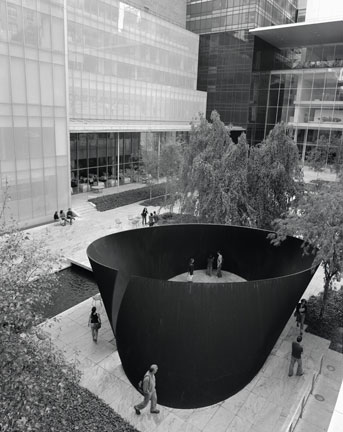
Richard Serra's Torqued Ellipse IV (1998), MOMA Sculpture Garden, New York, taken by Alexandra P. Spaulding. I like this picture because the viewer gets some sense of the scale Serra works on, as well as the weight of those sheets of steel (note the thickness of the edge). Here, by the way, is a shot that places this sculpture in its spatial context.

(My initial post on Serra is here.)

In no particular order, what follows are some bits and pieces that, with a little teasing out and squinting just so, might help push some ideas in that January post a little bit closer to, at least, field goal range.

**From John Berger's "A White Bird," which I discussed here back in February:

Art does not imitate nature, it imitates a creation, something to propose an alternative world, sometimes simply to amplify, to confirm, to make social the brief hope offered by nature. Art is an organized response to what nature allows us to glimpse occasionally. Art sets out to transform the potential recognition into an unceasing one. It proclaims man in the hope of receiving a surer reply . . . the transcendental face of art is always a form of prayer.


**In a comment on the first Serra post, Jim of This Analog Life noted that Serra's work summons adjectives like "monumental" and "memorial"-- and then asked, what's being memorialized?

**Somewhere, I read that Serra had once said that Robert Smithson's Spiral Jetty is "pictorial."

**Serra again, this time referring to the site-specific nature of his own work: "If you move it, you destroy it."

**Ralph Waldo Emerson, "Nature": "Why should we not also enjoy an original relation with the universe? . . . . Enbosomed for a season in nature, whose floods of life stream around and through us, and invite us by the powers they supply, to action proportioned to nature, why should we grope around the dry bones of the past, or put the living generation into masquerade out of its faded wardrobe? The sun shines to-day also."

**Walter Benjamin, "The Work of Art in the Age of Mechanical Reproduction":
"Even the most perfect reproduction of a work of art is lacking in one element: its presence in time and space, its unique existence at the place where it happens to be. This unique existence of the work of art determined the history to which it was subject throughout the time of its existence. This includes the changes which it may have suffered in physical condition over the years as well as the various changes in its ownership. (Illuminations 210)


In the comments for that first Serra post, I (half-)jokingly said my next post on this subject would contain "contributions from Emerson and This Is Spinal Tap." This is because I got to thinking of a place like Stonehenge within the context of the ideas of monuments and irreproducibility, and how the notion of irreproducibility would seem somehow to run counter to the idea of art as something that is reproducible--though not (as Benjamin argues and this scene illustrates) without some sort of loss. So, the gathering of the above bits is an attempt to ground that remark.

I know that Benjamin does not have Stonehenge in mind in his essay, but I think that it serves as a pretty expansive example of what he's addressing in the passage above. Stonehenge (I'm referring here to the site as originally built, not its current state) is not merely the stones but their placement--and not just in relation to the other stones but precisely where each stone is placed--and, moreover, on that hill, and not some other, neighboring hill. Stonehenge's physical location is included in the work called Stonehenge. But, given one of Stonehenge's apparent functions as an observatory built to mark and celebrate the beginnings of the seasons, it is not about itself alone, nor is it mimetic, a gesture in the direction of some other, immediately-recognizable object. Rather, it's a space in which we're asked to take seriously our relation to the cosmos in the moment in which we find ourselves at that place, not later at the pub or while we're posting pics of the place on Facebook. If Stonehenge is having its proper effect on us, we shouldn't be looking only at it. Otherwise, we're not seeing it.

I hope I'm not bastardizing Berger's meaning too much when I say this: Stonehenge is, like art more generally, "an organized response to what nature allows us to glimpse occasionally"--in Stonehenge's particular case, finding comfort and meaning in the ability to see beyond the Here and Now of our particular moment and be able to see rhythms and patterns in the sky beyond the sun's daily reappearance or, even, its yearly appearances in certain parts of the sky but be able to say, with as much certainty as possible, This will always be. Hence Stonehenge's irreproducibility: Stonehenge is not merely an arrangement of objects but an invitation that it can't extend except via our physical presence there to ponder an implicit metaphysical claim about the most essential questions of human existence. You have to be there.

[Aside: I wonder how a work like Walter De Maria's The Lightning Field fits into this discussion, especially given that its curators state that, despite its name, "A full experience of The Lightning Field does not depend upon the occurrence of lightning[.]" Whereas Stonehenge's existence and design are predicated upon the predictability (and affirmation of the importance) of a natural phenomenon, The Lightning Field's purpose is more like an invitation to consider and be open to nature's arbitrariness. Maybe. I have to think about this more, and elsewhere.]

I'm getting to Serra. Really.

The vast majority of art--even overtly-religious art--no longer extends such invitations to its viewers, nor has it for a really long time. (Maybe that's always been the case?) (This is true, these days, even of entire buildings built for expressly religious purposes: all one has to do is consider the office building-like quality of so many contemporary churches to see that this is so.) It engages us intellectually and perhaps even emotionally but not at the level of physical sensation, the idea that we're in its space and we must address its contribution to the intellectual and emotional dialogue between us and it as we look at it. This isn't due to the devaluing of the original in our age of mechanical reproduction but, rather, that its makers, for whatever reason, simply aren't interested in doing so. Or maybe I'm wrong about that (and I'd like to be) but that it's the rare piece of art that can make us forget we're seeing it in a museum or gallery or a classroom--that is, in an artificial space. To be sure, I have that flatness of experience far more often with sculpture than with paintings, as I noted in the first Serra post--paradoxically, most sculpture to me feels so self-contained, so much, ultimately, about itself, that despite its three-dimensional quality my chief preoccupation is how to get around the piece without bumping into it or other people. Again, I'm speaking for myself. Whatever the case, that flatness of response is a sad thing. I don't want to move around art. I want it to move me.

Perhaps, just perhaps, the monumental and memorializing quality of Serra's work arises from his attempt to hearken back recreate something of that "you have to be there" feeling in the audience, the feeling of tension one feels in the presence of genuinely great art that one can sense even when looking at pictures of it but which can't be fully replicated via pictures. But Serra's audience is far different from that of the builders and keepers of Stonehenge. Most of the self-identifying devout among us are thoroughly secularized, even in our religious lives; we have difficulty, I suspect, in fully grasping that structures designed for religious ceremony, not so long ago, were explicitly designed to elicit and shape a response in the visitor . . . and, in the case of ancient sites of worship such as Stonehenge, those structures likewise are constructed in accordance with natural phenomena that its builders wanted to draw attention to and offer implicit comment on. But. God may have created the cosmos, but Western religious expression is not predicated on seeing Him made manifest in its rhythms and patterns. How, then, to create a palpable emotional tension, verging on the physical, between the work and the viewer that can lead to a response verging on at least the existential, if not the spiritual?

Well, just look at Serra's pieces: You build something that looks like it might kill you if you get too close to it or if the wind blows--or, hey, if the earth moves--even as its very design requires that you get close to it. Judging from Jim's experiences with The Matter of Time at the Guggenheim in Bilbao, the fact that these pieces are in galleries and thus (we assume/hope) are deemed safe to be around doesn't mean that we believe that, no matter whether we know it (at the intellectual level). As Robert Hughes says of Serra's work, "It addresses the body through anxiety, and this is a thoroughly legitimate though long-repressed function of sculpture at its most archaic level." Serra's forms may be non-representational in the traditional sense of that term, but in another sense they evoke apprehension, if not fear . . . and not as abstraction but as an all-too-present, felt experience. Indeed, maybe part of Serra's point as well is that fear should be more present in our lives than it in fact is. And how can that idea be reproduced except by being in the presence of something that causes the viewer not just to muse on that idea but to genuinely feel it?

Serra's work is thus both contemporary in its forms and ancient in its concerns. But--assuming all this I've been speculating on here is even remotely true--is there in Serra's work also an accompanying catharsis of that fear? Not having seen any Serras in person, I can't say; I hope that someone will be able to speak to that question.

Read More...

Thursday, June 10, 2010

The anti-Ulysses: Some thoughts on 2666

Roberto Bolaño. Image (along with a brief bio and good discussion of 2666) from here.

It seems appropriate to me to begin talking about this book by talking briefly about another book. Or, two.

I am early on in my bedtime reading of a very odd book by Adam Thirlwell whose full title is The Delighted States: A Book of Novels, Romances, & Their Unknown Translators, Containing Ten Languages, Set on Four Continents, & Accompanied by Maps, Portraits, Squiggles, Illustrations, & a Variety of Helpful Indexes. Also, "Mademoiselle O," a Story by Vladimir Nabokov, translated by Adam Thirlwell. Its equally-big subject is translation: from one language to another, of course; but also and more subtly, of a writer's style from one language to another and from one writer to another, both of whom are contemporaries and speak the same language; and, most crucially, of Life-as-experienced into literature. I'm still trying to figure out why Barnes & Noble had this book shelved in the Fiction and Literature section of the store; I confess that it's that lingering question in my mind, as much as anything else, that leads me to call this book "odd." It's not fiction, but it's most definitely not straight criticism, either. It's more like dramatized literary history that doesn't follow a strict chronology but, rather, a kind of analytical interior monologue. Sort of. But, I keep reading: even if I can't tell exactly where we're headed, it's pretty clear to me that Thirlwell knows.

Reading is always something of a faith act, isn't it?

Anyway, the section I'm in at present is one in which Thirlwell is discussing Gustave Flaubert's influence on the style of the first novel of his contemporary, Guy de Maupassant (Maupassant's "The Necklace," often gets credit for being the first modern short story); along the way, Thirwell says this within the context of Flaubert's Madame Bovary and that novel's influence on the novel as an art form:

Form in a novel is a matter of composition, of architecture. It is based on the repetition and variation of specific elements, not the unity of a linear story. This can mean that a novel can dispense with a plot almost entirely, so that Milan Kundera can state, in his novel The Book of Laughter and Forgetting, that the 'coherence of the whole is created solely [italics are Thirlwell's] by the unity of a few themes (and motifs), which are developed in variations'. In this way, its closest analogue is the composition of a piece of music, which is also a successive presentation of elements, structured on a basis of theme and motif. (57)

Thirlwell's claim about the novel's being able to dispense with a plot "almost entirely" and yet still have a form may seem surprising and perhaps even disturbing to fans of not just Jane Austen but, say, Ulysses, or fans of genre-fiction such as mysteries. But a little thought even about those novels will show that they are ordered or framed not by calendars but by the narrator's (or, in Ulysses, narrators') attentiveness to "the successive presentation of elements" at the point in time that they (and we) happen to find ourselves. In the case of Joyce's novel, not a heck of a lot happens; indeed, one way to think about Leopold Bloom's sections is that he's engaged in keeping something from happening: he deliberately delays his return home to avoid encountering his wife Molly and her singing manager Blazes Boylan, the two of whom he suspects of having a tryst. But in terms of being structured, it's difficult to think of a more obsessively-ordered book. Bloom has not just the above-mentioned preoccupation but several others that shape his movements and thoughts; the same is true of Molly (even though she never leaves the house) and Stephen Dedalus, the novel's third major character. And there's also the novel's most famous ordering structure, which those characters aren't even aware of: the superimposing of episodes and themes from the Odyssey over these characters and their activities, all set in a very real Dublin presented to the reader with meticulous attention to how it actually appeared on June 16, 1904.

2666 is a little longer than Ulysses; its title's significance never emerges in the book but instead lies in another book by Bolaño that one needn't have read beforehand (more about the title later); and most of its action is firmly located in a city that, though fictional, one could map with reasonable completeness. However, as I implied here a while back, it is in many ways Ulysses' opposite. Joyce's novel's difficulties arise, I think, essentially from the fact that most readers are pretty sure they're not catching all that architecture I referred to above. 2066's chief difficulty is that, apart from its attention to the layout of Santa Teresa, it appears to lack any such architecture--especially maddening given the subject that takes up most of the novel's physical space, the mostly-unsolved/unexplained murders of scores of young women in Santa Teresa. Santa Teresa is a fictional border town in the Mexican state of Sonora. If it were real, it'd be located near Nogales, but it's pretty clear that Bolaño has Ciudad Juarez in mind as its model--not least of which because, just before the open warfare among the drug gangs there that began a couple of years ago, Juarez experienced the unsolved murders of scores of young women over the course of several years.) As readers, we naturally want justice for these deaths, or at least an explanation for them. Except in a very few instances, none is forthcoming. Meanwhile, for the main characters with whom we spend the most time, the murders either barely rouse their curiosity or they can't seem to get others interested in them.

What in the name of all that is (traditionally-considered) novelistic is going on?

Some speculation below the fold.

2666, for reasons of style as well as its often very grim subject matter, is not easy going. I know/have read of some otherwise very good readers who struggle to see what it's up to, what its point is. I think that one way to approach it is to consider the fact that Bolaño's novel pushes Thirlwell's observation above to its breaking point--or, depending on your tastes, beyond it. And more: the central feature of this novel's textual physics is, well, no center. Santa Teresa has drawn all these people--not just the academics, writers and journalists we spend the most time with but also the murder victims--to itself for all sorts of deliberate and arbitrary reasons and, with very few exceptions, does not allow them to escape. It is a black hole for which we are provided no explanation but to which we are asked to bear witness.

This black hole is Henry Hitchings' image for the novel as well, as he reports in his review (linked to in the picture caption above). He also has this to say about the title:
The novel's cryptic title is one of its many grim jokes; there is no reference to this figure in its 900 pages. However, in another of his novels, Amulet, a road in Mexico City is identified as looking like "a cemetery in the year 2666". Why this particular date? Perhaps it's because the biblical exodus from Egypt, a vital moment of spiritual redemption, was supposed to have taken place 2,666 years after the Creation.
"Perhaps" is the crucial word here. It's hard to find signs of spiritual redemption in this novel . . . though, of course, any attentive reader of Exodus can tell you that the Israelites had exactly the same trouble, more often than not. There's also that "666" embedded in the number, thus suggesting as well that something ominous is on its way . . . or often, one gets the feeling while reading this bleak novel, has already cast its shadow on this narrative space--and, given its contemporary setting, on us as well.

But what exactly is is that slouches toward this particular Bethlehem? What is the nature of this new Jerusalem? The short answer is, 2666 doesn't say. Consider something I said earlier in this post: That, though a fictional space, Bolaño has provided sufficient details of Santa Teresa's layout and its relation to actual cities in Mexico and the U.S. that if one were so inclined, one could draw a reasonably-accurate map showing the city's major streets, the relative locations of its neighborhoods, and even some major and not-so-major points of interest and businesses. But whereas in Ulysses one can do the same thing because the narrator informs us of all this via Dedalus's and Bloom's movements through Dublin, in 2666 the map becomes possible because the reader is given fairly precise information regarding the location of, it seems, each and every one of the bodies of the murdered women--sometimes, down to the very street addresses. That's a most distressing thing, to be able to map a city not because of where the living reside and how they move about but because of where the dead are found--the city as cemetery. It's even more distressing when, as I mentioned earlier, the vast majority of these unsolved murders were committed in the same way. Someone/Something is at work here, but who/what? And why? We're never told. There's a terrible irony in the fact that, as Kant tells us, we create knowledge out of the connections we make between/among discrete phenomena--that is, we establish patterns--yet those murders which clearly establish a pattern are the ones that go unsolved.

As I was thinking about 2666's lack of a center, I found myself thinking about another bleak reading experience, Cormac McCarthy's Blood Meridian. Still, as horrifying a read as that novel is, at least McCarthy has judge Holden explain its violence with the mantra "War is god." That is a terrible notion to consider, but it nevertheless gives the reader an anchor in its seas and rivers of bloodshed--and, more importantly, an idea to assess and respond to. In 2666, though, we're not even offered the explanation of the absence of (a) god.

By now you've probably gathered that 2666 is not exactly the feel-good novel of the 21st century's first decade. That may keep you from giving it a try. Or, you may read that Bolaño died before he finished its final draft and assume, as some have, that its sense of lack due to that it isn't in fact as close to being finished as his literary executors claim it is; and that, in combination with the fact that the novel's five sections don't seem to add up to a whole, may keep you away. But I would still encourage you, especially if you've read this far, to try it anyway, keeping in mind that though its sections touch each other, if only tangentially, they aren't in chronological order relative to each other--as just one example, the murders will begin at some point during the novel's opening section; we just won't know when that is because this section opens in Europe: the characters we meet haven't even heard of Santa Teresa, much less know, for some years, that they'll be heading there. Each of its sections has its own plot, but they don't add up to a single plot. It is, in other words, a pretty daring experiment in form and a very odd reading experience in that we're made to feel as though we're truly on our own as we try to make sense of what we're being told. In that sense, this particular novel feels a lot like Life.

Read More...

Wednesday, June 09, 2010

Attention, "John Henry" fans (a bleg)

A painting by Palmer Hayden of John Henry's death. Note the positioning of his body. Image found here.

First of all, welcome to my new students. It was a pleasure meeting you and talking with you about the next eight weeks.

Second, the bleg: for this summer's class I'm working on pulling together a little unit built around the American folk song "John Henry": (some of) its many different versions; the historical case for John Henry's existence and the two places that lay claim to being the site of the confrontation between John Henry and the steam-driven machine; some speculation as to why this legend and the songs about it hold the place it does in American folk culture; some images; etc. The goal is to use these materials as a kind of laboratory for different acts of interpretation. It could be fun or disastrous--but hey! It's the summer!

Here's where the bleg comes in: I'm looking for leads on either old recordings (or recordings of old versions of) "John Henry," along with a couple of more contemporary re-writings/updatings. In addition to the four versions I listed in this old post (though the Mississippi John Hurt piece is something of a ringer since it's more like a response to the legend rather than a version of the folk song), I also have a version by country blues performers John Cephas and Phil Wiggins. I'm toying with including Johnny Cash's version on his At Folsom Prison album. Here is a list of other performances, along with some contemporary updatings. I'm looking for around six versions of the song in all.

The goal is not to overwhelm but to suggest something of the variety of these songs, a variety nevertheless contained within a fairly firm narrative framework. I have a few weeks for this; I've scheduled it for July 1. Any advice/questions any of you might have would be most welcome.

I'm in the midst of writing up a post on Roberto Bolaño's novel 2666; that should appear here either later on today or tomorrow.

(UPDATE: The truly John Henry-obsessed can thank me later for being pointed in the direction of this and this. A tip of the hat to River's Invitation for leading me to both those places.)

Read More...

Sunday, June 06, 2010

Back

A map of my life since I last posted? No--rather, via Matthew Yglesias, a "NOAA image showing the course of the past 100 years’ worth of hurricanes through the Gulf." Given that the central Gulf is well overdue even for a tropical depression to come ashore, let alone a hurricane, this will be an especially tense hurricane season.

I am just filled with happy thoughts.


Anyone around still?

I think I will be able to resume more-or-less regular blogging here, now that summer is here and I have decompressed enough from the spring to have room in my head for the occasional post here.

I won't dwell too much here on the past two months except to say that they were difficult: the combination of an increased teaching load and the Mrs.' continuing health issues left me distracted and drained. Her health is still very much a concern, but school, for the summer, won't be the time-suck away it was. I have one class to teach; it starts day after tomorrow. I'll get to ride my bike to work, something my teaching schedule this spring didn't permit me to do. I'll have time to rouse my scholarly work from its slumber. And there's that back-log of promised posts to get to.

So. It feels good to have the sense that I have a little time and energy to do this.

Onward.

Read More...

Tuesday, April 06, 2010

Still still here

Those Four Horsemen known as Work, Computer Travails, Other and Stuff have kept me away from here and will continue to do so for the next few weeks, I'm sorry to say. In the meantime, though, here's a little something to read and, if you're so inclined, respond to at your respective places.

The big thing for some of the smarter bloggers out there of late has been to follow Tyler Cowen's lead and post a list of books that have influenced their thinking. Here is Matthew Yglesias' list; he links to Cowen's list, and the comments section has a good discussion of both the list and alternates for inclusion. Looking over the list made me want to join in the fun. So, here's mine.

These aren't necessarily favorite books (NB: some non-books included); they're books that, for better or for worse, have shaped my way of thinking about stuff. Most of these won't surprise long-time readers of this blog (again, for better or for worse).

1) Paul Tillich, Dynamics of Faith. This was required reading in my Intro. to Theology class, which I took in my first semester of college. Taught me not just that it's okay for a believer to doubt, it's necessary if his faith is to survive and grow stronger.

2) M. M. Bakhtin, The Dialogic Imagination: Four Essays. Essential for its discussion of heteroglossia (multivoiced-ness) in the novel--an important idea for me, in that it taught me how to listen to novels, not just read them.

3) William Faulkner, Go Down, Moses. "The Bear," this book's long center-piece, may have been the first thing by Faulkner that I read, back when I was a freshman in college. Years later, a re-reading of "Delta Autumn" would serve as the starting point for my dissertation/book-in-progress.

4) Henry David Thoreau, Walden. A book whose prescience about our own "the railroad runs us" times, elegance, wit, and firm conviction that life is best when experienced in its least-complicated form continually rewards--and challenges.

5) Wallace Stevens, "The Idea of Order at Key West." Yes, it's a poem and not a book, but not only is it the essential Stevens poem, it also made me realize, more powerfully than anything else I've ever read, the power (and, for that matter, the impulse) of the human mind to so shape our understanding of the world that it becomes very difficult to understand the world as it is apart from our perception of it.

6) Edward Snow, A Study of Vermeer. Snow is an English professor at Rice (he teaches Shakespeare and Milton classes), but he's best known for his translations of Rilke. I never took a class with him, but I did hear him give a talk on Brueghel's Peasant Dance that made me realize I had no idea how to look at paintings. I still don't, really, but this book helped me do it less-poorly. It also teaches the larger lesson that, as with so many other things, patience in academic criticism is a virtue.

7) Gabriel García Márquez, One Hundred Years of Solitude. Other books came before (Carlos Fuentes' The Death of Artemio Cruz) or are more analytical in their approach (Octavio Paz's The Labyrinth of Solitude), and, as I was reminded recently while reading Roberto Bolaño's 2666, magical realism now seems a bit dated given certain contemporary, brutal realities. Still, García Márquez's novel was still that book that, when I re-read it while living in Mexico, made emotional sense of the place I found myself.

8) Martin Luther, The Small Catechism. The simplest, most direct explanation of the essential expressions of Christian doctrine that you'll find. As Luther himself says, "This is most certainly true."

As I said above, if the spirit moves you, consider yourselves tagged; I hope you'll let me know if you decide to post your own list.

See y'all around.

Read More...

Thursday, March 04, 2010

Still here . . .

I've been catching up on grading, which has kept me away from here. One more week, then spring break . . .

A couple of weeks ago, I finished 2666, which I talked a little about here. I'll post something more substantial about it later, but here's my starting point: It was about midway through that I realized that this novel is detailed enough that if I were so inclined, I'd be able to create a fairly accurate map of Santa Teresa, the fictional border city in Mexico where most of the novel is set--much as one can do with Ulysses. But then I realized that, whereas Joyce's novel allows you to map Dublin via the characters' movements through the streets, with Bolaño's novel I'd be mapping the city via the locations of the bodies of murdered women.

2666 is the anti-Ulysses. It is also a truly fine novel.

Nor have I forgotten about this (and this), and this.

Read More...

Friday, February 12, 2010

Leafing through TNR's The Book

Berryman, friends, is interesting: John Berryman, drunk and in a hotel room in Dublin, recites his "Dream Song #29" (text here). Via The Book's video section.

The New Republic's online site has a new place for me to spend time, The Book. As its title suggests, it is a place where people offer up reviews of fiction, poetry and books on various other subjects. It's only been up for a couple of weeks, so it doesn't yet have a great deal of content; I'm also a bit disappointed that some of the reviews haven't been a bit more substantive. In something of an irony, The Book announced its arrival by noting that there's a lack of book-review sites on the Web and that it seeks to fill that particular niche, but some of the reviews I've read there--not just their brevity but also their lack of close examination of the texts--seem shaped by the medium (the Web does seem to favor, or create pressures forcing writing in the direction of, the miniature; perhaps reviewers, too, succumb to those dynamics). At any rate, the New York Review of Books, for better or for worse, this is not. And yes, yes, I see that this post is itself The Book in miniature . . .

That said, the range of books it promises to cover is indeed impressive; moreover, there's a feature called Lost and Found: New Looks at Old Books, which provide short visits to books long forgotten but perhaps worth our time. And the video feature is fun as well and, in the case of Arthur Miller and Marilyn Monroe announcing their pending marriage, a reminder that the world is stranger than anything most of us can imagine.

[To come: more substantive posts on the Irreproducible, Joyce and irony, etc.]

Read More...

Monday, February 08, 2010

A stretch of river LVII: "Something old folks do while waiting to croak"

Because you people are at least as cool as I am, I've decided to give you a little glimpse behind the scenes of that arranging, deepening, enchanting thing we do here. (Image found here.)

So. It's a snowy Monday morning here, I'm tromping about in the park with Scruffy in about five inches of new snow, there's been so little wind that even the thinnest tree branches have as much as two inches of snow on them, I'm kicking myself yet again for not having a camera to take some pictures to share here with my reader(s), I'm thinking Hmm--I haven't had a Stretch of River post in a while . . . and then I recall this from Nick Carr (via Andrew Sullivan:

I remember when it was kind of cool to be a blogger. You'd walk around with a swagger in your step, a twinkle in your eye. Now it's just humiliating. Blogging has become like mahjong or needlepoint or clipping coupons out of Walgreens circulars: something old folks do while waiting to croak.

[snip]

In 2006, 28% of teens were blogging [according to the Pew Internet and American Life Project]. Now, just three years later, the percentage has tumbled to 14%. Among twentysomethings, the percentage who write blogs has fallen from 24% to 15%. Writing comments on blogs is also down sharply among the young. It's only geezers - those over 30 - who are doing more blogging than they used to.
This past Friday, the geezer whose tinkling of the QWERTY-keys you're now reading rode his bicycle out to his weekly tutoring job, a round-trip of almost 36 miles. I'm a healthy geezer, but a geezer (I'll turn 48 in April). But I'm healthy!

And good old Blog Meridian is fast approaching blogospheric geezerdom as well--it will celebrate its 6th birthday on the 27th of this month. To paraphrase the Barbara Mandrell song, I was bloggin' when bloggin' was still cool.

I visited the survey to see if I could gain any insight as to why this dramatic, sudden demographic shift might be occurring. After all: aren't teenagers at least as self-absorbed as the baby-boomers and Gen-Xers who now comprise the majority of bloggers? Well, yes. But the rapid rise of Facebook among younger folks would seem to suggest that they are just as self-absorbed as they always have been--they just want to express that self-absorption more rapidly than blogs permit. No time to wallow. Now, a blog, on the other hand . . . but for the addition of the "L," it would read "bog": a really good place to wallow.

Carr's despair is rooted in his realization that "30 is the new 60," or something like that. I don't feel despair; it's really more like a puzzlement: Blogging brings me such regular enjoyment that it's hard for me to imagine more people, and younger people, don't find it equally enjoyable. Besides, I gave up deluding myself that I'm cool, or have or ever had a chance of becoming cool, a long time ago--back in high school, in fact. Now, it is true that I do ride a bike on a more-or-less regular basis, and here in Wichita that fact has the status of being so cool it's not yet cool. I'm actually cutting edge in something. Deal. But then again, all I have to do is dredge up this little missive and . . .
It's not hard, then, to find "cooless" suspect: maybe certain bands or writers, let's say, are unknown to all but a few initiates for a reason--they SUCK! And if your tastes in music run toward such bands/writers that suck, well, then, why should I buy into your anti-hype of "Nobody's heard of 'em!!"? But then again, I'm not cool, 'cause I'm, like, old, even if I do have a blog, so what do I know?

Read More...

Thursday, February 04, 2010

Excerpts from "The White Bird"

Image found here.

What follows are a few passages from John Berger, "The White Bird" (my source is Selected Essays). They might have some relation to some things I was trying to get at in my post on Serra and the Irreproducible. Maybe. But even if they don't, many thanks to Jim, in his comment on that post, for pointing me in this essay's direction. Reading Berger is always invigorating in its own right. Apologies for the length, but I want to show how Berger arrives where he does, and Berger is nothing if not a patient writer, showing his work. Especially in the case of the arts, anyone can declaim. Berger's great appeal for me is that he explains.

Everything not bracketed is Berger's own.

Urban living has always tended to produce a sentimental view of nature. Nature is thought of as a garden, or a view framed by a window, or as an arena of freedom. Peasants, sailors, nomads have known better. Nature is energy and struggle. It is what exists without any promise. If it can be thought of by man as an arena, a setting, it has to be thought of as one which lends itself as much to evil as to good. Its energy is fearsomely indifferent. The first necessity of life is shelter. Shelter against nature. The first prayer is for protection. The first sign of life is pain. If the Creation was purposeful, its purpose is a hidden one which can only be discovered intangibly within signs, never by the evidence of what happens.

It is within this bleak natural context that beauty is encountered, and the encounter is by its nature sudden and unpredictable. The gale blows itself out, the sea changes from the colour of grey shit to aquamarine. Under the fallen boulder of an avalanche a flower grows. Over the shanty town the moon rises. I offer dramatic examples so as to insist on the bleakness of the context. Reflect upon more everyday examples. However it is encountered, beauty is always an exception, always in despite of. This is why it moves us.

[snip]

[T]here seem to be certain constants which all cultures have found 'beautiful': among them--certain flowers, trees, forms of rocks, birds, animals, the moon, running water . . .

One is obliged to acknowledge a coincidence or perhaps a congruence. The evolution of natural forms and the evolution of human perception have coincided to produce the phenomenon of a potential recognition: what is and what we can see (and by seeing also feel) sometimes meet at a point of affirmation. This point, this coincidence, is two-faced: what has been seen is recognized and affirmed and, at the same time, the seer is affirmed by what he sees. For a brief moment one finds oneself--without the pretensions of a creator--in the position of God in the first chapter of Genesis . . . And he saw that it was good. The aesthetic emotion before nature derives, I believe, from this double affirmation.

Yet we do not live in the first chapter of Genesis. We live--if one follows the biblical sequence of events--after the Fall. In any case, we live in a world of suffering in which evil is rampant, a world whose events do not confirm our Being, a world that has to be resisted. It is in this situation that the aesthetic moment offers hope. That we find a crystal or a poppy beautiful means that we are less alone[; . . .] its form, perceived as such, becomes a message that one receives but cannot translate because, in it, all is instantaneous. For an instant, the energy of one's perception becomes inseparable from the energy of the creation.

[snip]

[. . . .]Art does not imitate nature, it imitates a creation, something to propose an alternative world, sometimes simply to amplify, to confirm, to make social the brief hope offered by nature. Art is an organized response to what nature allows us to glimpse occasionally. Art sets out to transform the potential recognition into an unceasing one. It proclaims man in the hope of receiving a surer reply . . . the transcendental face of art is always a form of prayer.

UPDATE (February 8): Over at Musings from the Hinterland, Randall pursues Berger's ideas in a couple of fruitful and compelling directions. Go and read.

Read More...

Tuesday, February 02, 2010

James Joyce: Comedy, and Irony as Principle-Weapon

(Or: Toward the Resurrection of Irony)

James Joyce, by César Abin. Image found here.

Today is James Joyce's birthday, and before the day slips away any further, I wanted to start a conversation that I hope will honor him.

In case anyone is wondering, "Principle-Weapon" is intentional.

Some assertions, in no particular order:

*Joyce was often very funny, but his mode was not humor but comedy.

*To quote one of my college English profs: "Comedy is deadly serious."

*Comedy's great subject is the Life Force: the affirmation, preservation and perpetuation of life--hence its seriousness. Its word is Love; its creed is Molly Bloom's final Yes; its churches are the conjugal bed and the kitchen; its parish the front porch.

*Irony is comedy's greatest weapon, exposing, when wielded most effectively, that which does not affirm the Life Force (hence, "principle-weapon").

[UPDATE: Here's an example of what I mean: In A Portrait of the Artist as a Young Man, Stephen Dedalus (Joyce's stand-in) is explaining to his friend Cranley why he (Stephen) has lost his faith. Cranley thinks Stephen's disaffection is with Catholicism and sxo asks him why he doesn't become a Protestant. Stephen's response: "`I said that I had lost my faith,' Stephen said, `but not that I had lost my self-respect. What kind of liberation would that be to forsake an absurdity which is logical and coherent and to embrace one which is illogical and incoherent?'" Whatever one may think of Stephen's assessment of the doctrine of being saved by grace through faith, that line always makes me, a good Lutheran, both laugh out loud and ponder a bit.]

*Irony would not be dead if people still accepted that the preservation and perpetuation of life were not merely a Grand Narrative to be suspicious of and instead is and remains both a sacred and a secular Ultimate Concern.


(Inspired by and in part quoted from my response to Jim at this post.)

Read More...

Sunday, January 31, 2010

Richard Serra and the Irreproducible

[UPDATE: The title for this post, I should have noted, has its origin in a comment by Jim: "Ok. Yes, Serra looks cool photographed. But I think there’s something very thought-out & challenging to how we — ok, I — tend to experience art these days in the way that he creates experiences that by virtue of their construction cannot be reproduced." [his italics]

Richard Serra, The Matter of Time (Guggenheim Museum, Bilbao). Image found here.

Follow the link just above, and you'll see that Jim Sligh of This Analog Life "scanned [this image] from a postcard a visiting friend bought for [him] in the giftshop." What you see is a copy of a scan of a photograph, itself reproduced who knows how many times and in how many places. If you read Jim's post, you'll see that he has linked to other, really good photos of Serra's work but in the same breath tells you that looking at pictures is "the dumbest way to experience Serra ever." He is right. This picture itself tells you this implicitly: "You have to be 'here' (which is really 'there')."

Well, I'm not. Bilbao is out of reach just now for various temporal and material reasons. But as I told Jim in a comment on his post, I keep returning to his post to keep looking at this picture, that I find it compelling in a way I find very little sculpture, of any sort (an idea I hadn't realized I thought, and one which caught me by surprise), and I keep trying to figure out why that is. This post is an attempt to do that.

It will probably fail; that's why the rest of it is below the fold.

As long-time readers of this blog know, I post fairly frequently on art, but the vast majority of those posts deal with paintings and drawings. They almost never mention sculpture, and then only in passing. I'd never really thought--at all--about why that is before a couple of days ago, when I first saw the post on Serra at Jim's blog and said, Wait a minute . . .

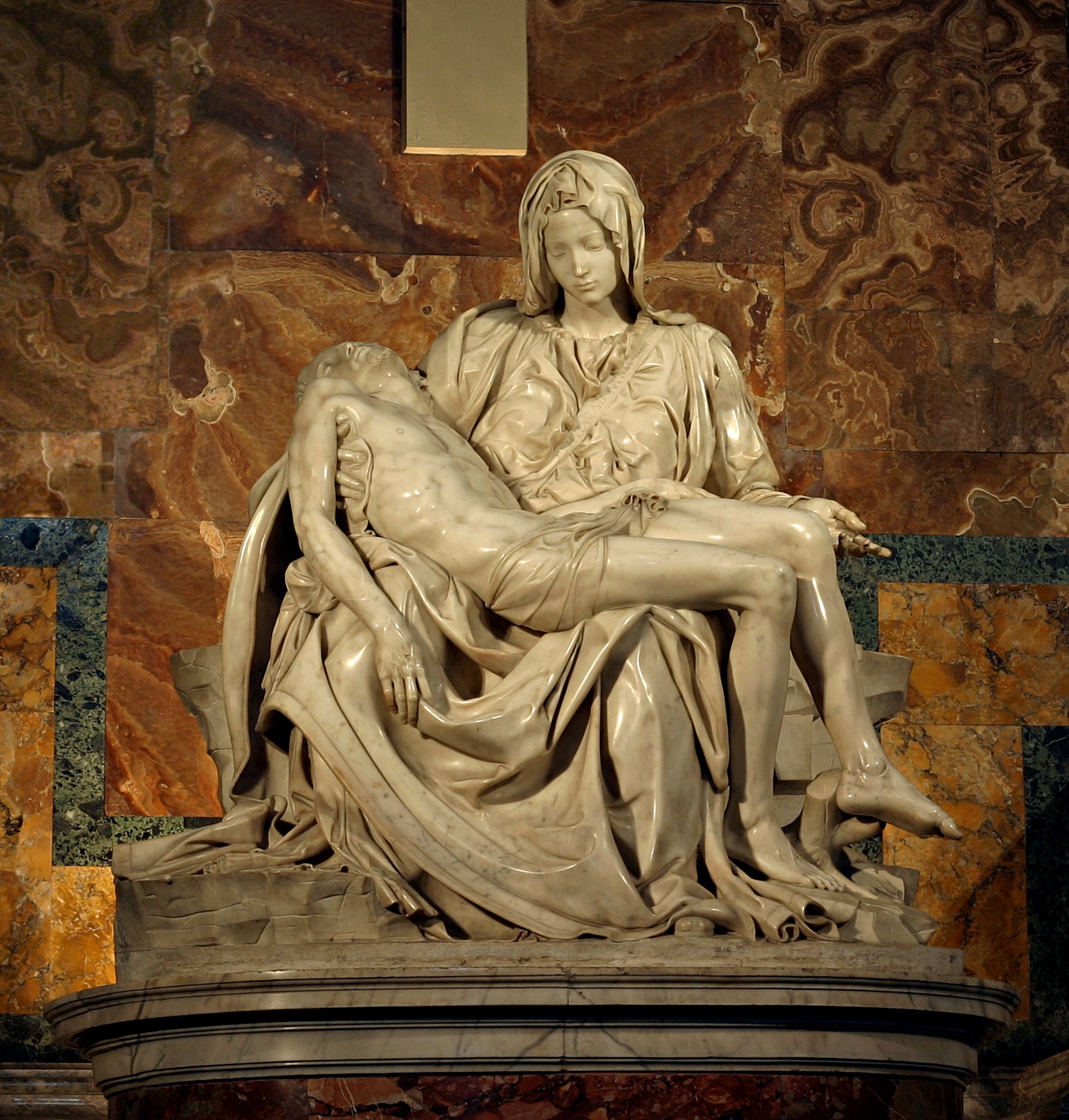
I like sculpture well enough. When my Humanities students and I meet in Kansas City at the Nelson-Atkins, as we will again this May, I make it a point to show them the full-size bronze cast of Rodin's The Thinker on the south side of the museum. We walk around the plinth it sits on, looking up as we do (the top of the plinth is about head-height; the sculpture itself sits on that and is itself around 7' or so from its base to its highest point); we talk about things such as the figure's distended, gnarled toes and Rodin's attempt to make the bronze look as though it had been carved rather than poured. It's cool to see this famous sculpture. But that's about it, as far as my engagement with that or just about any other sculpture is concerned. I get the idea that sculpture's there-ness, its occupying of space, makes its viewer have to deal with it in some way, if only to avoid it or walk around it. But then that makes our interaction with sculpture sound like the piece is like one of those people we have to interact with out of politeness--if we must. Which is to say, there's no genuine interaction except at the level of What's Expected of Us. It remains in its space, posing no ultimate challenge to mine. Even pieces as undeniably beautiful as Michelangelo's Pieta or Bernini's Ecstasy of St. Teresa, if this make sense, confront me without moving me. Or, put another way: Even though I very much enjoy looking at them, I don't feel the need to keep looking at them. Paintings, on the other hand, I will return to again and again, the Nelson's Rembrandt, for example: they don't engage my physical space, but they engage my imagination as very few sculptures do.

There are exceptions, of course. I've never seen Rodin's Burghers of Calais (scroll to the bottom of the page for a brief discussion of the sculpture) in person, but I get the feeling that I would want to walk around and around it and want to come back to it again. The reason: It photographs terribly. It has no "good side," which is to say that no one side presents itself to the viewer as the side to be seen. It--that is, the experience of seeing it in person--is irreproducible because it is so designed that it requires us to move around it. (The Thinker, by comparison, is a depiction of a very large naked guy sitting on a rock. He is shown in three dimensions and so has a back side to him, but that back side is, of course, the least interesting of his sides. So, take a picture of him from the front or in profile and, apart from its massiveness and the subtleties of texture you've reproduced a surprising amount of the reason to see it. This is not meant to be dismissive of a justly-famous sculpture; it's simply so.)

Though I've not seen the Burghers in person, I have seen a sculpture that I think owes much to Rodin's work, the sculpted soldiers at the Korean War Veterans Memorial in Washington, D.C. This one photographs poorly as well, but I can attest that seeing it in person is a very moving experience. You can't actually walk among the sculptures, but you can get so close to them that their size (each figure is well over 7' tall) creates the sense that you are. Moreover, their very different expressions and attitudes give the space a sense of tension and urgency that very few war memorials do that I've ever visited. These men are not on parade but on patrol. We are in their way.

Is the nearby Vietnam Memorial also sculptural in its treatment and shaping of the space the visitor occupies? The way that the visitor begins at ground level, the wall of names just a few inches tall; then, as the years progress and the wall of names gets taller, taller as the path gradually declines, till the visitor reaches the angle and the wall--one's reflection and the names on it--is all one can see? I had of course seen pictures of the Memorial and pictures of people weeping at it. I assumed that those people were grieving friends and family they had lost; I assumed that I would not be so moved if I ever visited it. And then I visited it. I lost no family or friends in that war; I was a child then, even now vividly recalling the nightly reports of dead and injured but otherwise unmoved by the war; yet that day I visited, the only thing I could think as I reached that place was, I am in a tomb. How can one not keep from getting teary-eyed there? I would like to know the secret, because I find myself really reluctant to visit it again, even though I want to.

It's an emotionally-dangerous space.

Also in Washington is a space made to feel physically-dangerous by a sculpture: the atrium of the East Wing of the National Gallery of Art, over which hangs Alexander Calder's enormous Mobile #3. The first time I saw it, I was standing in a queue to be admitted to a big Art Nouveau exhibit in that wing; since the queue was a couple hundred people long, I had a nice long time to contemplate Calder's work. It looks light and delicate . . . and then you look more closely at the shaft and hook from which it hangs--it looks like something from a construction site--and it suddenly loses a lot of its gossamer-like quality. But not all of it, of course. It's beautiful to look at, in the same way that an airplane in flight is beautiful to look at. But the physics of each, the forces required to keep each in the air, are very real, very much also part of what we're looking at--indeed, those forces are required to be present so that these things keep on being beautiful. And that makes us more attentive to our space, our place in that space.

This is also Serra's territory as a sculptor: the creating of a silent dialogue among the viewer, his materials and the forms they take, and not the defiance of physics (the way so much constructed metal sculpture can feel) but the implicit reminder to the viewer who moves among these pieces, via the fact that they don't come toppling on him, that despite the way things seem in the world, here the very oldest laws of the world are at work. By way of illustrating, here are two short passages on Serra's work that I want to put in proximity with each other:

At the dawn of the 21st century, an era of cyberspace, reproduction and the Internet, no one is doing more to make work that stands for the ancient and mysterious power of the real. --from a Time review of a documentary on the making of Matter of Time, found here via Jim's post.

"[T]he main character of Serra's work [is] its scariness. You are never allowed to forget the weight of Serra's metal. The possibility of being crushed by it is part of its sculptural effect. It addresses the body through anxiety, and this is a thoroughly legitimate though long-repressed function of sculpture at its most archaic level." --Robert Hughes, American Visions: The Epic History of Art in America, p. 568

It is hard to articulate all this because you can't reproduce via pictures, and barely through words, what's at work here. I suppose that that's the reason I find myself returning to the picture at the top of this post--it is like reading a poem whose meaning eludes one (Wallace Stevens says in his poem "Man Carrying Thing" that "the poem must resist intelligence/Almost successfully"). The sculptor made these forms, yes; but they signify something other than themselves. Or, more accurately, they can fully signify only with our physical, irreproducible presence there.

I don't mean to imply a religious or spiritual significance for these pieces, but I keep returning in my mind to Stonehenge and other monumental ancient solar calendars as a way to begin thinking about Serra's work. Without human agency, the movements of the sun and moon and stars would have no transcendant meaning. Those movements would be no less real, but they would not signify what the ancients said they signified. Serra doesn't build sun calendars; but, like the sun, his works obey the laws of physics even as they push those laws very, very hard. As the shapes of his pieces compel the viewer to move around and into them, their sides leaning this way and that and their tops opening wide or converging, light and sound changing as the viewer moves about, those laws become more present in our experience: they alter so as to be noticed, and the viewer changes as well. Something even more primitive than "ancient" occurs--indeed, you can't get any more ancient, or irreproducible, than "real."
__________
Bonus: A collection of short videos of Serra's work and interviews with him from the Museum of Modern Art's 2007 exhibition of Serra sculptures. The videos are shorter than I would like, but they do give something of the sense of what it's like to move around/between/through these pieces.


If you've read this far, you may be interested in my continuation of this discussion, here.

Read More...

Saturday, January 30, 2010

When the Muse phones it in, the poet should not mail it in

Via Andrew Sullivan, this bit by Elisa Gabbert made me laugh out loud, but her larger point is right on:

Here's what I'd like to see more of in submissions: IDEAS. Why don't poems have more ideas? So many poems I read are essentially just descriptions. So you went outside. It was beautiful. Or not. I don't care how creatively you describe it, if it didn't trigger any thoughts beyond "Hells yeah I am going to describe this," it's not a poem.

Read More...

Friday, January 29, 2010

"The greatest mind ever to stay in prep school": On Salinger and The Catcher in the Rye

The cover illustration for the September 15, 1961 edition of Time, by Robert Vickrey. Image found here.

The quote in the title is widely attributed to Norman Mailer. No matter who said it, though, to my mind it's among the better one-sentence assessments of a writer's abilities that you're likely to find. Salinger is one of that impressive list of American writers who lived a long time but wrote little but what they did write was highly regarded and who, for whatever reason, seemed to reach a wall they could or would not write their way past. Ralph Ellison (whose first novel, Invisible Man, is the sort of thing that's so good that it's completely understandable that his second novel remained uncompleted and wasn't published till after he died) is perhaps the most significant member of that list, but others are Harper Lee (To Kill a Mockingbird), Truman Capote (no book-length work after In Cold Blood), Henry Roth (his 1934 novel Call It Sleep was highly regarded and then forgotten in part because nothing else appeared by him until sixty years later with his Mercy of a Rude Stream tetralogy (two of which were published before he died). In Ellison's defense, he lost his manuscript (about ten years' worth of labor) in a house fire (in those stone-age days before thumb drives) and so had to re-write it; who knows about Harper Lee--she will talk about anything else, I've heard, except her work or that one marvelous novel; the film Capote implicitly argues that the experience of researching and writing In Cold Blood wrecked Capote emotionally; Roth suffered from depression but also, for a very long time, simply abandoned writing.

But Salinger? There had been rumors early in the just-completed decade that Salinger had a novel coming out, and in the obituary I read yesterday, he was quoted as saying that he wrote all the time for his own pleasure; but I think, personally, Mailer's one-off is on to something: Salinger became an old man, but he just didn't grow (up) as a writer. Holden Caufield is, for many, many people, the mid-twentieth-century voice of teenage angst, and that is indeed something on which to hang one's reputational hat. But I wish all those people outraged by Catcher's "goddamn"'s back in the day had engaged in some Fourth-Stage Literary Criticism and realized something pretty basic about the Literature/Life dynamic: Caufield will always be a teenager, and the teenager that he is; the teenagers reading about him, one hopes, will not.

In case you're interested, below the fold I have a little story about my first and only experience reading Catcher. It's worth telling because it's not the usual experience-reading-Catcher story: I was also teaching it to some college students. There's also some further yammering.

I didn't choose to teach it. Here's what happened: At my previous school, one of my colleagues resigned his position one summer to take on a job as a newspaper editor in his home state of Missouri. He'd already established the book list for the class (20th Century American Literature) and the books had been ordered. The class was going to make. And it was in my field. The chair asked me to take it on, and I agreed.

I wasn't entirely sure why my colleague had selected it, but I was glad to see Catcher on the reading list because it would give me a reason to get around to reading it. Of course, while I was growing up--I remember first hearing about it via whispered tones in grade school--it had for most all adolescents my age something of a talismanic quality because it had a reputation as one of those books adults thought kids shouldn't be reading. Hearing talk about it was a lot like hearing talk about sex: the subject was something magical and forbidden that more of us pretended to know something about than actually did and, in any event, was surely every bit as good as, if not better than, everyone said it was.

Sorry, Salinger-philes: Sex is better than The Catcher in the Rye.

Where were we . . . . ?

Oh, yes--I remember: Lots of books have reputations that precede them and Catcher is surely one of them, for the reasons above and for others as well. So, as I read it and made notes for teaching it, that reputation became for me part of what I wanted to talk about. That, in fact, became more interesting for me than the novel as a whole. Parts of it remain quite vivid--in particular, Holden's hiring the prostitute and only talking with her, thus putting a poignant spin on the joke my fellow male high-schoolers had thought was just the funniest thing:

"What's a four-letter word ending in 'k' that means 'intercourse'?"

"Talk."


In fact, that joke, now that I think about it, is very like how Catcher in the Rye read for me and, I suspect, for my students as well. It teases and tempts with the promise of hearing something true and/but forbidden, but it ends up telling us something true and, well, something all of us who live long enough will go through, being broadened in the meantime--something not forbidden but, on the contrary, crucial to know and yet, in its way, a bit ordinary as well. Some of my students, good Southern Baptists, were (or pretended to be) a bit taken aback by the language, but as I pointed out in the instance of Holden's boarding-school friend, who is Jewish and whose name escapes me just now, "Quit talking about my goddamned religion," they don't really hear what they are saying--which makes that particular instance, for me, not shocking but genuinely funny in its oxymoronic quality. It's an adjective, but none of Caufiled's peers see it as really describing anything--and certainly not in the word's comdemnatory sense. It's just something kids say.

It's that sort of thing that Salinger gets exactly right in his novel. Caufield--not his language but his tone--sounds just like a teenager. Anyone wanting some lessons in how to write young-adult fiction needs to read this novel. But despite his moments when he sees through the phoniness of adults and despite his dream in which he keeps kids in the rye field from running off the cliff by catching them before they reach the edge, Holden never sees what might be genuine about adult experience; he doesn't know, the cliff aside, what he's protecting the children from. He remains frozen in adolescence. He never seems to glimpse what it might mean, for him, to grow up.

As I started thinking about this post, I found myself thinking about another famous American novel, very controversial as well, whose narrator is an adolescent boy, likewise confronted by and dismissive of phoniness and whose first name, coincidentally, begins with an "H": The Adventures of Huckleberry Finn. One of my students this semester asked me if there was a novel I could read over and over again, and I chose Huckleberry Finn. As many times as I have read it, I still find myself getting frustrated and even angry with the title character, as he makes me laugh, as I see his growing awareness and epiphany regarding Jim and then, in the space of a few hours in the novel's time, reverting to going along with Tom Sawyer's playing Count of Monte Cristo with Jim's freedom once Tom shows up at the Phelps place in the last quarter of the novel. Why, if he were my kid . . . , I think. And that's it: Huck is our kid (those of us with teenagers), knowing right from wrong and having a kind of wisdom about people and the way things are screwed up and the way things should be that we wish we had when we were that age, and yet . . . (you parents can fill in that ellipsis as well as I can). I remember not feeling that frustration with Holden while reading The Catcher in the Rye; I felt sad for him, even pity, but not frustration. He condemns what he sees, but he doesn't really know. Huck, however partially and however imperfectly he may act as a result, knows.

So, as Huck plans to light out for the territory on the novel's final page, my understanding of that is not that he seeks to preserve as best he can the illusions of adolescence (Tom's "howling adventures amongst the Indians") but precisely to escape them--he wants to head out there "ahead of the rest." (True, Aunt Polly's sivilizing (note the serpentine shape of that "s") looms, but he wants even to leave Tom and Jim behind.) He knows, in other words, whereof he speaks or, rather, acts against as he seeks to protect himself. He has seen a boy his age try to kill others and be killed over something the cause of which the people shooting at each other can't even remember: A transcendant phoniness if there ever was one. Not meaning to disparage Holden's (legitimate) critique of phoniness, but: What, really, does Holden know by comparison? And, given how the novel ends, how will Holden ever know?

In his (very smart and very engaging) book, A Colder Eye: The Modern Irish Writers, Hugh Kenner says of Flann O'Brien (who'd be on the Irish version of that list of American writers above) and (after winning some fame for his best-known novel, The Third Policeman) his fateful choice (Kenner's judgment) to write a thrice-weekly newspaper column for the Irish Times for 26 years, "A great future lay behind him." That's very much like the way I think of Salinger and why I feel some sadness at his passing.

UPDATE: You could have spared yourselves a whole lot of reading to getn pretty much the same take on Salinger by visiting Randall's place . . .

Read More...