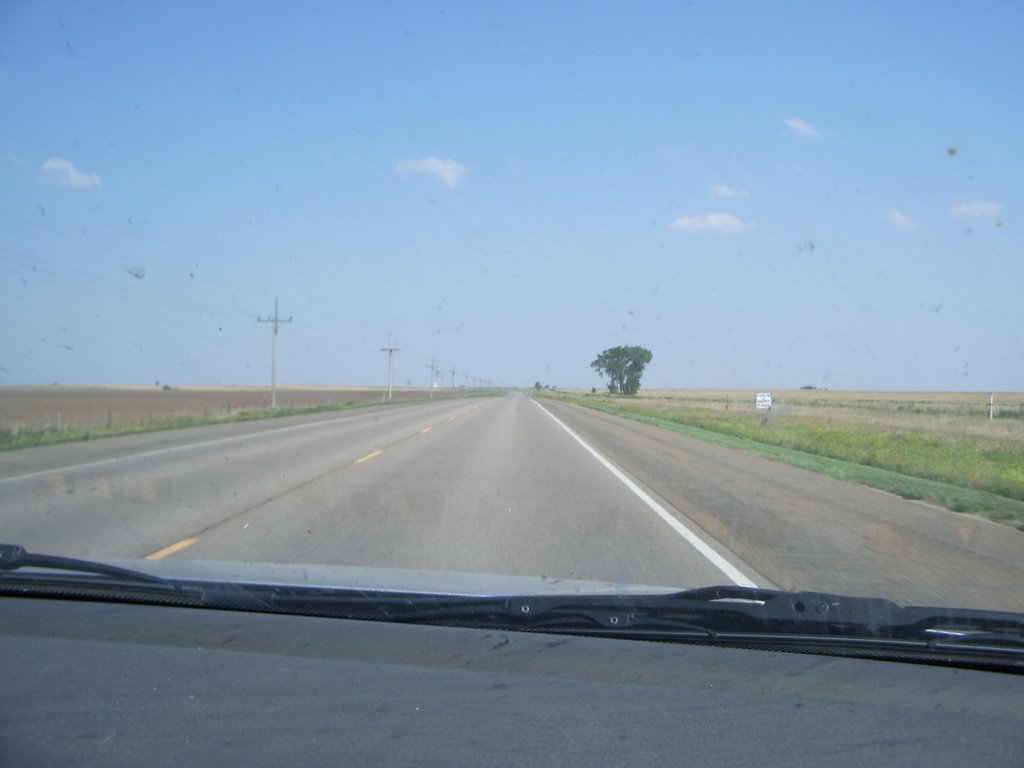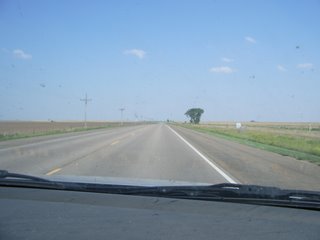
Because most of our 3-hour trip did indeed look like this picture, very often the most interesting things to look at/wonder about were signs. Quite often, they were just quirky, such as the signs advertising
the world's largest hand-dug well in Greensburg or "Farm Aid Liquor" in Ford. And in Dodge City itself there were mysteries embodied in signs (though not always texts),
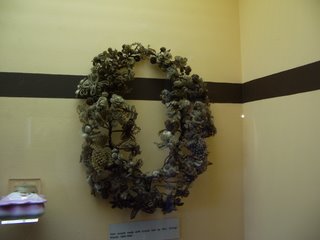
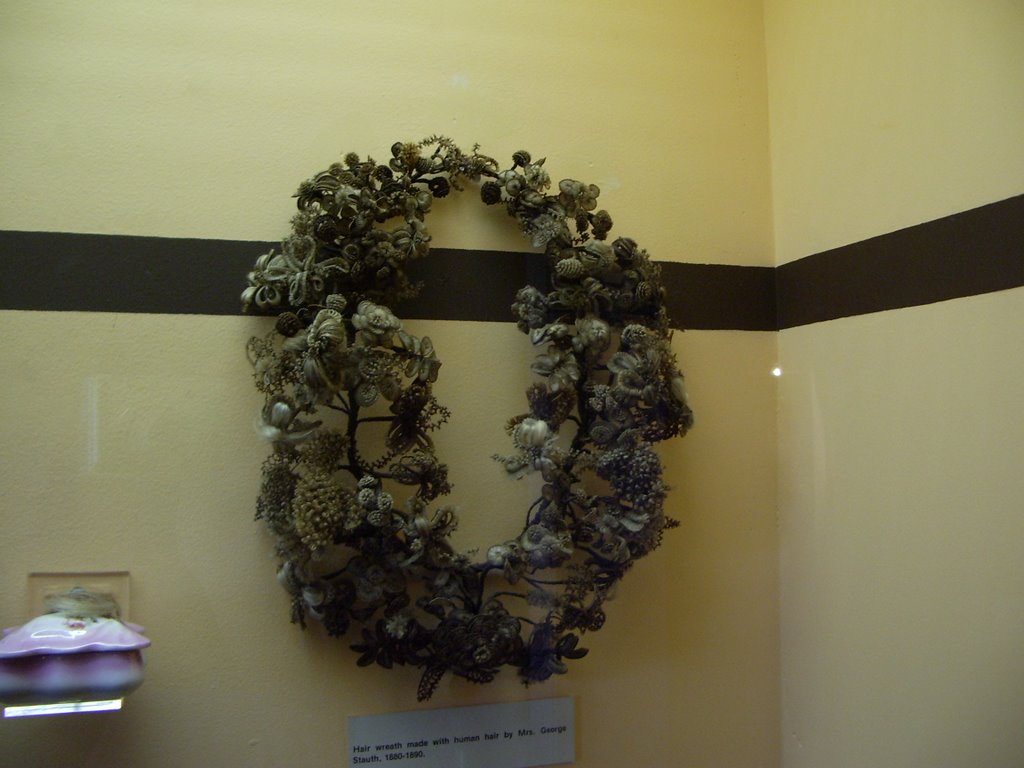
such as the several
hair wreaths we saw displayed in various places (who were the women whose hair this was? Who had loved them so much after their deaths that they wove these elaborate mementos?), the picture of a buffalo hunter sitting atop a 20-foot-tall pyramid of buffalo skulls, or the grave marker at Boot Hill for the unidentified man whose body had been discovered one morning hanging from a tree on the north side of town.
Stories aplenty float about in that space out there. Most people I know--even, in one case, a student I'm teaching this summer who is FROM there--would wonder, What would bring otherwise-sane people out there? To live, no less? Even if no one knows your name there, it is hard for you or the traces you leave behind to go unnoticed in such a place, the land being so flat and so relatively empty. You can't remain anonymous there, you can't just disappear. Even the Unknown Man left a trace of himself, his body, not to mention wonder at his life in the wake of his passing.
And maybe that's why they went, and why those who stay, stay.
Without any question, though, it was the signs that we saw along a quarter-mile stretch of U.S. 400 just outside
Mullinville, Kansas that most gave us literal and intellectual pause.
The signs you see below are the work (he calls them "totems") of
M. T. Liggett (the film linked to on the site is about half an hour but worth your time, as it reveals Liggett to be both thoughtful about his art and delightfully, vulgarly crotchety about (even) his neighbors--which, in a town of fewer than 300 people, seems a risky proposition). His work often isn't polite or especially subtle, as you'll see here and in the video; but as you'll also see, Liggett isn't above making art that will cause the viewer to scratch his/his her head a bit.
Some of the pieces have kinetic elements, some are static; some are cut from sheet metal, some are "found" art constructed from old farm implements; some are painted rather conventionally, some "action painting"-style, some not at all. It would be impressive just for its sheer quantity, but it also impresses (again, not always pleasantly) for its brashness and, more often than not, its curiousness. Why any sort of homage to Diogenes is here at the margins of a wheatfield in Kiowa County, Kansas, is really quite astonishing to me. But there it is.
Liggett's big themes are philosophy, mythology and politics; I've arranged them more or less in that order:
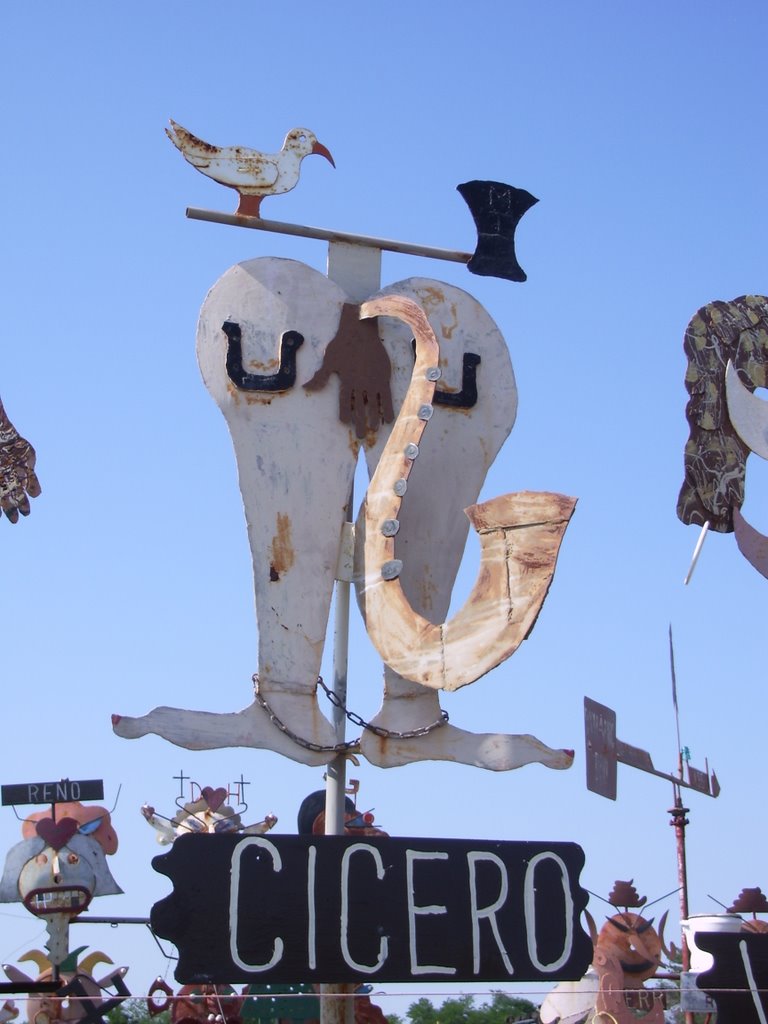
 Cicero.
 Here is one of the aforementioned head-scratchers. A quick read through Cicero's
Wikipedia article revealed nothing to me that would equate with this image with the ancient Roman orator--to my knowledge, he was chronologically unable to play the sax (and would in any case have been anatomically unable to play it in this fashion)--unless he's trying to suggest a link to Bill Clinton, also known as a skilled orator who certainly does play the sax . . . and whom,

judging from some of the other work there, Liggett loathes. As for the bird perched on the hatchet, the chains binding the ankles . . . I can't make sense of them. Yet.
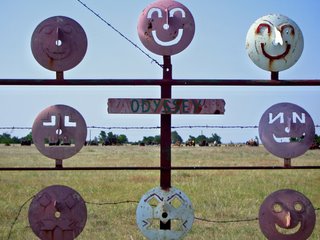 The Odyssey
. This is a portion of the center panel of a triptych of masks like these; the total length of the piece is about 20'. Many of the masks resemble pigs' faces, thus evoking Circe's transformation of Odysseus' men into swine.
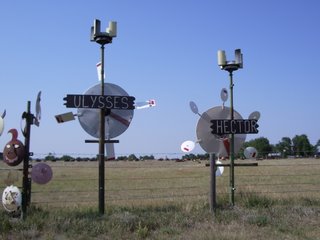
At (your) far right of
The Odyssey stand these totems,
Ulysses (on the left) and
Hector.
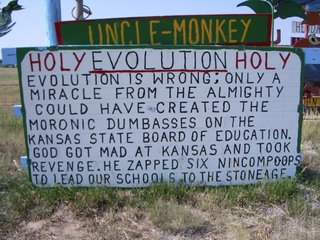
And finally, one of Liggett's many commentaries on Kansas politics. I included this one because, for better or for worse, this one is most accessible to good old Blog Meridian's out-of-state reader(s).
Liggett says in the video that people in New York have no idea what people in Kansas are doing or thinking. Mr. Liggett, I can assure you that there are lots of people in Wichita who don't know what people to the west of them are doing or thinking--nor, sadly, do they much care. In a place like southwest Kansas, there's not much time or place for frivolity. There is the land, and there is working the land, and that's about it. But it's valuable for the vast majority of us, only a couple of generations removed from the land but which to us might as well be like a life on another galaxy, that we go out and look and see and read what we find out there. Here and there, people have cleared a bit of space out there to be remembered by.
Update: Over at 3 O'Clock in the Morning, emaw_kc not only has the extraordinary (lapse in) good taste to link to this post, he also was inspired to
share some of his impressions of Liberal, Kansas, where he once lived for a few years. Go have a look.
Technorati tags:
Kansas,
Dodge City,
Folk art,
M.T. Liggett .jpg) Update: Edited to fix a few problems with links. We're new at this Carnival stuff; thanks for your patience.
Update: Edited to fix a few problems with links. We're new at this Carnival stuff; thanks for your patience.