Monday, July 10, 2006

Welcome to this week's KGB Carnival of Bloggers

Update: Edited to fix a few problems with links. We're new at this Carnival stuff; thanks for your patience.

Updated update: Apparently, we're having trouble with gender identification. Damn this screen's resolution. Sorry about that, Lyn.

Running a wee bit late with this week's posting, but we're here now, and thanks for dropping by.

I hope you'll be amazed and enlightened by this week's submissions, coming to y'all all the way from, well, Kansas:

Over at Gone Mild, Dan makes a brief but compelling case for his favorite living American writer with It's Summer - Read Helprin.

Josh of Thoughts from Kansas over the past few months (years?) has written many compelling posts documenting the debates in this state over the struggles between advocates of evolutionary theory and Intelligent Design and the caught-in-the-middle science standards for Kansas public schools. This week he submits two posts on this issue, Replace the Creationists on the Board of Ed! and Creationists are such buzz kills (this latter post specifically addressing the creationists who recently spoke at the Haviland Meteorite Festival

Over at Three O'Clock in the Morning, emawkc reminds his readers of the delights and horrors of country living in Good, bad, ugly.

At Becoming and Staying Debt Free Kevin (the Prince of Thrift) Surbaugh helpfully reminds his readers to Plan To Curb Out of Control Spending.

It's primary season here, and over at Bloggin' Outloud, king of Kansas bloggers (and fellow Wichitan) Lyn presents his reasons for supporting Eric Carter for Insurance Commissioner in the Republican primary in his post, Short Pause for State Politics.

And finally, our resident entomologist Paul Decelles shares pictures (he's just bought a new camera; what's a boy to do with new toys, after all?) of winged exoskeletoned1 visitors to his garden in his post Sometimes I don't even leave the yard. posted at his blog, The force that through....

That's it for this week. I hope you'll submit something for next week's Carnival . . . and let me know if you'd like the pleasure of hosting it some time in the future. Otherwise, the Carnival will be extending its engagement here.

1Oops . . . moths don't have exoskeletons. And I'm college-educated and everything.

Technorati tags:
,

Read More...

Sunday, July 09, 2006

Pouring concrete as Wagnerian opera

In this often-forgotten scene from Götterdämmerung, Siegfried (disguised as Gunther) warns Brünnhilde away from a freshly-screeded slab of concrete.

As you read what follows, here are the basic facts that shaped the better part of my just-passed Friday and Saturday and that you need to be mindful of in order to appreciate said weekend:

1) A 4-in.-thick slab covering 90 sq. ft. requires just over 1 cubic yard of concrete. The Popular Mechanics website's page on concrete gives the proportions for concrete mixtures here:

To make 1 cubic yard of concrete, you’d need seven 94-pound bags of cement, about 1/2 cubic yard of sand and just over 3/4 cubic yard of gravel. The amount of water you use depends on how wet the sand is. If it’s already moist, you’ll need about 4-1/2 gal. per bag of cement.

2) Four of us (well, let's say 3 1/2, seeing as my learning curve for working concrete began pretty much at the intersection of the x and y axes) spread 22 cubic yards of concrete on Friday and Saturday for two sidewalks and a 21'x40' slab in front of a garage. We fortunately didn't have to mix it all, as it was delivered in 3 cement mixers (two on Friday, one on Saturday). But having it delivered and poured all at once presented its own problems, the chief one being the getting it to look halfway decent before it set up so much that we couldn't do anything with it.

I am still trying to process what I experienced on those days; indeed, I considered just not posting at all about it for a few days. But this afternoon I came across this post by Fearful Syzygy over at his blog, Delights for the Ingenious, in which he provides a most unexpected answer to the question, "What do you do when you're in Europe for the summer and it's raining?" Obviously, pouring concrete wouldn't be an option that one would pursue (it's raining, after all), but to my mind it's only slightly less likely than what he chose to do. Anyway, reading his post kinda sorta inspired this one.

Ways in which pouring concrete resembles Der Ring des Nibelungen:

1) We spent about the same amount of time on this job--14 hours total--as it would take to watch a performance of the entire Ring Cycle.

2) We had no immolations, such as Brünhilde's on Siegfried's funeral pyre in Götterdämmerung, but on Friday Gracie, my in-laws' West Highlander terrier, got out of the house and almost fell into a just-poured 6-inch deep slab of concrete.

3) In a famous scene from Siegfried, the titular hero shatters Wotan's spear. My brother-in-law, who used to work with concrete for a living, at one point got frustrated with the consistency of the concrete we had received, how fast it was setting up, and the tools he was working with, and threw his trowel into a slab he had just been working on, shattering the work he had just accomplished.

4) Wagner wrote in German; though we spoke in English, the roots of much of the language used by some of my co-workers can be traced to good old medieval Germanic languages of various sorts. I'll spare you examples, leaving that up to your imagination and/or your recollection of George Carlin skits about words you're not supposed to say.

5) As near as I can recall, Wagner keeps his gods and humans too busy alternately fighting with and seducing each other to allow them much time for feasting; of course, though, they would have drunk German beer in their leisure hours. We drank beer with German names. My nomineee, by the way, for the domestic beer with the most Wagnerian-sounding name: Leinenkugel.

And that's pretty much the end of the similarities, at least with reference to this job. Opera--especially the Ring Cycle--always looks hard to me. Before Friday, I had no clue how hard everything about working with concrete was. And that brings me to something Winston of Nobody asked . . . said in his comments on my previous post:
I've watched the pros do it, and always wanted to be the finisher dude with the broom and get to make those swirly patterns.

I got to be the finisher dude part of the time, Winston. You'd rather sing in the church choir than be the finisher dude, I'm pretty sure. You can get only so fancy with a 4-foot-wide broom attached to a 15-foot handle. But then again, I was the learning-on-the-fly dude the entire two days, immersed in a kind of work that told me that, as much as I knew about hard, physical labor, this was nothing like what I knew. Just like, say, seeing Wagner after having just seen Gilbert & Sullivan.

Technorati tags:
,

Read More...

Friday, July 07, 2006

Off for the weekend

I will be learning how to work with concrete this morning and on Saturday.

Mrs. Meridian's father is replacing a driveway and some steps at his house in Topeka, and I'll be helping him and his youngest son do the pouring and spreading (he's renting a truck to do the mixing).

Perhaps I am strange, looking forward as I do to stuff like this: Helping my father-in-law cut and stack about 8 cords of wood last fall and winter. And now this. But this sort of work reconnects me, however indirectly, with my father and my childhood growing up in the woods next to my father's parents' farm west of Austin. Of late, that has felt important.

All this is to say that I'll be away from "here" for the weekend. Thanks as always for reading.

Read More...

Thursday, July 06, 2006

In which the Meridian cultivates his talent for idleness via posting on another meme


I've seen this meme floating about the 'sphere and have had a hankering to post something with it, but it's only this morning, as I'm a) waiting for the caffeine to kick in and b) delaying the i) paying of bills and ii) doing of laundry, that I'm thinking, Hey--what about that cool meme? You could post about that!

I saw this most recently at Debra's blog, Find the Beauty . . ., which I learned just this morning has a sidebar link(!) to good old Blog Meridian. I'll put aside for now a considered exploration of the inevitable aesthetic question her linking here raises--specifically, just what "beauty" she found here worthy of a sidebar link(!) to this blog--and just thank her and ask you to go visit her place and get on with the meme-ing:

Instructions:
1. Go to Wikipedia.
2. In the search box, type your birth month and day (but not year).
3. List three important events that happened on your birthday.
4. List two interesting birthdays and one interesting death.
5. List one holiday or observance (if none, make one up).

My birthday is April 25th. Let's do a bit of trivia-mining, shall we?

This isn't part of the meme, but it's a Fun Fact I've known ever since I could really care about such things: April 25th is the last possible date that Easter can fall on.

Three important events:
1) 1846 - Thornton Affair: Open conflict begins over the disputed border of Texas, triggering the Mexican-American War
2) 1898 - Spanish-American War: The United States declares war on Spain
[One lesson here would seem to be that the leaders of Spanish-speaking nations should become especially attuned to bellicose rhetoric from my nation come springtime]
3) 1953 - Francis Crick and James D. Watson publish Molecular structure of nucleic acids: a structure for deoxyribose nucleic acid describing the double helix structure of DNA

Two interesting birthdates:
Some intriguing people named here that I already knew about (Cromwell, Al Pacino, Ella Fitzgerald); I'll define "interesting" here as "people whom I admire but whom I didn't know before doing this that I shared a birthday with them"
1) 1874 - Guglielmo Marconi, Italian inventor, recipient of the Nobel Prize in Physics (d. 1937)
2) 1933 - Jerry Leiber (of Leiber and Stoller), American composer

One interesting death:
1) 1995 - Art Fleming, American game show host (b. 1925)

Holiday/Observance:
ANZAC Day (Australia, New Zealand). (Equivalant to the U.S.'s Memorial Day)

Hmm . . . I'm now richer in knowledge . . . time now to expend some monetary riches.

Technorati tag:

Read More...

Wednesday, July 05, 2006

The KGB Carnival is blowin' into town!

Yes indeed. And what's more, the Manager sez it'll be setting up right here at good old Blog Meridian this Monday.

I have posted before about the Kansas Guild of Bloggers' weekly carnival, and this blog has benefitted greatly from participating in it via new visitors here who have turned into regular readers. I feel honored to begin returning those favors to the Carnival by hosting it.

Again, here are the oh-most-stringent requirements for participation: You MUST be a blogger who lives in Kansas, once lived in Kansas, is a native of Kansas, entertains the occasional thought (happy or derogatory) about Kansas, and/or knows the words to either "Over the Rainbow" or "Dust in the Wind" (extra credit if you can pick John Brown out of a line-up). Your post MUST be about some aspect about life in the Sunflower State. Or not.

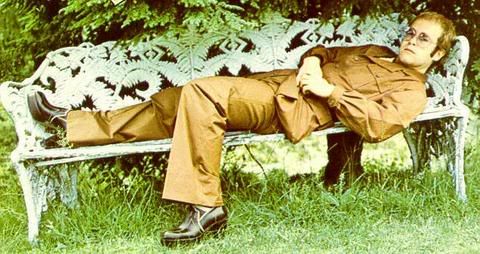
Once you've determined that both you and your post meet or exceed these rigorous requirements, go here to submit your post. Then return here Monday afternoonish to see links to your post and those of your fellow Carnival-goers up in pixels here on the Blog Meridian midway. As you can see from the picture (click on the pic for a larger image), we're an, um, diverse bunch, but there's always room for more fellow travellers on this particular ride.

I hope you'll submit something and return here Monday. And if you'd like to host the Carnival sometime, let me know, and we'll get you set up.

Technorati tags:
, , ,

Read More...

Tuesday, July 04, 2006

In which the Meridian gets to help Lady Justice with those scales of hers

It is most fitting that, this Independence Day week, yesterday I received a jury summons in the mail. I am to appear at the county court house (which, as it happens, is two blocks from where we live) at 8:30 on July 17.

This is my first ever jury summons. I am thrilled. No--really. I am.


There must already be some Peter Principle-like or Murphy's Law-like axiom with regard to jury duty, but on the offhand chance that one doesn't exist, I will coin one:
Blog Meridian's Jury Duty Axiom: The likelihood of one's being summoned to serve on a jury increases in direct proportion to one's preternatural unwillingness to serve on a jury.

This is certainly true in my own experience; I hope that my legions of readers (and in particular those of you I know of who are involved with the law) will be willing to confirm the truth of my axiom via your comments, so as to lend added weight to the block-quote formatting and bold type above and I can get on with the business of printing up T-shirts and filing trademark applications and retaining lawyers in case of infringements.

Geez. This more fully participating in our nation's legal system has gonne to my head a bit.

I digress.

I truly am serious about being excited about serving. We are guaranteed the right to a trial by a jury of one's peers; it seems to me that in order to ensure that we ALL have access to that right, there is a corresponding price that should, that must be paid by those of us who are citizens. Hence that word "duty." Cue the "freedom isn't free" and "with freedom comes responsibility" tapes. In terms of time, at least, missing a day or two of work is a small price to pay to ensure that my fellow citizens have the same access to a right that, should the need ever arise, I'd sure as all heck would want to have access to.

Money is another matter, though, for many who would otherwise be willing to serve, and we all know that the state's compensation for jury duty is, charitably, paltry. While one doesn't serve for the money, one often seeks to be excused (or just plain doesn't show up) because of lost wages. Enter, in Texas, Steven Wentworth, a state senator, who here announces recently-passed legislation that seeks to increase compensation for jury members. Part of his rationale for the bill follows:
I would like to believe that most Texans respond positively to a notice to appear for jury duty at their local courthouse to sit and determine the facts in a case.

Reality, however, is that the number of Texans reporting for jury duty has decreased significantly, placing many jurisdictions in danger of constitutional challenges for violation of the Sixth Amendment to the United States Constitution, which states that jury pools must reflect a representative cross-section of the community.

A jury pool should include people from all walks of life; however, so many Texans called to serve on juries are not showing up that we run the very real risk of cases being overturned on appeal because the jury pool did not include a broad spectrum of Texans.

For many Texans, the axiom, "time is money," applies to jury duty. A broad cross-section of Texans, including high-paid self-employed professionals as well as lower-paid salaried employees, find jury duty to be a financial sacrifice, and one that many are unwilling to endure.

There is much to say here about some rather ominous implications for our system of justice (and, indeed, government itself) if more and more of us deem ourselves "unwilling to endure" not just jury duty but all sorts of matters that hinge on the existence and participation of an informed citizenry. But: as I literally am typing these words, NPR is broadcasting its annual July 4th reading of the Declaration of Independence, which happens to list as a grievance against the King a denial of the right to jury trials for some colonists.

So, yeah: come July 17, I'll feel like a patriot. But I'll also be taking along something to read. The wheels of jury selection, I'm told, like the wheels of Justice themselves, grind slowly.

Technorati tag:

Read More...

Monday, July 03, 2006

Spelunking and kerplunking: a story for the chiropractor

We Mreidians (Scruffy, too) are indeed safely back from our trip to Austin to visit with my mother for a couple of days. It was a relaxing trip, but we're glad to be back.

The main adventure on this trip was a journey to New Braunfels (just north of San Antonio) on Saturday to visit Natural Bridge Caverns, "Texas' Largest Cave." That's the "spelunking" part, though it's admittedly overstating to call it spelunking when one is walking along lighted, paved walks with strategically-located handrails. But sometimes searches for rhymes force the writer to exaggerate or distort the truth of some things in order to be true to something larger, more significant; to wit, the "kerplunking" in this instance.


Some context: Mom is not Old, but she is 20 years older than I am, and I am 44. More to the point of this post, for the past few years she has lived with pain in her hips that limits the amount and kind of walking she can do. This pain is the result of pressure on nerves in her lower back, and she'll be having surgery to correct this later this summer. In the meantime, she has visited a chiropractor who is able to give temporary relief for her pain, but as things have progressed that relief has lasted for ever-shortening lengths of time. The chiropractor is decent and compassionate enough to admit to her that he can do no more for her than what he's been doing.

So: when I suggested we visit the caves, it was done with a partial eye to her state: a short car ride to them; a walk in the caves themselves of 3/4 mile . . . piece of cake. This is Texas' Largest Cave, but it ain't no Carlsbad Caverns in size.

One other, crucial difference: Carlsbad is a mostly-dead cave. Natural Bridge is very much "alive"--meaning wet.

Mom said later that when we heard the cheerful young woman at the cave's entrance warn us about taking into consideration our physical limitations and asked us to think about the shoes we were wearing, she (Mom) almost turned back to wait for us to go on through the cave, but she decided in the end that she wanted to see it with us. So, go with us she did; and at the first switchbacking descent her right foot slipped awkwardly, causing her to sprain her ankle, and down she went on the walkway.

Kerplunk.

Of course, none of this was especially funny at the time, given the shape her back and hips are in. But she knew immediately that nothing worse than the sprain had occurred, and so she got angry that she wouldn't be able to finish the tour.

And something odd happened as well: now, Mom feels no pain at all in her hip when she stands. It may just be that the pain in her sprain is distracting her from feeling the pain in her hip, but still. Sometimes, one takes good news however it may come along, however fleeting it might be.

Read More...

Sunday, July 02, 2006

8 1/2 Mile

I don't know if it helps to know Fellini's film in order to appreciate this, but I have to say that the result is better than funny; like all great parody, this shows a real understanding (and appreciation) of both pieces.

(and yes, I'm back safe and sound)

Technorati tag:
, , , ,

Read More...

Thursday, June 29, 2006

Road trip alert

Today Mrs. Meridian and I are heading to Austin to visit my mom for a few days; we'll return on Sunday.

Those who have come here in search of blogospheric sustenance (as if you could find that sort of thing here to begin with) could do worse than peruse the links over there on/in the right gutter of this humble blog.

See y'all soon.

Read More...

Tuesday, June 27, 2006

In which the Meridian goes to YouTube to learn about string theory

My long-time readers know me. (aside: and yet they keep returning here anyway) I guess the cat thing wasn't helping me understand Mr. Schrödinger, so he goes here, where they use a cute puppy, and he suddenly gets it. Dogs being demonstrably dumber than cats, and my being (mostly) the product of the dumbed-down American public education system--and an English major in college besides--I confess to, on the one hand, wanting to know more about How Things Work but, on the other, having to rely on, um, popularizers of said Things. You know: like how people are finding out about Jesus from reading The DaVinci Code.

And now comes more help for me--and you good people as well, seeing as I've gone to the trouble to get an account to do so, so you'd best be appreciative--via YouTube


and this Steve Colbert interview of Brian Greene (he of The Elegant Universe). Who worse to interview who better?

Actually, it IS pretty informative in its own way; even more importantly, the issue of just what a "theory" is in the sciences gets raised, something I've been thinking about in another context.

Enjoy.

Technorati tags:
, , ,

Read More...

#10,000

This thing in the picture behind the men is a "10,000-transistor multidimentional [sic] pulse height analyzer." Being as my background in nuclear physics pretty much consists of being able to spell "nuclear physics," I refer you to the caption that accompanies the picture, taken in March of 1964:

Fission studies owed much of their success to sophisticated new equipment for detection and analysis of nuclear fragments. In their Bldg. 70 laboratory, nuclear chemists John Rasmussen (left), Stanley Thompson and Harry Bowman share honors with their 10,000-transistor multidimentional pulse height analyzer.

Why a picture of this? Because some time today, if current visiting patterns hold true, the 10,000th visitor will arrive in this particular sector of the blogosphere, and I was looking for something associated with "10,000" that also evoked something of my sense of both me and my blog: it's almost as old as I am, for one thing; and there's something quaint about transistors nowadays, isn't there, something that fits my sense of whatever it is I'm doing here: behind the trends of the better-stronger-faster sites out there but which still (mostly) accomplishes what I hope to accomplish when I post something. There's also the not-entirely-insignificant fact that I've posted a picture of a technology I have not the faintest comprehension of using a technology I have only the faintest comprehension of.

Anyway.

I know I say this every time I post something acknowledging one of these milestones, but the very fact that the milestones occur in the first place confirms it as truth: I would have stopped doing this long ago if I hadn't had visitors who kept on returning and leaving comments and linking to things I've posted, all of which in turn causes me to visit their sites and link to them and leads me to post more stuff. It's a most delightful vicious cycle. It's been fun for me, but as with most fun things, it's more fun if others feel they get something out of it as well.

So: once again, Thank you. I promise the next post will be far less milestone-ish.

Read More...

Friday, June 23, 2006

4 Meme, and a reminder


(This picture was among those that popped up for a Google Image search for "blogosphere meme," sooo . . .)

It's been a while since I was last tagged for a blog meme; I was beginning to think the meme craze had died down. But no: yesterday I learned that Josh of Thoughts from Kansas, which is only the most prominent progessive-politics blog in the state (hold all those big-fish-small-pond jokes and go visit him instead) had tagged me for the meme that follows. I gotta figure that if someone like Josh is doing these things, surely complete, total, utter blogospheric domination cannot be far behind. My Teutonic/Nieztschean propensities urge me on; I cannot resist.


4 jobs you’ve had
1) "Assistant" (ahem) at a house being rehabbed for a distant cousin's equipment-rental business in Austin. The first paying job I ever had.
2) "Assistant" (more throat-clearing) at the machine shop that employed my father. The job that convinced me I wanted to go to college after all, and the first time I really SAW what my father did for a living (and whom he had to do it with). I worked there from August till December of 1980, began college in January of 1981, and my father died in April of that same year.
3) "Assistant" (everything from stall-mucker to helping out with surgeries) for a large-animal veterinarian in Seguin, Texas. Easily the job with the most varied tasks that I've ever had.
4) Teacher of English as a Second Language, various schools, Durango, Mexico. The first job I had that didn't have some sort of euphemism in front of it.

4 movies you could watch over & over
1) Vertigo
2) Zeffirelli's Romeo and Juliet
(which I've not seen in years but certainly belongs here anyway)
3) Eternal Sunshine of the Spotless Mind
4) Casablanca

4 places you’ve lived
(a complete list wouldn't be much longer than this)
1) Durango, Mexico
2) Houston
3) Mobile, Alabama
4) Wichita, Kansas

4 tv shows you love to watch
1) House, M.D.
2) Lost
3) Cheers
4) Frazier

4 places you’ve been on holiday
1) A family trip to Alpine, Texas
2) Hawaii
3) Zacatecas, Mexico
4) Mérida, Mexico

4 websites you visit daily
I visit many sites, of course, but these are the ones I visit without fail for news and political commentary:
1) CNN (though lately I've been disturbed by their homepage's drift away from hard-news items in their Top Stories list. If anyone has a better suggestion for whatever passes for straight news these days, I'd happily take your suggestions)
2) Dan Froomkin at White House Briefing
3) Kevin Drum at Political Animal
4) Andrew Sullivan at Daily Dish

4 of your favorite foods
1) Chicken mole
2) German potato salad
3) Cochinita pibil
4) red beans and rice

4 places you’d rather be
1) New Orleans (before Katrina)
2) Zacatecas. Here's a picture:


3) Gulf Shores, Alabama, at sunset
4) (copying one of Josh's responses here) The Metropolitan Museum of Art, New York


4 lucky people to tag
1) Steph at Rubrics Twist
2) jmb at A Simple Life and Times
3) R. Sherman at Musings from the Hinterland
4) Aunty Marianne at Tomato and Basil Sandwiches

And now the reminder: It's submission time for the Kansas Guild of Bloggers' weekly blog carnival, hosted by emaw_kc over at 3 O'Clock in the Morning. Don't be shy, don't worry about not living in/being a Kansan. Just send 'er in.

Technorati tags:
, , , ,

Read More...

Thursday, June 22, 2006

Junebug: A (Southern) poetics of space

"I have found that anything that comes out of the South is going to be called grotesque by the Northern reader, unless it is grotesque, in which case it is going to be called realistic." --Flannery O'Connor, "The Grotesque in Southern Fiction"
I am going to try to get some things right about Junebug (2005), a film that gets very little wrong--especially about the South. In the course of trying, I hope to convey my sense of this film as being about space--more particularly, Southern space.

The plot could not be simpler or, for that matter, more familiar: a gallery owner specializing in folk art, a cosmopolitan outsider recently married to a Southern boy, travels with him to his home in North Carolina to negotiate a deal with a so-called Outsider artist and, secondarily, to meet her new husband's family. Misunderstandings of various sorts arise. A tragedy occurs. The cosmopolitan woman and her husband return home. You get the sense that everyone has learned something, but the end is, on the surface, at least, very much in the no-hugging-no-learning mode. But from the film's very opening, Junebug reveals its intention to be a very different film: a film as much about a space, a place, as about its characters. Maybe more so.

A LONG post ensues.

The film opens with short clips of people competing in the National Hollerin' Contest, held annually in Spivey's Corner, North Carolina. The initial impulse is to laugh, but there was something about the sound the hollerers made that seemed to me as I watched to hearken back to something old, something not campy or comedic at all but something emanating from the very bedrock of what remains of older, rural Southern culture. And indeed, if you go here to read about the origins of hollering, that's exactly what you learn. In its own way, then, Junebug's opening is a secular summoning to the hearing of a story that, even though set in the contemporary world, will be misunderstood unless one takes seriously the idea that Southern culture is something more, and more substantive, than a mass of clichés.

The Outsider artist, who gets introduced in the next scene, is an extension of this idea. Like the hollerers, the artist depicts through his art what makes the South different from the rest of the U.S.: invasion and conquest at the hands of its fellow Americans. He is a visionary who literally prophesies, through his art and in speeches, that the South Will Rise Again. His accent is so thick as to be, at points, almost unintelligible, thus evoking the fundamentalist and charismatic practice of speaking in tongues. We may laugh at what he says, but we know he's not, at his core, a buffoon.

The same is true of all the other characters Madeleine (the cosmopolitan art-dealer--more about her name later) will meet. Junebug is full of humor, but the actors aren't playing for laughs. And, the same is true of the very setting for this film: a contemporary suburban neighborhood outside Winston-Salem that, aside from clouds of insects and humidity that you get the feeling you can actually see, looks just like suburban neighborhoods do anywhere these days (more's the pity, but let that alone for now). Not a trailer park or a hound dog asleep on or under a porch or a Larry the Cable Guy in sight.

And that leads me to something unusual and striking about this film that made me want to post about it in the first place. At a few intriguing points in the film, characters will be in a room conversing with each other and then leave that room together, carrying on their conversations, but the camera won't follow them. Instead, we are shown various rooms in the house empty of people--the dining room, the living room, spare bedrooms--as, offstage, we can hear the continuation of the conversation. It is as though the house is listening, too--not in a sinister way, but exactly as one would expect of a region with such a strong sense of place as the South has.

Home is a powerfully resonant theme in this film: George (Madeleine's husband, the Southern boy) feels it powerfully; Madeleine, the daughter of British diplomats who, we learn, really has had no place to call home and thus is more or less uncomfortable throughout the film. Her name, perhaps unintentionally, ironically evokes Proust's Remembrance of Things Past in that she has no comparable memory of a place. Perhaps unsurprisingly, then, we learn that one of her favorite novels is Huckleberry Finn, which she correctly identifies as a picaresque novel and one of whose themes she correctly identifies as "escape."

Madeleine is an Outsider as well, and she knows it. Thinking she had known her husband, she is introduced to a part of him that resides in, as Yeats might put it, his deep heart's core. She could live there, or at least visit often, but she'll never feel comfortable there--not because George's family is unfriendly toward her but because at a fundamental level she just won't "get" this place. And that is something else Junebug gets absolutely right about the South, too: hospitable though the people certainly are, those not from the region tend to feel politely kept at arm's length by those who are from there. It's just different, is all.

Technorati tags:
, ,

Read More...

Tuesday, June 20, 2006

Intolerable?

Go and visit this website, Tolerate Mornings, which to all appearances seems to have The Folger Company's blessing. Do NOT miss clicking on the TV in the lower-right corner of the page; what you will see there is, after all, pretty much the whole reason I'm sending you there.

Then ponder the extent to which it is inevitable that bad products will lead to, if not bad commercials, then commercials that leave the viewer absolutely dumbfounded.

(Hat tip: Andrew Sullivan)

Read More...

This blog is certified 81% Dixie

Find out if y'all are Yankees or Rebels. It's an online dialect quiz set up by a linguist. Quick and fun. (Hat tip: NPR)

A word about my score: Long-time readers know that I'm not a Kansas native; I was born and raised in Austin and then lived in Houston for three years and Mobile for seven before moving here. But this part of Kansas has a strong southern-central US presence to it, so even here I hear a fair number of southernisms. And that, of course, is another point of the quiz: to reveal something about migration patterns in the U.S.

Update: Another interesting dialect map: Do you say "pop" or "soda"?

Technorati tag:

Read More...

Sunday, June 18, 2006

Happy Father's Day

The literal and figurative shadows are lengthening as I post this, but my wishes are no less sincere to those of you who are fathers. My daughters called me earlier today to wish me well and to ask me what kind of cookies I would like to receive in the mail (oatmeal raisin, in case you're wondering).

C.: Daddy, I have something very important to tell you.
Me: What's that? Tell me.
::dramatic pause::
C. (slowly, deliberately): 2 . . . +2 . . . =4!

Yes indeed. On the hierarchy of Important Things, that information ranks pretty highly. But Art surely is fairly high up in that hierarchy, too; and when C. sang "You Are My Sunshine" to me a little later during the call, it almost made me forget that other Important Thing.

My father has been dead since 1981, and so that gives this day a tinge of sadness even after all those years. I still count myself fortunate, though, that he was alive long enough for me to say, along with Mark Twain, "The older I get, the smarter my dad becomes."

As for another place to go to read some well-written sentiments of the day, over at Musings from the Hinterland R. Sherman quite fittingly does some musing about his children. Enjoy.

Technorati tag:

Read More...

Odysseus in Kabul: the death of epic?

Those of you who have read the Odyssey no doubt remember Odysseus' journey into Hades. Among his many meetings there is one with Tiresias, the ancient prophet, who tells Odysseus he has another journey to undertake after he arrives in Ithaka:

[G]o overland on foot, and take an oar,
until one day you come to where men have lived
with meat unsalted, never known the sea,
nor seen seagoing ships, with crimson bows
and oars that fledge light hulls for dipping flight.
The spot will soon be plain to you, and I
can tell you how: some passerby will say,
"What winnowing fan is that upon your shoulder?"
Halt, and implant your smooth oar in the turf
and make fair sacrifice to Lord Poseidon . . .
(trans. Robert Fitzgerald)

Of the Odyssey's many wonders, this one, a description not of gods or monsters but of a very human place, has been the one that most give me pause: what would such a place look like? How long would it take to get to such a place? This place, wherever it might be, seemed more fantastic, all because, paradoxically, it was a place of human culture that I had great difficulty imagining.


I was reminded instantly of Odysseus' journey-to-come when I heard a story this morning on NPR about an enterprising Afghan giving boat rides to people, many of whom had never even seen a boat in person before, much less ridden in one. "Odysseus has finally arrived!" I thought . . . though, things being what they are in Kabul these days, I wasn't certain how smoothly that sacrifice to Poseidon would go.

What happens in such moments? This is analogous to, say, the experience of a Kansas girl eating Indian food for the first time in her life, as happened when Mrs. Meridian and I visited an Indian restaurant here in town a couple of weeks ago. Surely the Afghans recognize the boat's ancientness, that it after all has an existence within their linguistic memory if not in their personal recollection.

The image you see at the beginning of this post might provide a clue. It doesn't depict Odysseus' journey inland but, rather, his arrival on Calypso's island; the caption on the original document reads, "Odysseus finds an oar on the island of Calypso and remembers that he is a human being." The Afghans clearly know they are human beings; I think it fair to say, though, that the boat's presence in their midst expands their knowledge of what it means to be human. That is, the boat compels them to imagine other places, other peoples, where boats are not novelties but a matter of course.

Which leads me to this abstract of an essay (MUSE subscription, which I don't have, required) in which the writer argues that Odysseus' inland journey foretells the end of the (Homeric) epic tradition. Perhaps that is because Odysseus' erecting an altar to a sea god in a place that doesn't even use salt on its food is analogous to a leaving behind of the world as known by the Greeks; that is, though epic's vision is cosmic, that vision is filtered through the lens of a culture--and even in the world of the Odyssey, we learn through Nestor that an older, still-more-ancient world is passing from the Greeks' collective memory. Similarly, Afghani culture will, sooner or later, no longer have a memory of a time when boats were unknown to them, except, perhaps, among a Nestor or two, whose long, long memory might inspire a Homer in their midst.

Perhaps it is the (ever-)impending death of culture that leads to the birth of epic?

Technorati tags:
, , , ,

Read More...

Saturday, June 17, 2006

Adventures at the Wichita Art Museum

This, people, is a picture of a watercolor painting.

Phil Chalk's extraordinary photorealist watercolor, Miss Scarlett Walks the Dog, is one of about 80 paintings exhibited at the art museum in the Kansas Watercolor Society's annual Great 8 Exhibition, a juried competition featuring watercolorist's works from Kansas and seven other central and southern Plains states. Later on you'll see some links to the work of other exhibitors. But good old Wichita Art Museum had a couple of other nice surprises today. Below the fold, you'll find some of them.


I have posted about my visits to the WAM a couple of times in the past. Perhaps I go too frequently because today, as I rounded the corner that led to the exhibit of their selections from the permanent collection, I found myself thinking that the paintings there were getting a bit stale for me. But I asked a docent there if the museum had any plans to rotate the pieces there, and he told me that they had plans to do so next month, most likely some sort of thematic exhibition. So, I'm looking forward to returning in August.

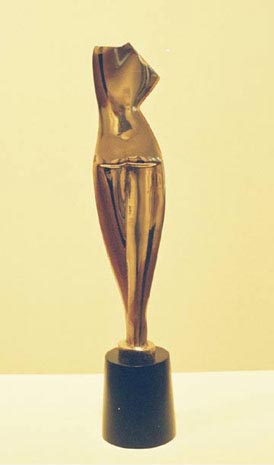
Even so, though, there were a couple of new-to-me paintings out that I was pleased to see, and the sculptures were much more numerous as well. I especially liked the three small bronzes by Alexander Archipenko, one of which,this rear view of Flat Torso (1922), you see here (the others are similar in style). Archipenko sculpted in other, more angular styles as well, but these bronzes reminded me of a fusion of Brancusi's Bird in Space series and Art Deco sensibilities.

THE big surprise, though, was finding that photographer Rick Nahmias' travelling exhibition, The Migrant Project: Contemporary California Farm Workers, was here and will be here till August 13. To say that these pictures are humbling to ponder for those of us whose only labor in getting our food means earning money and then going to a store to buy it is an understatement. To take only one example of what I mean, have a look at Tomato Tokens, Stockton, read the text, then do the math, keeping in mind that the man is holding seven tokens in his hand . . . then think about how much you pay per pound for tomatoes at the store. Or, think about this picture the next time you eat a watermelon. The pictures come from the workers' lodgings, from their transportation to the fields, from the fields themselves. I feel especially fortunate to have seen these pictures while we are in the midst of debates over immigration policy: at the very least, they have the effect of transforming these particular workers from rhetorical straw men into men and woman and children. But more to the point: I do not feel sad for these people; they are not tragic. Rather, I feel sadness for myself that I am not more mindful of just how my food gets to my table, more mindful of the prices paid by others and not paid by their employers or the people they feed.

On now to the Great 8 Exhibition. I have seen a couple of these exhibitions at the WAM in the past, and though this one is not quite as impressive in terms of overall quality, it is easily the one with the greatest diversity of styles that I've seen. Those of you who associate watercolor with wisp-thin washes of pastels would really like a show like this. Watercolorists really do seem to be able to do whatever they want with their chosen medium--witness the Chalk painting above. There was much to like there, but two artists in particular whose work I liked are E. Gordon West (scroll down to see his Windowscape #1, which is very similar to a piece he submitted to the show), and Yeqiang Wang's detailed paintings of corn and wheat fields; his submission for this exhibition won one of the cash awards. Born in China, he now teaches and paints in Dodge City.

I could go on, but you get the idea: It was a good day at the museum.

Read More...

Friday, June 16, 2006

A stretch of river XIII: Cottonwoods in bloom(sday)

(with apologies to James Joyce on his day)

Nervous, thin Scruffy Meridian descended the stairwell, wearing his monkeyemblazoned collar to which a leash was attached. His sleepy-eyed human held the leash's other end and drifted behind him like an ungirdled dressinggown sustained gently on the mild morning air. Scruffy thrust his nose into the air and thought:

--Cave canem.

Spasmodically he lunged forward and stood on the sidewalk. He looked back at Blog Meridian, then peed gravely thrice on the downstairs neighbor's potted plants, the privacy fence, and a small cottonwood sapling. Then he and Mr. Meridian mounted the small berm on the summit of which was the paved trail they walked on twice daily and began their counterclockwise walk round their stretch of river.

In his mind, Scruffy Meridian addressed his human:

--The mockery of it! Your absurd name, a word that didn't exist 5 years ago combined with ancient Romans sun-worshipping. And a bad pun on that McCarthy novel you're always going on about.

His tongue lolled out his mouth in a friendly way and he went to sniff a damplooking tuft of grass near the trail. Mr. Meridian followed him wearily and stood waiting for him to finish sniffing.

Scruffy Meridian's gay thoughts tried to keep up with his body, panting.

--My name is absurd too: Scruffy Meridian, two dactyls. But it has a Hellenic ring, hasn't it? Tripping and sunny like dogs chasing rabbits. We must go to the park. Can we go? Huh? Can we can we?

As if reading his thoughts, Mr. Meridian sighed resignedly.

--We're going, we're going. Calm down.


As they walked the sundappled path, Mr. Meridian noted the cottonwood blossoms drifting in the air and how they seemed especially heavy this year. You'd think it was flurries. June, not January. But look where they've collected like snowdrifts. Like sixty-foot-tall dandilions, they are. Erect fathers? mothers? of thousands. How many seeds, how many. So many will never know soil, never spawn? Beseed? Flower? Never took botany. Be fecund? Eh--good enough for a blog post.

They reached the Murdoch Street bridge that crosses over the River Little Arkansas. That canaryyellow Focus that always passed by at this time and with whose driver Mr. Meridian always exchanged smiles and waves passed by at this time, and Mr. Meridian and the driver exchanged smiles and waves. The breeze was freshening, the air still cool with just a hint of dampness from the jadegreen water that reminded Mr. Meridian of that little passage in Ulysses where that Mulligan guy gasses on about the scrotumtightening snotgreen sea as a great sweet mother.

When they came even with the far bank of the river, Mr. Meridian looked down its length along the exposed mud and shallows.

A white heron stood before him in the shallows, alone and still, gazing into the water with one eye, looking for minnows. It seemed like one whom magic had changed into the likeness of a strange and beautiful girl. Its literally skin-and-bone legs disappeared abruptly into its white body like a woman with really knobby knees who had boldly kilted up her skirts about her waist. Its breast was like a woman's bosom, warm and full, full and warm . . .

--Damn, Mr. Meridian thought. Wrong novel. Always did like that figures in distant pools line, though.

Scruffy and Mr. Meridian had by this time left the bridge and were walking through Riverside Park, their route parallelling can a curving path be said to parallel a curving river? Parallel lines never meet. These curves are concentric don't meet either. Curves aren't lines because not in the same plane. Right? No matter. My thoughts will now curve happily toward the curvy Mrs. Meridian who by this time is no doubt stirring about in the apartment drinking the coffee I poured for her before beginning my walk and eagerly awaiting my return from my 20-minute not 20-year walk.Will she read Ulysses? She (and Marilyn Monroe) the last page or so and here and there. Everyone reads that last page or so. She says she should, really should yes she really should, the whole thing. Says that about Moby-Dick, too. Fickle literary loyalties. Mustn't think on that. Something else. All that sugar . . . how can she? Like mine black, occasionally milk, sugar, a little cinnamon. Learned that in Mexico. Long ago, far away. But that coffee brings it back like madeleines. Tortillas. Diesel fumes, too.

Scruffy and Mr. Meridian approached the Nims Street bridge. Even as Mr. Meridian was thinking all these things he had just thought, he took at the same time an informal census of the waterfowl, always most plentiful at sunrise. Herons, egrets, both white. Do egrets have regrets? Canada geese who've never been to Canada. But kind of like the music. Mallards, lots and lots. How many broods hatched this spring summer? 4? 5? Lost count. Some already now as big as their mothers. Even saw the woodduck's brood first time yesterday. Why so shy, mallards almost as assertive as geese? Look it up sometime.

Scruffy and Mr. Meridian crossed the bridge, reached a patch of green that Mr. Meridian gaily referred to as the Pooping Fields because of the task that Scruffy more often than not performed there twice daily, and then turned toward home. He smiled. He thought about Ulysses some more, how it had taken Joyce 7 years to write a book about a single day, Thursday, June 16, 1904 . . . the very day he met and fell in love with long-suffering yet circumspect Nora. Love. Word known to all men. Takes just about a day to read the thing straight through. Quicker to think than to read. Labor of love to read it, too. One never reads Ulysses only rereads. Someone said that.

They arrived at their building. Scruffy bound up the stairs, Mr. Meridian hurrying to keep up and fishing for his housekey in the deep commodious pocket of his walking shorts at the same time. Sure glad I didn't forget it like Bloom did his. No climbing into these windows. Keep out Error of every sort. He struggled a bit to unlock the door because Scruffy was jumping up and down in front of it, his head bumping Mr. Meridian's hand, but unlock it he finally did and he turned the knob to let them in and bent down to remove the leash from Scruffy's collar.

Scruffy eagerly gazed at Mr. Meridian who was now standing in the kitchen in close proximity to the liver treats. And then I asked him with my eyes for a Bil-Jac asked him again yes and then he asked me would I bring him my Kong yes to say yes my Scruffilupagus and then he knelt down to hug me and I licked his face and made him smell me all doggy-perfumey yes and he was wiping his face like mad and yes I said yes I will get my Kong Yes.

Technorati tags:
, ,

Read More...

Thursday, June 15, 2006

Reading signs: A trip to Dodge City

"What's a Tonsorial Parlour?" Mrs. Meridian asked me.

"I suspect it's a fancy name for 'barber shop,'" I answered. And a later peek through the window proved that to be the case.

We were standing in front of the re-created Front Street in Dodge City on this, our first trip to this place (I had not learned till we arrived there that this was also the first trip for Mrs. M., a Kansas girl. Shocking, no?). We had gone there this past Sunday out of restlessness, a mood, it now occurs to me, that as much as any other reason got the West settled in the first place. I've lived here for almost six years now and I'd never been farther west in the state than a small state park just outside Wichita. So, every once in a while I'd tell Mrs. M. that I'd like to see Dodge City with her.

"It's just wheatfields and stockyards out there," she'd say--her way of saying "No." And having gone there now, I can attest that she exaggerates only a little. But there IS more out there, and below the fold you can see a bit of it that caught our collective eye.


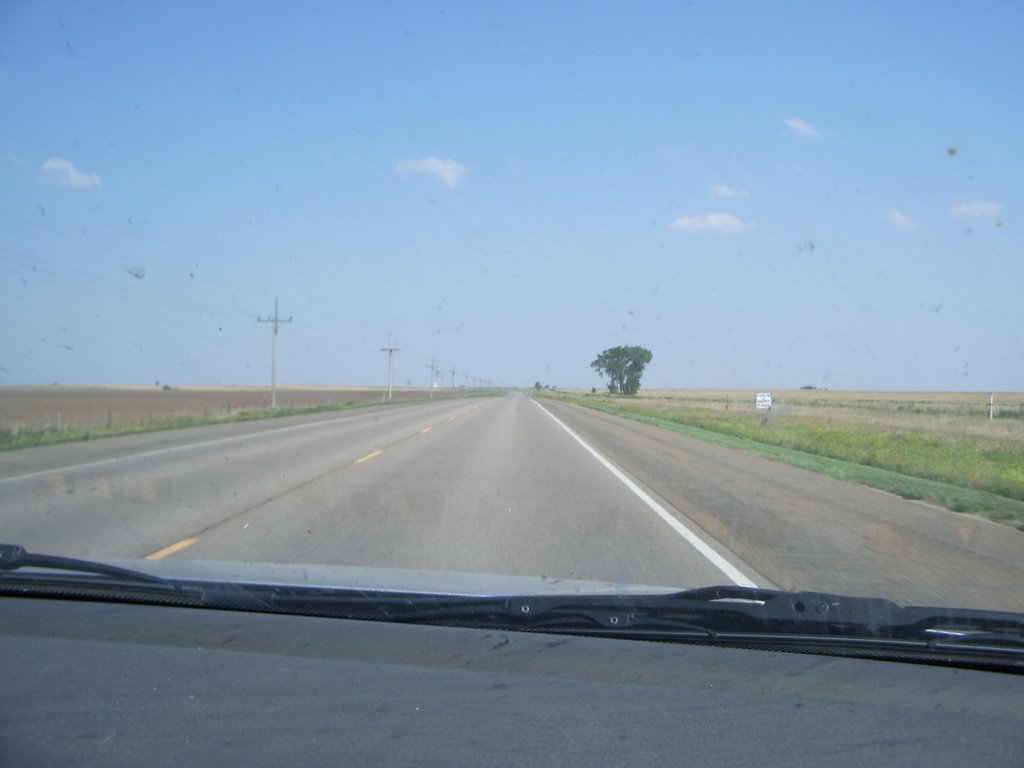
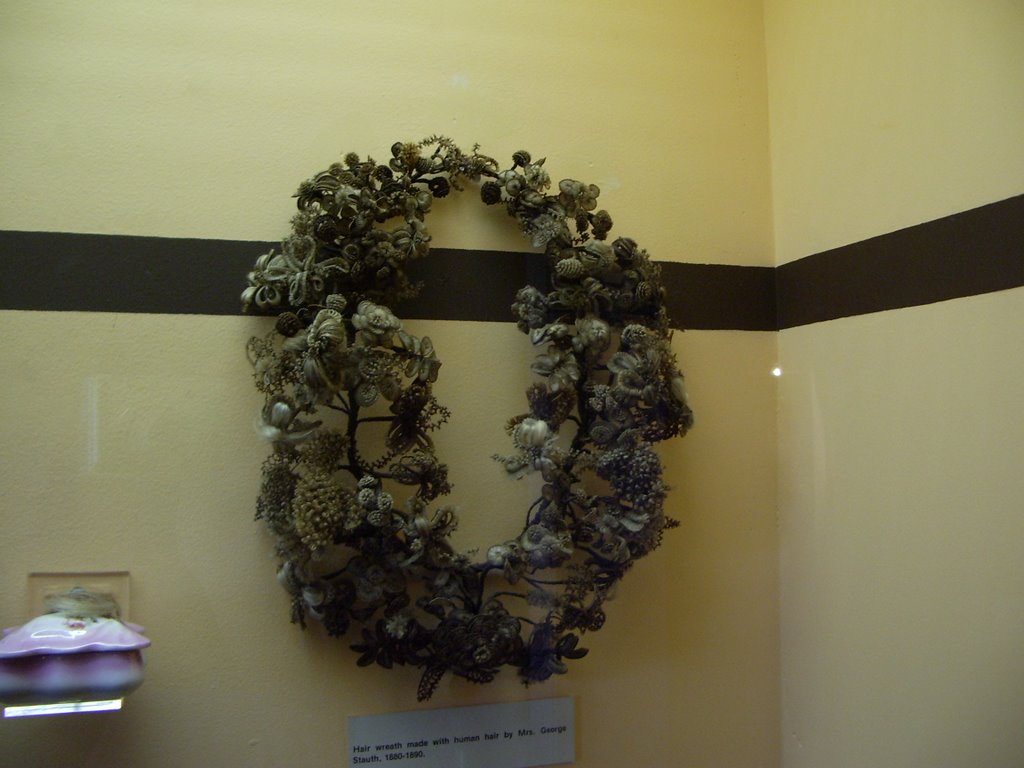
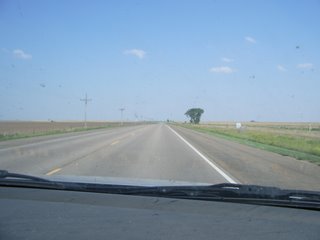
Because most of our 3-hour trip did indeed look like this picture, very often the most interesting things to look at/wonder about were signs. Quite often, they were just quirky, such as the signs advertising the world's largest hand-dug well in Greensburg or "Farm Aid Liquor" in Ford. And in Dodge City itself there were mysteries embodied in signs (though not always texts), such as the several hair wreaths we saw displayed in various places (who were the women whose hair this was? Who had loved them so much after their deaths that they wove these elaborate mementos?), the picture of a buffalo hunter sitting atop a 20-foot-tall pyramid of buffalo skulls, or the grave marker at Boot Hill for the unidentified man whose body had been discovered one morning hanging from a tree on the north side of town.
Stories aplenty float about in that space out there. Most people I know--even, in one case, a student I'm teaching this summer who is FROM there--would wonder, What would bring otherwise-sane people out there? To live, no less? Even if no one knows your name there, it is hard for you or the traces you leave behind to go unnoticed in such a place, the land being so flat and so relatively empty. You can't remain anonymous there, you can't just disappear. Even the Unknown Man left a trace of himself, his body, not to mention wonder at his life in the wake of his passing.

And maybe that's why they went, and why those who stay, stay.

Without any question, though, it was the signs that we saw along a quarter-mile stretch of U.S. 400 just outside Mullinville, Kansas that most gave us literal and intellectual pause.

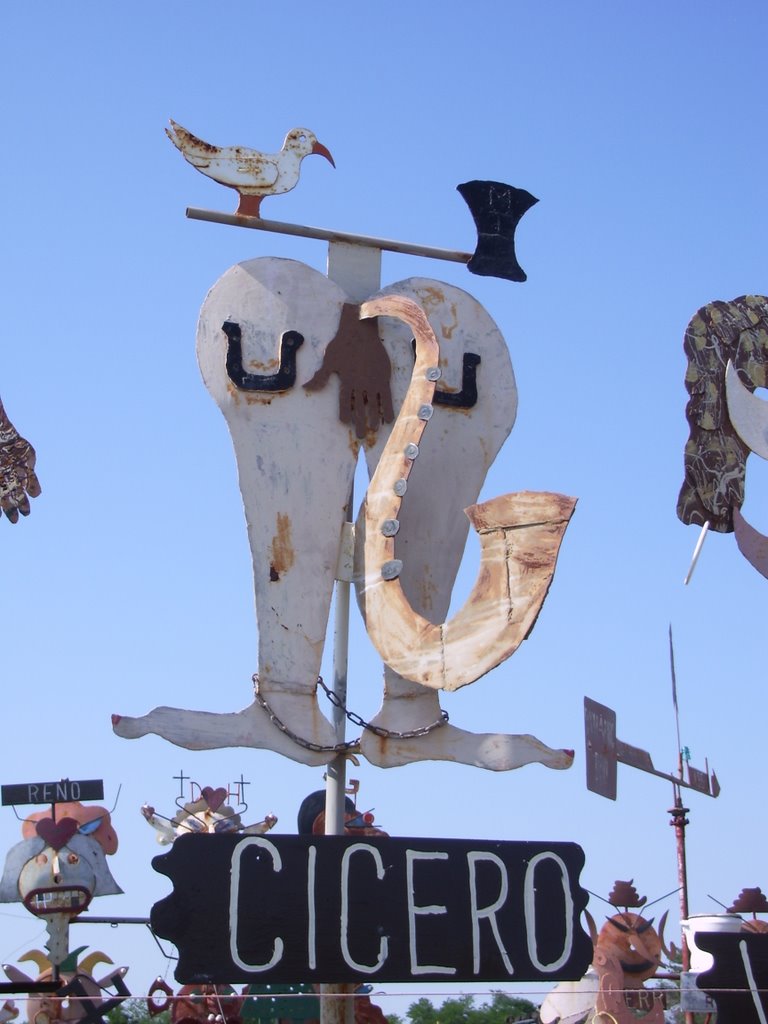
The signs you see below are the work (he calls them "totems") of M. T. Liggett (the film linked to on the site is about half an hour but worth your time, as it reveals Liggett to be both thoughtful about his art and delightfully, vulgarly crotchety about (even) his neighbors--which, in a town of fewer than 300 people, seems a risky proposition). His work often isn't polite or especially subtle, as you'll see here and in the video; but as you'll also see, Liggett isn't above making art that will cause the viewer to scratch his/his her head a bit.

Some of the pieces have kinetic elements, some are static; some are cut from sheet metal, some are "found" art constructed from old farm implements; some are painted rather conventionally, some "action painting"-style, some not at all. It would be impressive just for its sheer quantity, but it also impresses (again, not always pleasantly) for its brashness and, more often than not, its curiousness. Why any sort of homage to Diogenes is here at the margins of a wheatfield in Kiowa County, Kansas, is really quite astonishing to me. But there it is.

Liggett's big themes are philosophy, mythology and politics; I've arranged them more or less in that order:

Cicero. Here is one of the aforementioned head-scratchers. A quick read through Cicero's Wikipedia article revealed nothing to me that would equate with this image with the ancient Roman orator--to my knowledge, he was chronologically unable to play the sax (and would in any case have been anatomically unable to play it in this fashion)--unless he's trying to suggest a link to Bill Clinton, also known as a skilled orator who certainly does play the sax . . . and whom, judging from some of the other work there, Liggett loathes. As for the bird perched on the hatchet, the chains binding the ankles . . . I can't make sense of them. Yet.
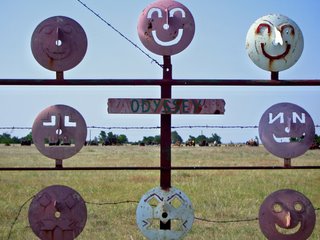

The Odyssey. This is a portion of the center panel of a triptych of masks like these; the total length of the piece is about 20'. Many of the masks resemble pigs' faces, thus evoking Circe's transformation of Odysseus' men into swine.
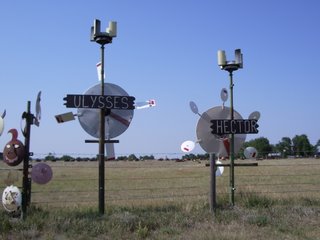
At (your) far right of The Odyssey stand these totems, Ulysses (on the left) and Hector.
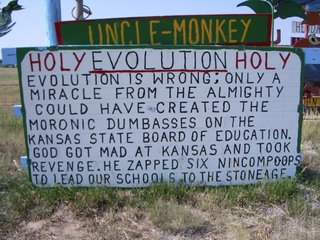
And finally, one of Liggett's many commentaries on Kansas politics. I included this one because, for better or for worse, this one is most accessible to good old Blog Meridian's out-of-state reader(s).

Liggett says in the video that people in New York have no idea what people in Kansas are doing or thinking. Mr. Liggett, I can assure you that there are lots of people in Wichita who don't know what people to the west of them are doing or thinking--nor, sadly, do they much care. In a place like southwest Kansas, there's not much time or place for frivolity. There is the land, and there is working the land, and that's about it. But it's valuable for the vast majority of us, only a couple of generations removed from the land but which to us might as well be like a life on another galaxy, that we go out and look and see and read what we find out there. Here and there, people have cleared a bit of space out there to be remembered by.

Update: Over at 3 O'Clock in the Morning, emaw_kc not only has the extraordinary (lapse in) good taste to link to this post, he also was inspired to share some of his impressions of Liberal, Kansas, where he once lived for a few years. Go have a look.

Technorati tags:
, , ,

Read More...

Friday, June 09, 2006

Meet the Press in Hell, and other fun stuff for your brain

Go. Read. Laugh. And ponder just how close to actual political discourse this is: the rhetorical equivalent of napalm. (Hat-tip: Crooked Timber)

While you're at it, I encourage you to go and visit Steph's relatively new blog, Rubrics Twist. Steph has a strong philosophical bent, but apparently has "a past," as they say: in an early post, she says she had recently been wondering if she has any illegitimate children.

Also worthy of your attention: this post by Fearful Syzygy on Pirandello's theme of the intersection(s) between fiction and reality and the perils of self-knowledge; and Raminagrobis reports on a seminar by Slavoj Žižek he attended in which the subject was "Hegel and Deleuze via Lacanian ethics" . . . and good old Vertigo.

Read More...

Dennett's dangerous word


Actually, not "dangerous" so much as "troublesome."

A while back, I mentioned that I had begun reading Daniel C. Dennett's book, Darwin's Dangerous Idea in part to see if my thinking about God would change as a result. I also said I would be reporting back on what I find. This isn't that post. It is, instead, a rather haphazard meditation on Dennett's use of the word "design" and, for me at least, the unintended but unavoidable tensions that word creates within the context of Dennett's larger discussion of evolutionary theory.


I should say, first of all, that my purpose here isn't to argue that Dennett's argument fails as a result of his vocabulary. Indeed, as you'll see, Dennett's choosing to discuss Darwinism as he does forces him to use the word "design." My only point here is that, given the increased popular attention to Intelligent Design which, coincidentally or not, I first became aware of right about the time Dennett's book came out, he shouldn't be surprised if people have misread him.

The core image Dennett uses in describing natural selection is that it is an enormous biological algorithm: as vast as is the number of species of living things that are alive or have ever been alive, they came into being through, basically, a combination of blind luck in coming into being at all and surviving long enough to pass on their genetic traits to a new generation whose members survived long enough . . . and etc. Natural selection is not an argument for prediction or inevitability or for "higher orders" of things; it simply attempts to explain the extraordinary diversity of living things.

So far, so good. It's when Dennett begins his discussion of organisms at the molecular level that (the potential for) confusion arises. It's about that that point that he argues that engineering and biology have more in common with each other than biologists are usually willing to admit; indeed, before that, he'd been using the terms "skyhooks" (think deus ex machina) and "cranes" (that is, biological mechanisms that explain certain features in living things) to describe people's various attempts to explain--or explain away--evolutionary theory. So, in adopting something of the worldview of engineering in describing organisms and their features, he uses the word "design" quite often to describe them. This, of course, got me to thinking about the connotations of the word as Dennett uses it and as used by IDvocates1.

Both use the word as a noun, but each means it in a different sense. IDers, I take it, are emphasizing the activity of the making of life in their use of "design," that living things' existence isn't happenstance or blind luck but came into being "intelligently." Dennett's sense of the word focuses on the finished--or, more accurately in a Darwinian sense, always-evolving--organism itself. It's a clear difference in usage; only a sloppy or willful misreading would overlook that difference.

And yet. Dennett is a very smart fellow, and he's certainly aware when other writers use vocabulary that can lead to misunderstanding or distortion, as he accuses Stephen Jay Gould of doing. The problem is in what I take to be an uncomfortable marriage that results from discussing biological phenomena in the language of engineering. It's as though he unintentionally but implicitly anthropomorphizes natural selection as a result--the very thing he's arguing against. Surely he's aware that, no matter how clearly he writes, his discussion of biology by borrowing something of the attitude of engineering is going to keep pulling his readers in directions he states, again and again, he denies as even existing as possibilities.

So: why "design" and, for that matter, the borrowing of the attitude and some of the language of engineering? I don't know. I'd have to look again to make sure of this, but as best I recall, Dennett simply states without saying exactly why that, though biologists tend to disagree with him, biology really IS engineering, and then he's off and running. Perhaps I'm making mountains out of molehills here, but after having given this some thought I can readily see why they would disagree with him. There's enough semantic noise surrounding evolutionary theory as it is, even within biology. Why add to it? Why make your job of explication even harder than it already is?
__________
1Not bragging or anything--especially if you think it's dumb--but a quick check of Google seems to indicate that I'm the first person to mean this not as a typo of "advocate" but as "an advocate of Intelligent Design (ID)."

Technorati tags:
, , , , , ,

Read More...

Thursday, June 08, 2006

In which the Meridian confesses he has unconsciously behaved like John Nash for 3 months


This can be told, now that the first week of summer school is safely past, and I can even laugh about it, a little.

Flash back with me if you will to March of this year, when full-timers at my college were asked if and what we wanted to teach summer school. I said yes and signed up for two classes at another branch of my college. I remember, NOW, when I signed for them, that these classes would be meeting on Mondays and Wednesdays. But at some point in the days that follow, it got stuck in my head that these classes would be meeting on Tuesdays and Thursdays.

Uh-oh, those of you who care might be thinking. Yeah: uh-oh.


After the end of the spring semester, I was, to put it elegantly, a gentleman of leisure, so it was not until Friday of last week that I prepared my syllabi for the summer classes. There was no reason to confirm the days the classes would be meeting because, you see, I knew, beyond any doubt, when they would be meeting.

Monday morning. 10 till 8. I'm sitting in the study whence emanates the profundities, the wisdom of the ages, that is good old Blog Meridian, reading blogs in my pajamas and drinking coffee, when I think, I haven't checked my college e-mail in a couple of days . . . what the heck. I don't have anything better to do; still, since my classes start tomorrow, I suppose I should check it now.

I read an e-mail from a student saying he'd be missing "today's" comp class but would be in attendance "Wednesday."

Poor soul: school hasn't even started, and already he's confused.

But something about the certainty with which he wrote "today's (as opposed to, say, "the first day of") class" made me think, Hmmm. Well, just to humor this guy, I'll check the live schedule and read what I know to be there and then write him back and set him straight.

I check the live schedule and what I read there chills my bones: my first class would be meeting in 35 minutes at a campus that usually takes me about half an hour to get to.

I'm in my pajamas, recall. Those syllabi I had oh-so-lovingly prepared with such confidence were at my usual office, a 20-minute drive from home . . . and were wrong in any case.

I had no choice but to show up late and empty-handed (and feel like I was showing up empty-headed as well). But I did have time after that class to go to my office, make the needed changes to the syllabi, e-mail the corrected syllabus to the morning class, AND print off more corrected copies for the afternoon class. That class went okay, and yesterday's classes felt just fine.

But still. I've been teaching for 13 years and, sure, I've forgotten to bring things to/say things that needed saying in class. But never before had I been mistaken about something as fundamental as the days a class would be meeting.

We don't think about it much, because it would drive most of us nuts if we dwelled on it too much, but our mind is far from a neutral or transparent perceiver of the world outside us. It shapes, colors (literally as well as more figuratively)--translates--that world, and most of the time what is lost or garbled in that translation gets straightened out quickly enough, via our interaction with others or the gathering of more/new evidence, so that we can either smile about it later or, even at worst, come to no great harm as a result. But for me the great (and frightening) lesson of A Beautiful Mind, as I've written about before, is that, no matter how brilliant and/or thoughtful we are, it's not until or unless that interaction occurs that we can ever get a sense of how accurate our mind's particular translation of the world is--and even then it's not a sure bet. Granted: John Nash's life is an extreme instance, but except for the fact of that extremity we are no different from him.


Indeed: now that I think about this little tale, I think I might have benefited from being a little MORE attentive to texts and codes and calendars and such. Pajamas optional, of course.

Read More...

Tuesday, June 06, 2006

Are you this way because you read this blog? Or do you read this blog because you are this way?


(You may or may not consider this something of a companion piece to an earlier post of mine.)

I'm asking the question posed in the title because I just read this post by the estimable R. Sherman of Musings from the Hinterland, and I thought, Surely my readers are just as naughty or otherwise "interesting" as Musings's are. And I'm bored.

But you know what? I may be bored, but at least my condition is reparable. You guys are boring

. . . at least, those of you who have found good old Blog Meridian via the blogosphere's various search engines.

In the five months I've been using GoStats as the cumulative stats-gatherer for this site, about 600 people have been referred here via search engines. Only one--ONE!!--search could be considered even remotely naughty: this one. I do have to admit, though, that it is thanks to this search that I have learned that Meridian is the name of a porn star--and now, having learned a new thing, I can go home after I finish this post.

The vast majority of search-engine users who have found this blog have found it for perfectly logical reasons, if not legitimate ones.1 I think that's a good thing. Putting aside for the moment whether what I have to say about the subjects I write on is "any good," I take seriously what I say about them, and so I like to think, delusional person that I am, that those who visit--and those who return, even more so--find themselves predisposed toward seriousmindedness.

So, yeah: You're boring. But so am I, most of the time.

You're my kind of people.
____________
1Some search phrases, such as "analysis of__________" and "papers on __________," have the tone of approaching paper deadlines and desperate writers. I don't mind sharing what I think I know about things, but it goes without saying that if an instructor finds uncredited quotes or echoes of this blog's contents in the submitted work of others, you have my wholehearted blessing to do the very worst to that student that your conscience and your institution's policies permit you.

Technorati tags:
, , ,

Read More...

Friday, June 02, 2006

The Metaphysics of the Clothes Care Center. Part IIb: Time's Topography

You can read Part I of the Metaphysics here and Part IIa here.


The routine of Clothes Care would seem to suggest that a laundry room's layout would most likely be some iteration of the ancient notion of the Eternal Return, and in a small way, which I'll come to later, that is the case with the Center. But I will be arguing here that its layout, even the very nature of its machines, serves as a mute but profound meditation not just on Time but how we invest in and spend it.


The Clothes Care Center is a single rectangular room measuring approximately 20' wide and 50' long. It has two entrances, as mentioned before, one at either of its narrow ends.

The first time one enters the Center, all appears chaotic: the rows of washers appear haphazardly arranged, contrasting with all the stacked-unit dryers built into one of the long walls. But the two enormous folding tables, placed back to back and dividing the room width-wise into two equal halves, serve to orient the disoriented. Standing by the table, one instantly sees that the two rows of washers, far from being arbitrarily placed, are in fact at 45° angles relative to the walls; moreover, they are oriented so that the ends nearer the dryers incline toward the dryer-end of the folding tables. Thus, the placement of the washers and the tables suggest an arrow . . . pointing at the dryers!

And that reflection in the dryer doors that you think is you . . . actually, it's Mary Magda-- Sorry--wrong tale.

If you're not getting goosebumps yet, though, you're not likely to from here on out: I'm afraid I don't have any surprises waiting in DaVinci frescoes to spring on you. I figure it's better to foreshadow the very real likelihood of your eventually being let down so that when it does happen, well, you've already been warned.

It seems pretty clear that the arrangement of the washers and tables indicates that the Center's dryers are the Center's focal point, so we should give them a little attention. These are stacked units built into one wall in three groups consisting of four units (that is, eight dryers/group), for a total of 24 dryers. Seeing as a quarter buys 10 minutes of drying time, the user has a fair amount of control over how much time s/he can buy.

The two sets of washers, meanwhile, are in rows of six placed back to back, for a total of 12 in each set and--possible goosebump alert--24(!) washers in all. Though the washers have various temperature settings, the user has only two wash cycle options: Regular (33 minutes) and Super (36 minutes). The prices for these are fixed, of course.

Yes: 24 washers, 24 dryers, yet grouped and arranged differently so as to go unnoticed by all but the more contemplative among us. Add to that the fact that the Center is open 24 hours a day . . . But this outer, admittedly simplistic nod to the solar day's length holds deeper significances. 24 washers divided into two rows of 12 each; 24 dryers divided into three groups of eight--the strong suggestion is that we can divide and spend the solar day in multiple ways, yet the total allotment of hours per day remins the same for all of us. That sounds trite as well, admittedly, until we consider the literary example of Christopher Marlowe's Doctor Faustus: he sells his soul to Mephistophiles in exchange for 24 years in which he can order Mephistophiles to do (just about) anything he commands. Putting aside the question of whether Faustus should have entered into such a bargain in the first place, it's more than a little sad, not to mention instructive, to see this man with such immense power at his disposal content himself with supernatural high school pranks like putting antlers on a man's head and turning straw into horses that will turn back into straw as soon as they get wet. Kind of like the person sitting in a room filled with books, not all of which he has read, and with the intellectual resources of the Internet at his disposal who instead whiles away his time writing blog posts about laundry rooms as meditations on Time and hopes to sucker other people into reading them.

Anyway.

So: there is the consideration of how one's life is spent as we ponder the 24 washers and 24 dryers. But even though we get only 24 hours in a day, those of you reading this have gotten considerably more than one day and, God willing, will get a few more of them. Our respective allotments of those days aren't infinite, of course; we have no choice in that. Similarly, many times circumstances present themselves in which we have little choice: simple either/ors. But about a great many things, though, we do have considerable say and, in the abstract, an enormous range of say as to the time we invest in those things. Those matter define who we are to ourselves and to others, we tend to think, and here again the Center's topography comments on this.

I had mentioned before that the washers present the visitant with only two wash-cycle lengths, whereas the dryers permit him/her the option of paying for multiple 10-minute increments. I think it's telling that the washers and folding tables are arranged to form an arrow pointing at the dryers: I think it's our sense of things that in the normal course of living (apart from moments of crisis) it's the accretion of choices freely made from a range of options that amalgamate into something called "us." I think it equally significant that, until I actually counted them, I thought the Center had more dryers than washers. That accretion seeming to have more significance for us is, in the end, illusory. It is more likely that the Center's topography suggests that that accretion's significance is balanced by the choices we make when we have, or sense we have, fewer options, even if we tend to be more focused on those matters over which we have more say.

At the center of the Center, as mentioned, are the back-to-back folding tables. Folding and hanging, it goes without saying, are the endgame of Clothes care, the narrow neck at the center of the hourglass. With washing and drying, we guess-and-gosh our way through the process: This feels like a Super load; that load should take 50 minutes to dry. At the folding table we assess the results of guess-and-gosh: we tally; we come across the results of oversights that now, in retrospect, our work nearly done, we wish we could rectify but now can do nothing but curse our luck or shrug our shoulders; we pledge to amend our Caring next time. Even though the table serves as the shaft of the arrow that points toward the dryers, it is in fact the axis of the space of the Center. It is the site of recognition of sins of (c)omission and the site of communion with that for which we've come to the Center in the first place.

The table is the embodiment of the Center's--and Time's--yin and yang. It is the terminus and so embodies Time's linear quality. Yet while standing there folding, one cannot help but think, "Next week, give or take--probably take--I'll be here again," and be reminded of the coming resumption of the Cycle.

Technorati tags:
,

Read More...

Thursday, June 01, 2006

Are you this way because you blog? Or do you blog because you are this way?


One of my favorite bloggers, Petite Anglaise, asks here in a recent post if her readers feel they have changed now that they blog. Good question. And though I don't think she intended it as a meme, I thought I'd borrow her question and both answer it for myself and pose it to my reader(s).

I'll begin by way of a brief anecdote: one day when I returned from my walk with Scruffy, Mrs. Meridian asked me what I liked best about the route he and I take. My response was, "Well, I've gotten some good blog posts out of it." Which is mostly true.

What that has to do with my answer to Ms. Anglaise's question is that I've always noticed in myself a tendency to note and then mull over not just the unusual but, more often than not, the mundane, the quotidian. All that's really changed is that I put some of that mulling here. To the response of "Why not just retire to your garret and fill up notebooks with that crap about Clothes Care Centers and cakes abandoned in parks?" I say, well, something else that had caused my journal-writing in the past to just fizzle out but didn't understand before was that my writing and thinking benefit, as does that of most people, from interaction with others. So for me, blogging has less to do with a certain kind of exhibitionism or self-obsession than with the desire and need for comments from others, sympathetic or not.

So: I would say, in answer to the question I pose in the title, "I blog because I am this way." Whether that's reassurring or disconcerting for you to decide.
Technorati tags:
,

Read More...